This site is supported by our readers. We may earn a commission, at no cost to you, if you purchase through links.
 A Bald Eagle perched on a frozen branch catches your eye as you drive through the Colorado Rockies. You pull over, grab your binoculars, and watch it scan the valley below for prey. Just decades ago, spotting one of these impressive raptors here would’ve been nearly impossible—the state had only three nests in the 1970s.
Today, over 300 nests dot Colorado’s landscape, and that eagle is just one of 27 birds of prey species calling this state home. From the Red-tailed Hawks soaring above prairie grasslands to Cooper’s Hawks nesting in suburban backyards, Colorado’s raptors have adapted, survived, and thrived in striking ways.
Whether you’re a seasoned birder or just curious about the hawks circling overhead during your morning hike, understanding these powerful predators opens up a whole new dimension of Colorado’s wild side.
Table Of Contents
- Key Takeaways
- Birds of Prey in Colorado
- Raptor Rehabilitation in Colorado
- Raptor Viewing Locations in Colorado
- Raptor Conservation Efforts
- Raptor Identification
- Raptor Ecology
- Raptor Education and Outreach
- Frequently Asked Questions (FAQs)
- How many birds of prey are there in Colorado?
- What do birds of prey eat in Colorado?
- Are there Raptors in Colorado?
- Are there birds in Colorado?
- Are common birds endangered in Colorado?
- Where can you see birds in Colorado?
- Are there birds of prey in Colorado?
- How many birds are in Colorado each year?
- What birds can you see in Colorado?
- What is a Raptor a bird of prey?
- Conclusion
Key Takeaways
- Colorado’s raptor population has made a remarkable comeback, with bald eagles increasing from just 3 nests in the 1970s to over 300 today, proving that targeted conservation efforts really work.
- The state hosts 27 species of birds of prey that you can spot year-round across every habitat imaginable—from suburban backyards where Cooper’s Hawks nest to mountain ridges where golden eagles patrol.
- Rehabilitation centers across Colorado successfully release 75-80% of injured raptors back into the wild, with 2023 seeing 69% of treatable birds return to their natural habitats.
- Early morning hours between 7-10 AM give you the best chance to see raptors hunting, while fall migration (September-October) offers peak viewing opportunities at spots like Dinosaur Ridge Hawk Watch and Rocky Mountain National Park.
Birds of Prey in Colorado
Colorado’s skies host an astounding variety of birds of prey—27 species in total, ranging from tiny American Kestrels to massive Golden Eagles. You’ll spot everything from hawks and falcons to owls and vultures across the state’s diverse raptor habitats. These Colorado birds of prey have adapted to nearly every environment imaginable, from high mountain peaks to bustling suburban neighborhoods.
The raptor species in Colorado show fascinating migration patterns. Some stick around year-round, while others journey thousands of miles seasonally. Red-tailed Hawks, the most common hawk you’ll see, might winter here or head south depending on snow conditions. Cooper’s Hawks have become urban legends, thriving right alongside people in developed areas.
What’s really exciting? Conservation status for several bird species in Colorado has dramatically improved. Bald Eagles went from just three nests in the 1970s to over 300 today. That’s noteworthy progress. This is partly due to Colorado’s increasing population of bald eagles. Prey abundance and nesting success continue improving as Colorado wildlife management efforts pay off.
Raptor Rehabilitation in Colorado
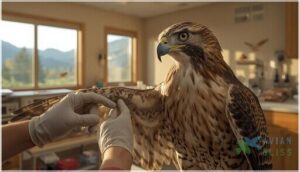
When a bird of prey gets injured in Colorado, it doesn’t have to mean the end of its story. The state has several dedicated rehabilitation centers that rescue and care for wounded raptors until they’re ready to fly free again.
Let’s look at where these centers are located and what their success rates tell us about saving these impressive birds.
Raptor Rehabilitation Centers
Across the state, raptor rehabilitation centers are lifelines for injured birds of prey. You’ll find experts at places like the Rocky Mountain Raptor Program and the Nature & Wildlife Discovery Center working with Colorado wildlife to heal everything from vehicle collisions to electrocutions.
These facilities partner with veterinary hospitals for specialized care and rely on funding sources like Wildlife Rehabilitation Grants and donations.
Their conservation efforts mean most rehabilitated raptors—around 75-80%—soar free again, while those with permanent injuries become wildlife ambassadors, teaching you about conservation of raptors firsthand. These grants support wildlife rehabilitation efforts across Colorado.
Rehabilitation Statistics
Rehabilitation programs track impressive outcomes you should know about. In 2023, Colorado facilities admitted 312 raptors, with 69% of treatable birds returning to the wild.
In 2023, Colorado raptor rehabilitation centers saved 69% of treatable birds, releasing over 200 back into the wild
Release rates depend on injury type—vehicle strikes and window collisions are most common. Treatment length averages 53 days, though funding impacts and capacity limits at facilities sometimes increase euthanasia rates.
Conservation efforts need your support to help more birds of prey recover.
Raptor Viewing Locations in Colorado

Colorado offers some superb spots where you can watch raptors in action. Whether you’re hoping to catch eagles soaring over mountain ridges or hawks migrating through the state, knowing where and when to look makes all the difference.
Let’s explore the best hawkwatching locations and the ideal times to visit them.
Hawkwatching Spots
If you’re keen to see Colorado birds of prey up close, you’ll find several prime hawkwatching spots that showcase impressive species diversity. These vantage points let you observe hawks and other raptors during their natural migration patterns, with each location offering unique habitat features.
Here are three must-visit destinations:
- Dinosaur Ridge Hawk Watch – holds the national spring record for Ferruginous Hawk sightings
- Pawnee National Grassland – excellent for spotting Northern Harrier and Swainson’s Hawk
- Rocky Mountain National Park – top location for Red-tailed and Ferruginous Hawks
Remember to practice good observer ethics and respect seasonal variations in birdwatching activity.
Optimal Viewing Time
Timing your visits can make all the difference when you’re hoping to catch Colorado birds of prey in action. Early morning hours between 7–10 AM give you the best shot at spotting active raptors during their peak feeding time. Here’s what you need to know about prime viewing windows:
- Peak Migration – Fall movements concentrate in September and October
- Daily Activity – Hawks migrate mid-morning; falcons appear in late afternoon
- Seasonal Nesting – March through July offers excellent breeding behavior observation
Weather influence matters too, since clear days within these months boost your birdwatching success.
Raptor Conservation Efforts

Colorado’s raptors face real challenges, from shrinking habitats to environmental threats that affect their survival.
But the good news is that conservation groups across the state are working hard to protect these amazing birds. Let’s look at two key ways they’re making a difference.
Captive Breeding Programs
Captive breeding programs became Colorado’s lifeline for peregrine falcons in the 1970s. When DDT decimated populations—leaving just five wild pairs by 1976—scientists launched an ambitious recovery effort. Between 1974 and 1990, roughly 400 captive-bred young were released statewide using fostering and hacking techniques.
| Release Techniques | Success Rate | Conservation Impact |
|---|---|---|
| Fostering in wild nests | ~80% to independence | 50% productivity boost |
| Hacking from artificial sites | ~80% survival | Population self-sufficiency |
| Combined breeding methods | High genetic diversity | 100+ pairs by 2001 |
These breeding ethics and program costs paid off—Colorado’s peregrine population increased tenfold, proving captive variants can thrive. Today, this bird of prey conservation model guides future strategies for protecting Colorado’s raptors.
Habitat Preservation
Since the 1970s, habitat preservation has anchored Colorado bird habitats conservation—because even thriving captive populations need safe homes. You’ll see this commitment through three key strategies:
- Buffer zone policies that restrict development within a quarter to half-mile of active nests
- Land acquisition programs investing $11 million annually in raptor habitats and migration corridors
- Restoration programs reversing habitat fragmentation by increasing species diversity in treated areas
Raptor Identification
Spotting a raptor soaring overhead is exciting, but knowing which species you’re looking at makes it even better. Colorado’s skies are full of hawks, eagles, owls, and falcons, and each one has its own signature look.
Let’s break down the most common raptors you’ll see and the key features that set them apart.
Common Raptor Species

Colorado’s skies host 27 species of raptors, and you’ll quickly notice which ones dominate the landscape. The Red-tailed Hawk reigns dominant, accounting for up to 80% of all raptor sightings in some surveys. These adaptable hawks thrive everywhere from grasslands to urban parks. You’ll also spot American Kestrels frequently—our smallest falcon makes up 19% of roadside observations. Winter brings Rough-legged Hawks to 42% of survey areas, while Bald Eagles and Golden Eagles command attention near water and mountains year-round.
Here are Colorado’s most commonly spotted birds of prey:
- Red-tailed Hawks soaring overhead with their distinctive rusty tails
- American Kestrels hovering above fields hunting mice
- Bald Eagles fishing near reservoirs and lakes
- Golden Eagles patrolling mountain ridges and prairies
- Rough-legged Hawks visiting grasslands each winter
Distinguishing Features

Think of raptor identification as a puzzle where plumage, talons, and beak shape reveal each bird’s identity. You’ll notice female raptors outweigh males by 25–50%—that’s sexual dimorphism in action. Juvenile features differ dramatically from adults, while morphological adaptations like feathered legs help cold-weather survival.
Here’s what to watch for when identifying birds of prey:
- Sharp, curved talons and hooked beaks on all raptors
- Red-tailed Hawks with rusty tails (adults only—juveniles show banded brown)
- Bald Eagles displaying white heads after age five
- Flight behavior patterns: eagles soar with flat wings, harriers fly low
Raptor Ecology
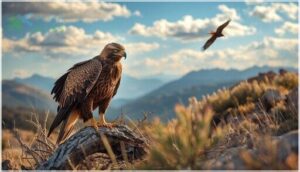
Understanding how raptors live and survive in Colorado gives you a much clearer picture of these amazing hunters. You’ll see how their daily routines revolve around two essential activities: finding food and raising their young.
Let’s look at what keeps these birds thriving in the wild.
Feeding Habits
Ever wonder how these sky hunters fill their bellies? Raptor Feeding Habits reveal remarkable Raptor Dietary Habits shaped by their environment. You’ll find that diet changes with the seasons—Red-tailed Hawks switch between mammals and birds during weather shifts, showing impressive seasonal prey shifts. Urban Raptor Diets differ too, as Cooper’s Hawks exploit backyard feeders while Great Horned Owls adapt to suburban prey.
Here’s what shapes their feeding habits of birds of prey:
- Hunting Techniques include perch-scanning and aerial pursuit
- Prey Composition varies from insects to medium mammals
- Trophic Cascade effects regulate small mammal populations
- Boulder County studies show 65% small mammal preference
- Raptor Diets and Hunting adapt to available resources year-round
Nesting Behavior
Once raptors have secured their next meal, they shift focus to raising their offspring. Raptor Nesting Habits in Colorado showcase remarkable variety in nest site selection—Northern Goshawks prefer towering 80-foot ponderosa pines, while Cooper’s Hawks now exploit mature suburban trees. You’ll notice breeding happens spring through summer, with nesting success rates averaging better on private lands. Conservation practices like buffer zones help protect these sites.
Here’s what shapes their nesting behavior:
- Timing and seasonality dictate courtship from January through May
- Habitat adaptation allows suburban nesting near bird feeders
- Nest materials range from sticks to repurposed structures
- Bird Habitats influence Raptor Habitats and Diets year-round
Raptor Education and Outreach
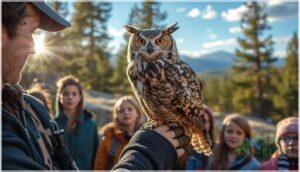
Learning about Colorado birds of prey doesn’t have to mean just reading books or scrolling through photos. You can actually get up close with these amazing hunters through programs designed to spark your curiosity and deepen your understanding.
Program reach across the state is impressive. The Rocky Mountain Raptor Program connects with over 15,000 schoolchildren every year, while the Raptor Education Foundation has brought live bird presentations to more than half a million students since 1980. These aren’t stuffy lectures—they’re engaging experiences where you’ll meet non-releasable raptors that serve as conservation ambassadors.
Community partnerships make these programs possible, linking schools, parks, and local organizations. Volunteer support keeps everything running smoothly, with dedicated folks contributing at least 8 hours monthly.
- Feel your breath catch when a great horned owl lands just feet away during a live presentation
- Watch kids’ faces light up as they learn how raptors survive in urban environments and wild habitats alike
- Stand alongside other birdwatching enthusiasts at a migration count, binoculars in hand
- Support measurable outcomes that protect bird habitats and ranges for future generations
Frequently Asked Questions (FAQs)
How many birds of prey are there in Colorado?
Colorado is a treasure trove for raptor fans. You’ll find 27 species of birds of prey here, including hawks, eagles, owls, falcons, and vultures as of
What do birds of prey eat in Colorado?
You’ll find dietary diversity among Colorado’s raptors, from fish-specialist ospreys to insect-loving kestrels.
Prey availability drives hunting strategies—hawks target rodents (90% biomass contribution), while seasonal shifts influence what owls and eagles catch throughout the year.
Are there Raptors in Colorado?
Yes, you’ll spot impressive Birds of Prey in Colorado—about 27 species including hawks, owls, falcons, and eagles.
These Raptors in Colorado thrive from mountains to cities, showing considerable Species Diversity and Habitat Range year-round.
Are there birds in Colorado?
You’ll find around 800 bird species calling Colorado home. That’s quite a lineup!
From raptors soaring over mountains to songbirds flitting through riparian zones, the habitat variety here fosters amazing avian diversity year-round.
Are common birds endangered in Colorado?
Like canaries in a coal mine, raptors signal ecosystem health. Most common birds of prey in Colorado aren’t endangered—they show population stability.
However, habitat threats, poisoning risks, and collision mortality demand ongoing conservation efforts.
Where can you see birds in Colorado?
You can spot birds of prey across Colorado’s diverse landscape—from urban parks and wetlands to mountain forests and grasslands.
Key birdwatching spots include Rocky Mountain National Park and Rocky Mountain Arsenal National Wildlife Refuge.
Are there birds of prey in Colorado?
Colorado hosts around 40 raptor species across diverse habitats—from golden eagles in mountain moorlands to red-tailed hawks in grasslands.
You’ll spot these impressive birds of prey hunting throughout forests, deserts, and even urban areas statewide.
How many birds are in Colorado each year?
Each year, you’ll see over 300 breeding pairs of bald eagles and hundreds of other raptors migrating through Colorado.
Total raptor counts vary, but rehabilitation programs release about 80% of treated birds of prey back into the wild year-round.
What birds can you see in Colorado?
You’ll encounter hawks gliding through open skies, owls perched in shadowy forests, and falcons diving at breathtaking speeds.
Colorado hosts 13 to 17 raptor species, including the abundant Red-tailed Hawk and recovering Bald Eagle populations.
What is a Raptor a bird of prey?
Raptors are birds of prey built for hunting. You’ll recognize them by their razor-sharp talons, hooked beaks, and remarkable eyesight—up to eight times keener than yours.
These adaptations make them nature’s greatest aerial predators.
Conclusion
You don’t need fancy gear or a birding degree to start spotting Colorado birds of prey—just patience and curiosity. Once you learn the difference between a hawk’s steady glide and a falcon’s sharp dive, you’ll notice raptors everywhere.
They’re hunting above highways, nesting in city parks, and patrolling mountain ridges. Each sighting connects you to Colorado’s wild recovery story.
So grab those binoculars, head outside, and see what’s circling overhead. You might be surprised what you find.
- https://birdwatchinghq.com/birds-of-prey-in-colorado/
- https://www.publicnewsservice.org/2025-07-08/endangered-species-and-wildlife/coloradans-urged-to-speak-up-about-at-risk-wildlife-habitats/a97566-1
- https://bioone.org/journals/journal-of-raptor-research/volume-55/issue-4/JRR-20-47/Nest-Distribution-of-Four-Priority-Raptor-Species-in-Colorado/10.3356/JRR-20-47.pdf
- https://www.boulderclimbers.org/closures-1
- https://www.nps.gov/romo/raptor-closures.htm