This site is supported by our readers. We may earn a commission, at no cost to you, if you purchase through links.
Florida hosts five hawk species year-round or seasonally, ranging from the reddish-barred Red-shouldered Hawk patrolling cypress swamps to the Northern Harrier drifting south each September.
Most people spot one overhead and move on—but once you learn to read wing shape, tail color, and hunting style, every sighting tells a different story.
Hawks in Florida occupy nearly every habitat the state offers, from longleaf pine stands to suburban backyards, and their populations are shifting in measurable ways.
Cooper’s Hawks are gaining ground in cities while Sharp-shinned Hawks have declined at 48% of migration count sites.
Knowing which species you’re watching—and why it’s there—changes everything.
Table Of Contents
- Key Takeaways
- Common Hawk Species in Florida
- Hawk Identification Tips
- Habitats and Distribution of Hawks
- Hawk Diet and Hunting Behavior
- Conservation Status and Population Trends
- Frequently Asked Questions (FAQs)
- What is the most common hawk in Florida?
- What’s the punishment for killing a hawk?
- What’s the most common hawk in Florida?
- What attracts hawks to your yard?
- Why are hawks around my house?
- Are hawks good to have around?
- How do hawks avoid predators in Florida?
- What time of year do hawks migrate?
- How can I identify a juvenile hawk?
- Do hawks pose a threat to pets?
- Conclusion
Key Takeaways
- Florida’s five hawk species each claim a distinct niche—from Red-shouldered Hawks ruling cypress swamps year-round to Northern Harriers drifting in each September to sweep marshes and farmlands.
- Wing shape, tail color, and hunting style are your fastest ID tools: accipiters like Cooper’s have short rounded wings and dart through trees, while buteos like Red-tailed Hawks soar wide and slow on broad, plank-like wings.
- Cooper’s Hawks are quietly taking over Florida’s cities, but Sharp-shinned Hawks are fading—down at 48% of migration count sites—a split trend that citizen science platforms like eBird are actively tracking.
- Every hawk in Florida carries federal protection under the Migratory Bird Treaty Act, yet rodenticide poisoning, habitat loss, and power line electrocution still hit populations hard despite the legal safeguards.
Common Hawk Species in Florida
Florida is home to some of the most fascinating hawks you’ll find anywhere in North America. Whether you’re out on a trail or just scanning the sky from your backyard, knowing which species to look for makes all the difference.
From soaring buteos to agile accipiters, Florida’s skies reward patient watchers — explore the full Florida hawk and bird species guide to sharpen your ID skills before your next outing.
Here are the hawks you’re most likely to encounter across the Sunshine State.
Red-Shouldered Hawk Identification and Range
If you spend any time outdoors in Florida, the Red-shouldered Hawk is one wing species you’ll learn to recognize fast. It’s a year‑round resident statewide — adults show reddish‑barred underparts and checkered wings, while juvenile markings lean brown‑streaked with white underwing coverts. Their wingspan 37–43 inches.
Watch for these ID clues:
- Pale gray head with rufous shoulder patches
- Blackish wings with pale crescents near tips
- Narrow white tail bands with black terminal band
- High‑pitched kee‑yer call repeated 5–12 times
- Prefers cypress and pine‑oak forests near water
The distinctive reddish shoulder barring helps separate juveniles from similar hawks.
Red-Tailed Hawk Features and Habitats
Where the Red-shouldered Hawk hugs Florida’s wooded wetlands, the Red-tailed Hawk owns the open country.
This large buteo — a key subject in Hawk Identification and Habitat study — ranges from Tampa Bay south through the Kissimmee Prairie.
Its brick-red tail, dark belly band, and 44–52‑inch wingspan make Redtailed Hawk identification straightforward.
Nesting height generally reaches 30–120 feet, and its piercing scream — familiar from countless films — doubles as a territorial display and Mating Call.
They exhibit partial migrant behavior, moving seasonally while many individuals remain year‑round.
Cooper’s Hawk Year-Round Presence
Unlike the Red-tailed Hawk’s seasonal drift, Cooper’s Hawk stays put.
These migration-free residents anchor year-round habitat from the Panhandle down to central Florida, with eBird population monitoring confirming steady presence across most regions.
If you’re serious about hawk identification and habitat study, or bird watching in Florida, watch for their ambush-style hunting in pine-oak woodlands — a master class in raptor conservation efforts made visible.
Sharp-Shinned Hawk Seasonal Visits
Cooper’s Hawk holds its ground year-round, but the Sharp-shinned Hawk plays a different game entirely — arriving on Florida’s doorstep each fall and leaving by spring.
Here’s what defines its seasonal pattern:
- Migration Peaks hit in early October, driven by Cold Front Influence pushing thousands through the Florida Keys
- Sexual Dimorphism is stark — females weigh nearly twice the males
- Feeder Stalking targets sparrows and warblers near suburban woodlands
- Winter Roosting spreads statewide through March
Northern Harrier Winter Occurrence
When September cools the northern plains, the Northern Harrier begins its southward drift into Florida. This raptor migration timing aligns with prey availability dropping in Canada and Alaska. Habitat preference and migration timing shape where you’ll spot them.
| Factor | Detail | Florida Impact |
|---|---|---|
| Arrival | September–November | Statewide spread |
| Habitat Preference | Marshes, grasslands | Everglades, farmlands |
| Weather Influence | Cold fronts accelerate movement | Peak influx October |
Unlike most raptors, harriers hunt low and silent — no dramatic vocalizations, just skill.
Their quiet, low-gliding style sets them apart from the bold field-edge presence of red-tailed hawks common to Michigan grasslands.
Rare and Occasional Hawk Species
Florida occasionally draws in unexpected visitors.
Swainson’s Hawk peaks during late October through November in the Keys, with single-day counts reaching 64 birds.
Short-tailed Hawks hold a statewide population near 500, showing rare habitat use in Everglades corridors.
Vagrant patterns also bring Gray Hawks and Crane Hawks south.
Population monitoring and legal protection gaps remain concerns for these irregular migrants, where seasonal migration peaks reveal much about each species’ range shifts.
Hawk Identification Tips
Spotting a hawk in Florida is one thing — knowing exactly which one you’re looking at is another.
The good news is that hawks give you plenty of clues if you know where to look.
Here are the key identification tips that’ll sharpen your eye in the field.
Key Physical Characteristics
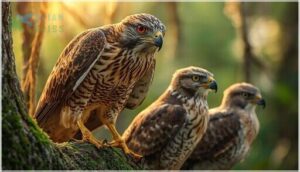
Every hawk carries its identity in plain sight — if you know what to look for. These five physical traits sharpen your Hawk Identification skills fast:
- Eye Color Variations — Adults show red or orange eyes; juveniles display yellow.
- Beak Morphology — All Florida Hawk Species have hooked beaks built for tearing.
- Leg Talon Structure — Yellow, scaled legs with gripping talons define every species.
- Plumage UV Reflection — Feather patterns reveal markings invisible to human eyes.
- Head Shape Profiles — Cooper’s projects forward; Sharp-shinned appears small and rounded.
Wing and Tail Shape Differences
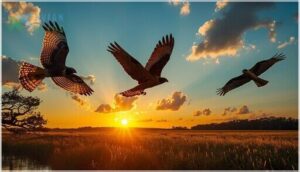
Wing and tail shape are your fastest tools for Hawk Identification in the field.
Accipiters like Cooper’s Hawk show short, rounded wings built for darting through trees, with long tails that handle tail rudder dynamics mid‑chase. Buteos carry broad, plank‑like wings and shorter tails.
Harrier silhouette profile — narrow wings held in a shallow "V" — doesn’t match either group, making it instantly recognizable among Hawks in Florida.
Color Patterns and Markings
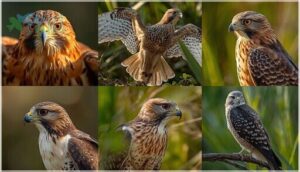
Color alone can reveal a hawk ID in seconds. When watching Birds of Prey in Florida, train your eye on these five key markers:
- Reddish Shoulder Bands — adult Red-shouldered Hawks show warm orange chest barring
- White Rump Patches — Northern Harriers flash this instantly in flight
- Belly Band Variations — Red-tailed Hawks display dark streaky lower-abdomen bands
- Tail Barring Patterns — bold black-and-white banding differs species to species
- Morph Color Differences — Short-tailed Hawks appear in distinct light and dark forms
Size and Weight Variations
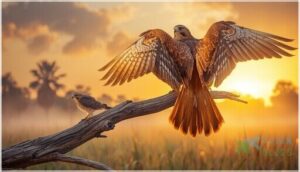
Size is one of your sharpest tools for hawk identification. Sharp-shinned Hawks weigh just 87–218 grams, while Red-tailed Hawks tip the scales at 690–1,460 grams.
Sexual dimorphism runs strong here — females consistently outweigh males across hawk species in Florida.
Regional size differences matter too: Florida Cooper’s Hawks are lighter than northern populations.
Even juvenile growth patterns shift morphometric data enough to affect your field ID.
Accipiters Vs. Buteos Distinctions
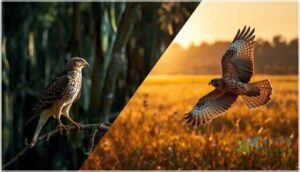
Beyond size, two groups shape your hawk identification tips more than any other: accipiters and buteos.
- Wing Morphology — Accipiters carry short, rounded wings; buteos spread broad, blunt‑tipped ones.
- Tail Aerodynamics — Accipiters use long, rudder‑like tails; buteos fan out short, wide ones.
- Flight Rhythm — Watch for flap‑flap‑flap‑glide versus slow thermal soaring.
- Hunting Tactics — Accipiters ambush from cover; buteos scan open ground from above.
- Habitat Preference — Forests versus farmlands, respectively.
Habitats and Distribution of Hawks
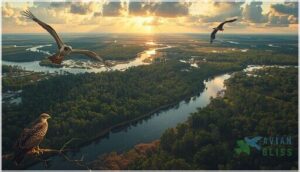
Hawks in Florida don’t stick to one kind of place — they spread across a surprisingly wide range of landscapes. Where you find them depends on the species, the season and what’s on the menu.
Here’s a look at the key habitats that shape where Florida’s hawks live, hunt, and travel through.
Forests, Wetlands, and Woodlands
Hawks in Florida rely on a mosaic of forest types, wetlands, and woodlands to survive year-round.
Red-shouldered Hawks thrive in cypress swamps and bottomland forests, where riparian vegetation and wetland edge dynamics concentrate amphibian prey.
Cooper’s Hawks prefer closed canopy structure — dense oak and pine stands averaging 70% coverage.
Understanding these wildlife habitat connections sharpens your raptor ecology knowledge and bird identification skills considerably.
Grasslands, Marshes, and Farmlands
Open country is where some of Florida’s most watchable raptors truly shine.
Northern Harriers sweep low over seasonal marsh flooding zones and coastal grasslands from September through April, using owl-like facial disks to pinpoint Grassland Vole Populations by sound.
Red-tailed Hawks claim Farmland Powerline Perches along agricultural roadsides — up to 11 birds on a single stretch.
Marsh Edge Perches draw Red-shouldered Hawks hunting frogs and snakes near wet prairies like Kissimmee and Paynes Prairie, key stops for Birdwatching in Florida.
Urban and Suburban Sightings
Florida’s suburbs aren’t just for people.
Red-shouldered and Cooper’s hawks thrive here, drawn by Urban Prey Abundance — pigeons, starlings, and squirrels are basically fast food for raptors. Feeder Attraction pulls Sharp-shinned hawks straight into backyards. Watch for three common urban hawk encounters:
- Nest Defense dive-bombing near driveways
- Window Collisions after feeder flushes
- Power Line Hazards for dispersing juveniles
Seasonal Migration Patterns
Migration transforms Florida’s skies each year. Resident Hawk Patterns anchor Red‑shouldered hawks here year‑round, but Winter Visitor Peaks bring Red‑tailed hawks south from colder states. Accipiter Arrival Times push Sharp‑shinned hawks into woodlands by October. Harrier Marsh Winters fill wetlands from August through April. Fall Migration Hotspots like Curry Hammock track Hawk Migration Patterns across Florida’s seasonal raptor movements.
| Season | Species | Key Location |
|---|---|---|
| Fall (Sept–Nov) | Sharp-shinned, Broad-winged | Curry Hammock, Florida Keys |
| Winter (Dec–Mar) | Red-tailed, Northern Harrier | Marshes, open fields statewide |
| Spring (Apr–May) | Swainson’s, Cooper’s | Inland pastures, wooded corridors |
Hawk Diet and Hunting Behavior
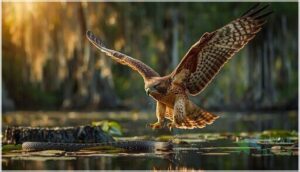
Hawks are built to hunt, and every species in Florida has its own way of getting the job done.
What they eat, how they chase it down, and how their bodies are wired for the kill — it all varies more than you’d expect.
Here’s a closer look at what drives their behavior in the field.
Primary Prey and Food Sources
Every hawk in Florida has its own menu.
Mammal prey like voles, rabbits, and mice anchor most diets, while reptile consumption — anoles, skinks, and snakes — is especially strong in red-shouldered hawks, where reptiles make up 58% of nestling deliveries.
Amphibian targets like frogs round things out.
Avian prey types and an invertebrate diet of crayfish and grasshoppers fill seasonal gaps.
Hunting Strategies and Techniques
Watching hawks hunt reveals a masterclass in strategy.
Red-tailed hawks favor soaring pursuit, drifting 20–50 meters high before diving on rabbits below.
Cooper’s hawks rely on stealth attack, threading through dense canopy before striking.
Northern harriers use low-flight quartering under 15 feet, while their hover pounce technique triples success rates in freshwater marshes.
Each perch ambush or aerial dive reflects refined raptor behavior shaped by habitat and distribution.
Adaptations for Prey Capture
Hawks didn’t stumble into perfect predators — evolution carved every feature with purpose. Talon morphology alone tells the story: red-tailed hawk hallux talons reach 34 mm, punching through prey instantly. Beak mechanics and vision acuity, reaching eight times human sharpness, complete the toolkit.
Evolution carved every hawk into a perfect predator, with talons that punch through prey and vision eight times sharper than our own
- Leg grip holds struggling mammals without muscle fatigue using tendon-locking systems
- Facial disk hearing lets northern harriers pinpoint hidden voles beneath dense marsh grass
- Curved beak tears through crayfish shells exceeding 100 psi compression
Raptor behavior and ecology shaped these birds of prey across every habitat and distribution zone.
Seasonal Shifts in Diet
Florida’s seasons quietly rewire what hawks put on the menu.
Red-shouldered hawks ride the Amphibian Surge in spring, with reptiles making up 58% of breeding deliveries.
Summer brings peak Reptile Summer Intake across wetlands.
winter, a Rodent Winter Spike draws northern harriers toward Marsh Vole Focus zones.
Sharp-shinned hawks show clear Bird Feeder Preference, targeting songbirds along Bird Migration Patterns corridors.
Conservation Status and Population Trends
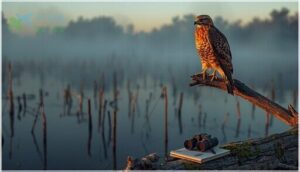
Hawks in Florida aren’t just surviving — they’re being watched, counted, and protected more carefully than ever before. But their future depends on a mix of legal safeguards, public awareness, and honest data about how populations are actually doing.
Here’s what you need to know about where things stand right now.
Legal Protections in Florida
Both state and federal law stand guard over every hawk in Florida. Here’s what that protection looks like in practice:
- Federal MBTA Enforcement covers all raptors — taking, possession, or nest disturbance without an MBTA Permit triggers fines up to $250,000.
- State Raptor Regulations mirror federal standards under FWC Rule 68A-16.003.
- Active Nest Permit: active nest removal requires USFWS authorization.
- Violation Penalties escalate to felony charges for repeat offenders.
Threats to Hawk Populations
Even with strong legal protections in place, hawks across Florida still face serious pressure from multiple fronts. Habitat Loss from urban sprawl strips away nesting forests. Rodenticide Poisoning reaches 100% exposure rates in tested Red‑tailed Hawks. Power Line Electrocution and Illegal Shooting remain persistent killers. Climate Change threatens mangroves and wetlands alike.
| Threat | Primary Species Affected |
|---|---|
| Habitat Loss | Short-tailed, Broad-winged |
| Rodenticide Poisoning | Red-tailed, Red-shouldered |
| Power Line Electrocution | Red-tailed, Red-shouldered |
| Illegal Shooting | Red-tailed Hawk |
Wildlife Conservation in Florida and broader Raptor Conservation efforts are working to restore Ecological Balance through Habitat Preservation and targeted Conservation Efforts.
Hawk Population Trends and Citizen Science
Tracking these pressures wouldn’t be possible without solid data — and that’s where citizen science steps in.
Through eBird Data Trends and Migration Count Analysis, volunteers contribute thousands of annual records shaping Wildlife Conservation in Florida.
Cooper’s hawks show steady urban gains, while Sharp-shinned hawks decline at 48% of count sites.
Ornithology and Research benefit enormously from Birdwatching communities, whose Citizen Survey Methods reveal Avian Biodiversity shifts, Genetic Bottleneck Monitoring needs, and Urban Breeding Success patterns statewide.
Ongoing Raptor Conservation Efforts
Data alone doesn’t save hawks — action does. Wildlife Conservation in Florida now runs on four coordinated fronts:
- Rehab Center Partnerships — Centers like Audubon’s Maitland facility treat 600–700 raptors annually, releasing over 40% back into the wild.
- Electrocution Prevention — Utilities retrofit poles with insulation and safe perches, cutting adult mortality in open landscapes.
- Habitat Corridor Planning — Connected preserves reduce fragmentation, supporting Avian Biodiversity and natural Hawk Behavior.
- Public Outreach Programs — Education teams turn residents into conservation allies.
Frequently Asked Questions (FAQs)
What is the most common hawk in Florida?
Florida’s feathered frontrunner is the Red-shouldered Hawk — dominating eBird sightings at 20% in summer and 27% in winter, its breeding pair distribution spans over 85% of the state’s survey quadrangles.
What’s the punishment for killing a hawk?
serious federal penalties under the Migratory Bird Treaty Act — up to $15,000 in fines and six months jail per bird.
State criminal charges, license suspension, and wildlife conservation reward programs add further consequences.
What’s the most common hawk in Florida?
If one hawk rules Florida’s skies, it’s the Red-shouldered Hawk — appearing in roughly 27% of winter birding reports statewide, making it the most common hawk year-round in population monitoring records.
What attracts hawks to your yard?
Hawks come to yards that offer prey abundance, open space, perching structures, and water features. If your yard checks those boxes, raptors will find it.
Why are hawks around my house?
Your yard likely offers three things hawks can’t resist: food attractors like rodents or songbirds, perch availability on trees or fence posts, and nesting sites in tall pines nearby.
Are hawks good to have around?
They’re both a gift and a challenge. Raptors deliver rodent control, snake reduction, and natural pest management — real biodiversity boosts. But expect nesting aggression and the occasional missing songbird.
How do hawks avoid predators in Florida?
Florida raptors rely on Elevated Nest Sites, Camouflage Plumage, Agile Flight Evasion, Aggressive Nest Defense, and Enhanced Vision Alerts — five overlapping strategies rooted in Avian Ecology that keep them alive across Florida Wildlife habitats.
What time of year do hawks migrate?
Migration peaks in fall from mid-September through November, triggered by cold fronts.
Spring arrival windows run February to May, varying by species.
Sharp-shinned and Cooper’s hawks follow slightly different species-specific timelines through Florida.
How can I identify a juvenile hawk?
Juvenile hawks wear a thousand field clues at once. Look for streaked underparts, pale yellow eyes, and banded brown tails — their plumage patterns, flight behavior, and seasonal timing reveal everything.
Do hawks pose a threat to pets?
Hawks rarely threaten pets, but small animals under 10 pounds face real risk outdoors. Supervise tiny dogs and cats, use covered runs, and remember — all raptors are federally protected.
Conclusion
Hawks in Florida have a lot riding on your attention—literally.
Every time you look up and recognize a Red-shouldered Hawk banking over a cypress swamp or a Northern Harrier skimming a winter marsh, you’re reading the landscape more accurately than most people ever will.
Wing shape, tail pattern, hunting style—these details aren’t trivia.
They’re the language Florida’s raptors speak daily.
Learn it, and every open sky becomes a field guide written in real time.