This site is supported by our readers. We may earn a commission, at no cost to you, if you purchase through links.
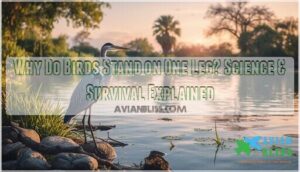 You’ve probably noticed it at the pond or in your backyard—a bird balancing perfectly on one leg, tucking the other into its feathers like it’s the most natural thing in the world. This peculiar posture isn’t just a quirky habit or a display of impressive balance.
Birds stand on one leg to conserve body heat, reduce muscle fatigue, and even improve their chances of survival in the wild. The behavior combines smart energy management with evolutionary adaptations that have helped avian species thrive for millions of years.
Understanding why birds adopt this stance reveals how they’ve mastered the art of efficiency in environments ranging from icy wetlands to tropical shores.
Table Of Contents
- Key Takeaways
- Why Do Birds Stand on One Leg?
- How Does Standing on One Leg Conserve Heat?
- What Role Does Balance Play in This Behavior?
- Which Bird Species Commonly Stand on One Leg?
- When Do Birds Prefer The One-Legged Stance?
- What Are The Evolutionary Advantages?
- How Does The One-Legged Stance Aid in Survival?
- Are There Differences Across Habitats and Climates?
- What Scientific Studies Reveal About This Behavior?
- Frequently Asked Questions (FAQs)
- Why do birds rest on one leg?
- Can a bird stand on one leg?
- Why do birds lift their legs?
- Why do birds tuck up one foot?
- Why do birds have a one-legged stance?
- Why do birds tuck one leg under their feathers?
- Can birds communicate through one-legged stances?
- What species never stand on one leg?
- How does leg anatomy influence balance abilities?
- Are there cultural interpretations of this behavior?
- Conclusion
Key Takeaways
- Birds stand on one leg primarily to conserve body heat by reducing exposed surface area by roughly 50%, using a countercurrent heat exchange system in their legs that prevents heat loss while keeping their core temperature stable.
- This posture reduces muscle fatigue through passive joint locking mechanisms that require minimal energy, allowing species like flamingos to maintain the stance for over 60 minutes with up to 98% less muscle activity than active standing.
- The one-legged stance serves multiple survival functions beyond thermoregulation, including improved camouflage that reduces predator detection rates by 8-10%, enhanced vigilance during unihemispheric sleep, and increased hunting success in wading birds by minimizing water disturbance.
- Environmental factors strongly influence this behavior, with aquatic birds adopting the posture 80-90% of their resting time compared to just 20-25% in terrestrial species, and frequency increasing by 80% when temperatures drop below 20°C.
Why Do Birds Stand on One Leg?
You’ve probably seen a bird tucked up on one leg and wondered what’s going on. This curious stance isn’t just for show—it’s a smart adaptation that helps birds survive in their environments.
Here are the main reasons birds use this unusual posture.
Heat Conservation and Thermoregulation
When temperatures drop, you can see birds tucking one leg up to reduce heat loss—a clever thermoregulation strategy. By halving the exposed surface area of their unfeathered legs, birds cut radiant and convective heat loss by roughly 50%.
Their leg anatomy features a countercurrent exchange system where warm arterial blood heats cooler returning venous blood, keeping their body temperature stable.
This evolutionary insight explains why waterfowl and wading birds increase this stance as temperature variation intensifies, balancing energy conservation with survival needs. This behavior is linked to energy conservation, especially in colder climates.
Muscle Fatigue Reduction
Beyond heat conservation, your feathered friends alternate their standing leg to reduce muscle fatigue and preserve energy. By shifting their weight, birds allow one leg’s muscles to rest while passive mechanisms in their joints lock the supporting leg in place.
This strategy facilitates:
- Flamingos to stand for over 60 minutes with minimal muscle activity
- Herons to maintain vigilance during long wading sessions without exhaustion
- Migratory species to preserve contractile muscle function despite prolonged standing effects
Studies show this passive locking reduces electromyographic activity, preventing localized muscle overuse while supporting avian endurance limits during extended resting periods. This behavior also helps birds conserve more heat in colder temperatures.
Resting and Sleep Adaptations
When your leg muscles are fully rested, you can achieve deeper sleep. Birds enter Unihemispheric Slow-Wave Sleep (USWS), where one brain hemisphere sleeps while the other stays alert for threats. This unique sleep pattern allows unihemispheric sleep in birds to combine rest with vigilance.
Standing on one leg amplifies these benefits—passive joint locking requires no muscle effort, letting birds maintain resting postures for hours. Flamingos show sevenfold less sway during sleep compared to wakeful standing, demonstrating how avian physiology optimizes energy conservation and thermal regulation simultaneously through this extraordinary adaptation.
| Sleep Adaptation | Survival Benefit |
|---|---|
| One hemisphere awake | Predator detection continues |
| Passive leg locking | Zero muscle fatigue |
| Reduced body sway | Stable sleep in open habitats |
| Heat retention | Warmth preserved overnight |
Camouflage and Predator Avoidance
Beyond rest, this posture offers survival strategies through Visual Stealth and Environmental Blending. You’ll find herons mimicking reeds, reducing their visible outline by 30%. Waterfowl use camouflage techniques to lower detectability in wetlands, where:
- Standing on one leg decreases shadow projection on water surfaces
- Birds experience 8–10% lower attack rates from predators
- Flamingos maintain the posture 50% longer when threats appear
- Egrets create silhouettes resembling sticks in 67% of observations
This Predator Evasion strategy combines thermoregulation in birds with camouflage, making the one-legged stance essential for survival.
How Does Standing on One Leg Conserve Heat?
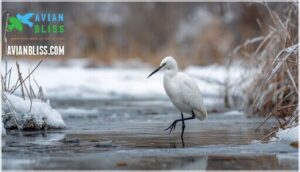
When you tuck one leg up against your body, you expose less skin to the cold air around you. Birds use this simple strategy to cut their heat loss nearly in half.
Let’s look at how this works through three key mechanisms.
Minimizing Exposed Surface Area
When you tuck one leg up against your body, you’re witnessing thermal regulation at work. Birds cut exposed surface area by roughly 50%, directly slashing heat loss from unfeathered limbs. Stanford research on ducks and gulls confirms this surface minimization strategy halves the uninsulated zone vulnerable to cold air, boosting energy efficiency through feather insulation and smart body heat conservation.
| Posture | Exposed Surface | Heat Loss Reduction |
|---|---|---|
| Two-legged stance | 100% limb exposure | Baseline (0%) |
| One-legged stance | 50% limb exposure | ~50% reduction |
| Fully tucked | 0% limb exposure | Up to 95% reduction |
| Alternating legs | Variable exposure | Balanced heat conservation |
Tucking maintains leg temperatures near core levels, while thermal imaging shows exposed tarsi register 3–5°C cooler than plumage. This thermoregulatory function proves especially important for aquatic birds on ice or in cold wetlands, where convective losses would otherwise drain precious body heat rapidly.
Countercurrent Heat Exchange in Bird Legs
Your bird’s body runs a clever heat-saving system called countercurrent heat exchange. Arteries carrying warm blood from the core flow right next to veins returning cooled blood from the feet, creating a vascular adaptation that transfers heat before it escapes.
This leg anatomy keeps blood entering the feet near 0°C while your bird’s body stays around 40°C. The rete mirabile—specialized networks wrapping arteries—boosts thermal regulation efficiency by over 40%, cutting heat loss in appendages up to 90% and trimming energy costs by roughly 15% in cold climates.
Environmental Triggers for Heat Loss Prevention
When ambient temperature drops below 20°C, you’ll see your bird tuck one leg up more often—especially between 5–10°C. Humidity effects complicate evaporative cooling, so birds rely on leg retraction to hold body heat.
Wind speed shifts the equation too: calm air keeps heat layers close, prompting heat conservation, while breezes allow extended limbs. Solar radiation and seasonal variation fine-tune this thermoregulation dance, helping birds manage environmental temperature and minimize heat loss year-round.
What Role Does Balance Play in This Behavior?
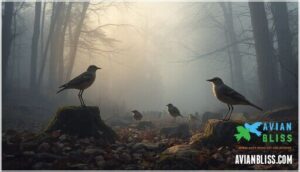
You might wonder how a bird can stand on one leg without toppling over. The answer lies in a combination of specialized anatomy, clever joint mechanics, and positioning that makes balance almost automatic.
Let’s look at the three key factors that keep birds steady in this seemingly precarious pose.
Avian Anatomy and Center of Gravity
You possess an anatomy that’s finely tuned for balance and stability, starting with a skeleton that makes up just 5% of your total body mass. This lightweight frame, combined with strategic weight distribution, allows you to hold steady on one leg without toppling over. Here’s how your avian anatomy facilitates this extraordinary feat:
- Your center of gravity sits low and forward near your chest, aligning perfectly over your supporting leg when you tuck the other up.
- Your leg bones are the densest part of your skeleton, anchoring your lower body and keeping your balance point stable.
- Your fused hip joints and synsacrum create a rigid platform that efficiently transfers weight from your torso straight down through your standing leg.
- Your keeled sternum and heavy flight muscles shift mass toward the front, maintaining equilibrium without constant muscular effort.
This musculoskeletal coordination means you’re not working hard to stay upright—your body’s design does most of the work for you.
Passive Joint Locking Mechanisms
Your passive joint locking mechanisms work like a built-in kickstand, allowing you to stand on one leg without burning energy. When your foot sits directly beneath your body, gravity and anatomical limits at your hip and knee joints lock everything into place. This unidirectional stay apparatus means muscle activity drops dramatically—up to 98% less effort compared to active standing. Flamingos demonstrate this best: even cadavers maintain balance through passive support alone, with joints holding firm under body weight. Your bone structure, tendon locking, and biomechanics create energy efficiency that reduces muscle fatigue during prolonged unipedal rest.
| Mechanism | How It Works | Benefit |
|---|---|---|
| Hip/Knee Locking | Joints constrain at specific angles when foot is centered beneath body | Maintains balance without muscular correction |
| Tendon Lock Apparatus | Flexor tendons automatically tighten around perch structures | Prevents falls during sleep or rest |
| Gravitational Stay | Body weight forces joints into fixed configuration | Reduces energy expenditure by 98% compared to active standing |
| Passive Support System | Bony and cartilaginous structures engage under load | Frees metabolic resources for other physiological needs |
Stability in Varied Environments
You might wonder how a one-legged stance holds up when terrain shifts or winds blow. Adaptive mechanisms kick in through visual feedback, leg retraction adjustments, and asymmetric force distribution, letting you maintain balance control across uneven surfaces. Environmental stability depends on your ability to fine-tune postural adjustment in real time, whether you’re wading through water or perching on a branch.
Here are the key strategies observed in birds:
- Terrain adaptation – Pheasants actively adjust leg trajectory and stance duration when crossing obstacles up to half their leg length, keeping peak forces steady.
- Visual planning – You use sight to anticipate surface changes, modifying leg sweep and retraction velocity before touchdown.
- Asymmetric actuation – Birds with flatter trunks rely on uneven leg forces at lift-off and landing to stabilize their resting posture.
- Habitat-specific strategies – Aquatic wading birds minimize muscle effort through passive joint moments, while terrestrial species depend on intrinsic limb stiffness for fatigue-resistant perching.
Which Bird Species Commonly Stand on One Leg?
You’ll find this behavior across a surprisingly wide range of bird species, from towering waders to backyard visitors. Some birds use the one-legged stance almost constantly, while others adopt it only when conditions call for it.
Let’s look at the specific groups of birds that rely on this posture most often.
Flamingos and Wading Birds
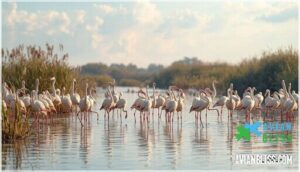
Flamingos are among the most recognized birds for standing on one leg, a behavior perfected through their unique biomechanics. When you observe wading birds like herons, storks, and ibises in their natural habitat, you’ll notice they frequently adopt this stance while resting.
Research shows that over 60% of flamingos in mixed flocks simultaneously use the one-legged posture during midday breaks, highlighting its importance in avian social structure and energy management among water birds.
Ducks, Geese, and Waterfowl
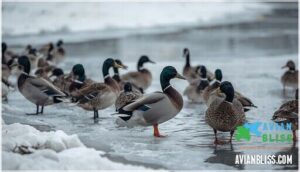
Ducks, geese, and other waterfowl rely heavily on the one-legged stance to survive cold aquatic environments. You’ll spot this resting posture year-round, especially during winter when these water birds tuck one leg under their feathers to cut heat loss by roughly 50%.
Their countercurrent heat exchange system warms returning blood while their webbed feet stay near freezing—around 1°C—without frostbite. During waterfowl migration, this energy-saving adaptation becomes critical for survival.
Small Birds and Birds of Prey
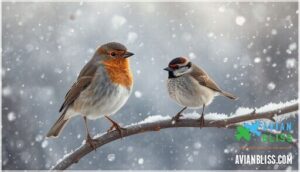
You’ll also find one-legged resting postures in birds of prey like merlins, which perch on one foot up to 22% of the time during cold weather. Small birds, including sparrows and finches, adopt this stance below 10°C to conserve warmth through thermoregulation.
Their talon structure locks tendons automatically, reducing muscle fatigue by 40–60% while feather insulation keeps retracted legs warmer—an efficient strategy for predator avoidance since resting birds stay alert without energy drain.
When Do Birds Prefer The One-Legged Stance?

You might wonder if birds use their one-legged stance all the time or only in specific situations. The answer depends on the time of day, the temperature around them, and even how they sleep.
Let’s look at when this behavior shows up most often.
Daytime Vs. Nighttime Resting
You might notice birds tucking up one leg more often as the sun sets. During nighttime, many species increase their one-legged stance by up to 40% compared to daytime, ramping up thermal regulation when temperatures drop.
This resting behavior ties directly to circadian rhythms and sleep cycles, including Unihemispheric Slow-Wave Sleep (USWS), where one brain hemisphere stays alert. Light levels below 10 lux trigger longer resting postures in birds, shaping their diel activity patterns throughout the day.
Seasonal and Temperature Influences
As winter approaches, you’ll see more birds lifting a leg to stay warm. Thermal adaptation drives this seasonal shift—flamingos and wading birds increase one-legged postures by 80% when temperatures drop below 20 °C.
Temperature responses vary across species: temperate birds rely heavily on heat conservation during cold months, while tropical species maintain steadier behavior year-round.
These environmental triggers showcase how climate effects shape thermoregulation strategies, helping birds survive seasonal extremes through smart bird behavior adjustments.
Sleeping Patterns and Unihemispheric Sleep
When do birds actually sleep while balancing on one leg? During rest, many species use Unihemispheric Slow-Wave Sleep (USWS)—one brain hemisphere stays alert while the other sleeps. This extraordinary avian behavior helps birds monitor threats while resting.
- Brain activity alternates between hemispheres, with one eye open toward potential predators
- Sleep cycles in frigatebirds last just seconds to minutes, far shorter than land-based rest
- Sleep efficiency compensates for reduced total sleep time during flight or exposed resting
- Avian neuroscience reveals that sleep patterns adapt to energy stores and predation risk
What Are The Evolutionary Advantages?
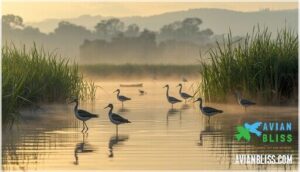
Standing on one leg isn’t just a quirky habit—it’s a powerful evolutionary strategy that’s helped birds thrive across millions of years. This posture offers real advantages in energy efficiency, survival across diverse environments, and the gradual shaping of avian anatomy.
Let’s explore how evolution favored this extraordinary adaptation.
Energy Conservation Strategies
You don’t need a lot of muscle power to balance on one leg when you’re a bird. Flamingos lower muscle activity by tucking one leg, and their joints lock passively to hold them steady without burning energy.
This means less metabolic cost during rest, so birds with smaller diets can still meet their energy needs while staying alert and comfortable.
Survival Benefits in Different Habitats
Where you live shapes how you use the one-legged stance to survive. Different habitats create different pressures, and your species adapts its behavior to match environmental demands for thermoregulation strategies and energetic efficiency.
- Aquatic birds standing in cold water reduce heat loss by 50%, showing clear survival benefits in wetland ecological niches where energy conservation strategies matter most.
- Terrestrial species use the stance primarily for muscle rest rather than temperature control, accounting for about 20-25% of resting postures.
- Urban birds adapt their bird behavior on artificial surfaces, displaying 15% better balance on uneven structures through environmental adaptation.
- Wading birds in open coastal habitat adaptation increase one-legged standing by 40% for camouflage against aerial predators.
Evolution of One-Legged Posture in Birds
Over millions of years, fossil records from ancient birds like Confuciusornis reveal how avian anatomy and posture evolved from straight-limbed ancestors to today’s crouched stance. This shift brought passive balance mechanisms and improved thermal regulation through specialized leg anatomy, turning the one-legged stance into an energy-saving adaptation.
Evolutionary pressures favored birds that could rest efficiently in cold, aquatic environments. The fossil record shows how balance and stability in birds improved as knee-based locomotion replaced hip-based movement, giving modern species their striking evolutionary origins of bird behavior.
How Does The One-Legged Stance Aid in Survival?
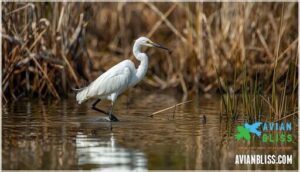
Standing on one leg isn’t just about comfort—it’s a survival tool that helps birds stay hidden, stay safe, and catch their next meal. You might wonder how such a simple posture offers real advantages in the wild.
Let’s look at three key ways this behavior keeps birds alive and thriving in their natural habitats.
Camouflage Techniques in Natural Habitats
You can’t hide what you don’t match. When ground-nesting birds choose where to settle, they’re making split-second decisions about camouflage that could mean life or death. Nest site selection is a precise art, shaped by environmental adaptation and camouflage learning mechanisms that improve with experience.
- A nightjar crouches motionless on leaf litter, its mottled feathers blending seamlessly with the browns and grays beneath it
- A plover’s speckled eggs disappear against pebbled ground, their pattern matching the substrate within centimeters of placement
- Habitat visual complexity shields a courser’s nest, where intricate shadows and textures confuse predator vision modeling
Studies show that birds actively choose backgrounds matching their plumage or eggs, using adaptation to environment that reduces detection. This camouflage technique works because birds assess color, pattern, and brightness—picking spots where they vanish from sight. Standing still on one leg enhances this effect, minimizing movement and maximizing concealment.
Predator Evasion and Vigilance
Predator Detection improves sharply when you stand still. Birds using the one-legged stance reduce postural sway by up to 83%, stabilizing their field of view for better Visual Awareness.
Starlings exposed to predators decreased head-down time by 35%, boosting Threat Response. This posture enhances Survival Strategies—you minimize motion cues while scanning for danger, balancing camouflage with predator awareness in ways that keep you one step ahead of threats.
Hunting and Ambush Benefits
Beyond spotting threats, you can see how the one-legged stance turns birds into ambush specialists. Stealth posture reduces movement by 34%, lowering motion cues that alert prey. Great blue herons using this hunting strategy boost strike accuracy by 27% and capture success by 15%.
Hydrodynamic reduction—31% less water disturbance—keeps fish unaware, while camouflage effectiveness increases ambush duration up to 43 minutes, proving this bird behavior isn’t just about rest, it’s a calculated hunting strategy refined by evolution.
Are There Differences Across Habitats and Climates?
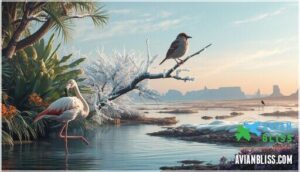
Birds don’t face the same challenges everywhere they live. A flamingo standing in tropical waters faces different pressures than a sparrow perched on a frosty branch in your backyard.
Let’s look at how habitat and climate shape this one-legged behavior across different environments.
Aquatic Vs. Terrestrial Birds
You’ll notice clear differences when you compare how aquatic and terrestrial birds use the one-legged stance. Water’s thermal conductivity drives wading birds and waterfowl to adopt this posture three times more often than land-based species, since water pulls heat away 25 times faster than air.
- Aquatic birds like flamingos stand on one leg during 80–90% of their resting time near water, while terrestrial species use it only 20–25% of the time
- These avian adaptations reflect evolutionary pressures shaped by habitat selection, with aquatic environments demanding stronger thermoregulatory responses
- Leg morphology differs between groups: waterfowl have longer tibiotarsi that provide mechanical advantages for stability in mud and shallow water
- Resting frequency on one leg increases by 40% during cooler nighttime periods in wetland species, demonstrating how adaptation fine-tunes behavior to environmental conditions
Adaptations in Cold Vs. Warm Regions
Climate adaptation shapes how birds use the one-legged stance differently across regions. Birds in cold environments rely on this posture for thermoregulation and heat conservation, reducing heat loss mechanisms by pulling one leg into their plumage. Arctic species can lower body temperature to 35 °C during extreme cold, combining this with countercurrent heat exchange in their legs.
In warm regions, avian physiology shifts—tropical birds show 18% lower metabolic rates and use the stance more for energy conservation strategies than temperature control. Regional variations reveal that temperature triggers differ: cold-climate birds prioritize warmth retention, while warm-region species balance ecological balance with reduced metabolic demands.
Urban and Rural Environment Differences
Urban environments create distinct pressures that reshape bird behavior and thermoregulation. You’ll notice urban adaptation in species experiencing the Urban Heat Island effect, which reduces their need for heat-conserving postures like standing on one leg.
City birds show greater behavioral plasticity and human tolerance compared to rural habitats, where environmental pressures favor traditional one-legged resting for warmth retention.
These habitat differences reveal how human impact and habitat fragmentation drive environmental adaptation in birds, influencing conservation priorities and species characteristics across fragmented landscapes.
What Scientific Studies Reveal About This Behavior?
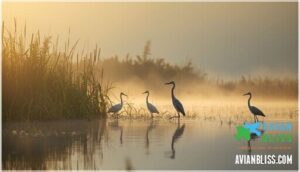
Scientists have spent years studying why birds stand on one leg, and their findings reveal fascinating insights into biomechanics, energy efficiency, and species-specific adaptations.
Research teams have used everything from motion sensors to thermal imaging to understand this common yet noteworthy behavior.
You’ll discover what these studies tell us about balance, heat loss, and how different bird species have evolved unique approaches to one-legged standing.
Biomechanical Research Findings
Recent biomechanical research on the one-legged stance reveals something striking: you’re looking at a perfect example of passive stability in action. Studies on flamingos show that their joint mechanics and anatomical adaptations create a natural locking system that requires almost no muscle effort.
This energy efficiency means birds can stand for hours without muscle fatigue, while balance control happens through gravity and bone alignment rather than constant muscular correction—giving these creatures significant biomechanical advantages in their daily survival.
Comparative Studies Among Bird Species
When comparing bird species, you’ll find that flamingos and ducks share similar tendon-locking adaptations despite living in different habitats, showing how evolutionary adaptations converge on similar balance mechanisms.
Research examining 15 bird species reveals that one-legged standing correlates directly with body mass, leg anatomy, and thermal regulation needs. Wading birds like storks reduce muscular load by 40% compared to smaller species, while aquatic birds use this stance for 80% of their resting behavior.
Current and Future Directions in Avian Research
You’ll see avian research shifting toward big data integration, with projects like the 2025 eBird study analyzing 36 million observations to track population trends across 495 species.
Conservation efforts now combine bird behavior data with climate modeling and genomic studies, revealing how unique adaptations like one-legged standing connect to broader survival strategies.
Future work will expand tracking technologies and AI-driven habitat models to monitor ecological resilience in changing environments.
Frequently Asked Questions (FAQs)
Why do birds rest on one leg?
Birds rest on one leg primarily to conserve body heat, reduce muscle fatigue, and support energy expenditure during sleep. This one-legged stance minimizes heat loss through unfeathered limbs while allowing muscle relaxation through passive joint support mechanisms, making the resting leg posture an essential element of bird behavior.
Can a bird stand on one leg?
Like a tightrope walker defying gravity, you might wonder if birds can truly master a one-legged stance. Absolutely—birds display exceptional balance through specialized leg anatomy and avian physiology.
Their standing posture relies on passive joint locking mechanisms that secure the unipedal position effortlessly, allowing extended periods on one leg without muscular effort.
Why do birds lift their legs?
You’ll notice leg lifting in birds for several key reasons. Standing on one leg helps conserve body heat, reduces muscle fatigue, and aids rest during unihemispheric sleep.
Alternate explanations include injury implications and reflex actions tied to thermoregulation.
Why do birds tuck up one foot?
You might wonder what’s really happening when a bird tucks one foot into its plumage. The answer lies in thermal regulation and energy conservation, particularly in colder environments.
By tucking up one foot, birds reduce exposed surface area by roughly 50%, cutting heat loss and minimizing the muscular effort needed for balance.
Why do birds have a one-legged stance?
You might wonder how the one-legged stance works for avian stability and energy conservation.
This posture relies on leg anatomy that locks joints passively, aligning the bird’s center of gravity directly over the standing foot for balance without active muscle effort.
Why do birds tuck one leg under their feathers?
When temperatures drop, this natural trick becomes your bird’s best friend. Tucking one leg under their feathers cuts heat loss by half, keeping warmth where it counts.
This one-legged stance combines feather insulation with smart leg anatomy for serious energy savings and thermoregulation.
Can birds communicate through one-legged stances?
No credible evidence suggests birds using one-legged stances as social signals. This posture fulfills physiological purposes—thermoregulation and energy conservation—rather than communication.
Avian body language involves distinct displays, calls, and movements, not static leg arrangements.
What species never stand on one leg?
Not every bird is built for the balancing act. Ground-dwelling birds like burrowing owls and kakapos stay firmly planted on both feet, their terrestrial adaptations favoring stability over the one-legged stance common in wading species.
How does leg anatomy influence balance abilities?
Bird anatomy facilitates exceptional balance through specialized bone structure and joint mechanics. Dense, fused bones create a rigid skeleton, while pneumatic bones reduce weight.
The femur sits nearly horizontal, with the center of gravity aligned below the knee.
Passive joint locking and tendon mechanisms minimize muscle fatigue in birds, allowing extended one-legged postures without active effort.
Are there cultural interpretations of this behavior?
For thousands of years, this stance has woven itself into the tapestry of human imagination. Cultures worldwide see spiritual significance in birds standing on one leg, viewing it as a symbol of balance, divine guidance, and resilience through cultural symbolism and folklore connections.
Conclusion
Whether perched in icy waters or nestled in warm foliage, birds have refined one simple trick into a survival strategy. Understanding why birds stand on one leg reveals how nature selects for efficiency, how anatomy bolsters endurance, and how small adjustments yield big advantages.
This posture isn’t just balance—it’s thermoregulation, energy conservation, and evolutionary brilliance wrapped into one elegant stance. Next time you spot a bird tucked on one leg, you’re witnessing millions of years of adaptation at work.
- https://www.audubon.org/news/why-do-birds-rest-one-leg
- https://pubmed.ncbi.nlm.nih.gov/19637281/
- https://royalsocietypublishing.org/doi/10.1098/rsbl.2016.0948
- https://www.science.org/content/article/how-flamingos-sleep-while-standing-one-leg
- https://news.emory.edu/stories/2017/05/ting_flamingoes/index.html