This site is supported by our readers. We may earn a commission, at no cost to you, if you purchase through links.

Say wild turkey out loud and watch what happens—someone nearby will either picture a bird strutting through the woods or reach for a glass.
That split identity is surprisingly rare for a name, and it tells you something about how deeply both have planted themselves in American culture.
The bird has been roaming North American forests for millions of years, long before European settlers arrived with confused geography and borrowed names.
The bourbon came later, born on a hunting trip in the 1940s and aged into one of the most recognized whiskey brands in the world.
Whether you’re trying to tell them apart, track one through the woods, or simply understand what makes each notable, there’s more to both than the label suggests.
Table Of Contents
- Key Takeaways
- Wild Turkey: Bird Vs. Bourbon
- Wild Turkey Bird Identification
- Habitat, Range, and Seasonal Behaviors
- Diet, Foraging, and Ecological Role
- Conservation and Human Interactions
- Frequently Asked Questions (FAQs)
- How rare is it to see a wild turkey?
- Is wild turkey a bourbon or whiskey?
- Are wild turkeys OK to eat?
- What attracts wild turkeys?
- What is the difference between a turkey vulture and a wild turkey?
- How does climate change impact wild turkeys?
- What subspecies are living in suburban areas?
- How do wild turkeys adapt to snowy conditions?
- What factors influence wild turkey population dynamics?
- How has artwork depicted wild turkeys historically?
- Conclusion
Key Takeaways
- Wild turkeys have roamed North America for over 23 million years, making them one of the continent’s most ecologically important birds — shaping forests through seed dispersal, pest control, and soil aeration long before they shared a name with a bourbon brand.
- The “Wild Turkey” bourbon got its name from a 1940s hunting trip and has kept its recipe unchanged ever since, earning it a spot as one of the most recognized American whiskeys in the world.
- Wild turkey populations crashed from nearly 10 million birds to just 30,000 by 1920 due to overhunting and habitat loss, but smart conservation efforts brought them back to over 7 million today — one of wildlife management’s genuine success stories.
- Whether you’re watching them forage at the forest edge or spotting them in suburban backyards, wild turkeys are far more adaptable than most people expect — thriving across 49 U.S. states and shifting their diet, behavior, and social structure with every season.
Wild Turkey: Bird Vs. Bourbon
Wild Turkey means two very different things depending on who you ask. One’s a bird that roams North American forests, and the other is a bourbon with a century-old recipe that hasn’t changed a bit.
Here’s a closer look at what sets them apart, where each name comes from, and the mix-ups people tend to make.
If you’re curious how migration patterns shift the picture even further, regional migration differences by species help explain why the same bird can look and behave differently depending on where you spot it.
Key Differences Between Bird and Whiskey
Same name, completely different worlds. One’s a living bird with complex vocalizations and feather composition built over millennia — the other is a Kentucky bourbon with a rich aging process and layered flavor profile. Here’s a quick look at what sets them apart:
| Feature | Wild Turkey Bird | Wild Turkey Bourbon |
|---|---|---|
| Heritage | Natural evolution | 100-year recipe |
| Sensory Trait | Gobbles, yelps, clucks | Vanilla, spice, oak aroma |
| Timeline | 28-day incubation | 6–8 years aging |
The bird measures a 36-44 inch length, detailed in its 36-44 inch length.
Origins and Naming History
How did one bird end up sharing its identity with a Kentucky straight bourbon? layered story
The Greek etymology behind Meleagris — Linnaeus classification from 1758 — points back to guineafowl, not turkeys.
The European misnomer did the rest, tangling trade routes and Mesoamerican domestication into one confused label.
Fossil lineage, brand history, tradition, heritage, Eddie Russell’s legacy, and even Prohibition shaped what “Wild Turkey” means today.
| Timeline | Wild Turkey Bird | Wild Turkey Bourbon |
|---|---|---|
| Ancient Roots | Fossil lineage ~23M years ago | Kentucky heritage, 1800s origins |
| Naming Moment | Linnaeus classification, 1758 | Brand history solidified mid-1900s |
| Cultural Highlight | Mesoamerican domestication ~2,000 yrs ago | Survived Prohibition, revived by Eddie Russell |
| European Influence | European misnomer via trade routes | Exported globally as iconic American spirit |
| Etymology | Greek etymology from meleagris | “Wild Turkey” name coined 1940s hunting trip |
Wild turkeys have persisted for over ten million years.
Common Misconceptions
Two things sharing a name doesn’t mean they share a story — and that’s where Wild Turkey identification and characteristics get murky fast.
Whether you’re tracking the bird or pouring a dram, Wild Turkey habitat and range details reveal just how much context shapes the full picture.
| Misconception | Reality |
|---|---|
| Rain Drowning Legend | Wild turkeys shelter during storms — no documented drownings exist |
| Nest Trampling Falsehood | Predators raid nests; toms never do |
Spur Age Myth trips up even seasoned hunters, and Crop Damage Blame mostly belongs to raccoons.
Wild Turkey Bird Identification
If you’ve ever spotted a large bird strutting through a field and wondered exactly what you were looking at, you’re not alone. Wild turkeys have a few telltale traits that make them easier to identify once you know what to look for.
Here’s a closer look at how scientists classify them, what sets males and females apart, and how different subspecies vary across North America.
Scientific Classification and Taxonomy
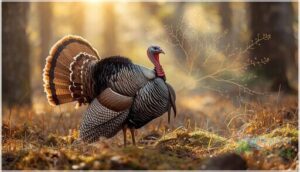
If you’ve ever wondered where the wild turkey fits in the grand tree of life, the answer goes back to 1758, when Carl Linnaeus gave it the binomial nomenclature Meleagris gallopavo. Its taxonomic history runs deep:
- Order Galliformes links it to chickens and pheasants
- Family Phasianidae confirms those phylogenetic relationships
- Six recognized subspecies make subspecies delineation essential for wild turkey identification and characteristics
Today, genetic barcoding continues refining our understanding of this species.
Physical Features and Sexual Dimorphism
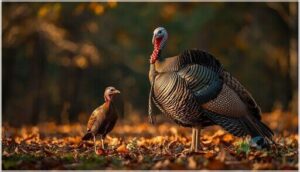
Size dimorphism makes wild turkeys easy to tell apart. Males tip the scales at up to 11 kg, while females rarely exceed 5.4 kg.
Plumage iridescence — bronze, copper, and green feathers that shift in sunlight.
Head caruncles color shifts red or blue during wild turkey breeding season.
Beard length variation and spur development round out the wild turkey anatomy package.
Subspecies and Regional Variations
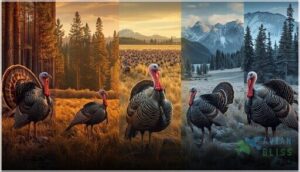
Five subspecies make up the wild turkey family, and each one has its own personality.
The Eastern turkey rules forests from Canada to Florida, known for its Eastern gobble strength — the loudest of any subspecies.
The Osceola, Florida’s own, stands out for its Osceola spur length.
The Rio Grande turkey forms impressive flocks, with Rio Grande flock size sometimes reaching hundreds of birds.
Head west, and you’ll find the Merriam turkey in the Rockies, modest in Merriam beard size but striking in its white-tipped feathers.
Rounding out Wild Turkey Subspecies and Range in Washington and beyond, the Gould impresses most with its Gould leg length — the longest of all.
Habitat, Range, and Seasonal Behaviors
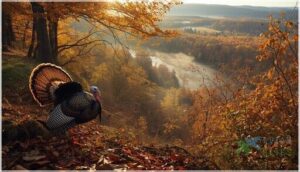
Wild turkeys are remarkably adaptable birds, and their range across North America reflects that.
Where they live, how they move through the seasons, and how they organize themselves socially tell you a lot about what makes them thrive.
Here’s a closer look at the key aspects of their habitat, range, and seasonal behaviors.
Natural Distribution in North America
Wild turkeys have pulled off one of nature’s great comebacks, spreading across 49 U.S. states today. Each subspecies carved out its own corner of the continent:
- Eastern range: Maine down to Florida, west to Minnesota — over 5 million birds strong
- Rio Grande range: Texas through the Great Plains and into California
- Merriam range: Rocky Mountain high country, with Montana alone holding 130,000
North American wild turkey range now includes introduced populations even in Hawaii.
Preferred Habitats and Ecosystems
Turkeys aren’t picky — but they’re specific. They thrive where forest edge habitats meet open ground, giving them nesting cover types like brush and leaf litter close to insect‑rich brood‑foraging zones.
Roost tree selection favors large oaks and cottonwoods in riparian mast corridors near water. Open understory light regime keeps foraging ecology productive, letting hens scan for danger while poults feed freely.
Migration, Roosting, and Social Structure
Most wild turkeys don’t migrate — but don’t mistake that for staying put.
In the Rockies, Merriam’s turkeys make elevational shifts of 20 to 40 miles as snow melts each spring.
Their roost tree preference leans toward large, mature timber near water.
Flock pecking order governs everything from feeding to roosting spots.
Come spring, seasonal group splits break large winter flocks into smaller breeding units, with morning dispersal routine starting at first light.
Diet, Foraging, and Ecological Role
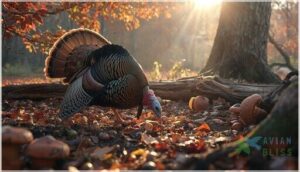
Wild turkeys are surprisingly adaptable eaters, and their foraging habits shape the landscape around them more than most people realize.
What they eat shifts with the seasons, and those changes ripple outward in ways that affect the whole ecosystem.
Here’s a closer look at what’s on the menu, how it changes year-round, and why it matters.
Primary Foods and Feeding Habits
Think of them as nature’s cleanup crew with serious food standards. About 90 percent of their diet comes from plants — acorns rank highest, especially from nut‑bearing trees like white oak.
They rely on ground scratching to uncover buried seeds, grubs, and roots beneath leaf litter. Insect protein fills the remaining gap, while morning foraging peaks right after they fly down from roost trees.
Seasonal Dietary Changes
wild turkey diet shifts with every season.
spring insect surge fuels hens during breeding, while poult growth shifts lean‑heavy on bugs — nearly 80 percent protein in early weeks.
soft mast like berries and weed seeds take over by July.
hard mast means acorns and hickory nuts.
Winter scarcity foods? Pine buds, rose hips, whatever the cold leaves behind.
Role in Local Ecosystems
Forget passive bystanders — these birds are actively shaping the forests around them. Their ecological role touches everything from seed dispersal to pest control, soil aeration, and prey dynamics.
- Seed dispersal — Seeds hitch rides in droppings, planting nut-bearing trees like oaks in new clearings.
- Pest control — One turkey eats 200+ insects daily.
- Soil aeration — Scratching loosens compacted ground, boosting root health.
- Prey dynamics — Turkeys feed 20+ predator species.
- Biodiversity indicator — Healthy flocks signal thriving forest ecology.
Conservation and Human Interactions
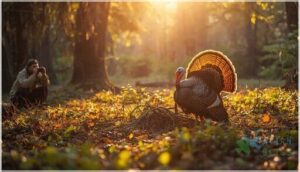
Wild turkeys have had a complicated history with humans — nearly wiped out, then slowly brought back through real effort and smart management.
Today, they’re a conservation success story, but that doesn’t mean everything is simple. Here’s a look at how that recovery happened, where things stand now, and how you can coexist with these birds if they show up in your world.
Historical Decline and Recovery Efforts
Once numbering nearly 10 million, wild turkey populations crashed to roughly 30,000 birds by 1920 — a brutal consequence of overhunting impact and widespread habitat loss from deforestation.
Wild turkey populations plummeted from 10 million to just 30,000 by 1920, decimated by overhunting and deforestation
But the story doesn’t end there.
Trap-transfer programs, backed by NWTF funding and coordinated state reintroduction success, turned things around dramatically.
Wild turkey conservation and population recovery became a genuine triumph, proving that species reintroduction works when people commit to it.
Current Conservation Status
Today, the wild turkey holds IUCN Least Concern status — a direct result of those hard-won recovery efforts. Population trends look encouraging, with over 7 million birds across North America.
That said, habitat loss impact, disease threats like blackhead, and hunting pressure effects still shape the picture. Wild turkey conservation isn’t finished work — it’s ongoing, and those challenges keep researchers and wildlife managers paying close attention.
Attracting Wild Turkeys to Backyards
Turning your backyard into a turkey-friendly space doesn’t take much — just a few smart choices.
Scatter birdseed or cracked corn in open areas, and focus feeder placement near nut-bearing trees like oaks or hickories.
Add a ground-level water feature design that mimics a natural puddle. Layer in cover plant selection with native shrubs, and you’ll have regular visitors working your yard like they own it.
Managing Human-Turkey Conflicts
Sometimes, the turkeys you love watching can become a real headache.
Wild turkey conflict prevention starts with simple steps — install exclusion barriers like 6-to-8-foot fencing, use scare devices such as motion sprinklers or air horns, and apply deterrent sprays on fruit crops. Habitat modification, like mowing short grass, removes food sources.
Community outreach helps neighbors stay consistent, because effective wild turkey management only works when everyone’s on the same page.
Frequently Asked Questions (FAQs)
How rare is it to see a wild turkey?
Spotting one isn’t as rare as you’d think.
With around 5 million across the U.S., population density and urban sightings are climbing — especially where hunting restrictions give these birds room to roam freely.
Is wild turkey a bourbon or whiskey?
Wild Turkey is both — but more precisely, it’s a bourbon, which is a specific type of whiskey.
All bourbon is whiskey, but not all whiskey is bourbon.
Wild Turkey qualifies as Kentucky straight bourbon.
Are wild turkeys OK to eat?
Yes, they’re excellent eating. Wild turkey is lean, high in protein, and genuinely delicious — just cook it right, follow legal harvest guidelines, and you’re in for a rewarding wild meal.
What attracts wild turkeys?
Think of turkeys as nature’s treasure hunters. Acorn mast, insect-rich patches, grain field edges, open strut zones, and dust bath sites consistently draw them in — especially near nut-bearing trees.
What is the difference between a turkey vulture and a wild turkey?
At a glance, turkey vultures soar on V-shaped wings and weigh only 3 pounds, while wild turkeys stay grounded, weigh up to 24 pounds, and gobble loudly — completely different birds.
How does climate change impact wild turkeys?
Climate change hits hard through nesting timing mismatch, drought habitat loss, and insect phenology shift.
Extreme winter snow blocks foraging, while heat stress mortality and habitat fragmentation quietly reshape population distribution and breeding behavior season by season.
What subspecies are living in suburban areas?
The Eastern subspecies owns the suburbs.
Through restocking success since the 1970s, urban adaptations and behavioral shifts have made city sightings routine — from Boston yards to Manhattan boroughs, suburban foraging is now second nature.
How do wild turkeys adapt to snowy conditions?
When snow piles up, feather insulation and fat reserves kick in fast.
Wild turkeys rely on conifer roosts, reduced movement, and snow foraging near forest edges to survive — smart winter feeding built into their seasonal behavior.
What factors influence wild turkey population dynamics?
A thousand things can tip the balance.
Predation pressure, habitat fragmentation, weather impacts, and hunting regulations all shape recruitment success — and when habitat suitability drops near nutbearing trees, populations feel it fast.
How has artwork depicted wild turkeys historically?
Early engravings often stiffened the bird into awkward profiles, but Audubon’s contrapposto pose changed everything.
Catesby plumage studies, Thanksgiving postcards, and modern wildlife realism each reshaped how people visually understood this iconic creature.
Conclusion
Picture a November morning—frost still clinging to the oak leaves, a wild turkey picking its way through the underbrush while a bottle of bourbon sits waiting on a shelf back home. Two things sharing one name, yet each unmistakably its own.
The bird shaped this land long before anyone thought to bottle it in spirit form. Now that you know both, you’ll never hear that name the same way again.