This site is supported by our readers. We may earn a commission, at no cost to you, if you purchase through links.
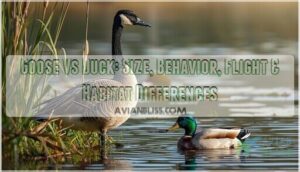
Standing at the edge of a pond, you might think those honking birds waddling across the grass are just oversized ducks. But geese and ducks belong to distinct branches of the waterfowl family tree, with differences that run far deeper than size alone.
A Canada goose stretches up to 50 inches and tips the scales at 20 pounds, while a mallard duck rarely exceeds 26 inches or 5 pounds. Beyond these obvious contrasts, their beaks reveal separate evolutionary paths: geese clip tough grasses with short, triangular bills, whereas ducks filter aquatic invertebrates through broad, flat bills lined with fine lamellae.
These physical traits shape where they live, how they move, and what they eat—turning casual pond visitors into master grazers or agile divers.
Table Of Contents
- Key Takeaways
- Goose and Duck Characteristics
- Behavioral and Habitat Differences
- Flight and Swimming Abilities
- Frequently Asked Questions (FAQs)
- What’s better, duck or goose meat?
- What is the difference between goose and duck feathers?
- Is a male duck called a goose?
- What is the difference between a goose and a duck?
- How big is a duck compared to a geese?
- Do geese have longer bills than ducks?
- What are the similarities and differences between ducks and geese?
- What is the difference between a white goose and a duck?
- Is duck better than goose?
- What is the difference between a duck and goose?
- Conclusion
Key Takeaways
- Geese outweigh ducks by two to four times (10-20 pounds versus 2-5 pounds) and use their longer necks—equipped with up to 24 cervical vertebrae—to graze terrestrial grasses, while ducks stay compact with shorter necks designed for dabbling and diving in shallow wetlands.
- Bill structure separates these waterfowl completely: geese clip tough vegetation with short, triangular beaks built for bite force, whereas ducks filter aquatic invertebrates and seeds through broad, flat bills lined with fine lamellae that act like sieves.
- Geese form lifelong pair bonds and defend nesting territories aggressively during up to 90% of daylight hours, while ducks establish seasonal partnerships and gather in fluid flocks with minimal territorial conflict.
- Migration patterns reveal geese as long-distance specialists traveling 2,800-4,000 kilometers in strict V-formations along traditional flyways, compared to ducks that follow shorter, more flexible routes with looser flock organization.
Goose and Duck Characteristics
When you spot a waterfowl at the local pond, you might wonder whether you’re looking at a goose or a duck.
One of the most common species you’ll encounter is the mallard duck, recognizable by its vibrant green head and signature quack.
The differences between these birds go far beyond simple labels, and understanding their physical traits helps you identify them with confidence. Let’s examine the key characteristics that set geese and ducks apart, starting with how they look and what makes each species unique.
Physical Appearance Differences
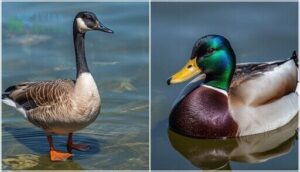
Physical appearance tells you almost everything you need to know when separating these feathered friends in the field. Though both belong to the Anatidae family, their waterfowl characteristics reveal clear distinctions you can spot from a distance.
- Head markings and face structure – Geese show bold, simple patterns like solid white cheeks on dark heads, while ducks display intricate patches and iridescent areas across rounder, dome-shaped heads.
- Beak shapes and bill structure – Duck bills are broad and flat with fine, sieve-like edges for filtering, whereas goose beaks are shorter and triangular with a distinct “grin line” for clipping grasses.
- Plumage and feather textures – Ducks sport vibrant, sexually dimorphic colors with glossy greens and blues, while geese wear muted grays, browns, and whites in softer, simpler patterns.
Their body proportions differ too, with geese showing longer necks and more upright posture. Leg colors vary, with geese usually displaying solid orange or pink feet. To explore more specific that help identify ducks and geese, check reliable birding resources.
Size and Shape Distinctions

Beyond those head and bill features, you’ll spot dramatic contrasts in overall body proportions. Most Anatidae geese stretch 30 to 50 inches and weigh 10 to 20 pounds, while typical ducks measure just 15 to 26 inches at around 2 to 5 pounds—making geese roughly two to four times heavier.
Wing span follows suit: mallards show 32 to 37 inches, but larger geese exceed 50 inches for powerful migration. Leg length and placement matter too—geese stand upright with centrally positioned legs for grazing, while ducks waddle on shorter, rear-set legs optimized for paddling.
These distinctions in key waterfowl characteristics are essential for understanding the differences between geese and ducks.
Neck and Beak Variations
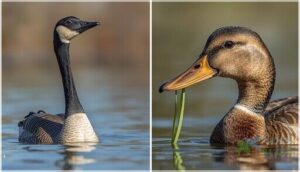
Neck anatomy reveals striking contrasts in duck and goose differences that help with bird identification. You’ll notice geese carry 17 to 24 cervical vertebrae, letting them stretch upright to graze fields and shallow wetlands, while most ducks possess 16 or fewer neck bones for compact dabbling at the surface. Beak shapes diverge just as sharply: geese wield triangular bills—around 65 to 80 mm—that clip tough stems like pruning shears, whereas ducks sport broader, flatter bills (30 to 50 mm) designed for filter feeding.
The Fulvous Whistling-Duck shows similar elongated proportions, blending traits from both waterfowl families with its slender neck and upright stance.
Both Anatidae groups show lamellae structure along their beaks, but ducks pack finer, denser ridges for straining tiny seeds and invertebrates, and geese use coarser edges to grip fibrous plants.
- Feeding adaptations: Goose beaks concentrate bite force for clipping; duck bills spread wide for scooping
- Bill functions: Waterfowl behavior ties directly to beak design and neck reach
Plumage Characteristics
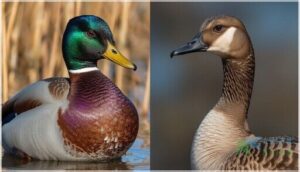
While beak shapes set waterfowl apart structurally, plumage patterns offer your quickest field mark for bird identification. Male ducks dominate the ornithology spotlight with iridescent greens, purples, and bold wing patches—you’ll see this sexual dimorphism in over 58% of Anatidae duck species, whereas geese keep both sexes in matching gray, brown, or white tones year-round.
Feather coloration isn’t just for show: ducks pack denser barbule arrangements at 52 per millimeter compared to geese’s 38, boosting waterproofing beyond 150° contact angles. Tail feathers and wing structure reveal more differences—many ducks flash colorful speculum bars during flight, while geese display uniform flight feathers built for migration.
Ducks pack denser feather barbules than geese, creating superior waterproofing and flashier flight displays instead of uniform migration plumage
Down beneath those contour plumage layers, geese win the insulation race at 2.5 clo units versus ducks’ 2.1, keeping them warm across Arctic breeding grounds.
Behavioral and Habitat Differences
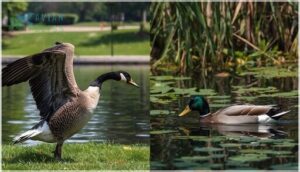
Beyond physical traits, geese and ducks differ sharply in how they interact with their surroundings and each other. You’ll notice these differences when you observe their territorial disputes, feeding strategies, and habitat choices.
These behavioral patterns also influence their seasonal migration strategies, where geese typically follow traditional flyways while ducks show more flexible route selection.
Let’s examine the behavioral and environmental factors that set these waterbirds apart.
Social and Territorial Behaviors
When you observe geese near a nest, expect ganders to patrol relentlessly—up to 90% of daylight hours—charging anyone within a 10-meter zone. Their Social Hierarchy and Territorial Behaviors drive Agonistic Behavior at 0.45 interactions per minute, establishing a strict Social structure through Flock Dynamics and lifelong Mate Selection.
Ducks take a different path: their Avian Behavior favors fluid groups with seasonal bonds and conflicts rarely lasting 10 seconds, making their Territorial Marking and overall Bird Behavior far less confrontational.
Vocalization and Communication
You’ll pick up distinct Call Types when you watch these birds: Canada geese deploy 13 to 14 honks, hisses, and grunts for Social Coordination, while ducks surprise Birdwatching and Observation enthusiasts with up to 16 Vocalization patterns showing impressive Vocal Learning.
Acoustic Signals differ sharply—goose honks fall between 500 and 850 hertz, carrying across open water, whereas duck calls range from classic quacks to softer murmurs suited for close-range contact. Parent Offspring bonds rely on these sounds; goose parents use urgent calls to freeze goslings, and ducklings imprint on their mother’s voice within hours of hatching, shaping fundamental Avian Behavior and Duck and Goose Behavior through early Bird Behavior patterns.
Feeding Habits and Foraging
In terms of Feeding Habits and Foraging, geese and ducks take radically different approaches to dinner. Geese graze like tireless lawn mowers, clipping ryegrass, fescue, and clover in open fields—these herbivores spend half their daylight hours munching terrestrial vegetation and spilled grain. Ducks, by contrast, are opportunistic omnivores: dabbling species tip forward in shallow wetlands to sift seeds and insects through broad, flat bills, while diving ducks plunge deep for mussels and crayfish.
These Feeding Adaptations reflect distinct Diet Variations shaped by bill structure and habitat.
- Geese use short, strong bills to shear tough plant stems on land, while ducks employ longer bills with fine lamellae to filter Food Sources from water
- Dabbling ducks feed in shallow water less than 18 inches deep, tipping tails up to reach pondweed and invertebrates
- Diving ducks propel themselves underwater with powerful legs, accessing deeper Food Sources unavailable to surface-feeding Waterfowl
- Geese demonstrate consistent Grazing Patterns across pastures and crop fields, walking in loose flocks to pick up agricultural waste
- Seasonal shifts in Diet show geese loading carbohydrate-rich grains before migration, while ducks maintain flexible Foraging Methods year-round
Habitat Preferences and Adaptations
You’ll notice geese master terrestrial foraging across golf courses and harvested crop fields, grazing short grass with long necks that let them feed 30 inches from shore, while ducks stick to shallow wetlands and vegetated mudflats within arm’s reach of water. Their habitat preference splits along structural lines—geese exploit open sightlines on suburban retention ponds and park lawns, demonstrating urban adaptations that include rooftop nesting, whereas ducks favor dense emergent vegetation in marshes and tree cavities.
Migration and habitat shifts reveal how waterfowl respond to climate changes: geese now overwinter in temperate cities with heated outflows, and ducks adjust stopover wetland use as milder winters expand ice-free zones, showcasing distinct ecological adaptations.
Flight and Swimming Abilities
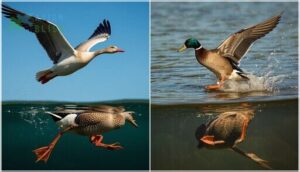
When you watch geese and ducks in action, you’ll notice they move through air and water in completely different ways.
Geese rely on powerful flight with steady wingbeats, while ducks excel at quick takeoffs and agile swimming maneuvers.
Let’s break down exactly how these birds differ in their flight speed, swimming mechanics, and migration patterns.
Flight Speed and Efficiency
Flight speed reveals how geese and ducks master different aerodynamic benefits through distinct flight patterns. You’ll spot geese cruising at 30-40 mph normally, jumping to 50-60 mph with tailwinds during migration patterns, while some ducks hit 70-80 mph in bursts. That V-formation you notice during birdwatching isn’t just beautiful—it cuts wind resistance by 70%, boosting energy conservation.
Altitude effects matter too, as bar-headed geese maintain 67 kph crossing mountains.
- Spur-winged geese reach 88 mph despite heavy waterfowl builds
- V-formations let avian flocks travel 70% farther per energy unit
- Geese rotate lead roles to share wind resistance burden
- Teal ducks sustain 70-80 kph with compact wingspans
- High-altitude flight requires stronger wingbeats over gliding techniques
Swimming Speed and Mechanics
When you observe waterbirds gliding across a pond, you’re watching two distinct propulsion systems refined by evolution. Ducks cruise at roughly 0.3 to 0.7 meters per second—about 1 to 2.5 kilometers per hour—using webbed foot paddles that spread wide on each swimming stroke to push water backward.
Diving ducks beat their feet around 4.3 times per second underwater, demonstrating precise buoyancy control as air compression reduces lift by 15 percent at shallow depths. Geese paddle more steadily, sitting higher due to greater air volume in their plumage.
During birdwatching sessions, you’ll notice dabbling ducks maintain horizontal body postures for surface feeding, while diving techniques require stronger, continuous strokes to overcome natural buoyancy and reach deeper zones where waterfowl forage.
Migration and Movement Patterns
While swimming mechanics show you finesse in aquatic locomotion, migration patterns reveal endurance and navigational mastery across continents. Canada geese cover 2,800 to 4,000 kilometers during spring migration alone, traveling major flyways—Pacific, Central, Mississippi, and Atlantic—that link Arctic breeding grounds to southern wintering areas. You’ll spot their signature V-formations cruising between 1,000 and 3,300 feet, with flocking behavior that cuts air resistance and boosts efficiency. Geese use stopover sites spaced roughly 400 kilometers apart, resting 40+ hours before continuing. Ducks scatter across shorter migration routes with looser flocks, adjusting altitude between 200 and 4,000 feet as weather shifts. Both waterfowl navigate using celestial cues and Earth’s magnetic field, but geese maintain stricter schedules while ducks improvise.
- Recent climate warming has pushed waterfowl winter distributions northward by 260 to 325 kilometers, shortening traditional bird migration and habitat distances.
Frequently Asked Questions (FAQs)
What’s better, duck or goose meat?
Duck wins for most people—milder flavor, easier cooking, better availability. Goose offers richer nutrient profiles and abundant cooking fat, but costs more and tastes gamier, requiring greater culinary commitment.
What is the difference between goose and duck feathers?
Though both birds look waterproof, their plumage tells a different story.
Goose feathers offer larger down clusters with higher fill power and exceptional feather insulation, while duck feathers contain more oil content, affecting softness comparison and avian characteristics.
Is a male duck called a goose?
No, a male duck is called a drake, not a goose. Correct terminology in waterfowl identification matters—gander refers to male geese.
These species distinctions in ornithology help you understand bird classification and male duck names properly.
What is the difference between a goose and a duck?
Both belong to the same family yet look worlds apart.
Geese tower high at 30 to 50 inches with elongated necks for grazing, while ducks stay compact at 15 to 25 inches, built for diving and dabbling.
How big is a duck compared to a geese?
In body size comparison, most waterfowl species scaling shows ducks weighing 2-5 pounds and measuring under 2 feet long, while geese usually weigh 5-14 pounds with length variations reaching over 3 feet.
Do geese have longer bills than ducks?
No, ducks actually have longer bills than geese. Most duck species carry broad, flat bills that span 4 to 6 centimeters, while geese have shorter, more tapered bills designed for grazing.
What are the similarities and differences between ducks and geese?
You’ll find the waterfowl family both share webbed feet and migration patterns, yet they diverge sharply: geese graze fields with territorial honks, while ducks dabble wetlands with colorful plumage and seasonal pair bonds.
What is the difference between a white goose and a duck?
A white goose carries its long neck upright and grazes on fields, while ducks show brighter plumage, shorter necks, broader beaks for dabbling, and more compact bodies suited for quick swimming and diving.
Is duck better than goose?
Neither bird outranks the other—your choice depends on priorities. If you value Egg Nutrition and Culinary Versatility, ducks excel.
For Down Insulation and Pet Suitability, geese shine in different ways.
What is the difference between a duck and goose?
You notice it immediately when both birds approach: geese tower over ducks with their elongated necks and heavier builds, while ducks display compact bodies, vibrant plumage, shorter bills, and more adaptable Feeding Habits across diverse Habitat types.
Conclusion
Next time you spot a V-formation overhead, watch how the larger birds hold steady while smaller ones dart and weave—that’s the goose vs duck divide playing out in real time.
Geese commit to long-haul endurance with powerful wingbeats and herbivore fuel, while ducks trade size for agility, diving after protein-rich prey. Recognize these patterns, and you’ll never mistake one for the other again.
- https://a-z-animals.com/animals/comparison/goose-vs-duck/
- https://www.birdspot.co.uk/bird-brain/whats-the-difference-between-a-duck-and-a-goose
- https://animals.howstuffworks.com/birds/goose-vs-duck.htm
- https://avianreport.com/guide-ducks-geese-and-swans-north-america/
- https://owl-online.org/animal-guide/duck/