This site is supported by our readers. We may earn a commission, at no cost to you, if you purchase through links.
Walk through Florida’s scrublands on a clear morning, and you might catch a flash of blue landing fearlessly on a nearby branch—close enough to study you right back. That’s the Florida Scrub-Jay, one of the few bird species found nowhere else on Earth except Florida’s disappearing oak scrub ecosystems.
Reclassified as its own full species in 1995, this corvid carries a conservation story as distinctive as its crestless blue-and-gray plumage. Understanding what makes it unique—its habitat needs, cooperative family behaviors, and precarious population status—reveals why protecting it matters far beyond state borders.
Table Of Contents
- Key Takeaways
- What is The Florida Scrub-Jay?
- Physical Characteristics and Identification
- Habitat and Geographic Range
- Behavior, Diet, and Social Structure
- Conservation Status and Protection Efforts
- Frequently Asked Questions (FAQs)
- How rare is Florida scrub-jay?
- Where can I find Florida scrub-jay?
- Are Florida Scrub-Jays friendly?
- Is a Florida scrub-jay the same as a blue jay?
- What does a Florida Scrubjay look like?
- What is a Florida Scrubjay?
- Where do scrub jay birds live in Florida?
- Where can I see a Florida scrub jay?
- Are scrub jays native to Florida?
- Is the Florida Scrubjay a endemic bird?
- Conclusion
Key Takeaways
- The Florida Scrub-Jay is the only bird species found exclusively in Florida, shaped by over two million years of genetic isolation in fast-disappearing oak scrub ecosystems.
- Its population has crashed by roughly 90%—from around 40,000 birds to fewer than 10,000—driven by habitat loss, fragmentation, and fire suppression that lets scrub grow too dense to survive.
- Unlike most birds, scrub-jays live in tight family groups where older offspring stick around to help raise younger siblings, a rare cooperative breeding strategy that directly boosts survival rates.
- Protecting this species isn’t just about one bird—it anchors an entire scrub ecosystem, and conservation tools like prescribed burns and habitat corridors are the difference between recovery and local extinction.
What is The Florida Scrub-Jay?
The Florida Scrub-Jay (Aphelocoma coerulescens) is one of North America’s most fascinating birds — and the only bird species found exclusively within Florida’s borders.
Its story is just one example of the remarkable regional diversity covered in this guide to North America’s native bird species.
It carries a rich scientific history, from its reclassification as a full species to its ongoing role as a symbol of Florida’s threatened scrub ecosystems.
Here’s what you need to know about its taxonomy, endemic status, and how its classification has evolved over time.
Taxonomy and Scientific Classification
The Florida Scrub-Jay’s scientific name, Aphelocoma coerulescens, tells a quiet story. Aphelocoma draws from Greek, meaning simple hair — a nod to its unbanded feathers — while coerulescens is Latin for “becoming blue.”
Described in 1795, the species wasn’t officially split from western scrub-jays until 1995, when molecular evidence and behavioral differences placed it firmly as its own branch within genus Aphelocoma, family Corvidae.
Endemic Status in Florida
Unlike most birds that range across continents, the Florida Scrub-Jay exists nowhere else on Earth — making statewide endemism its defining trait. Genetic isolation over two million years shaped a species so specialized that its habitat requirements and threats are inseparable from its identity.
That’s partly why it has carried federal threatened status since 1987, a legal protection reflecting a real population bottleneck now below 10,000 birds. Prescribed burning maintains habitat for the species.
Historical and Current Species Status
That long-term decline tells a sobering story. Pre‑settlement abundance sat near 40,000 birds — today, fewer than 10,000 remain, confirming a 90% population decline driven by habitat loss and fragmentation. Recent survey findings show isolated groups facing local extinction risk.
From 40,000 birds to fewer than 10,000, the Florida Scrub-Jay has lost 90% of its population to habitat loss
- Legal protection timeline: state‑threatened since 1975, federal threatened status under the Endangered Species Act since 1987
- Current conservation status: Vulnerable on the IUCN Red List
- Genetic diversity changes accelerate as populations shrink and fragment
- Conservation funding levels remain critical for scrub restoration programs
The groups are defending the Charlotte County Habitat Plan.
Physical Characteristics and Identification
If you’ve ever spotted a flash of blue darting through a low scrubby thicket and wondered what you were looking at, the Florida Scrub-Jay makes identification pretty straightforward once you know what to look for.
Its cobalt-blue head and wings make it one of Florida’s most striking birds, as covered in this guide to Florida’s native bird species.
Its size, coloring, and markings each tell a distinct story — and they set it apart from every other jay you might encounter.
Here’s what to notice when you’re out in the field.
Size, Plumage, and Distinctive Markings
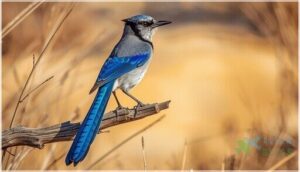
Spot one in the field and you’ll notice the blue-gray bib right away — it’s like a neat collar finishing off the white throat.
Adults measure 23–28 cm with an especially long tail.
| Feature | Adult Males | Adult Females |
|---|---|---|
| Weight | ~80–92g | ~66–80g |
| Plumage | Blue, gray, white | Identical visually |
| UV Reflectance | Higher | Lower |
Sexual size dimorphism is subtle but real.
Differences From Other Jays and Blue Jays
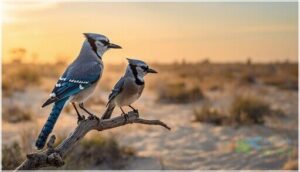
Once you start comparing corvids side by side, the Florida Scrub Jay really stands out. Unlike blue jays, it relies on fire‑dependent habitat and stays ground‑foraging in low scrub rather than treetops.
Its vocal distinctiveness — scratchy calls instead of ringing “jay” notes — reflects tighter family coordination. Sentinel behavior and cooperative breeding further separate it from the blue jay’s loosely paired lifestyle.
Adult Vs. Juvenile Features

Telling adults from juveniles comes down to a key physical characteristics. Adults display crisp blue plumage on the head and chest, while juveniles show brownish-gray crowns that gradually shift during plumage change during their first molt between late summer and fall.
Bill morphology stays consistently dark across both age groups. By fall, molt timing blurs the differences considerably — juveniles begin resembling adults closely enough to challenge even experienced observers.
Habitat and Geographic Range
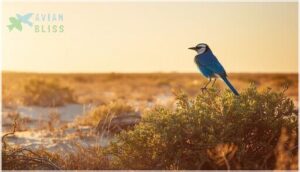
Florida Scrub-Jay doesn’t just live anywhere in Florida — it’s remarkably picky about where it calls home.
Understanding its habitat tells you a lot about why this bird is so vulnerable and why protecting the right land matters so much.
Here’s what you need to know about where this species thrives, where you can spot it, and what keeps its ecosystem alive.
Preferred Ecosystems and Vegetation
Florida Scrub-Jays don’t just live anywhere — they need xeric oak scrub, and they’re picky about it. Here’s what makes their scrub habitat work:
- Shrub Oak Diversity — Sand live oak, Chapman oak, and myrtle oak form a dense 1–3 meter canopy.
- Open Sand Patches serve as acorn caching zones where jays bury thousands of acorns annually.
- Scrubby flatwoods and sand pine communities provide additional cover between foraging areas.
- Prescribed burn mosaics maintain fire ecology that keeps vegetation low and open — without it, the scrub closes in and jays disappear.
Key Locations for Observation in Florida
If you want a reliable Florida Scrub-Jay sighting, a few sites consistently deliver.
The Merritt Island Trail puts you right in prime scrublands where birds approach surprisingly close. Lake Wales Ridge protects ancient sandy habitat supporting multiple breeding pairs. Oscar Scherer Park anchors the west coast, while Lyonia Preserve and Jonathan Dickinson Site round out your range maps for tracking this species across its Florida habitat.
Role of Fire in Habitat Maintenance
Fire isn’t the enemy here — it’s the whole point. Without regular burns, oak scrub grows too tall and dense within roughly 20 years, and scrub-jays simply vanish from those patches.
Prescribed burning resets the clock, creating mosaic habitat with open sandy gaps jays need to forage and watch for predators. Pyrodiversity benefits the entire ecosystem, but fire suppression quietly unravels it all.
Behavior, Diet, and Social Structure
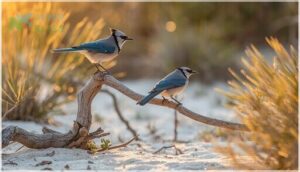
The Florida Scrub-Jay isn’t just interesting to look at — it’s fascinating to watch in action.
From how it raises its young to what it eats and how it defends its territory, this bird has a social life that’s surprisingly complex.
Here’s a closer look at the behaviors that make it one of Florida’s most studied species.
Cooperative Breeding and Family Groups
Few birds take “it takes a village” as seriously as the Florida Scrub‑Jay.
These cooperative breeders live in family groups centered on one breeding pair, supported by one to six helpers — mostly offspring from prior years demonstrating strong philopatry patterns.
Through load lightening, helpers reduce female workload, boosting her survival.
Despite breeding delay, helpers gain territory inheritance opportunities by staying close to home.
Foraging Habits and Omnivorous Diet
Beyond family teamwork, these jays are opportunistic and adaptable eaters. Their omnivorous diet spans acorns, insects, berries, lizards, and even bird eggs.
Ground insect probing and acorn caching — up to 8,000 nuts per bird each fall — define their foraging behavior. They also practice cache maintenance, relocating rotting acorns. That seasonal diet shift makes them surprisingly effective seed dispersers, quietly reshaping scrub habitat year after year.
Territoriality and Non-Migratory Behavior
Territory fidelity runs deep in Florida Scrub-Jays — most families hold the same 22–24 acre patch for generations.
They’re nonmigratory and sedentary year-round, rarely crossing unsuitable habitat. Philopatry patterns mean young helpers often stay close to home for years before dispersing. Boundary defense stays cooperative, with helper dynamics strengthening the group’s ability to hold and protect their territory.
Conservation Status and Protection Efforts

The Florida Scrub-Jay is in real trouble, and the numbers don’t lie.
Habitat loss, fragmentation, and development have pushed this species to the edge of what it can survive.
Here’s what’s driving the decline — and what’s actually being done about it.
Population Trends and Threats
The numbers don’t lie — this species is in serious trouble. Population decline has been steep, with roughly 90% of Florida Scrub‑Jays lost over the last century, leaving only 7,500–9,300 birds statewide.
- Genetic Isolation from fragmented habitats reducing diversity
- Predator Pressure from cats, raccoons, and vehicle strikes
- Climate‑Driven Disease risks like West Nile virus
- Fire Regime Impacts disrupting food and nesting cycles
- Human impact on Florida Scrub‑Jay populations near suburban edges
Monitoring confirms this species is genuinely threatened.
Impact of Habitat Loss and Fragmentation
Habitat loss hits harder than most people realize.
As scrub shrinks and splits, Dispersal Limitation kicks in — jays physically can’t reach new territories.
Females disperse up to 8.1 km through fragmented suburban landscapes, yet Breeding Success Decline follows.
Edge Effects degrade patch quality, while Genetic Isolation quietly accumulates.
Population Viability collapses when fragmentation severs connectivity.
| Fragmentation Factor | Observed Impact | Population Consequence |
|---|---|---|
| Habitat Loss | Reduced patch size | Smaller breeding groups |
| Genetic Isolation | Rising inbreeding rates | Lower genetic diversity |
| Dispersal Limitation | Longer but less effective movement | Breeding success decline |
Conservation Strategies and Management Practices
Saving the Florida Scrub‑Jay takes more than good intentions — it takes a coordinated playbook.
Prescribed Burn Scheduling keeps scrub open and low, while Mosaic Habitat Management ensures jays always have usable patches nearby.
Conservation Easement Programs protect private lands long‑term, and Landscape Connectivity Corridors help juveniles disperse safely.
Adaptive Management Monitoring ties it all together, tracking population dynamics so habitat restoration efforts stay ahead of decline.
Frequently Asked Questions (FAQs)
How rare is Florida scrub-jay?
Fewer than 10,000 individuals remain wild — a population density so thin that sightings frequency drops yearly.
Endemic to Florida, this threatened species faces severe range contraction, with habitat destruction pushing it toward a dangerous genetic bottleneck.
Where can I find Florida scrub-jay?
You’ll find them in Central Florida Parks, coastal preserve sites, and along the Lake Wales Ridge.
Oscar Scherer and Jonathan Dickinson State Parks are reliable spots, especially near scrub habitat maintained by prescribed burns.
Are Florida Scrub-Jays friendly?
Like ravens of legend, these birds show no fear.
Their human habituation and boldness cues are notable — perching behavior, feeding interactions, and cooperative flocks make them unusually approachable, though risk of tameness threatens their survival.
Is a Florida scrub-jay the same as a blue jay?
No, they’re not the same.
Despite sharing the Corvidae family, these birds show clear genetic divergence — different genera, distinct plumage, contrasting migration patterns, and separate nesting sites make them two entirely different species.
What does a Florida Scrubjay look like?
living flash of pale blue and pale gray, it wears a blue gray bib, shows dull brown upperparts when young, and carries a long tail with relaxed tail posture when perched.
What is a Florida Scrubjay?
The Florida Scrub-Jay (Aphelocoma coerulescens) is an avian species endemic to Florida, known for its complex sociality, omnivore status, scrub habitat preference, average lifespan of four to five years, and extensive research history.
Where do scrub jay birds live in Florida?
Ironically, one of Florida’s most exclusive residents doesn’t live in its famous beaches or swamps.
Scrub jays thrive only in dry, sandy scrub habitat — from Lake Wales Ridge preserves to coastal dunes and suburban fragments.
Where can I see a Florida scrub jay?
You’ll find Florida scrub-jays at Coastal Scrub Sites like Merritt Island, Inland Preserve Loops at Lyonia Preserve, or Roadside Scrub Hotspots along U.S.
Early Morning Hotspots offer the best sightings year-round.
Are scrub jays native to Florida?
Yes, scrub jays are truly native to Florida. Through paleogeographic isolation and genetic divergence timing spanning 2 million years, fossil evidence confirms they evolved exclusively here — a textbook case of range-endemism.
Is the Florida Scrubjay a endemic bird?
Absolutely — it’s only bird species endemic to a single U.S. state.
The Florida ScrubJay exists nowhere else on Earth, making endemic species conservation in Florida critical to its survival.
Conclusion
Think of the Florida Scrub-Jay as a living barometer for the health of Florida’s oak scrub—when it thrives, the ecosystem beneath it does too.
Every conservation effort protecting this species protects an entire web of life that depends on the same disappearing landscape.
Learning the Florida Scrub-Jay’s habits, territory, and needs doesn’t just make you a sharper birder; it makes you a more informed advocate for one of North America’s most fragile and irreplaceable ecosystems.
- https://www.allaboutbirds.org/guide/Florida_Scrub-Jay/id
- https://www.fws.gov/species/scrub-jay-aphelocoma-coerulescens
- https://myfwc.com/wildlifehabitats/profiles/birds/songbirds/florida-scrub-jay/
- https://www.audubon.org/field-guide/bird/florida-scrub-jay
- https://www.lauraerickson.com/radio/program/9298/cooperative-breeding-in-the-florida-scrub-jay/