This site is supported by our readers. We may earn a commission, at no cost to you, if you purchase through links.
Colorado hosts fourteen owl species, more than most people realize when they first start scanning the tree lines at dusk. From the Great Horned Owl patrolling suburban parks to the palm‑sized Flammulated Owl tucked inside ponderosa pine forests at 8,000 feet, the state’s varied elevation and ecosystems create ideal conditions for an unusually diverse owl community.
Burrowing Owls nest in prairie dog towns on the eastern plains while Boreal Owls hunt spruce forests near treeline—two worlds separated by hundreds of miles and thousands of feet. Knowing where to look, and what to listen for, changes everything.
Table Of Contents
- Key Takeaways
- Common Owl Species in Colorado
- Great Horned Owl: Widespread and Adaptable
- Barn Owl: Heart-Shaped Face and Silent Flight
- Burrowing Owl: Unique Ground-Dwelling Behavior
- Flammulated Owl: Tiny Forest Resident
- Short-eared and Long-eared Owls: Elusive Hunters
- Northern Saw-whet and Northern Pygmy-Owls: Small Mountain Owls
- Spotted and Boreal Owls: Rare and Hard to Spot
- Owl Habitats Across Colorado
- Identifying Colorado Owls
- Owl Behaviors and Adaptations
- Conservation and Owl Watching Tips
- Frequently Asked Questions (FAQs)
- What is the most common owl in Colorado?
- What scares owls away at night?
- Can owls hear heartbeats?
- Is it good or bad to have an owl in your yard?
- What kind of owl is in Colorado?
- What is the most common owl in Colorado Springs?
- Why put an owl in your yard?
- What type of owl box is suitable for Colorado?
- How can barn owls help control pests?
- What owls commonly use nesting boxes in Colorado?
- Conclusion
Key Takeaways
- Colorado’s 14 owl species span every major habitat in the state, from prairie dog towns on the eastern plains to spruce‑fir forests near treeline, so knowing the elevation and ecosystem you’re in is your first step to finding the right bird.
- Each species has its own acoustic fingerprint—whether it’s the Great Horned Owl‘s deep hooting duets or the Burrowing Owl’s rattlesnake‑mimicking chatter—making your ears just as useful as your eyes in the field.
- Several Colorado owls, including the Mexican Spotted Owl and Burrowing Owl, face real conservation pressure from habitat loss, and protecting prairie dog colonies and old‑growth forest stands is directly tied to keeping these populations stable.
- Ethical owl watching comes down to a few simple habits: stay at least 12–20 meters back, skip the recorded call playback, and swap your flashlight for a red‑filtered headlamp to avoid disrupting hunting and nesting behavior.
Common Owl Species in Colorado
Colorado is home to fourteen owl species, each occupying its own niche across the state’s remarkably varied landscapes. From open grasslands to dense mountain forests, you’ll find owls adapted to nearly every environment the state offers.
Whether you’re spotting a tiny Elf Owl or a commanding Great Horned Owl, this Colorado owl species field guide covers the key details for identifying each one in the wild.
Here’s a closer look at the species you’re most likely to encounter.
Great Horned Owl: Widespread and Adaptable
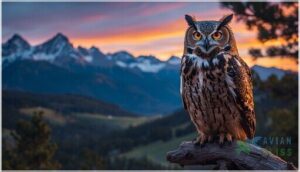
The great horned owl is Colorado’s most widespread owl — documented in every state park, from Denver’s urban greenbelts to high Rocky Mountain slopes near 3,300 meters. It’s a master of nesting site selection, commandeering old hawk and heron nests rather than building its own. Its prey diversity spans rabbits to raptors, making it a dominant force in Colorado owl species diversity year‑round.
For more on other species, see the Colorado owl guide.
Barn Owl: Heart-Shaped Face and Silent Flight
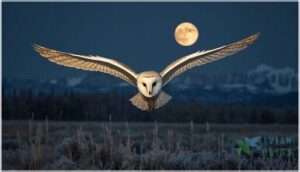
Unlike the great horned owl’s commanding presence, the barn owl works quietly — almost invisibly. Its heart-shaped facial disk acts as a natural acoustic funnel, channeling sound toward offset ears with exceptional precision.
Four key adaptations make it Colorado’s stealth hunter:
- Facial Disk Acoustics intensify faint prey sounds
- Feather Serrations reduce turbulence
- Wing Morphology allows slow, buoyant flight
- Noise Reduction Mechanics allow near‑silent approach
Its ghostly pale coloration([https://www.allaboutbirds.org/guide/American_Barn_Owl/overview) helps it blend into moonlit fields.
Burrowing Owl: Unique Ground-Dwelling Behavior
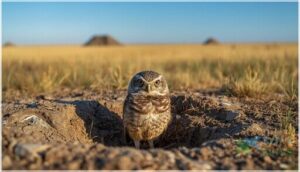
The burrowing owl flips the script on typical owl behavior. While barn owls haunt the night sky, this species hunts in broad daylight — a diurnal hunting tactic that sets it apart.
It nests in prairie dog towns through genuine prairie dog symbiosis, borrowing abandoned burrows rather than digging its own. Watch for white droppings marking active burrow entrance designs across Colorado’s eastern plains.
Flammulated Owl: Tiny Forest Resident
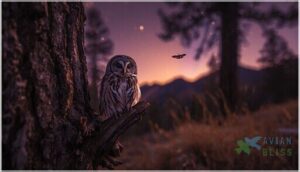
The Flammulated Owl punches well above its weight — barely six inches long, yet its low-pitch calls echo through Colorado’s ponderosa pine forests like something much larger.
Here’s what defines this tiny forest resident:
- Moth-Driven Diet — moths, crickets, and beetles fuel nightly hunts
- Cavity Nest Selection — old woodpecker holes, no added nesting material
- Ponderosa Pine Preference — dry mountain slopes and mixed conifer stands
- Seasonal Movement — arrives in spring, departs before winter
Short-eared and Long-eared Owls: Elusive Hunters
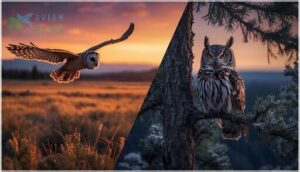
Two owls that reward patient birdwatchers, the Short-eared Owl and Long-eared Owl, each claim distinct corners of Colorado.
Watch for Short-eared Owl using dawn flight patterns low over Pawnee National Grassland, targeting voles through grassland prey dynamics. Long-eared Owl prefer riparian roosting in dense conifers, relying on ear tuft camouflage to disappear against bark.
Seasonal migration cues bring both through Colorado’s open owl habitats each year.
Northern Saw-whet and Northern Pygmy-Owls: Small Mountain Owls

Colorado’s mountain forests shelter two pint‑sized predators worth knowing: the Northern Saw‑whet Owl and Northern Pygmy Owl. Their size comparison is striking — both fit in your palm — yet they’re fierce hunters with surprising diet overlap.
Telling these two owls apart gets easier when you know their calls — seasonal owl vocalizations and identification tips can sharpen your ear through every month of the year.
- Size: Saw-whets reach 17–22 cm; Pygmy‑Owls stand just 16–18 cm.
- Nesting Cavity Choice: Both use old woodpecker holes.
- Diet Overlap: Voles, mice, and small birds.
- Vocal Duet Patterns: Pygmy‑Owls duet during daylight hours.
- Seasonal Movements: Some Saw-whets descend Colorado’s slopes each winter.
Spotted and Boreal Owls: Rare and Hard to Spot
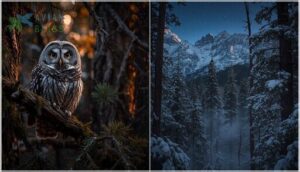
If there’s one chapter of Colorado’s owl story that reads like a mystery, it’s this one. The Spotted Owl and Boreal Owl are genuinely hard to find — not because they’re gone, but because their mountain haunts don’t give up secrets easily.
| Feature | Spotted Owl | Boreal Owl |
|---|---|---|
| Conservation Status | Federally Threatened | Species of Concern |
| Preferred Habitat | Mixed conifer canyons, 2,100–2,400 m | Spruce-fir forests, high elevation |
| Detection Methods | Four-note territorial hoot | Rapid hollow hoots, spring nights |
| Seasonal Patterns | Year-round, canyon-dependent | Rare breeder; few records post-1983 |
| Prey Availability | Flying squirrels, woodrats, voles | Voles, shrews, small mice |
Survey challenges are real — sightings near Denver remain isolated, and owl conservation efforts depend on protecting the old-growth stands both species call home.
Owl Habitats Across Colorado
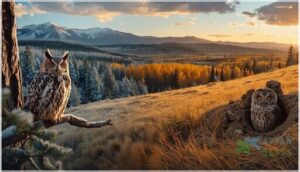
Colorado’s owls don’t all share the same address — they’re spread across a surprisingly wide range of landscapes, each one shaped by elevation, vegetation, and prey availability.
From dense mountain forests to open prairie flats, the habitat determines which species you’re likely to find.
Here’s a look at the key environments where Colorado’s owls make their homes.
Forests: Home to Flammulated, Spotted, and Long-eared Owls
Dense forests are where some of Colorado’s most specialized owls make their home.
The Flammulated Owl favors mature Ponderosa Pine stands above 7,000 feet, relying on cavity nesting in old woodpecker holes and thick understory cover to stay hidden by day.
Mexican Spotted Owls prefer conifer-hardwood blends in steep canyon terrain, while Long-eared Owls haunt riparian edge zones — all three are dependent on elevation zones and habitat preservation.
Grasslands and Prairies: Burrowing Owl Strongholds
shortgrass grasslands are the heartland of Burrowing Owl territory.
Their survival depends on Prairie Dog Symbiosis — owls don’t dig their own burrows; they move into abandoned prairie dog colonies, where Predator Detection Networks of alert prairie dogs act as an early warning system.
Burrow Architecture provides shelter from March through September.
Habitat preservation of these grasslands remains essential for birdwatching spots and stable Seasonal Population Fluctuations.
Mountain Regions: High-Altitude Owl Species
The mountains don’t give up their owls easily. Across a sweeping elevation range — from 3,000 to over 10,000 feet — species like the Northern Pygmy Owl, Boreal Owl, and Great Horned Owl carve out distinct niches shaped by climate adaptations and prey availability.
Three species worth knowing in Colorado’s high country:
- Boreal Owl — Nests in spruce-fir nesting cavities near Rocky Mountain National Park, hunting voles almost exclusively.
- Northern Pygmy Owl — A diurnal predator threading through dense conifers along mountain streams.
- Snowy Owl — A seasonal migration visitor, dropping into alpine zones during winter irruptions.
Urban and Suburban Areas: Adaptable Owl Populations
Not every owl waits for wilderness.
Great Horned Owls hold Suburban Greenbelt Territories in Boulder and Aurora year-round, hunting City Rodent Prey that thrives alongside human development.
Eastern Screech Owls — natural cavity nesters — nest in Denver parks, where Nest Box Programs combat habitat loss by installing manmade nesters for Citizen Science Monitoring.
Burrowing Owls show Daytime Burrowing Activity on golf courses and near airport edges, making birdwatching surprisingly accessible for Colorado Parks and Wildlife enthusiasts.
Open Landscapes: Hunting Grounds for Barn and Short-eared Owls
Out on the open rangelands and prairie dog colonies of eastern Colorado, two owls have figured out exactly how to work this terrain.
Barn owls run low‑altitude glides at night, using acoustic prey detection to zero in on voles and kangaroo rats.
Short‑eared owls take the dawn dusk flights shift, coursing over open habitats where rodent pulse density stays high.
Seasonal migration patterns bring extra short‑eared numbers each winter.
Identifying Colorado Owls
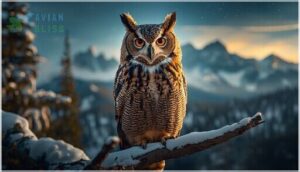
Spotting an owl in the wild starts with knowing what to look for. Colorado’s 14 species each leave behind their own set of clues — in the air, on the ground, and even in the sounds they make. Here’s what to pay attention to when you’re out in the field.
Visual Features and Plumage Patterns
Knowing what to look for transforms a frustrating search into a satisfying find. Colorado’s owls wear their identities on their feathers — if you know the code.
- Facial Disks and ear tufts (called plumicorns) vary sharply: Great Horned carry wide‑set tufts; Long‑eared sit narrower
- Plumage camouflage ranges from Barn Owls’ pale undersides to Spotted Owls’ mottled brown and white forest patterns
- Juvenile plumage appears softer and less defined than adult feathering
- Flammulated Owls use rust‑gray color morphs to vanish against conifer bark
Distinctive Calls and Vocalizations
Feathers tell part of the story — but owl vocalizations often seal the deal. Colorado’s species each carry a distinct acoustic fingerprint.
The Great Horned Owl‘s deep hoot pattern variation echoes through forests, while pairs perform mating duets, trading lower and higher notes.
Burrowing Owls use territorial rattles mimicking rattlesnakes.
Seasonal vocal shifts also help — Saw-whet toots intensify from January through May.
Flight Patterns and Silhouettes
Once you’ve locked in a call, watching how an owl moves through the air becomes your next best identification tool.
Wing Beat Rhythm varies sharply between species — Great Horned owls push through the dark with stiff, silent strokes, while Short-eared Owls tilt into erratic V‑shaped glides low over grasslands.
Silhouette Contrast, Hovering Mechanics above prairie towns, and each species’ Nocturnal Flight Glow all reinforce owl identification and characteristics without a sound.
Tracking Signs: Pellets, Feathers, and Nests
Even without a sighting, owls leave clues worth reading.
Great Horned Owl pellets — 7 to 10 cm long — reveal owl diet and hunting habits through trapped mouse bones and fur.
Barn Owl’s smooth blackish-grey pellets signal grassland roosts nearby. Pellet Morphology, Feather Coloration Patterns, and Nest Material Composition all reflect owl habitats and behavior, giving you a remarkably complete picture of which Colorado species passed through.
Owl Behaviors and Adaptations
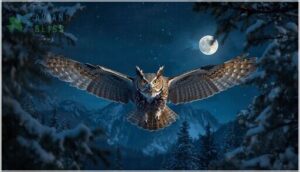
Owls don’t just look impressive — they’re built to survive in ways that might surprise you.
From hunt in near-total darkness to how they raise their young in Colorado’s unpredictable mountain weather, every behavior fulfills a purpose.
Nocturnal and Diurnal Hunting Strategies
Not every owl waits for darkness. Colorado’s owls split between nocturnal and diurnal hunters, each shaped by impressive physical tools.
Great Horned Owls rely on Silent Flight Mechanics and Prey Acoustic Localization — their vision outperforms yours by 100 times in low light. Meanwhile, Burrowing Owls use Daylight Perch Tactics, and Short-eared Owls exploit Dawn‑Dusk Flight Patterns through Ear Asymmetry Detection to pinpoint prey.
Breeding, Nesting, and Chick Rearing
Nest Site Selection varies widely across Colorado’s species — Great Horned Owls commandeer red‑tailed hawk nests 15 to 70 feet up, while Burrowing Owls settle into abandoned rodent burrows.
Egg Incubation Timing shifts too: Great Horned Owls pairs begin in January, Barn Owls stretch from March through November.
Parental Feeding Rates can reach 30 rodents nightly.
Chick Fledging Strategies and Seasonal Nest Reuse differ by species.
Physical Adaptations for Colorado’s Climate
Colorado’s climate demands a lot from its owls — and they’ve evolved some impressive tools to handle it. Feathered insulation and countercurrent heat exchange in the legs keep Great Horned Owls comfortable at -20°F. High-altitude lungs help Flammulated Owls thrive above 9,000 feet.
Colorado’s owls endure -20°F winters and 9,000-foot altitudes through feathered insulation and high-altitude lungs
A compact body shape minimizes heat loss, while thermoregulatory behavior — like panting and shade-seeking — prevents overheating in eastern prairies topping 100°F.
Communication and Territorial Displays
Owls don’t just hoot — they run a full communication system. Knowing owl sounds and communication helps with owl identification and calls in the field. Watch for:
- Duet Timing: Great Horned pairs trade calls at dawn and dusk
- Ear Tuft Signaling: raised tufts signal aggression; flattened means relaxed
- Alarm Rattles: Burrowing Owls chatter sharply at ground threats
- Visual Posture Displays: wing-spreading and head-bobbing deter rivals
- Seasonal Song Variation: Saw-whet males call persistently January through May
Conservation and Owl Watching Tips

Knowing where owls live is only part of the picture — knowing how to protect them matters just as much.
Colorado’s owl populations face real pressures, from habitat loss to human disturbance, and a few mindful choices can make a genuine difference.
Here’s what you need to know about conservation efforts and how to watch owls responsibly in the field.
Threatened and Endangered Owl Species
Several owl species in Colorado face serious pressure from habitat loss and climate impacts. Mexican spotted owl has held federal threatened status since 1993, while the burrowing owl and northern pygmy owl carry state threatened designations.
Population monitoring reveals troubling trends, and habitat fragmentation continues to strain recovery programs. Legal protections exist, but wildlife conservation depends on understanding what these owls actually need to survive.
Habitat Preservation and Restoration Efforts
Knowing which species are at risk is only half the battle — protecting their homes is where real conservation begins. Four active efforts are making a measurable difference:
- Prairie Dog Conservation maintains active colonies, which support burrowing owl reproduction at documented rates above 85%.
- Motus Tracking Programs follow flammulated owls across migration routes, pinpointing critical stopover habitat.
- Conservation Reserve Partnerships restore native grass seeding across converted shortgrass prairies.
- Controlled Burn Strategies clear dense understory, reopening ponderosa pine forests for nesting.
Best Practices for Ethical Owl Watching
Protecting habitat matters — but so does how you show up in the field.
Ethical owl watching starts with Viewing Distance: stay 12–20 meters back and let binoculars do the work. Noise Management and Light Control are equally important — whisper, ditch the flash, and use red‑filtered headlamps.
| Practice | Recommendation | Why It Matters |
|---|---|---|
| Viewing Distance | 12–20 meters minimum | Prevents stress behaviors |
| Playback Avoidance | Skip recorded calls | Disrupts hunting and nesting |
| Legal Compliance | Migratory Bird Treaty Act | Protects owl nesting habits |
Human impact on owls is real — your choices directly shape owl conservation outcomes.
Top Locations for Owl Watching in Colorado
Rocky Mountain National Park delivers year‑round sightings — flammulated owls return in late April, while boreal owls hunt high‑altitude meadows above 9,000 feet.
Pawnee National Grassland‘s prairie dog burrows attract burrowing owls all summer.
For nighttime reservoir edge views, Chatfield State Park‘s riparian trail spots are hard to beat.
Frequently Asked Questions (FAQs)
What is the most common owl in Colorado?
Small or large, rare or common, one owl dominates Colorado’s skies — Great Horned Owl. Its population density, urban adaptation, and broad prey preferences make it the most widespread owl species in Colorado.
What scares owls away at night?
Bright lights, loud noises, and reflective tape disrupt owls at night. Motion-activated floodlights, predator decoys, chimney screens, and bird feeder removal also deter them effectively from roosting near your property.
Can owls hear heartbeats?
It’s a popular myth, but owls can’t actually hear heartbeats. Their Frequency Detection Range starts around 200 Hz — far above the sub-1 Hz pulse of a mouse’s heart.
Prey Sound Cues like rustling win every time.
Is it good or bad to have an owl in your yard?
Having an owl in your yard is mostly a win — natural rodent control, zero chemicals.
Just expect noise disturbance at night, occasional pellet cleanup, and mind your pet safety if you have small animals outside.
What kind of owl is in Colorado?
Colorado hosts 14 owl species, from the tiny Flammulated Owl to the wide-ranging Great Horned Owl — each shaped by unique Altitude Range, Dietary Preferences, Migration Patterns, and Urban Adaptation across the state’s diverse ecosystems.
What is the most common owl in Colorado Springs?
Great Horned Owl is the most common owl species in Colorado Springs, thriving in urban parks and suburban woodlands year-round, where prey abundance and light-pollution impact supports consistent nocturnal hunting and stable nesting sites.
Why put an owl in your yard?
A single barn owl can take down thousands of rodents per season — natural pest control that beats traps, cuts chemical use, boosts biodiversity, and turns your yard into a living classroom with zero extra effort.
What type of owl box is suitable for Colorado?
Your best bet depends on the species. Barn owls need an 18×18-inch floor box, while cavity nesters like saw-whets do fine with an 8-inch square interior and a 3-inch entrance.
How can barn owls help control pests?
Barn owls are natural pest managers — a single pair can consume up to 6,000 rodents yearly, dramatically cutting rodenticide use and offering real agricultural benefits without chemicals harming surrounding habitat.
What owls commonly use nesting boxes in Colorado?
Think of nest boxes as ready-made real estate — and several Colorado owls don’t hesitate to move in.
Eastern Screech Owls, Great Horned Owls, Barn Owls, Flammulated Owls, and Northern Saw-whet Owls all readily use manmade nest boxes.
Conclusion
The more time you spend outside at dusk, the more Colorado’s owl community reveals itself—one silent wingbeat at a time. Each species you learn to identify becomes a thread connecting you to the broader web of ecosystems stretched across this state.
Owls in Colorado aren’t just wildlife to observe; they’re indicators of habitat health worth protecting. Bring patience, trust your ears as much as your eyes, and the landscape will keep surprising you.
- https://cpw.state.co.us/species/great-horned-owl
- https://www.nps.gov/articles/mexican-spotted-owl.htm
- https://avibirds.com/owls-in-colorado/
- https://wildbirdwarble.wordpress.com/2025/10/15/silent-shadows-the-secrets-of-colorados-owls/
- https://www.durangoherald.com/articles/rare-snowy-owl-spotted-at-lake-pueblo-state-park/