
This site is supported by our readers. We may earn a commission, at no cost to you, if you purchase through links.
 Along the rocky Pacific shores each winter, a black-bodied duck with a bill that looks like it was painted by an impressionist cuts through the surf with striking precision. The surf scoter earns its name honestly, riding ocean swells that would intimidate most waterfowl while diving repeatedly for mussels clinging to submerged rocks.
Males sport a distinctive white forehead patch and a multicolored bill—orange, white, and black—that makes identification straightforward even at a distance. Females wear more subdued brown plumage but share the same chunky build and diving prowess.
These sea ducks spend most of their lives in saltwater, breeding on remote northern lakes before returning to coastal waters where they gather in rafts of hundreds. Understanding their unique adaptations, seasonal movements, and conservation challenges reveals how specialized these diving ducks have become.
Table Of Contents
- Key Takeaways
- Surf Scoter Identification and Appearance
- Habitat and Geographic Range
- Diet and Foraging Behavior
- Breeding and Social Behavior
- Conservation Status and Threats
- Frequently Asked Questions (FAQs)
- What do surf scoters look like?
- When does a surf scoter become flightless?
- Where do surf scoters live?
- Where do surf scoters winter?
- Are Surf Scoters rare?
- Is a Surf Scoter a duck?
- What is the difference between a Surf Scoter and a Black Scoter?
- Where does a Surf Scoter live?
- How long do Surf Scoters live?
- What is the population trend of Surf Scoters?
- Conclusion
Key Takeaways
- Surf scoters are medium-sized sea ducks easily identified by the male’s velvety black plumage with white forehead and nape patches, plus a distinctive multicolored bill that makes them stand out even at a distance.
- These specialized diving ducks spend most of their lives in saltwater environments, consuming primarily marine invertebrates like mussels and clams through coordinated underwater hunts that can reach depths of 33 feet.
- The species breeds in remote boreal lakes across northern Canada and Alaska during summer, then migrates to both Pacific and Atlantic coasts where they gather in flocks of hundreds or thousands throughout winter months.
- Surf scoter populations have declined 50-70% over four decades due to habitat loss, coastal pollution, and climate change impacts, with urbanized estuaries like San Francisco Bay showing particularly steep drops in wintering numbers.
Surf Scoter Identification and Appearance
If you’re watching a flock of sea ducks bobbing in the waves, you’ll want to know what sets the Surf Scoter apart from the crowd.
These medium-sized diving ducks have some pretty distinctive features that make identification easier once you know what to look for.
Let’s break down the key characteristics that’ll help you confidently spot a Surf Scoter in the field.
Male Surf Scoter Features
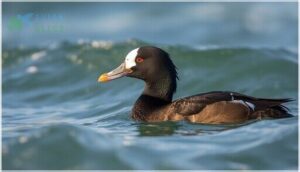
You’ll recognize a male Surf Scoter by its striking black body and bright white patches on the forehead and back of the neck—earning the nickname “skunkhead.” Adult males are hard to miss with their bold features:
- Velvety black plumage covering the entire body
- Multicolored bill displaying orange, white, and black patterns with a distinctive black spot at the base
- White forehead and nape patches unique among North American ducks
- Larger size than females, averaging 2.3 pounds with stocky build
They’re known for their silent demeanor.
Female and Juvenile Characteristics

Female Surf Scoters wear dark brown plumage with lighter underparts and two small white facial patches below and behind the eyes. Juveniles look similar but show paler tones and whitish bellies. You’ll notice females average 44 cm in length and weigh about 900 grams—smaller than males. This sexual dimorphism helps with identification. Juvenile molting begins late summer, darkening gradually through their first winter.
These birds are diving aquatic animals that feed on mollusks and crustaceans.
Bill Shape and Coloration
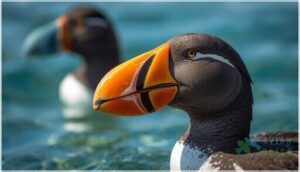
The Surf Scoter’s bill is your best identification feature beyond plumage. Males sport a striking orange bill with white, yellow, and black patches, measuring 3.5–4.0 cm long. Females have smaller, bluish-black bills. This sexual dimorphism reflects foraging adaptation—the bulbous, wedge-shaped bill crushes mussels and clams with considerable bite force.
- Males develop multicolored bill pigmentation after their first fall molt
- Bill morphology creates a blocky head profile unique among scoters
- Diagnostic features include the swollen upper mandible base in adult males
Plumage Patterns and Markings
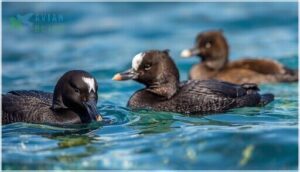
Beyond bill markings, plumage characteristics offer the quickest Scoter ID shortcuts. Male Surf Scoters display all-black feathering with two vivid white patches—one on the forehead, another on the nape. Female markings include two pale facial spots against deep brown plumage. Juvenile plumage resembles females but appears lighter brown. During molt variation from June to September, males temporarily lose head contrast, making identification trickier.
| Age/Sex | Key Plumage Characteristics |
|---|---|
| Adult Male | Velvety black with white forehead and nape patches |
| Adult Female | Chocolate-brown with two whitish facial spots |
| Juvenile | Pale brown, resembles female with diffuse facial markings |
| Molting Male | Patchy appearance, reduced head contrast (Jun–Sep) |
Size, Weight, and Body Structure
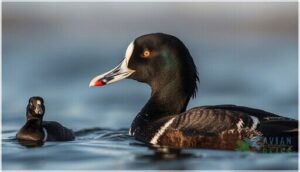
Size matters when you’re scanning winter flocks. Adult males measure 48 cm (19 inches) and weigh around 1,050 grams, while females average 44 cm and 900 grams—showing clear sexual dimorphism. Wingspan spans 76–77 cm for both sexes.
Their stocky body proportions, sturdy neck, and heavy bill create that chunky profile. Molting impact causes weight fluctuations, and morphometric variation helps researchers track populations across their range.
Habitat and Geographic Range

You’ll find Surf Scoters in different places depending on the time of year. During breeding season, they head north to remote lakes and wetlands, but come winter, they’re mostly coastal birds.
Let’s look at where these sea ducks spend their time throughout the year.
Breeding Grounds and Nesting Sites
You’ll find Surf Scoters breeding across Alaska and northern Canada’s boreal forests, where they build nests in secretive, well-hidden spots. These ducks show strong nest site fidelity, returning to the same areas year after year. Here’s what makes their breeding grounds unique:
- Nests tucked under dense vegetation, fallen logs, or low spruce branches
- Females lay 6-9 eggs in moss-lined cups near freshwater lakes
- Breeding range shifts northward as climate impacts intensify
- Nesting vegetation includes black spruce and Labrador tea
- Duckling mortality reaches 55-65% due to harsh weather
Wintering Areas on Coasts
During winter months, you’ll spot Surf Scoters concentrated along both North American coasts in shallow marine environments.
The Pacific Coast hosts around 225,000 birds from Alaska’s Aleutian Islands to Baja California, with major flocks in Puget Sound and San Francisco Bay.
Atlantic populations winter from Newfoundland to Virginia, favoring protected bays where coastal pollution and habitat degradation pose ongoing threats to these coastal wintering areas.
Migration Routes and Stopovers
During spring migration, you’ll notice most Surf Scoters travel one of two main routes: a southern inland path through staging areas like Puget Sound, or a northern coastal corridor hugging the Pacific shoreline.
Birds show striking route fidelity, returning to the same stopover sites yearly despite timing shifts.
Migration generally spans just six days, though coastal corridors and inland routes face increasing stopover threats from pollution and habitat loss.
Coastal Vs. Inland Habitats
You’ll find Surf Scoters split their year between two strikingly different worlds. During winter, they cluster in coastal areas and estuaries, where marine environments with salinity over 30 ppt and prey density exceeding 200 g/m² support massive flocks.
Come breeding season, they shift to freshwater lakes under 100 hectares in boreal forests, where habitat salinity drops below 1 ppt and breeding ecology centers on aquatic insects rather than mollusks.
Diet and Foraging Behavior
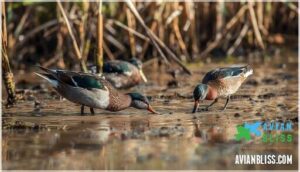
Surf Scoters are skilled underwater hunters that rely on a diet rich in shellfish and other marine animals. Their food preferences shift throughout the year, depending on what’s available in their coastal feeding grounds.
You’ll find them diving beneath the waves with a distinctive technique that sets them apart from other sea ducks.
Primary Food Sources
You’ll find Surf Scoters thriving on a diet dominated by marine invertebrates year-round. Winter bivalves, especially mussels, make up 67–86% of their food intake, while crustacean importance rises with seasonal amphipod blooms.
Gastropod selection peaks in spring when mussel stocks decline. Polychaete consumption doubles during certain periods, and herring dependence becomes critical during spawning events.
Their Surf Scoter diet and feeding habits shift strategically with prey availability.
Diving and Feeding Techniques
When you watch Surf Scoters foraging, you’ll notice their coordinated underwater hunts demonstrate impressive Dive Synchrony and Capture Efficiency. Their feeding strategy revolves around:
- Diving 23.5 seconds on average, reaching Depth Preferences under 33 feet
- Swallowing mollusks whole for later Prey Processing in muscular gizzards
- Performing 37.9 dives per hour during typical winter foraging
- Managing Energy Expenditure through strategic approach speeds of 0.90 m/s
Their diving technique uses partly-opened wings for propulsion.
Seasonal Diet Variations
You’ll notice dramatic shifts in what Surf Scoters eat throughout the year. Winter Bivalves dominate their diet at 86% in some areas, while Spring Roe from herring spawning events becomes their primary food source.
During Autumn Shift, they opportunistically target diverse shellfish along coastal staging areas.
Breeding Insects and freshwater invertebrates sustain them during nesting season, showcasing distinct Regional Variation in their feeding habits.
Breeding and Social Behavior
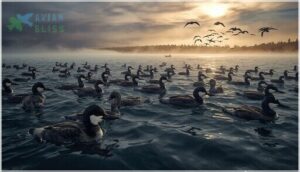
Surf Scoters follow a unique breeding pattern that starts long before they reach their nesting grounds. These sea ducks form pair bonds during winter on coastal waters, then migrate north to remote boreal lakes for nesting.
You’ll find them surprisingly social throughout the year, often gathering in large flocks that can number in the hundreds or even thousands.
Courtship and Pair Bonding
During courtship displays in coastal flocks, male Surf Scoters perform rapid swimming with exaggerated bowing, gurgling calls, and short display flights to attract females. These monogamous pair bonds generally form on wintering grounds before the breeding season begins, though the pair duration lasts only 2-3 weeks. You’ll notice group dynamics involve multiple males surrounding a single female, with courtship activities supporting reproductive synchrony across populations.
- Males stretch their necks upward and bow repeatedly during courtship
- Females respond with chin-lift displays and raspy crowing calls
- Pair bonds often reunite in successive breeding seasons
- Courtship occurs within large flocks numbering hundreds to thousands
- Males depart shortly after incubation begins, ending the bond
Nest Construction and Egg Laying
Once paired, females undertake nest construction solo, generally selecting sites under fallen branches or rocky ledges within 6–27 meters of water. Nests are built in mature boreal forest, lined with down feathers, moss, and spruce needles.
The typical clutch size ranges from 6–9 creamy white eggs, with the incubation period lasting 28–30 days under female-only care.
Duckling Care and Development
After eggs hatch in mid to late July, the ducklings emerge ready to swim and feed themselves. Female surf scoters provide parental guarding and warmth but don’t feed their young—ducklings dive for aquatic invertebrates independently from day one.
Growth rates are impressive, with chicks gaining up to 14 grams daily and reaching fledging dispersal around 55 days post-hatching, despite brood survival rates of just 35–45%.
Flocking and Social Interactions
Throughout the winter months, you’ll spot surf scoters in massive, gregarious assemblies—often hundreds strong—riding the waves together. These flocks follow precise interaction rules: they maintain short-range spacing, align with neighbors, and stay attracted to the group’s center.
Key elements of flock behavior include:
- Synchronized diving: Entire groups plunge underwater nearly simultaneously, resurfacing in tight formation
- Mixed flocks: Surf scoters commonly join black and white-winged scoters along coasts
- Group flexibility: Flocks adjust direction and spacing based on currents and threats
Flock synchrony strengthens with size, while social cues—mostly visual, not vocal—keep everyone moving as one coordinated unit.
Conservation Status and Threats

The Surf Scoter faces several challenges that have caused its numbers to decline over the past several decades. Scientists estimate the global population sits somewhere between 600,000 and 1 million birds, but tracking these sea ducks accurately is difficult given their remote breeding grounds and vast coastal range.
You’ll want to understand the main threats affecting these birds and what’s being done to protect them.
Population Trends and Estimates
The Surf Scoter’s global population remains uncertain, with estimates ranging between 250,000 and 1.3 million individuals. Regional variations in population trends are evident—eastern breeding populations show some stability since 1990, while western groups face steeper declines.
Conservation status assessments suggest a troubling 50–70% population decline over four decades. Harvest impacts and survival rates help scientists understand these downward trends and shape future outlook for recovery efforts.
Habitat Loss and Pollution
You’ll find the greatest threats to Surf Scoters in urbanized estuaries, where habitat loss and pollution intersect. Estuary degradation has driven a 90% decline in San Francisco Bay’s wintering numbers since 1987.
Oil spill effects, heavy metal contamination, and food web decline all compound to weaken reproductive impacts. When contaminants accumulate in mussels and clams, scoters face diminished body condition and breeding success in the marine environment—challenges that conservation efforts must address.
Climate Change Impacts
Climate change threatens Surf Scoters through habitat alteration across their entire range. Breeding grounds are projected to lose 25–40% of viable wetlands by 2050 as permafrost thaws.
Climate change will strip away up to 40% of Surf Scoter breeding wetlands by 2050 as Arctic permafrost melts
Migration shifts now occur 6 days earlier per decade, while winter changes include 1.5°C warmer coastal waters, reducing mussel abundance by 10–30%.
Nutritional stress from these climate change threats has driven population outcomes, showing a projected 26% decline by 2050.
Conservation Efforts and Protection
You can help Surf Scoters through conservation programs working coast to coast. Habitat Protection covers 60,000+ hectares of breeding wetlands, while Pollution Reduction laws secure 2,350 miles of coastal buffers.
International Agreements, like Migratory Bird Treaties, unite the U.S., Canada, and Russia in protection efforts. Research Programs track populations, and Restoration Initiatives improve prey zones.
These combined conservation efforts for seabirds address Climate Change Threats despite the species’ unlisted IUCN Red List and Conservation Status.
Frequently Asked Questions (FAQs)
What do surf scoters look like?
You’ll spot male Surf Scoters by their velvety black plumage with white forehead and nape patches, plus a multicolored orange bill.
Females show brown feathers with subtle white cheek markings and darker bills.
When does a surf scoter become flightless?
When do these sea ducks lose flight ability? During molt, surf scoters become flightless for about four weeks, usually from late July through mid-August, as they shed and regrow their flight feathers simultaneously.
Where do surf scoters live?
You’ll find these ducks wintering along both Pacific and Atlantic coastal areas, from Alaska to Baja California and Newfoundland to Virginia.
During breeding season, they prefer remote boreal forests and freshwater wetlands across northern Canada and Alaska.
Where do surf scoters winter?
During winter, you’ll find these ducks along both Pacific and Atlantic coasts, from Alaska to Baja California and Nova Scotia to the Gulf of Mexico, showing strong habitat fidelity to shallow bays and estuaries.
Are Surf Scoters rare?
Globally, you’ll find them classified as “Least Concern” with population estimates around 470,000 to 1 million.
However, regional declines from habitat loss and pollution impact reveal concerning vulnerability in areas like Puget Sound.
Is a Surf Scoter a duck?
Yes, the Surf Scoter is a duck. It belongs to the Anatidae family within the Anseriformes order, grouping it with other waterfowl.
This sea duck is specifically classified among diving ducks.
What is the difference between a Surf Scoter and a Black Scoter?
The devil’s in the details when comparing similar species. Black Scoters have a yellow knob on their bill, while Surf Scoters sport white head patches.
Males of both sea duck species show striking plumage differences.
Where does a Surf Scoter live?
You’ll find Surf Scoters in coastal waters during winter and boreal lakes for breeding.
They migrate along Pacific and Atlantic coasts, showing strong site fidelity to specific wintering areas like Chesapeake Bay and shallow estuaries.
How long do Surf Scoters live?
Like a seabird marathon runner, the average lifespan of Surf Scoters reaches around 5 years in the wild, though some notable individuals have survived over 20 years—with one recorded at 22 years old.
What is the population trend of Surf Scoters?
Population estimates suggest Surf Scoter numbers range from 600,000 to 1 million birds. However, conservation status reveals concerning population decline causes, particularly in the Pacific Flyway.
Juvenile recruitment rates have dropped sharply, signaling future population projections warrant close monitoring.
Conclusion
You might think identifying sea ducks requires expert-level birding skills, but the surf scoter makes it surprisingly simple. That bold bill pattern and chunky silhouette cut through any confusion, even when waves obscure your view.
Whether you’re scanning winter coastlines or tracking migration patterns, recognizing these specialized divers connects you to oceanic ecosystems most waterfowl never touch. Their story reminds us that adaptation isn’t about thriving everywhere—it’s about mastering one challenging niche completely.
- https://www.allaboutbirds.org/guide/Surf_Scoter/lifehistory
- https://www.ducks.org/hunting/waterfowl-id/surf-scoter
- https://science.ebird.org/status-and-trends/species/sursco/trends-map
- https://en.wikipedia.org/wiki/Surf_scoter
- https://www.fws.gov/story/2025-03/labrador-new-jersey-journey-22-year-old-surf-scoter