This site is supported by our readers. We may earn a commission, at no cost to you, if you purchase through links.
Few birds divide opinion quite like the brown-headed cowbird. Farmers have watched it follow their cattle for generations, picking off insects stirred up by hooves—a practical partnership that’s shaped where this bird lives and how far it’s spread.
What started as a Great Plains species tied to bison herds now ranges across most of North America, its fortunes rising alongside agriculture and land development.
That expansion comes with consequences, particularly for the songbirds forced to share territory with one of nature’s most committed brood parasites. Understanding what drives this bird—its appearance, movement, diet, and breeding strategy—tells you a lot about how wildlife adjusts to a changing landscape.
Table Of Contents
- Key Takeaways
- Brown-Headed Cowbird Identification
- Habitat and Geographic Range
- Diet and Foraging Behavior
- Breeding Habits and Brood Parasitism
- Conservation Status and Ecological Impact
- Frequently Asked Questions (FAQs)
- What is the difference between a Brown-headed Cowbird and a grackle?
- Are there Brown-headed Cowbirds in Florida?
- Are Brown-headed Cowbirds good?
- Why is the Brown-headed Cowbird considered a parasite?
- Why are Brown-headed Cowbirds a threat?
- Should I remove Brown-headed Cowbird eggs?
- How do cowbirds interact with their biological offspring?
- What is the cowbirds call and song like?
- When do cowbirds typically migrate and return?
- How many eggs can a female cowbird lay?
- Conclusion
Key Takeaways
- The brown-headed cowbird expanded from the Great Plains across all of North America by following cattle and human land development, replacing its original dependence on bison herds.
- It never raises its own young, instead, laying 30–40 eggs per season in other birds’ nests, with host species accepting those eggs roughly 90% of the time.
- Its impact on songbirds is measurable and serious — parasitized nests produce about one-third the fledglings of healthy ones, with some species like Kirtland’s Warbler once seeing parasitism rates above 70%.
- Targeted management works: trapping programs at Fort Hood reduced parasitism from 90% to 10% in just three years, and Kirtland’s Warbler singing males grew from 200 to over 2,200.
Brown-Headed Cowbird Identification
Spotting a Brown-headed Cowbird gets easier once you know what to look for.
The male’s glossy black body and rich brown head make it unmistakable, and understanding brown bird symbolism and spiritual meaning adds a fascinating layer to every sighting.
Males and females look quite different from each other, and even juveniles have their own distinct appearance.
Here’s what to pay attention to when you’re trying to make a confident ID.
Male and Female Physical Differences
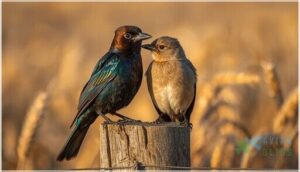
Males and females look strikingly different once you know what to watch for. The male carries glossy black plumage with subtle brown head coloring and a short stout bill that looks darker than the female’s paler version. Eye contrast is sharper on males too — pale eyes against a chocolate head.
Females show unmarked brown tones, a pale throat, and size dimorphism is modest but real, with males noticeably stockier.
Wing iridescence and tail shape clinch the ID. They’re commonly found in agricultural areas.
Juvenile Appearance and Size
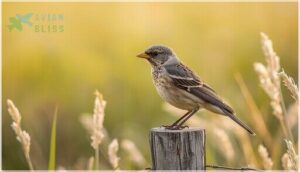
Juveniles don’t look anything like their parents at first. You’ll notice dull grayish-brown plumage overall, with pale buff edgings on back feathers creating a scaly wing feather pattern. Fine streaking runs across the breast.
Their bill development starts pale yellow — short and stout from day one. At fledging, body measurements already rival a European Starling: 16–20 cm long, 38–45 grams.
The juvenile’s pale fringing on back feathers aids identification.
Distinctive Colors and Bill Shape
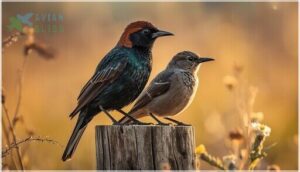
Once you move past size, color tells the real story. Adult males wear that signature black body dark brown head combo — look closely and you’ll catch glossy dark blue highlights rippling across their iridescent body plumage.
Females lean into female gray camouflage with a pale throat. Both sexes share the same short finchlike bill with noticeable bill curvature function:
- Warm brown head sheen on males
- Purple-green iridescent body plumage shifting with light
- Dull gray camouflage on females
- Pale throat contrasting soft streaked breast
- Stout conical bill with a finchlike head profile
How to Differentiate From Similar Species
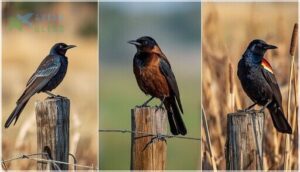
Color and bill shape get you close, but Brown-headed Cowbird identification really clicks when you compare it against similar species side by side.
| Feature | Brown-headed Cowbird | Look-alike Species |
|---|---|---|
| Bill shape cues | Short, thick, conical | Grackle: long, straight |
| Tail length contrast | Short, even tail | Grackle: long, keel-shaped |
| Habitat microhabitat | Dry pastures, livestock fields | Red-wing: marshes, wet reeds |
| Vocal signature | Liquid, gurgling song | Starling: sharp whistles |
| Geographic range clues | Widespread inland North America | Shiny Cowbird: coastal/Caribbean only |
Habitat and Geographic Range
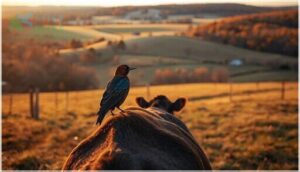
The brown-headed cowbird turns up in a surprising range of places across North America, and understanding where it lives helps explain a lot about how it behaves.
Its wide range overlaps with countless bird species, and wild bird nutrition needs by season shift dramatically as spring insects become essential for nesting success.
Its range has shifted considerably over time, shaped by farming, livestock, and human development. Here’s a closer look at where cowbirds actually live and how their territory has changed.
Distribution Across North America
The Historical Range Expansion of the Brown-headed Cowbird is a textbook case of a species following human footprints. Originally native to North America’s Temperate grasslands and Great Plains, it now spans the entire United States and southern Canada.
Three Population Density Peaks stand out:
- Central North Dakota — 93 birds per BBS route
- South Dakota — 52 birds per route
- Minnesota — 20 birds per route
Wintering Roosts in Texas and Louisiana can exceed one million birds, while Regional Migration Timing usually begins late September. An Elevational Range Shift also pushed birds into the Sierra Nevada after 1930, expanding their reach across middle North America considerably.
Preferred Habitats and Landscapes
Across its range, the brown-headed cowbird thrives wherever open ground meets scattered cover.
Open grasslands with short grass vegetation draw the largest flocks — birds forage easily where temperate grasslands stay low and visibility stays clear.
Forest edges, riparian groves, shrubby thickets, brushy thickets, and even arid deserts all serve as regular haunts, as do pastures and weedy fields.
| Habitat | Key Feature | Cowbird Use |
|---|---|---|
| Open grasslands | Short grass, seeds | Primary foraging |
| Forest edges | Snags, canopy gaps | Singing, parasitism |
| Riparian groves | Stream-side trees | Roosting, nest access |
| Shrubby thickets | Dense low shrubs | Nest parasitism |
| Arid deserts | Arroyos, sparse brush | Seasonal foraging |
Relationship With Livestock and Human Activity
Follow a cowbird long enough, and it’ll lead you straight to cattle. Nearly all observed feeding — about 98 percent — happens where livestock are actively grazing, flushing insects from the grass.
This cattle foraging relationship shaped the bird’s entire range expansion. Before European settlers arrived, bison filled that role. Human‑induced expansion via ranching, feedlot congregations, and cleared grasslands replaced those herds, spreading cowbirds coast to coast.
Seasonal Movements and Migration Patterns
Not every cowbird makes the same journey. Spring arrival timing varies — northern breeders return around March or April, while Illinois birds appear as early as February. Migration distance variability is real too, with some birds covering 700 km in under a month.
- Fall flock composition includes red-winged blackbirds and bobolinks
- Roosting site selection favors southern farmland and feedlots
- Stopover habitat use spans prairies and brushy edges
- Winter concentrations exceed one million birds at single sites
Diet and Foraging Behavior
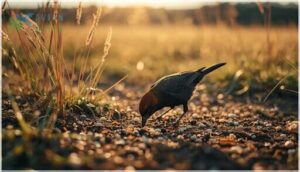
The brown-headed cowbird is an opportunistic feeder, and its diet shifts with the seasons and whatever’s available nearby. What it eats — and how it finds food — tells you a lot about why this bird thrives in so many environments.
Here’s a closer look at the key parts of its foraging life.
Primary Foods: Seeds, Grains, and Insects
Seeds, grains, and insects form the backbone of the brown-headed cowbird’s diet.
Plant matter — mainly grasses, weed seeds, and waste grains — makes up about 75 percent of what they eat annually, with winter seed dominance pushing that share even higher.
Their grain preference types include milo, millet, and cracked corn.
Livestock-driven foraging helps them catch grasshoppers, beetles, and caterpillars flushed by grazing animals.
Seasonal Changes in Diet
Winter seed reliance keeps cowbirds fueled on waste grain and weed seeds — over 90% plant matter when temperatures drop.
Protein boost drives a surge toward insects, beetles, and caterpillars in spring.
Laying females take this further, consuming 95% insects plus calcium shell consumption from snail shells.
Post-breeding, seeds reclaim the dominant role.
Foraging Techniques and Social Feeding Habits
insects replace seeds in spring, cowbirds shift tactics too. Ground pecking through short grass and bare soil is their baseline — steady walking, never hopping, bill probing for beetles and leafhoppers.
Livestock following kicks in near pastures, where hooves flush prey within easy reach.
Mixed-species flocks form afternoons, joining grackles and starlings, which cuts individual predator watch time and improves access to scattered food patches.
Breeding Habits and Brood Parasitism

The brown-headed cowbird has one of the most unusual breeding strategies in North American bird life — it never raises its own young. Instead, it lays eggs in other birds’ nests and lets them do all the work.
The brown-headed cowbird never raises its own young, laying eggs in other birds’ nests and letting them do all the work
Here’s what that actually looks like and why it matters.
Brood Parasitism Explained
Unlike most birds that raise their own young, the brown-headed cowbird practices brood parasitism — laying eggs in other birds’ nests and leaving foster parents to do the work. Here’s what makes this strategy so effective:
- Eggs hatch in just 10–11 days, outpacing most hosts
- Early sex ratio shifts across the season
- Parasitic timing aligns precisely with peak songbird nesting
Host defense strategies like egg recognition are the primary counter to this avian brood parasitism, shaping cowbird ecology and its impact on host fitness over generations.
Host Species Selection and Impact
The cowbird doesn’t parasitize randomly — it scouts carefully.
Females observe up to 220 species but regularly target 30 to 40, favoring open-cup nesters like song sparrows and yellow warblers at low nest heights.
Nest Height Preference matters: nests under 3 meters get hit hardest.
Host Defense Strategies vary widely — some species eject eggs, but around 90 percent simply accept them, intensifying Parasitism Pressure and creating notable Regional Host Variability.
Effects on Host Nestlings and Populations
once the cowbird egg hatches — usually a day ahead of the host chicks — the size advantage kicks in fast. Growth Rate Disparity and Food Competition work together against the host nestlings, who lose more feedings to the larger, louder intruder.
Nest Survival Rates drop noticeably in parasitized nests.
Still, some species offset losses through Renesting Strategies. Population Decline Trends persist across heavily affected host species.
Conservation Status and Ecological Impact

The brown-headed cowbird sits at a complicated crossroads between wildlife law, ecological damage, and ongoing scientific debate. Its widespread success as a brood parasite has created real problems for dozens of songbird species, including some already fighting for survival.
Here’s what you need to know about how it’s managed, what it’s affecting, and where conservation efforts stand today.
Legal Protections and Management
The Migratory Bird Treaty Act of 1918 gives brown‑headed cowbirds full federal protection — meaning you can’t touch their eggs or nests without a special permit. Still, management options exist:
- Depredation Order (50 CFR 21.150) permits lethal control for crop damage
- Trapping Permits support state conservation of vulnerable species
- State Management Plans guide regional programs like California’s vireo protections
- Nonlethal Control methods must precede lethal action annually
- Daily trap checks with food, water, and shade are required
Impact on Songbird and Endangered Species
Brood parasitism in birds hits hardest where habitat is already fragmented.
The impact of cowbirds on host species goes beyond individual nests — Kirtland’s Warbler once saw over 70% parasitism rate, driving sharp bird species decline.
Community Homogenization follows, as tolerant generalists replace specialists.
Seed Dispersal Disruption and Predator‑Prey Shifts reshape whole ecosystems, making conservation of endangered bird species and Population Decline reversal central to any Recovery Strategies.
Conservation Programs and Research
Real progress in bird conservation efforts has come from combining targeted action with solid science. Trapping Effectiveness programs prove it — Fort Hood cut parasitism from 90% to 10% in three years.
Here’s what’s driving avian conservation efforts forward:
- Funding Mechanisms shifted for Kirtland’s Warbler recovery, growing singing males from 200 to 2,200.
- Population Modeling tracks density-dependent survival rates.
- Community Science and Policy Compliance empower private landowners to act.
Future Challenges and Climate Change
Climate change is quietly reshaping the playing field for cowbirds — and not in songbirds’ favor. Warmer winters are fueling Range Expansion, while Urban Refuges like feeders and lawns keep cowbird populations strong.
Phenology Shifts and Host Mismatch throw off nesting timing, and Habitat Fragmentation opens more forest edges to parasitism.
These climate threats are among the most complex bird conservation challenges researchers face today.
Frequently Asked Questions (FAQs)
What is the difference between a Brown-headed Cowbird and a grackle?
Grackles are lankier, with iridescent plumage and bright yellow eyes.
Cowbirds are stockier, with a plain brown head and shorter bill.
Size contrast and plumage iridescence make these Icteridae family members easy to tell apart.
Are there Brown-headed Cowbirds in Florida?
Florida might seem too warm and lush for them, but Brown-headed Cowbirds thrive there year-round. Range expansion has pushed them south steadily, with seasonal abundance peaking statewide each winter.
Are Brown-headed Cowbirds good?
It depends on your perspective.
They offer real ecosystem services like seed dispersal and pest control, but brood parasitism trade-offs make management ethics complicated — especially for vulnerable songbirds already stressed by human activity.
Why is the Brown-headed Cowbird considered a parasite?
It’s called a parasite because it never raises its own young.
Through brood parasitism, it lays eggs in other birds’ nests, forcing host species to bear the full parasitic fitness cost of raising its chicks.
Why are Brown-headed Cowbirds a threat?
Brood parasitism in birds disrupts entire communities.
Through host egg damage, food monopolization, and nestling displacement, parasitized nests produce roughly one-third the fledglings of healthy ones — triggering community shifts and broader ecosystem disruption.
Should I remove Brown-headed Cowbird eggs?
Tempting as it is, don’t touch those eggs.
Removal risks legal penalties, nest desertion, and even mafia retaliation from the cowbird. Permit-only management exists for a reason — leave intervention to licensed professionals.
How do cowbirds interact with their biological offspring?
Adult cowbirds don’t raise their young at all.
Through brood parasitism, egg placement strategy and host nest monitoring replace direct care — leaving host parents to do the work while fledglings eventually find their own kind.
What is the cowbirds call and song like?
The typical cowbird song is a short gurgling song that flips into a high whistle.
You’ll also hear a contact chip, flight chatter, and chatter call — seasonal vocality peaks each spring.
When do cowbirds typically migrate and return?
As snow melts and insects stir, spring arrival begins in late February.
Fall departure peaks in September.
Regional timing, age‑specific movement, and weather cues all shape these bird migration patterns across the breeding season.
How many eggs can a female cowbird lay?
A female cowbird can lay 30 to 40 eggs per breeding season, depositing one egg per nest.
Daily laying rate averages about one egg, with clutch size variation and host nest availability limiting total fecundity.
Conclusion
brown-headed cowbird is less a villain than a mirror—reflecting how quickly wildlife rewrites its own rules when landscapes shift. Its spread tracks human change almost step for step, and its impact on host species is real and measurable.
Understanding this bird means seeing the full picture: an opportunist shaped by circumstance, not malice.
The more you know about what drives it, the better you are to support the songbirds sharing its range.
- https://www.audubon.org/field-guide/bird/brown-headed-cowbird
- https://fieldguide.mt.gov/speciesDetail.aspx?elcode=ABPBXB7030
- https://celebrateurbanbirds.org/learn/birds/focal-species/brown-headed-cowbird/
- https://wildlife.ca.gov/Conservation/Invasives/Species/Cowbird
- https://www.allaboutbirds.org/guide/Brown-headed_Cowbird/lifehistory