This site is supported by our readers. We may earn a commission, at no cost to you, if you purchase through links.
 Most people picture cockatiels perched happily in living room cages, but these charming birds didn’t start their journey in pet stores. They evolved in the vast, unpredictable interior of Australia, where survival means following the rain across thousands of miles of arid landscape.
Unlike many parrot species that claim specific forests or coastal territories, wild cockatiels are nomads at heart, drifting across mainland Australia in search of seasonal water and seed-rich grasslands. Their natural habitat spans from northern tropical zones to southern temperate regions, always inland, always moving.
Understanding where cockatiels live in the wild reveals striking adaptations that helped them thrive in one of Earth’s harshest environments—adaptations that still influence the quirky behaviors you’ll notice in captive birds today.
Table Of Contents
- Key Takeaways
- Where Do Cockatiels Live in The Wild?
- Habitat Preferences of Wild Cockatiels
- Importance of Water Sources in Cockatiel Habitats
- Cockatiel Diet and Foraging in The Wild
- Nesting and Shelter in Natural Habitats
- Social and Nomadic Behavior in The Wild
- Challenges and Conservation of Wild Cockatiels
- Frequently Asked Questions (FAQs)
- Where do cockatiel live in Australia?
- What habitat do cockatiels need?
- What do we know about cockatiels?
- Are cockatiels native to North America?
- Are wild cockatiels friendly?
- What are the predators of cockatiels in the wild?
- Are there still cockatiels in the wild?
- What is the native environment of a cockatiel?
- What is the diet of wild cockatiels?
- How do wild cockatiels communicate?
- Conclusion
Key Takeaways
- Wild cockatiels are nomadic birds that roam across mainland Australia’s arid and semi-arid interior regions, constantly following seasonal rainfall and seed-rich grasslands rather than claiming fixed territories like other parrot species.
- These resilient birds have adapted to survive in harsh environments by staying within 500 meters of permanent water sources, breeding opportunistically within days of rainfall events, and traveling hundreds of kilometers in flocks ranging from small groups to gatherings of over 500 birds.
- Cockatiels thrive in open eucalyptus woodlands and grasslands where scattered trees provide essential nesting cavities one to two meters high while maintaining the clear sightlines they need for predator detection during ground foraging.
- Their diet consists primarily of native grass seeds and grains from over 29 plant species, though they’ve increasingly adapted to exploit agricultural crops like sorghum, which now comprises up to 60% of their food intake in farming areas.
Where Do Cockatiels Live in The Wild?
If you’ve ever wondered where your feathered friend originally came from, you’re in for a fascinating journey across the Australian continent. Wild cockatiels call a surprisingly specific range of regions home, shaped by their need for food, water, and shelter.
Let’s explore the natural territories these charming birds occupy and why certain areas of Australia suit them better than others.
Native Range Across Australia
Across the vast Australian mainland, cockatiels carve out their natural range and distribution in a way that showcases impressive adaptability to climate variance. You’ll find these resilient birds thriving across multiple Australian regions, though their native habitat reveals distinct geographic boundaries shaped by resource availability.
Key aspects of their native territories include:
- They inhabit all mainland states and territories—Queensland, New South Wales, Northern Territory, South Australia, Victoria, and Western Australia—creating a continental presence
- Tasmania remains outside their natural range, with any sightings typically traced to escaped aviary birds rather than wild populations
- Inland areas dominate their distribution, as cockatiels favor the interior over coastal fringes where conditions differ dramatically
- Regional migration patterns shift with seasonal rainfall, driving these nomadic flocks to follow water and food sources across state lines
- Their native habitat spans diverse Australian regions, from northern tropical zones to southern temperate areas, demonstrating exceptional tolerance to climate variance
- Understanding their social nature habits is essential for appreciating their adaptability and behavior in the wild.
Preferred Regions and Exclusions
While wild cockatiels roam Australia‘s open woodlands and grasslands across most mainland areas, their spatial distribution reveals notable habitat exclusions. You won’t encounter them in Australia’s fertile southwest and southeast corners, the deepest Western Australian deserts, or Cape York Peninsula—geographic barriers and climate tolerance limits shape these boundaries.
Regional variations concentrate populations inland near freshwater sources, with southwestern regions and the Great Dividing Range’s western edge hosting the densest flocks. The cockatiels’ main diet consists of seeds from various wild seed types, which play a vital role in their survival.
Occasional Presence in Tasmania
Unlike mainland Australia, Tasmania rarely hosts wild cockatiels—fewer than 10 sightings over the last decade, primarily aviary escapees rather than native populations. You’ll find most Tasmanian sightings near urban centers during summer months, not in preferred eucalyptus woodland habitat.
Biosecurity assessments confirm negligible feral establishment risk, as the Bass Strait prevents natural colonization and no confirmed breeding populations exist despite occasional escape patterns from captive birds.
Habitat Preferences of Wild Cockatiels
Wild cockatiels aren’t picky about where they set up camp, but they do have clear preferences regarding their surroundings. These birds gravitate toward specific types of landscapes that offer the right balance of food, shelter, and open space for their nomadic lifestyle.
Let’s look at the main habitat types you’ll find them calling home across the Australian interior.
Arid and Semi-Arid Environments
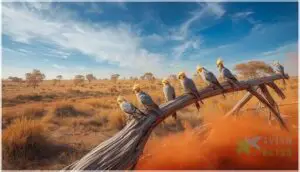
You’ll find wild cockatiels thriving across Australia’s arid and semi-arid ecosystems, where desert adaptations help them survive harsh conditions. These regions span roughly 6.2 million km², encompassing open shrublands and grasslands with scattered eucalyptus trees.
Cockatiels avoid actual desert cores but flourish in dry climate effects zones, where their nomadic lifestyle and water conservation strategies let them exploit arid landscapes’ unpredictable resources efficiently.
Eucalyptus Woodlands and Savannas
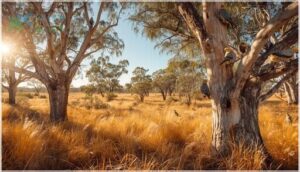
These open woodlands dominate roughly 66% of Australia’s non-mallee eucalyptus forests, creating ideal cockatiel territory where tree hollows provide essential nesting cavities.
You’ll spot flocks in medium-height woodland mosaics interspersed with savannas, where eucalyptus trees offer seeds and foliage while bordering grasslands supply diverse grains.
This woodland structure balances shelter with the clear sightlines cockatiels need for predator detection.
Open Grasslands and Non-Dense Woodlands
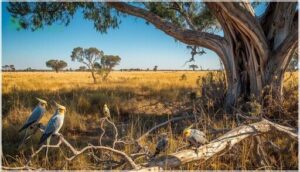
You’ll discover cockatiels thriving across Australia’s sprawling grasslands and open woodlands, where scattered eucalyptus trees punctuate the landscape without obscuring their critical sightlines. Habitat fragmentation increasingly affects these areas, though Grassland Ecology and Woodland Biodiversity remain healthy in inland regions.
- Temperature extremes range from 4.5°C to 43°C
- Acacia shrubs provide essential Seed Dispersal opportunities
- Tree hollows one to two meters high serve nesting needs
- Clear visibility facilitates predator detection during foraging
- Avian Migration patterns follow seasonal water and food availability
Scrublands and Farmlands
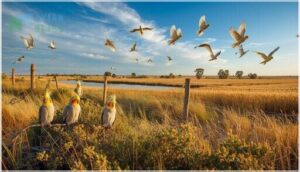
Across Australia’s scrublands, you’ll spot cockatiel flocks where acacia-dominated Scrubland Ecology blends with agricultural landscapes. Farmland Adaptation is striking—these birds exploit cereal crops during harvest, with foraging activity spiking thirty percent when seeds mature.
Nomadic Patterns shift populations between natural habitat and farmlands, driven by Water Sources and seasonal resources.
Despite Habitat Fragmentation from land clearing, cockatiels thrive in this mosaic of open woodlands, grasslands, and cultivated zones.
Importance of Water Sources in Cockatiel Habitats

Water isn’t just a convenience for wild cockatiels—it’s the lifeline that shapes where they settle and how far they roam. These nomadic birds have developed impressive strategies to survive Australia’s unpredictable climate, from seeking out permanent water bodies to adapting their movements with the seasons.
Let’s explore how access to water influences every aspect of their habitat selection.
Proximity to Rivers and Lakes
You’ll find wild cockatiels rarely venture far from water in Australia’s interior. Field observations show that over 85% of sightings occur within 500 meters of permanent or seasonal water sources like rivers and lakes.
These riverine habitats and riparian zones aren’t just convenient—they’re essential. Cockatiels depend on water proximity for daily hydration, with flocks congregating in aquatic ecosystems where hydrological cycles support both drinking needs and richer foraging opportunities.
Adaptations to Variable Rainfall
Australia’s arid regions have shaped exceptional Climate Resilience in cockatiels, who thrive despite unpredictable Rainfall Patterns. These birds maintain reproductive readiness year-round, allowing breeding within days of rain when Seed Germination surges.
Wild cockatiels thrive in Australia’s harsh deserts by breeding within days of rainfall, staying reproductively ready year-round
Their Water Conservation tactics include seeking moisture-rich foods and traveling vast distances as nomadic flocks. This adaptability ensures survival in harsh habitat conditions, though conservation efforts remain essential as climate variability intensifies across their range.
Seasonal Water Availability
When spring rains sweep across Australia, you’ll see wild cockatiel populations surge as water availability triggers breeding activity. Large rainfall events create riparian zones where flocks of 100–1,000 birds gather, nesting 1–2 meters high in eucalyptus cavities near water sources.
During drought impacts, these nomadic birds relocate to recently watered regions, tracking rainfall patterns and water tables to survive Australia’s unpredictable conditions.
Cockatiel Diet and Foraging in The Wild
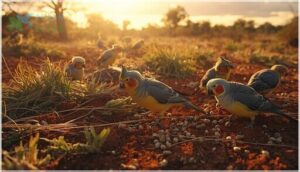
Wild cockatiels aren’t picky eaters, but they do have favorite foods that help them thrive in Australia’s tough environments. Their diet changes with the seasons and availability, from seeds and grasses to unexpected protein sources.
Let’s look at what these resourceful birds actually eat when they’re out foraging on their own.
Native Seeds and Grasses
Seed Preferences vary widely in your cockatiel’s natural habitat, where these birds forage across open grasslands and eucalyptus woodlands. Wild Grain from native grasses dominates their diet, with research documenting consumption from over 29 plant types.
Consider what sustains them:
- Grass seeds, particularly from Phalaris and Setaria species, provide essential nutrition
- Sorghum seeds sometimes comprise nearly 60% of crop contents
- Acacia seeds attract higher densities in inland Australia
This Native Forage reflects discerning Seed Nutrition selection, as cockatiels choose seeds containing 8.8% to 14% crude protein for peak health.
Foliage, Fruits, and Berries
Beyond grain alone, wild foraging includes foliage, fruits, and berries that round out your cockatiel’s nutritional needs. Leaf consumption from eucalyptus trees and seed-bearing plants climbs to 12% of their intake during scarcity.
Berry benefits and fruit nutrition peak seasonally, with fruits reaching 20-25% of crop contents in winter. This wild foraging flexibility—balancing seed supplements with fresh vegetation—sustains cockatiels through Australia’s unpredictable climate.
Insects and Invertebrates
When plant-based foods run thin, your wild cockatiels turn to protein sources that might surprise you—insects and invertebrates become strategic food sources in their diet. Insect nutrition provides essential fat and protein, especially during breeding when parents need extra fuel.
This dietary variety shows impressive wild foraging skills:
- Mealworms and beetles make up less than 5% of total intake by mass
- Ground-dwelling invertebrates are consumed during seed scarcity periods
- Seasonal protein boosts occur when reproductive demands climb, with the invertebrate role becoming more pronounced
Impact of Human Activity on Diet
Agricultural fields have reshaped what wild cockatiels eat—and not just a little. Human influence drives dramatic dietary shifts, with sorghum now filling 60% of crop contents in farming districts.
Your wild cockatiels abandon native grasses for immature grains, causing crop damage that prompts farmers to plant sacrificial strips.
This food adaptation highlights how habitat loss and agricultural impact force conservation efforts to balance cockatiel needs with farming realities.
Nesting and Shelter in Natural Habitats
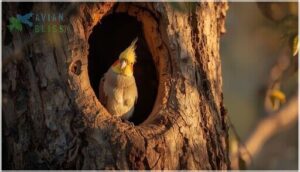
Wild cockatiels don’t build elaborate nests like some other bird species—they’re much more practical about it. Instead, they seek out natural tree cavities that offer protection from predators and Australia’s harsh weather conditions.
Let’s look at how these birds choose their nesting sites and what makes a good shelter in their natural habitat.
Tree Cavity Nesting Preferences
When choosing nesting sites, wild cockatiels in Australia show clear preferences. You’ll find their habitat almost exclusively in natural tree cavities, particularly within dead or dying eucalyptus trees.
These secondary cavity nesters claim entire trees as territory, not tolerating other pairs nearby during breeding seasons.
Only about 19% of available cavities meet their strict requirements for cavity size, dryness, and flood protection.
Nesting Material and Site Selection
Unlike most birds, you’ll notice cockatiels don’t weave elaborate nests during breeding season. They rely on natural wood dust found at the cavity floor, usually 1 to 2 meters high in dead eucalyptus trees. Both parents maintain this simple substrate, which cushions eggs and absorbs moisture.
Their breeding behaviors reflect strong site territoriality, claiming entire trees while avoiding flood-prone locations.
Proximity to Feeding and Water Sources
When selecting nest sites, you’ll find cockatiels strategically position themselves within 250 meters of open grassland foraging areas and within 500 meters of permanent water sources. This nesting proximity reflects critical behavioral adaptations to arid regions, where 88% of nests maintain close water availability for cockatiels.
Seasonal migration patterns shift based on flock dynamics, especially when cockatiel food sources become scarce, demonstrating striking efficiency in cockatiel habitat in the wild.
Social and Nomadic Behavior in The Wild
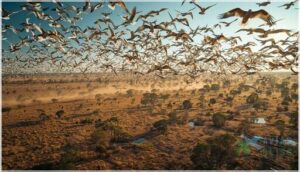
Wild cockatiels aren’t solitary birds sitting quietly in one spot—they’re social creatures constantly on the move across Australia’s vast interior. You’ll find them traveling in flocks that can range from just a handful of birds to massive groups numbering in the hundreds, all searching together for food and water.
Their nomadic lifestyle is shaped by Australia’s unpredictable climate, driving them to follow rainfall patterns and seasonal resources across their range.
Flock Structure and Size
When you observe cockatiels in their Australian homeland, you’ll notice they’re highly social birds that form impressive flocks with fascinating structure. These social interactions reveal how cockatiel social behavior adjusts to survival needs.
- Small foraging groups of 6 to 30 birds handle daily seed collection, with breeding pairs maintaining bonds as social subunits within the larger community.
- Super flocks can swell to 500 cockatiels near water sources during drought, demonstrating striking flock defense through cooperative predator vigilance.
- Pair bonding creates a flock hierarchy where multiple breeding pairs coordinate within the group during nesting season.
- Synchronized flight and vocal communication strengthen social interactions, keeping foraging groups cohesive and alert.
Nomadic Movement Patterns
You’ll find cockatiels constantly on the move across Australian habitats, with their nomadic behavior driven by seasonal changes and rainfall patterns. These flocks travel several hundred kilometers in search of fresh seeds and water, especially during drought in arid regions.
Environmental triggers like rain prompt swift relocations, with daily foraging flights reaching up to 30 kilometers while maintaining their social structure throughout migration.
Factors Influencing Migration and Range
Rainfall patterns are the primary driver of cockatiel nomadic behavior, with flocks relocating within days of significant rain events to capitalize on fresh vegetation and water. Temperature extremes can delay territorial movements by two months, while food distribution fluctuations push birds toward farmlands during droughts.
Human impact through habitat fragmentation restricts migratory patterns, forcing populations into remaining corridors with adequate habitat connectivity.
Challenges and Conservation of Wild Cockatiels
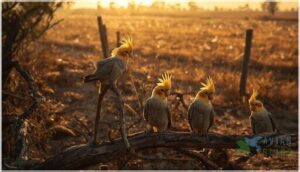
While cockatiels aren’t currently facing extinction, their lives in the wild aren’t without struggle. From shrinking habitats to conflicts with farmers, these adaptable birds navigate a changing landscape across Australia.
Let’s look at the main challenges they face and what’s being done to protect their future.
Habitat Loss and Fragmentation
Although cockatiels aren’t currently endangered, habitat loss and fragmentation pose real threats you should understand. Australia has cleared over 45% of its forests since European settlement, with agriculture and urbanization being the primary fragmentation drivers.
Here’s what’s happening to cockatiel habitats:
- Breeding Impact: Fewer tree hollows mean reduced nesting success
- Movement Disruption: Fragmented landscapes block their nomadic routes
- Extinction Debt: Isolated woodlands lose birds progressively over time
Conservation efforts remain limited, with most habitats unprotected.
Population Trends and Distribution
Despite habitat challenges, cockatiels remain abundant across Australia’s arid regions, with roughly one million birds thriving throughout the mainland. You’ll find striking regional variations in population density, driven by their nomadic patterns as they follow rainfall and seed availability.
Environmental impact from agriculture has actually increased local numbers in some areas, while long-term trends show overall stability. Their distribution shifts seasonally, with flocks congregating dramatically at water sources during droughts.
Conservation Status and Efforts
The IUCN Status classifies cockatiels as Least Concern, yet conservation of cockatiels confronts real threats. Habitat loss from agriculture fragments woodlands, while illegal capture for the pet trade disrupts wild populations.
Conservation efforts include habitat protection through national parks, restoration initiatives planting native trees, and monitoring efforts tracking flock movements. You’ll see researchers banding birds and working with communities to preserve nesting sites across their Australian range.
Frequently Asked Questions (FAQs)
Where do cockatiel live in Australia?
You’ll find cockatiels across mainland Australia, thriving in arid inland regions, wetlands, and scrublands. Regional variations create habitat diversity from Queensland to Western Australia, with introduced populations occasionally spotted in Tasmania despite climate adaptation challenges.
What habitat do cockatiels need?
Your cockatiel thrives in open woodlands near water, with eucalyptus trees offering nesting hollows.
They need arid adaptation skills, rely on water dependency, and access to native seeds meeting their dietary needs.
What do we know about cockatiels?
Like feathered nomads painting the sky, cockatiels are Australia’s charming natives with distinctive crests and cheerful whistles.
You’ll find these social birds thriving across arid inland regions, their 10-30 year lifespan adapting remarkably from wild habitat to beloved domestication.
Are cockatiels native to North America?
No, these Australian parrots aren’t native to North America. Any cockatiels spotted in North American wild habitats trace back to escaped or released pets from the pet trade, not natural populations.
Are wild cockatiels friendly?
No, wild cockatiels avoid humans instinctively. They flee at distances over 20 meters, showing defensive behaviors like alarm calls and rapid flight.
Their social bonds exist within flocks, not with people approaching their territory.
What are the predators of cockatiels in the wild?
In their natural habitat, your cockatiels face avian predators like wedge-tailed eagles and black falcons, mammalian threats from feral cats, and reptilian dangers including snakes and monitor lizards, especially during nesting vulnerability and juvenile stages.
Are there still cockatiels in the wild?
Despite captivity’s popularity, wild populations thrive across Australia’s mainland with impressive habitat resilience. Conservation success has maintained population stability, and their natural environment remains intact.
You’ll find approximately one million cockatiels flourishing in their natural habitat today.
What is the native environment of a cockatiel?
You’ll find cockatiels thriving in arid regions across Mainland Australia, where Eucalyptus Preference drives their habitat choices.
Water Dependence shapes their survival, though Habitat Destruction and Arid Adaptations constantly challenge these wild birds’ natural environment.
What is the diet of wild cockatiels?
In their native Australian grasslands, cockatiels rely heavily on seed-bearing plants and grasses, adjusting foraging techniques based on seasonal variations.
They also consume foliage, fruits, berries, and insects to meet their nutritional needs.
How do wild cockatiels communicate?
Wild cockatiels rely on a vocal repertoire including chirps and whistles, crest signals showing emotional states, alarm communication with shrill calls, courtship displays by males, and social cues maintaining flock cohesion during their nomadic travels.
Conclusion
The next time your cockatiel tilts its head at a water dish or flutters nervously during a storm, you’re witnessing echoes of Australia’s interior—instincts honed across millennia of nomadic survival. Understanding where cockatiels live in the wild doesn’t just satisfy curiosity; it transforms how you care for these resilient wanderers.
Their arid homeland shaped everything from their dust-bathing rituals to their flock-calling habits, reminding us that domestication hasn’t erased the desert traveler beneath those cheerful feathers.