This site is supported by our readers. We may earn a commission, at no cost to you, if you purchase through links.
 When a male bird’s testes balloon to 50% larger than their off-season size, it’s not preparing for battle—it’s gearing up for one of nature’s most intricate reproductive performances. Bird reproduction operates on a completely different blueprint than what you’re used to seeing in mammals. Most species don’t have external reproductive organs, females usually develop only one functional ovary, and the entire process hinges on a brief moment of cloacal contact that ornithologists call the cloacal kiss.
From the hormonal surge that transforms a songbird’s behavior to the precise temperature control needed during incubation, every stage involves extraordinary adaptations that have evolved over millions of years.
Understanding how birds reproduce reveals why certain species build elaborate nests, why clutch sizes vary so dramatically, and what determines whether a chick emerges ready to run or completely dependent on its parents.
Table Of Contents
- Key Takeaways
- Avian Reproductive Anatomy and Physiology
- Courtship and Mating Behaviors
- The Mating Process and Fertilization
- Nest Building, Egg Laying, and Incubation
- Parental Care and Chick Development
- Frequently Asked Questions (FAQs)
- How do birds reproduce?
- What is bird reproduction?
- How do you understand avian reproduction?
- What is a typical bird reproductive cycle?
- What is the process of bird mating?
- Why is bird reproduction important?
- How do birds mate?
- Can a bird reproduce asexually?
- How long are birds pregnant?
- How does a male bird fertilize the female egg?
- Conclusion
Key Takeaways
- Most male birds lack external reproductive organs and transfer sperm through a brief “cloacal kiss” lasting just seconds, though some species like ducks have evolved penises up to 40 cm long alongside female counter-adaptations to limit forced copulation.
- Female birds typically develop only one functional ovary (the left) as an evolutionary adaptation for flight efficiency, while specialized sperm storage tubules can keep sperm viable for up to 14 days after mating.
- Nest predation drives 91% of reproductive failures in tropical bird populations, making it the single greatest threat to breeding success—far exceeding impacts from food scarcity, disease, or environmental toxins.
- Altricial chicks (like songbirds) hatch helpless and demand intensive parental care for weeks, while precocial young (like ducks) emerge fully feathered and mobile within hours, representing two fundamentally different evolutionary strategies with distinct survival trade-offs.
Avian Reproductive Anatomy and Physiology
Before birds can engage in courtship displays or build nests, you need to understand the internal machinery that makes reproduction possible. Bird anatomy differs greatly from mammals, with specialized organs and unique structures that have evolved for flight and efficient reproduction.
Let’s examine the key components of avian reproductive systems, from the organs themselves to the hormones that regulate the entire process.
Male Reproductive Organs
Male bird reproductive organs operate on a completely internal blueprint, unlike what you might find in mammals. The male reproductive system sits tucked against the backbone, near the kidneys, where paired testes handle sperm production year-round or seasonally.
Here’s what makes up this efficient system:
- Testes structure: Bean-shaped organs filled with seminiferous tubules that manufacture sperm
- Seasonal changes: Testes can swell over 50% during breeding season, triggered by day length
- Sperm production: Occurs at body temperature (above 37°C) without needing external cooling
- Copulatory organs: Most species lack a penis, relying on cloacal contact instead
- Hormonal regulation: Leydig cells pump out testosterone to fuel reproductive behavior
The bird anatomy here reflects evolutionary efficiency—everything’s compact and responds rapidly to environmental cues. The avian epididymis size is very small compared to mammals.
Female Reproductive Organs
When you look at female reproductive organs in birds, Ovarian Asymmetry stands out—over 98% have only the left ovary and oviduct, a sharp contrast to mammals. The oviduct’s five segments shape egg production, while Follicle Dynamics and Hormonal Control drive ovulation. The avian oviduct consists of sections like the isthmus for membranes. These Evolutionary Traits reflect avian reproductive anatomy’s adaptation for efficiency and resilience.
| Structure | Unique Feature |
|---|---|
| Ovary | Left side only |
| Oviduct | Five segments |
| Follicles | Hierarchical growth |
| Hormonal Control | Cyclic regulation |
| Egg Production | Species-specific rates |
The Role of The Cloaca
After tracing the left-sided ovary’s role, your attention turns to the cloaca—a master of multitasking in bird anatomy.
Here, sperm transfer occurs through the cloacal kiss, egg laying and waste elimination share space, and the cloacal microbiome adapts with each season.
Its efficient design reflects adaptive features that support flight and efficiency, making bird reproduction a marvel of avian reproductive anatomy.
Hormonal Regulation of Reproduction
Behind that efficient cloacal anatomy lies an elaborate hormonal control system—the HPG axis—that orchestrates every stage of bird reproduction.
Gonadotropin regulation kicks off when long days trigger surges of LH and FSH, prompting sex steroids like testosterone, estrogen, and progesterone to rise.
Prolactin behavior aids incubation and chick-rearing, while seasonal influences fine-tune breeding season preparation, ensuring birds reproduce when conditions favor success.
Courtship and Mating Behaviors

Before birds can mate, they need to find the right partner—and that’s where courtship comes in. You’ll discover that birds use everything from elaborate songs and dazzling plumage to intricate dances and surprising gifts to win over potential mates.
These behaviors aren’t just for show; they help birds assess compatibility, establish pair bonds, and ultimately guarantee successful reproduction.
Visual and Auditory Displays
When you watch a bird court its mate, you’re witnessing multimodal communication—songs and calls paired with bright plumages and courtship displays working together. Display signal efficacy increases dramatically when visual and auditory signals combine.
Female song complexity can even predict reproductive success in species like New Zealand bellbirds.
Open habitat displays, especially aerial performances, increase both visual and acoustic reach during avian social signaling in courtship rituals.
Dance and Gift-Giving Rituals
When dance meets dedication, you see bird courtship rituals at their most striking. Structured dance is integral to courtship displays in over 80% of surveyed species, while gift-giving appears in about 14% of birds. These courtship displays directly influence mating success:
- Male manakins execute up to 40 rapid movements per second during signature dances
- Male northern cardinals deliver an average of 4 food items daily during peak courtship
- Greater sage-grouse males performing elaborate dances attract 2.5 times more mates
- High gift nutrition increases female receptivity to bird mating by 45%
Ritual evolution shows dance diversity and competitive gifting have diversified rapidly, with 68% of dance-specialist species showing parallel trends in mating behavior complexity.
Competitive Mating Strategies
When you look beyond the songs and displays, you’ll find that bird mating involves fierce competition. Mate guarding reduces extra-pair copulation attempts substantially, yet 19% of offspring in socially monogamous species are still sired by rival males.
Territorial aggression in bluebirds directly influences reproductive success, while sperm competition drives mating frequency higher in single-male groups.
These competitive strategies shape polygyny, polyandry, and promiscuity across species.
Pair Bond Formation
Once courtship rituals succeed, you’ll witness pair formation leading to bonding mechanisms that define mating systems. Approximately 90% of bird species practice monogamy, forming socially monogamous bonds through hormonal influence—oxytocin and vasopressin drive partner preference and fidelity.
Duration effects matter considerably: longer bonds produce 35% more fledglings. However, disruption trends reveal that divorce correlates with male polygamy and migration distance, impacting reproductive success.
The Mating Process and Fertilization

Once courtship establishes a pair bond, birds must complete the actual transfer of sperm to fertilize eggs. Most species accomplish this through a brief but precise maneuver called the cloacal kiss, though some groups have evolved different approaches.
You’ll find that the methods birds use for mating and the way sperm reaches the egg reveal fascinating adaptations shaped by millions of years of evolution.
Cloacal Kiss and Sperm Transfer
When you witness bird mating, what you’re seeing is a fleeting cloacal kiss—a rapid alignment of both partners’ cloacas lasting barely a second. During this brief contact, sperm transfer occurs, though only 1–2% of sperm actually reach the female’s reproductive tract.
That’s why you’ll observe copulation frequency varying wildly between species: European magpies manage just three attempts per clutch, while goshawks perform up to 600, maximizing transfer efficacy despite low success rates.
Females store viable sperm in specialized tubules for up to 14 days, creating intense sperm competition among males.
Penile Intromission in Certain Species
You might assume all birds rely on cloacal contact, but approximately 3% of species—primarily ducks and swans, ratites, and tinamous—possess external genitalia for penile intromission.
Phallus morphology varies dramatically, with waterfowl displaying lengths from 1.25 cm to over 40 cm.
These copulatory mechanisms evolved alongside female counter-adaptations like convoluted vaginal structures, limiting forced copulation success despite evolutionary reduction occurring in 97% of avian lineages.
Sperm Storage and Fertilization
Once sperm enters the female’s oviduct, specialized tubules in the uterovaginal junction create microscopic storage chambers. Turkey hens possess up to 30,566 sperm storage tubules (SSTs), while chickens have around 4,893.
These structures maintain sperm viability for weeks through reduced metabolic activity. Progesterone triggers release mechanisms timed with ovulation, allowing stored sperm to migrate from SSTs to the infundibulum where fertilization occurs near the ovary.
Nest Building, Egg Laying, and Incubation
After mating, birds shift their focus to creating a safe space for their eggs and preparing for the demanding work of incubation. Nest construction, clutch size, and incubation strategies vary widely across species, shaped by evolutionary pressures and environmental constraints.
Let’s explore the key stages that transform a fertilized egg into a hatching chick.
Types of Nests and Construction Materials

Across the avian world, nest architecture varies dramatically—from simple scrapes to intricate woven structures. Cup-shaped nests dominate, representing 38% of species globally, while domed, platform, and cavity forms each account for over 7%.
During nest construction, birds select materials based on functional properties: sticks, leaves, bark, and moss form sturdy bases, while spider silk provides flexibility in hummingbird nests. Material placement follows a deliberate pattern, with base components being considerably thicker and stronger than upper layers.
Urban nests increasingly incorporate anthropogenic materials like plastics and string, reflecting adaptation to human-modified environments—though these materials pose entanglement risks.
Clutch Size and Egg Development

Once you’ve settled on a nest, you’ll notice that clutch size varies wildly—from albatrosses laying a single egg to pheasants producing up to eighteen. This variation reflects intrinsic constraints like body size and environmental influences such as latitude and temperature.
Egg development follows precise timelines: passerines mature yolks in 3–4 days, while penguins require up to 16 days. Fertilization occurs in the oviduct before shell formation completes the egg-laying process.
Incubation Techniques and Parental Roles
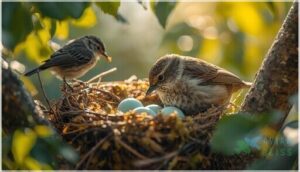
After laying begins, incubation techniques depend on precise egg temperature control—most species maintain 36.9°C to 37.4°C for successful hatching. Humidity effects and turning practices—rotating eggs at least twice daily—help guarantee proper chick development throughout this important parenting journey.
You’ll see dramatic variation in parental division: some shorebirds switch incubation shifts twenty times daily, while others sit for nineteen hours straight. Both parents generally share duties, adjusting bout lengths as ambient conditions change.
Embryonic Growth and Hatching
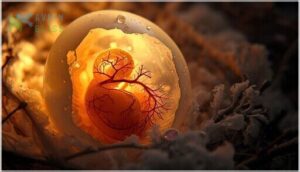
During incubation, embryonic development unfolds in three distinct phases—blastoderm formation, embryogenesis, and growth—transforming 20,000 cells into a hatchling.
Temperature effects critically shape this process: maintaining 37°C optimizes growth rate, while deviations reduce hatching success below the typical 67–91% range.
Incubation factors like humidity and turning influence chick development throughout the 10–21 day period until fertilization and egg development culminate in hatching.
Parental Care and Chick Development
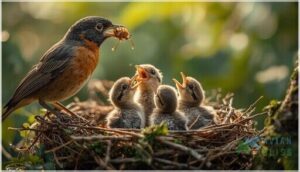
Once the eggs hatch, the real work begins for bird parents. The survival of chicks depends on how well adults feed, protect, and prepare them for life outside the nest.
Several key factors determine whether young birds will successfully reach independence.
Feeding and Protecting Chicks
Once chicks hatch, your focus shifts to their immediate survival. Parental care of young birds centers on two critical tasks: feeding and protection.
Chick feeding rates vary dramatically—you’ll find newly hatched songbirds consuming 10–15% of their body weight daily, with nutritional requirements including protein-rich insects for rapid chick development.
Meanwhile, parental defense behaviors like alarm calls and coordinated nest guarding directly influence offspring survival and post-fledging survival rates.
Altricial Vs. Precocial Young
When you compare offspring across bird species, you’ll notice two distinct paths shaped by evolutionary pressures. Altricial birds—think songbirds—hatch naked, blind, and helpless, demanding intensive parental care and extended nesting strategies.
Precocial birds like ducks emerge feathered and mobile, leaving the nest within hours. This developmental speed directly influences parental investment, survival rates, and the evolutionary trade-offs each lineage faces.
Fledging and Independence
You’ll witness fledging—the leap from nest to flight—within 8 to 30 days post-hatch for most songbirds, though raptors like bald eagles wait 11-12 weeks. This change marks the start of independence attainment, not its completion. Offspring still rely on parental care for weeks or months afterward, facing a gauntlet where mortality rates spike dramatically.
Key milestones in the fledging journey:
- Fledging age varies widely by species, from Clay-colored Sparrows at 8-11 days to eagles at nearly three months
- Mortality rates peak during the first week post-fledging, reaching 17% on average and up to 50% in some songbirds
- Parental care continues for several weeks to multiple months, providing critical food and protection
- Independence attainment generally occurs three to nine weeks after leaving the nest, when chicks no longer require parental support
- Nidifugous species like ducks disperse quickly, while altricial offspring demand extended chick rearing periods
Most fledglings disperse from their natal territory within two weeks, though broods in poorer condition may leave earlier. During this vulnerable period, predation and starvation claim roughly 31% of young raptors. Survival rates stabilize around three weeks post-fledging as self-sufficiency increases. In Eurasian spoonbills, parental contact drops from 11% at 40 days to under 3% at 90 days, illustrating the gradual withdrawal of care. Juveniles, notably, often don’t migrate with parents—care ends about four weeks before autumn departure.
Most fledglings leave their nest within two weeks, facing a perilous gauntlet where predation and starvation claim nearly a third before parental care gradually fades
Your understanding of these patterns reveals why first-year mortality can reach 90% across all bird types, with half dying before fledging. Environmental pressures shape these timelines profoundly: poor prey abundance correlates with increased fledgling deaths, while forced fledging from disturbance causes premature departures. Fledging success rates tell a sobering story—only 19.3% of snowy plover nests produce at least one fledgling, and success in sandy environments ranges from 0.06 to 0.57 fledglings per egg across breeding seasons.
Factors Affecting Reproductive Success
Nest predation drives 91% of failures across tropical populations, making it the dominant threat in avian reproductive biology. Breeding timing also matters profoundly: earlier nesters achieve higher success, especially at elevation. Parental investment shifts under predation pressure, reducing nest visits when danger looms.
Food availability proves equally critical—supplementation boosts breeding success by 33%, while shortages during chick-rearing devastate urban productivity.
Disease impact and toxins quietly erode hatching rates, with pesticide-exposed areas showing 40% lower nestling survival. These factors influencing clutch size and territorial behavior in birds ultimately shape reproductive strategies across every habitat.
Frequently Asked Questions (FAQs)
How do birds reproduce?
Unlike mammals with their elaborate internal arrangements, birds take a surprisingly efficient approach: they reproduce through a brief cloacal contact that transfers sperm, triggering egg formation and development within the female’s specialized reproductive tract.
What is bird reproduction?
Bird reproduction is the biological process by which avian species create offspring through courtship, mating rituals, egg formation, and parental care—driven by reproductive cycles and breeding habits shaped by evolutionary pressures.
How do you understand avian reproduction?
You understand avian reproduction by examining bird reproductive systems, avian hormonal balance, egg formation processes, and bird mating rituals.
These reproductive adaptations reveal how reproductive biology shapes mating and reproduction across species successfully.
What is a typical bird reproductive cycle?
The typical avian reproductive processes follow a seasonal pattern. Courtship displays establish pair bonds, mating transfers sperm through cloacal contact, egg formation occurs internally, incubation develops embryos, and parental care ensures fledging success.
What is the process of bird mating?
Most birds transfer sperm through a cloacal kiss—a brief touch lasting mere seconds. Males perform multiple daily attempts, though only about 64% succeed. Just 3% of species use penile intromission instead.
Why is bird reproduction important?
Reproductive strategies determine population dynamics, ecosystem services, and conservation efforts.
Breeding biology functions as a bioindicator of climate effects and pollution impacts, revealing environmental health while ensuring species survival across diverse habitats.
How do birds mate?
You might think birds have elaborate reproductive organs, but most actually lack external genitals. Instead, they mate through a quick “cloacal kiss,” where both partners’ cloacae touch, enabling rapid sperm transfer for fertilization.
Can a bird reproduce asexually?
Yes, but it’s exceptionally rare. Some species like California condors and turkeys can undergo parthenogenesis—asexual reproduction where unfertilized eggs develop.
However, offspring viability is low, most embryos die, and survivors face fertility challenges.
How long are birds pregnant?
Unlike mammals, you won’t find pregnancy in birds. Instead, egg formation takes roughly 24 hours from ovulation to laying.
Incubation duration varies widely by species—from 11 days in songbirds to 82 days in albatrosses.
How does a male bird fertilize the female egg?
Think of it like a high-speed data transfer: most birds mate through a cloacal kiss, where sperm transfer happens in seconds via brief cloaca contact.
Fertilization follows as sperm travels up the oviduct—though copulation duration is short, repeated contacts boost fertilization success.
Conclusion
Like a Swiss watch where every gear must engage at precisely the right moment, bird reproduction succeeds only when anatomy, timing, and behavior align perfectly. From the cloacal kiss to the final fledgling flight, each stage reflects evolutionary refinement honed across millennia.
You’ve now seen how hormones trigger testicular expansion, why most females retain just one ovary, and what separates altricial chicks from precocial runners. These adaptations explain the striking diversity you observe in nesting habits and parental strategies across species.
- https://pmc.ncbi.nlm.nih.gov/articles/PMC11782460/
- https://www.sciencedirect.com/science/article/pii/S205371662500043X
- https://www.pnas.org/doi/10.1073/pnas.2402652121
- https://www.usgs.gov/centers/eesc/science/north-american-breeding-bird-survey
- https://nestwatch.org/learn/general-bird-nest-info/clutch-size-phenology-for-common-species/