This site is supported by our readers. We may earn a commission, at no cost to you, if you purchase through links.
 A small bird with a rusty cap visits your backyard feeder in January, and you might assume it’s a common sparrow. Look closer at that bicolored bill and dark chest spot—you’re watching an American tree sparrow, a winter traveler from the Arctic tundra.
These hardy songbirds breed farther north than nearly any other sparrow species, then migrate south in massive numbers to spend cold months in weedy fields and woodland edges across the continent. Despite their name, they rarely perch in trees, preferring instead to forage on or near the ground where seeds are abundant.
Recognizing this species takes more than a casual glance, and understanding their unique habits reveals why they’ve declined by half over the past fifty years.
Table Of Contents
- Key Takeaways
- What is an American Tree Sparrow?
- Key Identification Features
- Habitat and Geographic Range
- Behavior, Diet, and Migration
- Conservation Status and Survival Challenges
- Frequently Asked Questions (FAQs)
- What does an American tree sparrow look like?
- What is an American tree sparrow?
- Where do American tree sparrows live?
- What is the difference between a field sparrow and an American Tree Sparrow?
- What are some fun facts about American Tree Sparrows?
- Where do American Tree Sparrows live?
- What are the predators of the American Tree Sparrow?
- When do American tree sparrows start singing?
- How do American tree sparrows handle severe winters?
- What are the nesting materials used by sparrows?
- Conclusion
Key Takeaways
- American Tree Sparrows are Arctic breeders identifiable by their rusty cap, bicolored bill (dark upper, yellow lower), and single dark breast spot, distinguishing them from similar species like Chipping and Field Sparrows.
- Despite their name, these sparrows rarely use trees and instead forage on the ground in weedy fields and woodland edges, shifting from a 98% seed diet in winter to insects during breeding season.
- Populations have declined by roughly 50% over the past five decades due to habitat loss, climate change impacts on Arctic breeding grounds, and reduced food availability from pesticide use.
- You can contribute to conservation efforts through citizen science projects like eBird and Christmas Bird Counts, which track migration patterns and population trends across their winter range in the northern United States and southern Canada.
What is an American Tree Sparrow?
The American Tree Sparrow is a small songbird that brings a touch of the Arctic to backyards and fields across North America each winter. With its rusty cap and gentle demeanor, this plump little sparrow is easier to identify than you might think once you know what to look for.
Let’s break down what makes this species unique and how it compares to other sparrows you’ll encounter.
Species Overview and Classification
The American Tree Sparrow stands as the sole member of genus Spizelloides. This avian species underwent genus redefinition in 2014 when genetic divergence studies revealed its phylogenetic placement apart from other Spizella sparrows.
You’ll find two subspecies within this New World sparrow: S. a. arborea breeding in central and eastern Canada, and S. a. ochracea inhabiting Alaska and western regions. During winter, this species is a common Nebraska visitor, numerous across the state.
This taxonomic history reflects modern molecular analysis of sparrow species classification.
Physical Characteristics and Field Marks
Beyond taxonomy, you can spot this sparrow by several reliable field marks. At 14 to 16.5 cm long and weighing 18 to 26 grams, its compact body carries distinctive plumage variations:
- Bright rufous crown – The chestnut cap stands out even in dim light
- Bicolored bill – Dark upper mandible, yellow lower mandible aids American Tree Sparrow identification
- Dark breast spot – A single spot centers the otherwise gray, unstreaked underparts
- White wingbars – Two crisp bars cross reddish-brown streaked wings
- Rusty eyeline and side patches – Warm tones frame the gray face
Juvenile markings include breast streaking absent in adults. As true songbirds, they’re capable of complex songs.
Regional subspecies show slight size dimorphism, with western birds slightly paler. These bird field marks make sparrow physical description straightforward once you know what to look for in the field.
Comparison With Similar Sparrow Species
Once you’ve mastered those field marks, you’ll face the real challenge: telling this species apart from look-alikes. Field mark confusion is common with winter sparrows, so here’s a sparrow species comparison showing key behavioral distinctions and size comparison pitfalls:
| Species | Key Differences |
|---|---|
| Chipping Sparrow | Smaller (5–5.5 inches), black eyeline with white eyebrow, no breast spot, weighs half as much |
| Song Sparrow | Heavy chest streaking merging into blotch, uniform bill color, solitary habits, overlapping length range |
| Field Sparrow | Pink bill with white eyering, smaller (5 inches), plain face without rusty eyeline, accelerating trill song |
| Swamp Sparrow | Prefers marshes year-round, no wingbars or breast spot, gray face with stout uniform bill |
| Immature White-crowned Sparrow | Pink bill, brown (not rusty) eyeline, larger overall, more back streaking, no breast spot |
Habitat overlap issues and song differentiation challenges make identifying winter birds tricky, but this bird identification guide helps you spot important details for sparrow identification success.
Key Identification Features
When you spot a small bird at your winter feeder, knowing what to look for makes identification much easier. American Tree Sparrows have several reliable features that set them apart from other sparrows.
Let’s look at the key physical traits that help you confidently identify this species in the field.
Size, Shape, and Body Structure

When you’re sizing up an American Tree Sparrow, you’ll notice a plump, round body measuring 14 to 16.5 cm in length with a wingspan around 21.6 to 24.8 cm. Weight variation ranges from 18 to 26 grams. The bill morphology shows a small, conical shape.
Sexual monomorphism means males and females share identical measurements. Skeletal adaptations support their lightweight build, and you’ll often see plumage fluffing in cold weather.
Plumage Coloration and Distinctive Markings
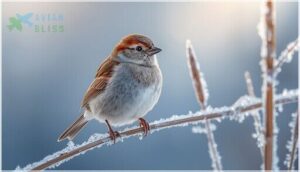
When identifying this species, you’ll first notice the rusty cap and facial markings defining the gray head. Crown coloration remains consistent across seasons, and nearly every adult displays a single breast spot on unstreaked underparts.
The shoulder patch shows rufous tones, while molt variation affects plumage brightness by up to 18% from winter to spring. This distinctive color pattern separates them from similar sparrows.
Bill Shape, Wingbars, and Tail Features
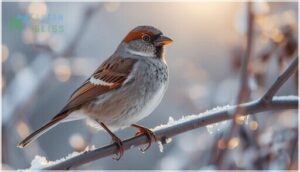
You’ll recognize the bicolored bill immediately—dark upper mandible paired with a yellow lower one—measuring about 8 to 9 mm long. The tail stretches 6 to 7 cm with a shallow notch, giving this sparrow its distinctive profile.
Two crisp white wingbars stand out against brown wings, aiding bird identification year-round. These plumage patterns show no seasonal changes and remain consistent across both sexes.
Habitat and Geographic Range
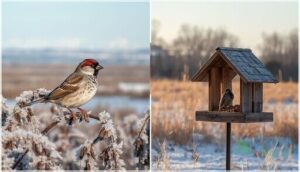
You’ll find American Tree Sparrows across a surprisingly wide range of North America depending on the season. These hardy little birds make their home in vastly different landscapes throughout the year, from remote Arctic regions to backyards and fields closer to where you live.
Let’s look at the key habitats and geographic areas where you’re most likely to spot them.
Breeding Grounds in Arctic Tundra
American Tree Sparrows breed across vast stretches of Arctic tundra and taiga where treeline habitats meet open scrubland. You’ll find their nesting grounds concentrated in northern Canada and Alaska, spanning roughly 250 million acres of remote terrain.
- Tundra nesting occurs on mossy hummocks among willows, birches, and stunted spruce
- Arctic vegetation provides essential cover and food resources during brief summers
- Breeding success depends on proximity to water bodies and adequate shrub density
- Climate impacts and treeline shifts increasingly affect traditional breeding grounds
Wintering Habitats Across North America
When winter arrives, you’ll spot American Tree Sparrows across the northern two-thirds of the United States, especially in the Midwest and Great Plains. These sparrows avoid the far west, deep south, and Florida entirely.
Wintering areas include weedy fields, marshes, woodland edges, and even your backyard feeders. Regional densities remain highest inland, though habitat loss and climate impacts have reduced populations by 50% over five decades. Urban adaptation helps some survive despite agricultural effects.
Preferred Vegetation and Landscape Types
You’ll find American Tree Sparrow habitat in open areas with plenty of low vegetation rather than tall trees. Despite their name, these birds avoid dense forests and stick to landscapes rich in seed-bearing plants.
Dense woodland sees 40–55% lower sparrow presence compared to open habitats.
- Tundra Shrublands: Arctic willows, alder, and stunted spruce near the treeline
- Grassy Meadows: Old fields with indiangrass, goldenrod, and ragweed
- Forest Edges: Shrubby wetland margins and hedgerows
- Weedy Landscapes: Early successional growth with abundant ground cover
Urban and Suburban Adaptation
You’ll spot these winter birds thriving in backyards and parks where bird feeders offer seeds. Urban tree sparrows adjust their calls to cut through city noise and nest successfully in gardens with hedges and green spaces.
Studies show urbanization increases their presence, yet they face survival factors like habitat loss contributing to overall population decline. Creating a bird-friendly habitat with backyard feeders aids citizen science monitoring efforts.
Behavior, Diet, and Migration

American Tree Sparrows shift their habits with the seasons, moving between feeding strategies and habitats in ways that help them survive harsh winters and distant migrations. You’ll notice they gather in flocks during cold months and change their diet dramatically from summer to winter.
Understanding their behavior patterns, from what they eat to how they travel and communicate, gives you a complete picture of these adaptable little birds.
Feeding Habits and Seasonal Diet Changes
Throughout the year, you’ll observe dramatic shifts in American Tree Sparrow diet and feeding behavior. In winter, these birds consume over 98% seeds from grasses, sedges, and weeds, meeting daily energy needs equal to 30% of their body weight.
Summer brings a complete shift to insects and spiders, especially when feeding nestlings. Adults scratch ground surfaces and flap wings to dislodge seeds from stalks onto snow, showing striking dietary adaptations to seasonal food availability.
Flocking and Social Behavior
You’ll find American Tree Sparrows gathering in flocks of 10 to 50 birds during the colder months. Mixed flocks with Dark-eyed Juncos and Song Sparrows are common.
Dominance hierarchies form through aggressive interactions at feeders, with males showing higher rates of threat displays. Cooperative behavior appears in alarm calling, benefiting the entire group.
Seasonal flocks shift from family groups in late summer to unrelated individuals by winter.
Migration Timing and Routes
After flocking together all winter, American Tree Sparrows begin impressive journeys between their arctic breeding grounds and temperate wintering areas. You can witness their nocturnal departures peaking in mid-April, when weather influence becomes critical. Most birds migrate under clear skies with mild temperatures. Fall arrivals return to southern regions between late October and mid-November, though route fidelity to specific wintering sites remains surprisingly low.
- Spring migration speed accelerates dramatically as day length increases through February to May
- Seventy percent of tracked departures occur at night, most within hours after sunset
- Weather influence dominates departure decisions, with birds favoring clear conditions over tailwinds
Vocalizations and Communication
While winter feeding flocks communicate through soft “tseet” notes, you’ll hear American Tree Sparrow vocalizations shift dramatically by season. Songs and calls serve distinct purposes: males deliver clear “dee-dee-dee” territorial songs during breeding, while alarm calls warn of threats.
Flock dialects vary between groups, showing song learning occurs socially. Urban adaptation has pushed contact frequencies higher to overcome noise.
Female vocalizations include distinctive “wehy” sounds when approached by singing males.
Conservation Status and Survival Challenges
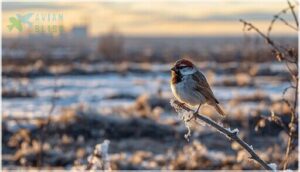
American Tree Sparrows remain widespread across North America, but their future isn’t as secure as it might seem at first glance. These hardy little birds face mounting pressures from habitat loss and shifting climate patterns that affect both their Arctic breeding grounds and southern wintering areas.
Understanding their current status and the challenges ahead helps you appreciate why monitoring efforts and conservation work matter for keeping these sparrows around.
Current Population Trends and Estimates
You might be surprised to learn that American Tree Sparrow populations have dropped by roughly 50% over the past five decades. Despite this steep decline, Partners in Flight still rates them 10 out of 20 on their Continental Concern Score, meaning they’re not yet a high conservation priority. The global breeding population size stands at about 26 million individuals as of 2025.
Despite a 50% population drop over five decades, American Tree Sparrows remain relatively common with 26 million individuals and moderate conservation concern
Key population trends include:
- Regional population shifts: Kansas and Nebraska now host up to 18% and 15% of the continental winter population
- Winter range changes: The southern edge has retreated northward in recent decades
- Breeding population monitoring: Canada’s Breeding Bird Survey documents an 87% national decrease
Though classified as Least Concern under IUCN Status, these population decline causes warrant attention. Climate change impacts on birds like the American Tree Sparrow are becoming increasingly evident through altered migration patterns and habitat availability.
Long-term data from Christmas Bird Counts confirm persistent declines across wintering grounds, particularly in the Northeast and Midwest regions.
Understanding these conservation status indicators helps you recognize why continued monitoring matters, even for species that remain relatively common.
Major Threats and Climate Change Impacts
As American Tree Sparrows confront an uncertain future, climate change impacts on birds accelerate habitat degradation across their range. You’ll see range shifts northward, with breeding zones shrinking due to climate threats like snow loss and extreme weather.
Habitat loss from agricultural conversion compounds anthropogenic mortality from window strikes and cats. Migration stress intensifies under nocturnal travel risks, while food availability declines through pesticide-driven insect losses and reduced natural seed sources impacting American Tree Sparrow conservation efforts.
Conservation Protections and Initiatives
Despite ongoing climate threats, American Tree Sparrow conservation is strengthened by legal protections under the Migratory Bird Treaty Act and coordinated conservation efforts.
Habitat restoration projects now target breeding tundra and wintering fields through collaborative efforts among federal agencies and nonprofits.
Population monitoring systems track the species’ conservation status, while urban adaptation programs encourage backyard stewardship to support these resilient sparrows.
Role of Citizen Science in Monitoring
You can contribute directly to American Tree Sparrow conservation through citizen science projects like eBird and Christmas Bird Counts. These platforms collect over 100 million annual observations, with data quality validated through expert review and AI assistance.
Your reports help track population trends and migration patterns at a continental scale. Trend analysis from public engagement has documented critical declines, giving conservation impact to every observation you submit.
Frequently Asked Questions (FAQs)
What does an American tree sparrow look like?
You’ll spot this sparrow by its rusty crown, gray face with a dark eye-line, and bicolored bill.
Regional differences are subtle, though plumage variations exist between seasons, affecting bird identification accuracy.
What is an American tree sparrow?
You might call this winter visitor a “chip off the old boreal block.” The American Tree Sparrow is a medium-sized sparrow with a rusty cap and distinctive dark breast spot that winters across North America.
Where do American tree sparrows live?
You’ll find these sparrows in Arctic tundra and boreal forests during breeding season.
Come winter, they migrate south to weedy fields, marshes, and gardens across southern Canada and the northern United States.
What is the difference between a field sparrow and an American Tree Sparrow?
Like twin siblings with telling differences, these birds are separated by key features.
Field Sparrows have solid pink bills and plain breasts.
American Tree Sparrows sport bicolored bills, rusty caps, and distinctive dark breast spots.
What are some fun facts about American Tree Sparrows?
You can spot their bicolored bill and distinctive melodic calls during winter. American Tree Sparrows demonstrate impressive cold weather survival through feather fluffing.
Their flocking behavior aids seed dispersal, while communal winter feeding calls coordinate group movements.
Where do American Tree Sparrows live?
You’ll see American Tree Sparrows in Arctic tundra during breeding season. Come winter, they spread across northern United States and southern Canada, visiting open fields, marshes, and backyard feeders.
What are the predators of the American Tree Sparrow?
Avian predators like Cooper’s Hawks strike adult birds with 20% success rates.
Mammalian predators, including domestic cats, kill roughly 4 billion birds annually across America.
Nest predation by corvids causes habitat loss impacts on American Tree Sparrow behavior.
When do American tree sparrows start singing?
You’ll hear American Tree Sparrow vocalizations starting in early May as breeding season begins.
Peak singing period runs from June through August when males use bird vocalizations for territorial defense and mate attraction.
How do American tree sparrows handle severe winters?
When the mercury drops, survival means working harder, not smarter. Sparrows boost their metabolic rate and pack on fat reserves. Dense plumage and winter plumage trap warmth, while constant foraging behavior meets sky-high dietary needs through cold weather adaptations.
What are the nesting materials used by sparrows?
Sparrows build nests using mosses, grasses, bark, and twigs for the outer structure.
The inner lining includes fine grasses, feathers, and animal hair. These materials provide insulation and cushioning for eggs and nestlings.
Conclusion
These rusty-capped visitors face an uncertain future as their numbers quietly slip away. By learning to recognize American tree sparrows and understanding the landscapes they depend on, you become part of a network watching over them.
Your observations matter—whether shared through citizen science or simply noted in a winter journal. Each sighting adds to our knowledge of how these northern travelers adapt to a changing world, helping guarantee their musical presence endures in snowy fields for generations ahead.
- https://animaldiversity.org/accounts/Spizella_arborea/
- https://journal.afonet.org/vol96/iss3/art1/
- https://wildlife-species.canada.ca/bird-status/tendance-trend-eng.aspx?sY=2019&sL=e&sB=ATSP&sM=p1&sT=6265c1df-b7cc-42af-9cb5-60cedc79e43d
- https://en.wikipedia.org/wiki/American_tree_sparrow
- https://www.allaboutbirds.org/guide/American_Tree_Sparrow/maps-range