This site is supported by our readers. We may earn a commission, at no cost to you, if you purchase through links.
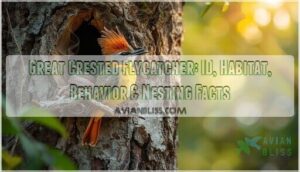
The loud “wheep!” call echoing through the forest canopy often announces the great crested flycatcher before you spot its rusty tail disappearing into the leaves. This robin-sized insect hunter isn’t shy about defending its territory.
You’ll find it patrolling the mid to upper forest layers with surprising confidence. Its olive-brown back and bright yellow belly make identification straightforward once you get a clear view.
The bird’s unusual nesting habits set it apart from other flycatchers. It famously decorates nest cavities with shed snakeskin or similar materials. Understanding this species reveals how woodland birds adapt to life between the treetops and forest floor.
Table Of Contents
- Key Takeaways
- Great Crested Flycatcher Identification
- Habitat and Range
- Behavior and Life Cycle
- Nesting and Reproduction
- Diet and Ecological Role
- Frequently Asked Questions (FAQs)
- Are great crested flycatchers rare?
- Where does the Great Crested Flycatcher live?
- Do great crested flycatchers come to feeders?
- Do great crested flycatchers eat flies?
- How do great crested flycatchers interact with other birds?
- What sounds do great crested flycatchers make during breeding?
- When do great crested flycatchers migrate south?
- How to identify potential nesting cavities for flycatchers?
- What challenges do flycatchers face during migration?
- How long do great crested flycatchers live?
- Conclusion
Key Takeaways
- You can identify the great crested flycatcher by its olive-brown back, bright yellow belly, rusty tail feathers, and loud “wheep!” call that carries far through the forest canopy.
- This species nests exclusively in tree cavities and often decorates its nest with shed snakeskin or shiny materials, which may help reduce predation by deterring nest predators.
- The bird migrates long distances between eastern North American breeding grounds and tropical wintering areas in Mexico and Central America, traveling mostly at night from late August through September.
- Great crested flycatchers provide valuable natural pest control by consuming over 95% insects during breeding season, including crop-damaging beetles, moths, and grasshoppers that threaten forest health.
Great Crested Flycatcher Identification
You can spot a Great Crested Flycatcher by looking at a few key features that set it apart from other birds. These flycatchers have a bold look that makes them easier to identify once you know what to watch for.
Let’s break down the main traits you’ll want to notice.
Physical Characteristics and Size
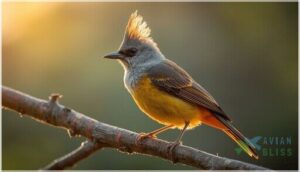
The Great Crested Flycatcher measures 17–21 cm in length with a wingspan of 33–34 cm. You’ll notice adult dimensions place this bird near robin size. Males and females show no sexual dimorphism in measurements or mass, commonly weighing 27–40 g.
Key size shape features include:
- Large rounded head with modest crest structure
- Heavy, thick bill suited for catching insects
- Fairly long tail length relative to body
- Broad wings supporting strong, maneuverable flight
During nesting, the male defends his nesting territory with loud calls.
Color Patterns and Markings
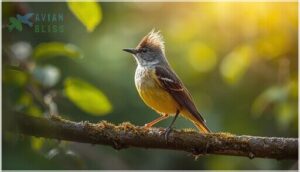
You’ll spot the Great Crested Flycatcher by its olive-brown upperparts crowned with a bushy crest. The gray throat and breast contrast sharply with bright yellow underparts. Rusty wings and tail feathers create diagnostic color patterns. Look for subtle white wing bars across darker coverts. This plumage variation offers excellent camouflage among leafy branches while the regional differences remain minimal across their range. These birds belong to the Tyrannidae family, also known as flycatchers.
| Body Region | Primary Color | Key Markings |
|---|---|---|
| Upperparts/Crest | Olive-brown | Uniform dorsal field |
| Breast/Throat | Gray | Sharp yellow boundary |
| Wings/Tail | Rufous-red | Rusty stripe panels |
Juvenile Vs. Adult Plumage
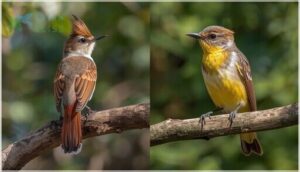
When you observe plumage wear and wing coverts closely, you can distinguish juveniles from adults. Juvenile plumage shows fresher, warmer rusty tones on wing feathers with more white edging than adults. Tail coloration appears richer in young birds. Molt timing matters for field identification:
- Juveniles display browner upperparts and duller yellow underparts
- Adults show stronger contrast between dark backs and bright bellies
- Wing coverts reveal pointed, rusty-edged feathers in first-year birds versus rounded coverts in adults
Distinctive Vocalizations
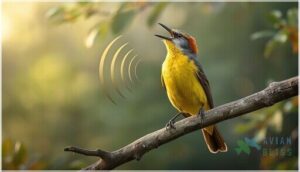
Beyond plumage, you’ll recognize this bird by its voice. The primary call—a loud, rising “wheep”—carries far through woodlands and helps locate hidden birds. Males deliver a distinctive dawn song with two whistles followed by a low churr. The repertoire includes at least 12 vocalization types, from contact calls to alarm notes, making the Great Crested Flycatcher’s sounds unmistakable.
| Call Type | Description |
|---|---|
| Primary Contact | Loud, buzzy “wheep” rising whistle |
| Dawn Song | Two whistles + soft burry churr |
| Alarm Series | Fast, insistent “wheep” repetitions |
| Social Notes | Rapid “whit-whit-whit” sequences |
Habitat and Range
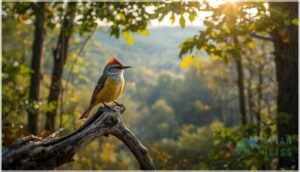
You’ll find Great Crested Flycatchers across a wide range of North American landscapes. These adaptable birds move between different habitats depending on the season.
Let’s look at where they live throughout the year and what draws them to these specific areas.
Preferred Habitats
You’ll find this species thriving in deciduous and mixed hardwood forests, particularly where the canopy opens up at edges and clearings. Forest type matters—they avoid dense conifers, preferring woodlands with plenty of snags and dead trees that offer cavity availability. Urban habitats work too, as long as mature shade trees remain.
Natural habitat preferences shift with seasonal variation, from temperate breeding grounds to tropical winter forests.
Breeding and Nesting Regions
Across eastern North America, from southern Canada down to the Gulf Coast, you’ll encounter Great Crested Flycatcher nesting activity primarily in hardwood forests. Breeding density peaks in the Southeast—particularly the Coastal Plain—while regional variability shows stronger presence where edge patterns create forest openings. Elevational tolerance extends from sea level to roughly 1,000 meters.
Seasonal occupancy concentrates in deciduous and mixed woodlands, where nest site selection focuses on natural cavities.
Wintering Grounds and Migration
Each autumn, you’ll witness these flycatchers undertaking long-distance migration from their eastern North American breeding grounds to tropical wintering habitats. They travel primarily at night, reaching destinations from southern Mexico through Central America to Panama.
Key Migration Patterns:
- Spring passage: northbound migrants arrive from late March through mid-May across the central United States
- Fall departure: southbound movement spans late June through early November, peaking August-September
- Winter habitats: forest edges, second-growth woodland, and semi-open tropical landscapes preferred
- Overwintering strategy: most winter in the tropics, though some remain in southern peninsular Florida
Year-Round Presence in Florida
Unlike their northern counterparts, you’ll find Great Crested Flycatchers in southern Florida year-round. The species maintains resident populations throughout the peninsula, with breeding birds joined each winter by migrants from the north.
Christmas Bird Counts routinely document hundreds across the state—including 43 at Corkscrew Swamp—confirming Florida’s dual role in both nesting habitat and overwintering refuge.
This geographic distribution makes conservation of Florida’s forests especially critical.
Behavior and Life Cycle
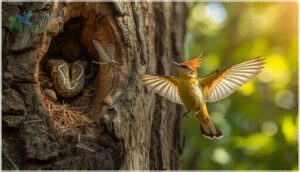
The Great Crested Flycatcher leads an active life filled with fascinating behaviors you can observe throughout the year. From hunting insects on the wing to defending territory with loud calls, these birds show distinct patterns in how they interact with their world.
Let’s look at the key aspects of their daily life and seasonal rhythms.
Feeding and Foraging Behavior
You’ll spot this insectivorous bird hunting from high perches, launching into the air to snatch flying insects with precision. Great Crested Flycatcher feeding behavior relies on aerial hawking and perch foraging in the canopy. Their seasonal diet shifts slightly as prey availability changes, making them essential for insect regulation in forests.
Key feeding strategies include:
- Watching from perches 10 to 20 meters high before attacking
- Sallying midair to capture beetles, wasps, and moths
- Hover-gleaning insects directly from leaves and twigs
- Eating fruits and berries outside breeding season
- Delivering whole insects to nestlings during reproduction
Social and Territorial Habits
Great Crested Flycatchers defend their space with fierce determination. They aggressively chase intruders and snap their bills at squirrels near nest trees. Territorial behavior centers on areas up to 1.2 hectares, with pairs reforming each spring if both survive winter migration.
Pairs concentrate activity within 30 to 50 meters of their cavity during nesting.
| Territorial Aspect | Observed Behavior |
|---|---|
| Territory Size | 0.4 to 1.2 hectares per pair |
| Aggression Defense | Bill snapping, raised-crest displays, physical grappling |
| Spatial Use | Mid to upper canopy, 10+ meters high |
| Pair Association | Socially monogamous, single breeding pairs |
| Migratory Habits | Solitary or paired daytime travelers |
Courtship and Mating Rituals
When males return to their breeding grounds, they launch into dramatic aerial chasing displays to win over females. You’ll witness males swooping down from perches toward potential mates, then climbing back up to repeat the dive.
These monogamous pairing rituals include mate guarding, with males shadowing females during nest building. Pairs sometimes perform duet calling, giving synchronized “wree-eep” notes. Copulation frequency remains high from nest construction through hatching.
Seasonal Activity Patterns
Beyond courtship, you’ll notice these birds follow a strict annual rhythm. Males arrive in May to claim territories, then breed from early April to early July. They’re most vocal for about two months before going quiet by mid-July. Peak activity happens at dawn and dusk.
Come fall, they migrate at night to Central and South America, completing their seasonal cycle.
Nesting and Reproduction
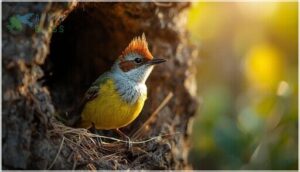
The Great Crested Flycatcher stands out as the only eastern flycatcher that nests in cavities. This unique nesting behavior sets them apart from their ground-nesting cousins.
Let’s explore how these birds find homes, build nests, raise their young, and share parenting duties.
Cavity Nesting Habits
Unlike species that excavate their own homes, you’ll find these flycatchers using pre-existing cavities as secondary nesters. They occupy abandoned woodpecker holes and natural tree hollows at heights ranging from 10 to 70 feet above ground.
Your backyard nest boxes can serve as suitable alternatives, especially when natural cavities are scarce. Most nests sit between 10 and 20 feet high in deciduous woodlands.
Nest Construction and Materials
Once inside their chosen cavity, these flycatchers get to work building. The female undertakes most nest construction, taking 2 to 14 days to complete the job. She backfills deep cavities with coarse debris—leaves, bark strips, and twigs—raising the foundation to within 5 to 10 cm of the entrance.
You’ll notice distinctive materials in many nests:
- Shed snakeskin appears in many nests, especially in southern regions like Florida
- Crinkly anthropogenic materials such as plastic wrappers and cellophane serve similar functions
- Fine linings of feathers and fur create a soft cup for eggs
- Regional variation reflects local availability, with pine needles common near conifers
Studies show nests containing snakeskin experience lower predation rates, suggesting this peculiar material choice has a protective function.
Egg and Chick Development
After laying a clutch size of 4 to 8 great crested flycatcher eggs, you’ll see the female incubate them for 13 to 15 days. These cream-colored eggs with brown streaking hatch into helpless nestlings.
Rapid nestling growth follows, with young fledging at 13 to 15 days old. Fledgling dependence continues for up to 3 weeks post-fledging.
Breeding success varies yearly, influenced by predation and cavity quality.
Parental Care Roles
While the female undertakes all incubation duties for 13 to 15 days, parental care quickly becomes a team effort once the eggs hatch.
Both parents share biparental provisioning, making frequent feeding trips to deliver insects to hungry nestlings. They split nest sanitation tasks by removing fecal sacs and debris.
Males focus heavily on territorial defense and nest protection, while both adults provide post-fledging care for about three weeks after young birds leave the cavity.
Diet and Ecological Role

The Great Crested Flycatcher is a skilled hunter that relies mostly on insects to survive. What it eats can change with the seasons, and its hunting style is built for catching prey in mid-air.
You’ll see how this bird plays an important role in keeping insect populations under control.
Insectivorous Diet and Prey Types
You’ll find that Great Crested Flycatcher diet consists mainly of insects—over 90% during breeding season. These skilled insectivores target relatively large prey including:
- Lepidoptera (moths and butterflies) and beetles (Coleoptera)
- Orthoptera such as grasshoppers and crickets
- Hymenoptera including bees and wasps
They also consume spiders and occasionally small lizards, demonstrating considerable versatility in insect prey selection and foraging techniques across different insect foraging substrates for effective insect population control.
Seasonal Dietary Changes
You’ll notice that Great Crested Flycatcher diet shifts dramatically with the calendar. During breeding season, these birds maintain breeding insect dominance—over 90% insect prey—to fuel rapid chick growth.
Come autumn, dietary adjustments kick in as migrants increasingly consume fruit for migration energy. By midwinter, winter fruit consumption can dominate in tropical wintering grounds where insect availability plummets, demonstrating striking seasonal dietary changes shaped by climatic diet influences.
Foraging Techniques
Great Crested Flycatchers excel as aerial hunters—you’ll spot them launching from mid-canopy perches to snag flying insects in striking aerial sallying dashes. This insectivore masters multiple bird feeding behavior techniques, switching seamlessly between hover gleaning at leaves and quick ground foraging for beetles. Their Great Crested Flycatcher diet reflects smart seasonal adjustments, with edge habitats providing prime hunting zones where foraging success peaks at dawn and dusk.
- Aerial sallying accounts for 60–80% of prey captures during breeding season
- Hover gleaning lets them pluck caterpillars directly from foliage surfaces
- Ground foraging happens in under 10% of observations, targeting larger invertebrates
- Edge habitats and canopy tops serve as preferred hunting perches
Importance in Pest Control
You’ll appreciate knowing these insectivorous birds deliver serious natural pest control across eastern forests. Their canopy foraging targets moths, beetles, grasshoppers, and crickets—arthropods that damage crops and trees. With over 95% insect-based diets during the breeding season, these insectivores provide essential ecosystem services through sustained pest management.
Great Crested Flycatchers provide essential natural pest control by consuming over 95% insects during breeding season, targeting crop-damaging moths, beetles, and grasshoppers across eastern forests
| Pest Group | Examples Eaten | Control Benefit |
|---|---|---|
| Beetles | 52+ species documented | Reduces leaf damage |
| Moths & butterflies | Caterpillars, adults | Stops defoliation |
| Grasshoppers & crickets | Katydids included | Protects vegetation |
This insectivorous bird’s aerial hunting complements ground-feeding species, creating layered insect control that aids healthier forests without chemical pesticides.
Frequently Asked Questions (FAQs)
Are great crested flycatchers rare?
Although you might seldom spot them in your backyard, Great Crested Flycatchers aren’t rare. They’re listed as Least Concern on the IUCN Red List, with stable population trends across their widespread eastern range.
Where does the Great Crested Flycatcher live?
You’ll find this species across eastern North America’s woodlands, from southern Canada to the Gulf Coast.
During breeding season, they favor open hardwood forests and edge habitats where trees meet clearings.
Do great crested flycatchers come to feeders?
Unlike most backyard visitors, these aerial insect eaters rarely visit traditional bird feeders. Mealworm feeders occasionally attract them, though feeder visit rarity remains high.
Proper nest boxes and natural food sources work better for attracting flycatchers to your yard.
Do great crested flycatchers eat flies?
Yes, you’ll see great crested flycatchers eat flies, though flies make up only a small part of their insectivorous diet.
They catch flies mid-air using quick sallies from high perches in the canopy.
How do great crested flycatchers interact with other birds?
Great Crested Flycatchers defend their territory fiercely during breeding season. You’ll see them chase other birds from nest sites and canopy perches.
They compete with bluebirds and starlings for tree cavities.
What sounds do great crested flycatchers make during breeding?
During breeding season, you’ll hear males give their signature “whee-eep” whistle as their primary song from high perches.
They also produce dawn chorus sequences, contact calls between mates, and harsh alarm calls near nests.
When do great crested flycatchers migrate south?
You’ll notice these birds heading south starting in late August, with most departing their breeding areas by September’s end.
They migrate mostly at night, traveling alone toward Mexico and Central America.
How to identify potential nesting cavities for flycatchers?
Studies show that up to 70% of flycatchers accept artificial sites. Look for tree cavities 12 to 20 feet high with 5 to 2-inch entrance holes, or install nest boxes near woodland edges with open flight paths.
What challenges do flycatchers face during migration?
You’ll find that migration exposes flycatchers to serious risks: stopover habitat loss disrupts refueling, collision hazards from buildings and towers cause mass mortality, weather extremes trigger die-offs, and declining insect prey reduces survival across their range.
How long do great crested flycatchers live?
You might assume a bird that migrates thousands of miles lives only a few years, but great crested flycatchers can reach 14 years in the wild, with most adults surviving 2 to 10 years.
Conclusion
What makes the great crested flycatcher stand out among forest birds? Its bold voice and rusty tail mark its territory, while the snakeskin in its nest tells a deeper story.
You’ve now got the tools to recognize this woodland hunter by sight and sound. Watch for that flash of yellow belly in the canopy. Listen for the sharp call.
The forest reveals its secrets to those who pay attention.
- https://en.wikipedia.org/wiki/Great_crested_flycatcher
- https://mnbirdatlas.org/species/great-crested-flycatcher/
- https://txtbba.tamu.edu/species-accounts/great-crested-flycatcher/
- https://www.tn.gov/twra/wildlife/birds/great-crested-flycatcher.html
- https://avianreport.com/great-crested-flycatcher-nest-and-eggs/