This site is supported by our readers. We may earn a commission, at no cost to you, if you purchase through links.
Most people who spot a varied thrush think they’re looking at an American Robin wearing a costume. Same round body, similar orange chest—but something’s off.
The dark breastband cuts clean across the throat, the colors run deeper, and the whole bird carries a quieter, more secretive energy. That’s no coincidence.
The varied thrush evolved for the dim, rain‑soaked forests of the Pacific Northwest, where blending into shadow matters more than standing out.
Understanding what sets this bird apart—its markings, habits, diet, and the old‑growth forests it depends on—opens a window into one of North America’s most atmospheric and underappreciated songbirds.
Table Of Contents
- Key Takeaways
- Varied Thrush Identification Guide
- Natural Habitat and Geographic Range
- Diet and Foraging Habits
- Behavior and Breeding Patterns
- Conservation Status and Migration
- Frequently Asked Questions (FAQs)
- How rare is a Varied Thrush?
- What does a female Varied Thrush look like?
- What do Varied Thrush eat in the winter?
- How do you identify a Varied Thrush?
- What is a Varied Thrush?
- Where do Varied Thrushes live?
- What does a Varied Thrush eat?
- What is the difference between a Varied Thrush and a Robin?
- Why does the varied thrush sing at night?
- What inspires varied thrush songs during gloomy weather?
- Conclusion
Key Takeaways
- The Varied Thrush is best distinguished from an American Robin by its bold dark breast band, blue-gray back, and a single haunting whistle — not cheerful phrases.
- It depends heavily on old-growth Pacific Northwest forests, using the dense understory, rich leaf litter, and cool microclimate for both nesting and foraging.
- Its diet shifts with the seasons — beetles, ants, and caterpillars in summer, then berries, acorns, and fallen fruit once cold weather sets in.
- Populations have dropped about 32% since 1966, driven by habitat loss, forest fragmentation, and climate shifts — making every backyard sighting worth paying attention to.
Varied Thrush Identification Guide
Spotting a Varied Thrush for the first time feels like catching a glimpse of something rare — even when you’re standing in your own backyard.
Once you’ve had that rush, it’s worth knowing how to identify a Hermit Thrush in the wild — a close cousin with its own quiet magic.
Once you know what to look for, though, identifying one gets a lot easier. Here’s what to focus on.
Size and Shape Comparison
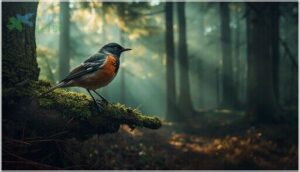
At first glance, the Varied Thrush looks like a stocky, compact bird — and the numbers back that up. It runs 7.9 to 10.2 inches long with a wingspan variability between 13.4 and 16.5 inches.
- Body mass range: 65–100 grams
- Tail length proportion: noticeably short, creating a chunky silhouette
- Leg length ratio: long and sturdy for ground foraging
- Bill size contrast: slender and straight, not seed-cracker thick
It usually breeds in coniferous forest(https://www.audubon.org/field-guide/bird/varied-thrush) during the breeding season.
Distinctive Plumage and Markings
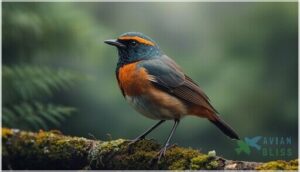
Once you see a Varied Thrush up close, bird identification gets easier fast.
The dark breastband shape — a shallow arc across a burnt orange chest — is your first anchor point. Above that, a bold eyebrow stripe cuts over each eye.
Flip your attention to the wings, and the orange-on-dark wing bar contrast makes this species hard to mistake.
The upperpart hue is cool blue-gray, and the tail coloration stays dark without any white edges.
The species is also noted for its orange legs and dark bill.
Male Vs. Female Differences
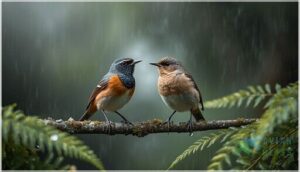
Telling male and female Varied Thrushes apart isn’t hard once you know where to look.
Males show a crisp black breast band contrasting against vivid orange — visible even from a distance.
Females wear a softer, brownish band, duller wing bar hue, and olive-brown upperparts.
Males also handle song role duties, while females take on nest building duties.
Weight variation between sexes is subtle, so plumage wins every time.
Juvenile Identification Tips
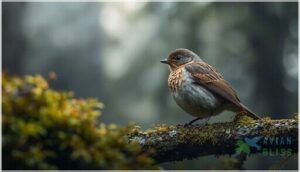
Young Varied Thrushes require a bit more patience to spot correctly. Look for chest mottling — speckled, scalloped markings instead of a clean band.
The belly contrast is your next clue: a white center against the darker breast.
Head markings look softer and browner than adults.
Wing bars still show orange, giving you solid confirmation of species identification even when everything else looks immature.
Differences From American Robin
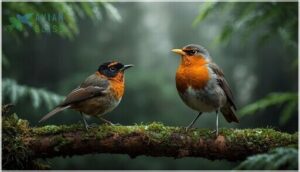
At first glance, a Varied Thrush and an American Robin look like cousins — and they’re both in the thrush family. But species identification gets easy once you know what to check:
- Plumage Contrast — The Varied Thrush has a bold dark breast band; the robin doesn’t.
- Bill Shape — Robin’s bill is longer and heavier.
- Posture Differences — Robins stand tall; thrushes crouch low.
- Song Structure — Robins sing cheerful phrases; the Varied Thrush delivers one long, eerie whistle.
Natural Habitat and Geographic Range
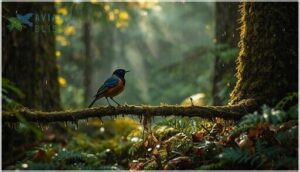
Knowing where the Varied Thrush lives makes it much easier to find one.
These birds have clear preferences — from the dense forests they breed in to the backyards they visit in winter.
Here’s a closer look at where they tend to show up and why.
Preferred Forest Environments
Varied Thrushes don’t just live in any forest — they’re picky about it.
They thrive in moist conifer canopy zones, where fir, hemlock, and spruce create cool, shaded conditions year‑round. Dense understory shrubs and ferns give them cover while foraging.
Old‑growth structure matters too, since mature trees support the rich forest floor they depend on.
Elevation gradients and canopy microclimate shape every habitat choice they make.
Pacific Coast and Inland Distribution
From Alaska down to northern California, the Coastal Breeding Range of Ixoreus naevius tracks the Pacific Coast’s temperate rainforests almost without a break. Inland, Thrushes shift elevation seasonally — breeding high, wintering low. Here’s how their range breaks down:
- Pacific Northwest – core Winter Coastal Residency zone
- Inland Elevation Shift – Rocky Mountain birds move downslope in fall
- Leapfrog Migration Pattern – northern birds bypass resident coastal populations
- Irregular Irruption Events – some years push Thrushes far east across the continent
Urban and Suburban Sightings
Even in cities, varied thrushes find their way in.
From late autumn through early spring, Seasonal Yard Visits become surprisingly common across Urban and Suburban Habitats — especially where Native Berry Planting and leaf litter mimic forest edges.
| Sighting Location | Key Attraction | Human Proximity Tolerance |
|---|---|---|
| Backyard feeders | Feeder Grounding, spilled seed | 4–5 meters |
| Park Edge Habitat | Dense shrubs, ravines | Low–moderate |
| Residential gardens | Native berries, brush piles | Moderate |
| Lakeside greenbelts | Fruiting trees, cover | Low |
| Suburban parks | Leaf litter, conifers | Moderate |
Diet and Foraging Habits
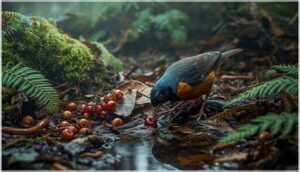
The Varied Thrush isn’t picky, but it’s practical — what it eats depends almost entirely on the season.
You’d be surprised how much its diet shifts between summer and winter.
Here’s a closer look at what fuels this bird throughout the year.
Insect and Arthropod Diet in Summer
prime hunting season for the Varied Thrush.
Its diet and foraging habits lean heavily on insects — beetles top the menu, dug from soil and debris through moist litter probing.
Ant trail exploitation keeps meals steady, while caterpillar feeding adds easy protein.
Millipede consumption rounds out this bird behavior pattern, showing just how well it reads the forest floor.
Fall and Winter Fruit Consumption
Once the cold sets in, the Varied Thrush trades insects for fruit — and it’s remarkably good at finding it. Across its wintering grounds, this thrush family member seeks out Native Berry Shrubs and fallen apples with quiet purpose. Fruit Ripening Timing shapes where Winter Fruit Flocks gather, and Apple Feeding becomes a daily routine.
Key cold‑season foods in their diet and foraging include:
- Snowberry, huckleberry, and salal berries
- Madrone and dogwood fruits
- Fallen apples in orchards and yards
- Toyon and manzanita berries
- Acorns and seeds when soft fruit runs short
Ground Fruit Foraging keeps them busy beneath shrubs, especially where dropped berries collect near the edges of mixed habitat.
Ground Foraging Behaviors
Beyond berries, the Varied Thrush is a methodical ground hunter.
Watch closely and you’ll notice its leaf‑toss technique — grabbing a dead leaf, hopping backward, then scanning the exposed soil.
Microhabitat selection matters here: they favor damp, shaded litter where insects stay active.
Their posture stays low and horizontal, and temporal activity patterns peak at dawn and dusk.
Attracting Varied Thrushes to Feeders
Since Varied Thrushes forage close to the ground, your setup needs to match that habit. Skip the hanging tube feeders — go low instead.
- Low Platform Placement near shrub cover, with cracked corn and white millet scattered on the tray
- Suet & Berries in a cage or smeared on bark near dense evergreens
- Shallow Birdbath with a dripper, kept ice‑free all winter
Stick to a consistent winter food schedule and they’ll find you.
Behavior and Breeding Patterns
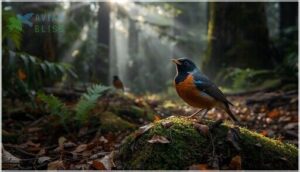
The varied thrush has a personality all its own — quiet, a little mysterious, and surprisingly territorial when the season calls for it.
Getting to know how it behaves on the ground and in the treetops tells you a lot about why it can be tricky to spot.
Here’s what you should know about its day-to-day habits and breeding patterns.
Secretive and Solitary Nature
The Varied Thrush is a master of staying hidden. Its camouflage plumage blends right into the forest shadows, making low profile behavior its default mode.
You’ll usually hear its quiet song before spotting it.
Shadowy foraging keeps it under dense cover most of the year.
Winter fluctuating sociality brings loose flocks briefly, but solitary habits quickly return.
Territorial and Social Behaviors
Though they prefer solitude, Varied Thrushes have a clear social structure once you know what to watch for. Males defend breeding grounds using tail‑lifting displays and head‑forward posture to warn rivals — no song needed.
Pair bond maintenance keeps mates working the same territory together. Come winter, hierarchy dynamics play out at feeders, where mixed‑species associations form loosely but dominance stays firm.
Haunting Calls and Song Patterns
The Varied Thrush’s bird call is one of the most unforgettable sounds in any forest. Those minor key melodies drift through the canopy like a slow exhale — eerie, beautiful, and sourceless. Whistle fade dynamics pull you in, then leave you waiting. After rain, song surges sharply.
The Varied Thrush’s call drifts through the forest like a slow exhale — eerie, sourceless, and impossible to forget
- Dawn chorus timing peaks in early spring
- Each whistle lasts several seconds before fading
- Pauses between notes run 3–5 seconds
- Rain-triggered song surges increase output sharply
- Canopy echo effects make the singer hard to locate
Nesting and Breeding Habits
When nesting season arrives, the female takes charge — scouting nest sites, gathering twigs, moss, and mud, and shaping everything into a sturdy cup lined with soft grasses.
Males defend the territory while she incubates eggs for 12–14 days. Both parents share parental feeding duties until fledglings leave around day 15.
| Nesting Stage | Key Detail | Timeframe |
|---|---|---|
| Nest Site Selection | Conifer branch, 5–15 ft high | April arrival |
| Egg Characteristics | Light blue, 3–4 per clutch | Laid after nest completion |
| Incubation Period | Female-led, male guards | 12–14 days |
| Parental Feeding | Both parents deliver insects | Days 1–15 post-hatch |
| Fledgling Development | Perching, still dependent | After day 15 |
Conservation Status and Migration
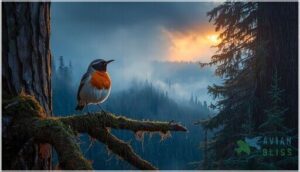
varied thrush faces real pressures in the wild, and understanding them helps you appreciate every sighting a little more.
From shifting populations to seasonal travel patterns, there’s a lot going on behind the scenes with this bird.
Here’s what you should know about where things stand.
Population Trends and Threats
The numbers tell a quiet but serious story. Varied Thrush populations dropped roughly 0.7% per year from 1966 to 2019 — a cumulative 32% decline rate that’s hard to ignore.
Key threats driving this trend include:
- Climate impact from warming temperatures shrinking suitable habitat
- Forest fragmentation breaking up the large forest blocks birds depend on
- Human mortality from window strikes, cats, and cars
- Monitoring gaps that make trend data harder to interpret
- Conservation status concerns, despite no current IUCN Watch List placement
Importance of Old-Growth Forests
Old-growth coniferous forests aren’t just pretty backdrops — they’re the Varied Thrush’s lifeline. These ancient stands deliver microclimate stability, keeping temperatures cool and humidity steady so nests don’t fail during heat waves.
Their structural complexity sustains insect diversity, giving birds reliable food all season. As biodiversity reservoirs and carbon sequestration powerhouses, protecting this nesting habitat isn’t optional — it’s the heart of any real ecological conservation strategy.
Seasonal Migration Patterns
The Varied Thrush doesn’t follow a simple here today, gone tomorrow schedule. Its Partial Migration means some coastal birds stay put while inland birds travel south.
Here are five key migration patterns worth knowing:
- Elevational Shifts push birds downslope each fall
- Timing of Departure begins around October
- Winter Range Expansion reaches California lowlands
- Irruptive Movements spike during poor food years
- Spring returns stretch into May
Conservation Efforts and Protections
Good news first: the Varied Thrush has legal protection under the Migratory Bird Treaty Act, making it illegal to harm, capture, or sell the bird.
But legal protection only goes so far.
Habitat Restoration, Climate Adaptation strategies, and Community Stewardship efforts all work together in species conservation efforts.
Monitoring Programs like the Breeding Bird Survey track population trends, helping guide wildlife habitat preservation and broader ecological conservation strategies.
Frequently Asked Questions (FAQs)
How rare is a Varied Thrush?
It depends on where you are. In the Pacific Northwest, it’s fairly common.
Elsewhere, it’s rare or a vagrant.
Despite Least Concern IUCN status, a 32% population decline raises real conservation concern.
What does a female Varied Thrush look like?
She’s softer‑toned than the male — warm buff‑orange underparts, a faint eyebrow stripe hue, muted wing bar intensity, brown tail tip coloring, and a pale bill color gradient from yellow to dark.
What do Varied Thrush eat in the winter?
In winter, they shift from insects to berries, acorns, and fallen fruit.
Snow-covered foraging keeps them busy, and they’ll visit feeders offering sunflower chips suet recipes, or a simple birdseed mix.
How do you identify a Varied Thrush?
Ever wonder what makes a forest bird truly unmistakable? Look for the bold orange breast band, striking wing bar contrast, short tail, straight bill shape, and orange leg color — those details nail the Varied Thrush every time.
What is a Varied Thrush?
The Varied Thrush is a stocky, striking songbird of the Pacific Northwest, known for its burnt orange breast, dark breast band, and haunting single-note whistle echoing through old-growth conifer forests.
Where do Varied Thrushes live?
Like a shadow slipping through wet trees, these birds call the dense coniferous forests of the Pacific Northwest, Alaska, and Canada home — from subalpine mossy slopes down to riparian thicket habitats.
What does a Varied Thrush eat?
Their diet shifts with the seasons. Beetles, ants, and caterpillars fuel summer nesting, while snowberries, madrone berries, and acorns take over in fall — a natural response to seasonal nutrient needs.
What is the difference between a Varied Thrush and a Robin?
Funny enough, most people assume they’re nearly the same bird.
But the American Robin favors open lawns, while the Varied Thrush retreats into shadowy conifer forests — two birds, two completely different worlds.
Why does the varied thrush sing at night?
Nighttime singing often comes down to acoustic advantage — quieter air carries sound farther.
Light pollution, rain-induced singing surges, and stamina signaling all push this songbird’s haunting whistle past sunset, reinforcing pair bonds when it matters most.
What inspires varied thrush songs during gloomy weather?
Gloomy, rain-soaked days trigger hormonal weather responses in songbirds, boosting testosterone and sparking territory defense whistles.
Acoustic rain advantages enhance their haunting calls, while seasonal gloom patterns and rain-triggered singing peak during wet, overcast spells.
Conclusion
most birds reward the bold watcher—bright colors, open perches, constant noise. varied thrush rewards patience.
It slips through the darkest corners of old‑growth forest, singing one long, ringing note and then going silent, as if testing whether you’re really listening.
Spot one at your feeder on a gray winter morning, and it doesn’t feel accidental. It feels like the forest sent you something.
Pay attention—that moment won’t last long.