
This site is supported by our readers. We may earn a commission, at no cost to you, if you purchase through links.

Along the rocky coasts of the North Atlantic, you’ll find one of nature’s most improbable-looking birds. The Atlantic Puffin sports a triangular beak painted in vivid orange, red, and yellow—colors so striking they earned the species its nicknames ‘sea parrot’ and ‘sea clown.’
But this seabird’s appearance is more than decorative. That distinctive beak acts as a fishing tool so efficient that puffins can carry up to 62 fish at once, lined up like sardines in a tin.
These adaptations have allowed Fratercula arctica to thrive in one of the ocean’s harshest environments, though changing seas now threaten their breeding colonies across Europe, North America, and Iceland.
Table Of Contents
- Key Takeaways
- Atlantic Puffin Species Overview
- Habitat and Geographic Distribution
- Diet and Foraging Behavior
- Breeding, Nesting, and Social Behavior
- Conservation Status and Threats
- Frequently Asked Questions (FAQs)
- What does an Atlantic puffin look like?
- Are Atlantic puffins monogamous?
- Are there puffins in the Atlantic Ocean?
- Where do puffins breed?
- Are Atlantic puffins solitary?
- How old is an Atlantic puffin?
- Where can Atlantic Puffins be found?
- Are Atlantic Puffins rare?
- Is the Atlantic puffin a penguin?
- How many Atlantic Puffins are left?
- Conclusion
Key Takeaways
- Atlantic Puffins can carry up to 62 fish at once using specialized beak spines and tongue mechanisms that stack prey crosswise, making them exceptionally efficient hunters despite their comical appearance.
- The species holds a “Vulnerable” conservation status with 12-14 million birds remaining globally, facing steep declines from climate-driven prey shifts that cause up to 90% chick mortality during warm years when herring and white hake migrate beyond foraging range.
- These seabirds maintain 85-93% lifelong pair bonds and return to identical burrows annually, with successful colonies like Maine’s Eastern Egg Rock growing from relocated chicks to 172 breeding pairs through sustained conservation efforts.
- Iceland hosts roughly 60% of the world’s Atlantic Puffins, but populations have crashed 33% since 2000, while Norway’s Røst colony suffered an 80% decline over four decades as warming seas disrupt the marine food web.
Atlantic Puffin Species Overview
The Atlantic Puffin is one of those seabirds that stops you in your tracks the first time you spot one. With its unmistakable appearance and quirky behavior, it’s earned a special place in the hearts of birdwatchers and marine enthusiasts alike.
Let’s start by looking at what makes this species unique, from its scientific classification to the distinctive features that earned it some pretty entertaining nicknames.
Taxonomy and Classification
The Atlantic Puffin, scientifically known as Fratercula arctica, belongs to the family Alcidae within the order Charadriiformes. You’ll find it grouped among the auks, with close evolutionary relationships to its Pacific cousins. The genus Fratercula includes three species, and taxonomic history reveals subspecies variation across the North Atlantic. Database recognition from IUCN and GBIF confirms its distinct classification established by Linnaeus in 1758.
These seabirds reside on North Atlantic rocky cliffs during the summer.
Physical Characteristics and Size
You’re looking at a compact seabird measuring 28 to 30 centimeters in length with a wingspan reaching 47 to 63 centimeters. Atlantic Puffins weigh between 310 and 550 grams—about the weight of a full beverage can. Males generally outsize females slightly during breeding months.
The beak morphology shifts with the seasons, stretching 4 to 5 centimeters and displaying vibrant reds and oranges in summer before dulling through winter. Plumage variation follows similar seasonal changes. These birds are known for their colourful beaks, which they shed after the breeding season.
Distinctive Features and Nicknames
Those bright triangular beaks earned Atlantic Puffins nicknames like “sea parrot” and “sea clown.” You’ll spot their striking plumage patterns—glossy black backs contrasting white underparts and pale gray face patches. Their upright posture on orange webbed feet resembles praying friars, inspiring the genus name Fratercula, meaning “little brother.”
Atlantic Puffins earned their sea parrot and sea clown nicknames from bright triangular beaks and striking black-and-white plumage that resembles praying friars
- Beak colors include orange-red, slate gray, and yellow sections
- Colorful beaks shed outer plates after breeding season
- Red orbital rings frame distinctive triangular-shaped eyes
- Naming origins trace to monastic robes and northern constellations
Habitat and Geographic Distribution
Atlantic puffins call the cold waters of the North Atlantic home, but their range isn’t as simple as you might think. These birds split their time between land and sea, choosing specific coastal regions for breeding while spending months far offshore during winter.
Let’s look at where you’ll find them throughout the year and which countries host the largest populations.
North Atlantic Coastal Regions

You’ll find Atlantic Puffin populations thriving along North Atlantic coastal regions from Maine and Canada through Iceland to Norway. These seabirds select rocky offshore islands for coastal nesting, where regional climate patterns support abundant fish stocks within their foraging range.
During non-breeding periods, migration routes extend southward across open ocean, though habitat threats from warming waters increasingly challenge traditional settlement areas.
Breeding Colonies and Nesting Sites

When you explore Atlantic Puffin breeding grounds, you’ll discover colonies ranging from hundreds to tens of thousands of pairs on predator-free islands. These bird colonies feature specific nesting success patterns tied to Site Fidelity and Population Dynamics:
- Burrow Characteristics: Tunnels extend 70-110 cm into turf soil on coastal slopes
- Colony Size: Maine’s Eastern Egg Rock grew to 172 pairs by 2024
- Nesting Success: Fledging rates reach 86% when fish stocks are abundant
Wintering Areas and Migration Patterns
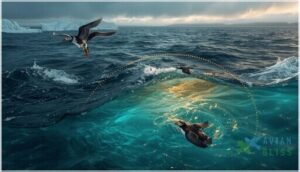
After breeding season ends, you’ll find Atlantic Puffins dispersing across vast North Atlantic waters for eight months. Tracking Technology reveals Migration Distances exceeding 7,700 km, with Sex Differences emerging—females from high Arctic colonies winter in warmer southern waters while males tolerate colder seas near ice edges.
These Avian Migration Patterns and Wintering Habitats reflect Climate Change impacts on Marine Ecosystem conditions, influencing subsequent breeding success.
Population Distribution by Country

You’ll discover Iceland hosts roughly 60% of all Atlantic Puffins—true Icelandic Dominance—though numbers fell 33% since 2000. Norway’s Røst colony suffered an 80% Norwegian Decline over four decades, while Scotland’s Isle of May shows promising UK Recovery with 33% growth since 2017.
Canadian Strongholds in Newfoundland shelter over 260,000 pairs, maintaining Genetic Diversity across distinct British Isles and North American populations.
Diet and Foraging Behavior
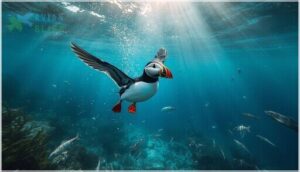
Atlantic puffins are fish-eating specialists that spend most of their lives at sea hunting for food. Their diet revolves around small schooling fish, and they’ve developed impressive underwater skills to catch them.
Let’s look at what these seabirds eat and how they’ve adapted to life as ocean hunters.
Primary Fish Prey Species
You’ll find the Atlantic Puffin’s menu dominated by white hake—roughly 75% of what chicks receive at Maine colonies. Atlantic herring, once a staple, has been declining, while butterfish shows a notable increase.
Regional variation matters: capelin fuels Newfoundland birds, sand eels sustain European colonies, and smelt or silversides supplement diets elsewhere.
These shifts directly affect Atlantic Puffin conservation efforts as prey availability changes.
Hunting and Diving Techniques
You’re watching avian behavior at its most active when an Atlantic Puffin dives. These seabirds reach swimming speeds up to 10 miles per hour, beating wings 400 times per minute. Dive depth generally stays under 15 meters, averaging 9.7 meters, though some reach 40 meters.
Diurnal variation shapes foraging range—peak hunting occurs at dawn and dusk, with 20-30 second underwater pursuits targeting schooling fish through visual prey capture.
Adaptations for Carrying Multiple Fish
You’ll notice Atlantic Puffins carry up to 62 fish simultaneously—an impressive feat enabled by specialized bill spine anatomy and a tongue fish clamp mechanism. These seabirds press prey against rough palatal spines, stacking 10 fish on average per trip.
Collection efficiency relies on bill grooves that align each catch crosswise. Trade-off constraints emerge during scarcity, when higher fish load quantity sometimes means reduced total mass, affecting chick provisioning success.
Seasonal Changes in Diet
Puffins don’t eat the same menu year-round—their diet shifts dramatically between seasons. During winter, Atlantic Puffins switch to a zooplankton diet with trophic level shifts of 0.65, while summer capelin dominance reaches 100% in adults feeding chicks. You’ll find local prey variation across colonies, though climate fishery impacts increasingly disrupt traditional marine ecosystem patterns, forcing Fratercula arctica to adapt feeding strategies.
Seasonal Diet Breakdown:
- Winter: 60-100% zooplankton including amphipods (Hyperia, Themisto)
- Summer breeding: 68-100% capelin or white hake in different regions
- Warm years: Increased butterfish and redfish replacing herring
- Colony differences: White hake dominates Maine (76%), varies elsewhere
Breeding, Nesting, and Social Behavior

Atlantic puffins return to the same nesting colonies year after year, creating a rhythm of life that’s equal parts charming and chaotic.
These seabirds are surprisingly social during breeding season, but their approach to family life involves some unique challenges. Let’s look at how they pair up, raise their young, and navigate life in crowded island colonies.
Mating Rituals and Pair Bonding
After months apart at sea, Atlantic puffin pairs reunite at breeding colonies with dramatic courtship displays. You’ll witness billing—where mates rub beaks together—reinforcing bonds that last for life. Over 90% of pairs stay together across seasons, making monogamy rates among seabirds remarkably high. Reproductive timing aligns with food availability, while divorce factors like breeding failure affect only 7-15% of pairs annually.
| Behavior | Function | Success Rate |
|---|---|---|
| Billing displays | Pair maintenance | 90%+ reunion rate |
| Synchronized return | Reproductive timing | Higher chick survival |
| Partner fidelity | Breeding efficiency | 85-93% mate retention |
Burrow Construction and Nesting Habits
Once pairs bond, you’ll see excavation behavior kick in as both mates dig burrows—males handle about 63% of the work. Burrow site selection favors steep, grassy slopes where 94% of puffin colony nests appear. These seabirds create tunnels averaging 88 cm long, lining chambers with grass for insulation. This bird habitat maintains temperatures 7-8°C warmer than outside, boosting puffling survival by 29%. Reuse frequency hits 70% in stable soils.
- Nesting materials like grass raise nest temperatures by 1.7°C
- Burrows curve toward chambers 22-30 cm wide
- Males contribute 63% of digging labor
- 73% of Atlantic Puffins nest in cliff-top turf
- Microclimate humidity stays 13-18% higher inside burrows
Chick Rearing and Fledging
After eggs hatch, you’ll observe chick growth accelerate between days 10-30 as parents deliver about 13 feedings daily at peak periods. Feeding frequency drives fledging success—2,500 fish over six weeks fuel that 75% adult weight target. The rearing length spans 38-50 days, depending on prey availability.
Post-fledging survival hinges on chick condition, with 95% of pufflings resighted within five years across Atlantic Puffins colonies.
Colony Dynamics and Social Structure
Within breeding colonies, you’ll notice Atlantic Puffins orchestrating complex social hierarchies that govern territory defense and courtship displays. Colony size varies dramatically—Iceland’s Westmann Isles hosts 4 million individuals, while smaller sites hold thousands. Group behavior includes billing rituals, territorial foot-stamping, and peaceful burrow-passing signals that maintain flock dynamics essential for wildlife conservation efforts.
- Monogamous pairs return to identical burrows annually, maintaining bonds exceeding 20 years
- Billing courtship attracts audiences of six birds, strengthening social bonds within auks communities
- Aggressive gaping and beak-locking establish nesting patterns and territorial boundaries
- Soldier-like guarding postures deter intruders near densely packed burrows
- Gene flow connects distant colonies differently than geographic proximity predicts
Conservation Status and Threats

Atlantic puffins face serious threats that have pushed their populations into vulnerable territory. Climate shifts, predators, and past human activities have all taken their toll on these charismatic seabirds.
Let’s look at the current status of puffin populations and the key challenges they’re up against.
Current Population Estimates
You might think Atlantic puffins are thriving, but the reality tells a different story. Global estimates place the population between 12 and 14 million mature individuals, yet the species carries a Vulnerable conservation status. Over 90% nest in Europe, with Iceland hosting roughly 60% of the world’s Atlantic puffins.
| Region | Population Estimate |
|---|---|
| Iceland | 8–10 million birds |
| North America | 750,000–760,000 birds |
| Europe (total) | 9.5–11.6 million adults |
Population trends reveal troubling declines across key breeding areas. The UK has lost 20–50% of its puffins since the early 2000s, while some colonies like Lundy Island collapsed from thousands to fewer than 20 breeding pairs.
Conservation efforts, including habitat protections and invasive predator removal, have sparked localized recovery strategies in select regions, offering hope for this charismatic seabird’s future.
Climate Change and Food Availability
Ocean warming drives prey shifts that reshape the Atlantic Puffin’s marine ecosystem survival. As herring and white hake migrate north and deeper at 1–8 km annually, you’re witnessing food scarcity reshape breeding success.
Climate change impact hits hard through:
- Marine heatwaves disrupting plankton blooms that feed fish
- Ocean ecology shifts forcing less nutritious prey substitutions
- Ecosystem disruption causing 90% chick mortality during warm, dry years
Ecological conservation efforts now prioritize tracking fish migration patterns.
Predators and Human Impacts
Great black-backed gulls kill adult puffins at colonies, while invasive species like rats devastate eggs and chicks—causing population drops of 99.7% on some islands. Marine threats from seals and fishing nets account for up to 10% of adult mortality annually.
Human exploitation through egg collection, pollution impacts from plastic ingestion, and oil spills compound these pressures, making Atlantic Puffin conservation urgent for endangered species protection.
Conservation Initiatives and Recovery Efforts
You’ll find hope in programs like Project Puffin, which relocated 954 chicks from Newfoundland to Maine starting in 1973, achieving 83% fledging success through Atlantic Puffin Conservation and Habitat Protection.
Conservation Biology efforts now span 500 sites worldwide, combining Invasive Species removal with Population Monitoring and social attraction techniques.
Wildlife Conservation Efforts focusing on Climate Resilience and Biodiversity Preservation, supported by Community Engagement, demonstrate Endangered Species Protection works when sustained long-term.
Frequently Asked Questions (FAQs)
What does an Atlantic puffin look like?
You’ll spot Atlantic Puffins by their unmistakable clown-like appearance—vivid orange beak colors splashed with yellow and slate, zebra-striped feather patterns of black and white, and those ridiculous orange webbed feet that make them waddle like tiny comedians.
Are Atlantic puffins monogamous?
Yes, Atlantic puffins are monogamous, forming lifelong pair bonds. About 85-93% return to the same partner each breeding season. Divorce rates remain low at 7-15%, usually triggered by reproductive failure or illness.
Are there puffins in the Atlantic Ocean?
The Atlantic puffin is the only puffin species in the Atlantic Ocean. You’ll find them across North Atlantic coastal regions, from Iceland to Maine, thriving in marine ecosystems where ocean wildlife and bird migration patterns converge.
Where do puffins breed?
You’ll find breeding colonies along rocky shores and nesting cliffs of the North Atlantic. Iceland hosts the largest sea colonies, followed by coastal habitats in Greenland, Norway, Canada, and breeding islands off Maine.
Are Atlantic puffins solitary?
It depends on the season. During breeding, these bird species thrive in dense colony dynamics with complex social interactions.
In winter behavior, they shift to social isolation, often engaging in solitary foraging across open ocean waters.
How old is an Atlantic puffin?
Wild Atlantic Puffins generally live 20 to 25 years, though longevity trends show some individuals reach 32 years.
Age records reveal survival rates depend on lifespan factors like food availability and predation affecting Fratercula arctica populations across their range.
Where can Atlantic Puffins be found?
You’ll find these seabirds across North Atlantic coastal habitats, from Eastern Canada to Europe. Their geographic range spans marine ecosystems throughout North America’s northeastern shores.
Iceland hosts about 60% of all Atlantic Puffins in island colonies.
Are Atlantic Puffins rare?
You won’t find these iconic seabirds on every coastline anymore. With 12–14 million Atlantic Puffins remaining globally and rapid population declines prompting vulnerable status, their rarity is growing concerning despite conservation efforts.
Is the Atlantic puffin a penguin?
No, they’re separate bird species from different evolutionary lineages. Puffins belong to family Alcidae in the Northern Hemisphere, while penguins are Spheniscidae family members found exclusively in southern waters.
How many Atlantic Puffins are left?
You might be surprised to learn that Atlantic puffins aren’t endangered yet—around 12 to 14 million mature individuals remain globally.
However, conservation status shows rapid population trends declining, threatening these iconic birds’ species survival.
Conclusion
For a bird nicknamed “sea clown,” the Atlantic puffin takes survival seriously. That gaudy beak isn’t just for show—it’s precision fishing gear honed by millennia of evolution.
Yet the same adaptations that let puffins thrive in the North Atlantic’s roughest waters can’t protect them from warming seas and collapsing fish stocks. Their future now depends less on nature’s design and more on whether we’ll act before these colonies disappear from coastlines they’ve occupied for thousands of years.