This site is supported by our readers. We may earn a commission, at no cost to you, if you purchase through links.
You’re watching what you assume is a male hummingbird dart between flowers when she suddenly wheels around, dive-bombs an intruder twice her size, and returns to her hidden nest woven from spider silk. That “drab” bird you almost overlooked? She’s a female hummingbird—and she’s running the show.
While males get attention for their flashy throat feathers and aerial stunts, females are the architects, warriors, and sole caretakers of the upcoming offspring. Their muted greens and browns aren’t a design flaw; they’re tactical camouflage that keeps predators away from nests and chicks.
Understanding how to spot these powerhouse birds reveals a hidden world of survival strategies, species-specific traits, and behaviors that put their showboating counterparts to shame.
Table Of Contents
- Key Takeaways
- Physical Characteristics of Female Hummingbirds
- Female Hummingbird Behavior and Roles
- Identifying Female Hummingbirds
- Female Hummingbirds by Species
- Habitat, Migration, and Conservation
- Frequently Asked Questions (FAQs)
- Are hummingbirds male or female?
- What is a female hummingbird like?
- How do you know if a hummingbird is male or female?
- What is the difference between male and female Anna’s hummingbirds?
- How can you tell a female hummingbird?
- What color is a female hummingbird?
- Do female hummingbirds have a red throat?
- Do female hummingbirds look different than males?
- How do female hummingbirds protect their nests from predators?
- What are the dietary needs of female hummingbirds during breeding season?
- Conclusion
Key Takeaways
- Female hummingbirds carry the entire reproductive burden solo—building nests from spider silk, defending territories against predators twice their size, and raising chicks through 18-28 days of intensive feeding without any male assistance.
- Their dull plumage isn’t a design flaw but tactical camouflage that reduces predator detection by over 70% compared to males’ iridescent feathers, with some females even developing male-like coloring to avoid social harassment.
- Females outweigh males by 15-25% across most species, prioritizing functional endurance and egg production over the aerial acrobatics males use for courtship, with longer wings and bills adapted for sustained foraging.
- A single female can defend territories containing over 1,000 flowers, sometimes nesting strategically near hawks to boost survival rates to 31%, demonstrating that survival intelligence outperforms any flashy display in the avian world.
Physical Characteristics of Female Hummingbirds
If you’re curious about what makes female hummingbirds stand out, you’re in the right place. Their bodies and feathers have unique features that set them apart from the males. Here’s what you’ll want to look for.
Duller Plumage Compared to Males
Plumage coloration in female hummingbirds isn’t just drab—it’s a masterclass in camouflage. While males flash vivid colors as visual signals for mating strategies, females blend into foliage with muted greens and browns.
This sexual dimorphism in feather structure gives females an edge: they avoid predators and protect nests, making dull plumage a survival trait, not a flaw. Female hummingbirds with male-like coloration experience reduced social harassment issues in their daily interactions.
Lack of Brightly Colored Gorgets
Beyond camouflage, female hummingbirds lack the shimmering gorgets that make males so eye-catching. Gorget coloration in males reaches over 70% light reflectance, while females measure below 20% in iridescence studies.
This isn’t an accident—color signal reduction protects nesting females from predators. Male vs female hummingbird characteristics show clear plumage evolution favoring survival over showmanship, making hummingbird identification tips straightforward once you know what to look for.
Understanding the differences in hummingbird species is essential for effective identification and appreciation of these birds.
Size Differences and Body Structure
Female hummingbirds outweigh males by 15–25% in most species—a size dimorphism that enables egg production and nest defense. Ruby-throated females average 3.6 grams versus males at 3.0 grams, while morphometric studies show females possess longer wings and bills.
Female hummingbirds outweigh males by 15–25%, prioritizing functional endurance and egg production over the aerial acrobatics males use for courtship
This body mass variance isn’t about plumage showmanship—it’s functional architecture. Wing span comparison reveals females prioritize endurance over the aerial acrobatics males use to court them.
Specialized Legs and Toes for Perching
Female hummingbirds possess four toes per foot—three forward, one backward—gripping perches with curved claws that lock onto branches. Their short legs can’t walk or hop; instead, leg structure evolved for flight balance and secure perching.
This toe anatomy lets them conserve energy by resting rather than hovering constantly. The backward hallux acts like a hook, stabilizing their grip even during strong winds.
Female Hummingbird Behavior and Roles

Regarding nurturing the upcoming cohort, female hummingbirds don’t just pull their weight—they carry the entire load. While males spend their days flashing colorful feathers and defending feeding territories, females take on every aspect of reproduction and parenting solo.
Here’s what sets their behavior apart from their flashier counterparts.
Aggressive Nest Defense
Regarding protecting their young, female hummingbirds don’t back down—even against predators twice their size. Their defensive strategies rely on aggressive display tactics, territorial marking, and smart nest site selection for nest predator avoidance.
You’ll witness females using:
- Rapid aerial attacks with sharp vocalizations
- Strategic nesting near hawks (boosting survival rates to 31%)
- Male-mimicking plumage in some species for camouflaging for defense
- Bluff charges against jays, snakes, and mammals
These nesting behavior patterns showcase how aggressive male behaviors pale compared to a mother’s fierce protection.
Nest Building Responsibilities
Regarding nest building, you’re watching a solo act of architectural genius. Construction Timeline spans 5–10 days as she makes hundreds of trips gathering spider silk, moss, and plant down. Her Material Gathering covers a 30-meter radius, while Nest Architecture features expandable walls and camouflaged exteriors.
This Energy Expenditure increases her metabolism by 30%, yet she carefully selects each Nest Site for maximum protection.
Raising and Caring for Young
Once eggs hatch, you’ll witness intensive Nestling Care as she feeds chicks three times hourly—regurgitating nectar and insects directly into their mouths.
Chick Development accelerates over 18–28 days through her relentless Maternal Strategies, with the Fledging Process marking independence.
She handles Brood Management solo, sometimes raising two clutches per season while maintaining aggressive territorial defense throughout these critical weeks.
Differences From Male Behaviors
While males chase everything that moves, you’ll notice Female Aggression in females stays focused on nest sites and feeding zones. Territorial Defense differs sharply between genders, shaping distinct Hummingbird behavior patterns:
- Males defend large territories year-round; females protect only nesting areas
- Male vs Female foraging shows males hoarding resources while females often share
- Gender Roles split after mating—he seeks new partners, she raises young alone
- Social Interactions among Female Hummingbirds include occasional resource-sharing, unlike solitary males
Identifying Female Hummingbirds
You’ve learned what makes female hummingbirds unique in their behavior and nesting habits.
Now it’s time to put that knowledge to work in the field. Let’s break down the specific markers you’ll use to confidently identify females from males and juveniles.
Key Visual Markers (Plumage, Throat, Size)
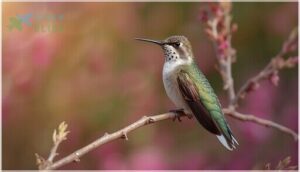
You’ll find female hummingbirds sport muted plumage patterns—metallic greens on the back with white or lightly streaked underparts. Their throat colors lack the vibrant gorgets males flash, showing plain white throats instead. Size variations reveal females are slightly larger, weighing 3–7 grams versus males’ 2–6 grams. Notice their rounded tail feathers with white edges—a telltale marker.
| Feature | Female Traits | Male Traits |
|---|---|---|
| Throat Colors | White, faint streaks | Striking iridescent gorgets |
| Plumage Patterns | Duller metallic green | Vibrant, colorful patches |
| Size Variations | 3–7 grams, slightly larger | 2–6 grams, smaller build |
Distinguishing Juveniles From Females
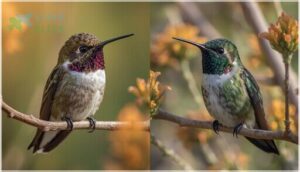
You’ll notice plumage patterns reveal key differences between female hummingbirds and juveniles. Juveniles display bolder throat streaks with early iridescent specks, while females show cleaner white throats.
Check for corrugated beak shapes in young birds—females have smooth bills.
Nesting behaviors confirm adults immediately, since juveniles don’t build nests.
Molting cycles also matter: juveniles show mixed feather colors from incomplete molts, unlike uniform adult plumage.
Common Mistakes in Gender Identification

Even after mastering those distinctions, you’ll still face sexing errors in field identification. Plumage variation trips up many observers—about 23% of species show females with male-like coloring, breaking traditional sexual dimorphism rules.
Behavioral misconceptions also cause mistakes: aggressive territorial displays don’t always mean “male,” since females fiercely defend nests.
Visual cues overlap more than you’d expect when identifying hummingbird gender.
Female Hummingbirds by Species

Each hummingbird species has its own signature look, and females show distinct patterns that set them apart from their flashy male counterparts. You’ll notice differences in color, size, and even behavior depending on which species visits your backyard.
Let’s break down what makes the females of common species unique so you can identify them with confidence.
Anna’s Hummingbird Female Traits
You’ll spot female Anna’s hummingbirds by their metallic green backs and grayish undersides, plus a subtle rose-colored gorget that catches the light.
They’re architects at heart, weaving nests from spider silk, lichen, and moss.
These urban adapters have expanded their range across the West Coast, defending feeding territories fiercely during nesting season. Females measure about 4 inches long and weigh 4-4.5 grams.
Ruby-throated Hummingbird Female Traits
While Anna’s hummingbirds hold court on the West Coast, ruby-throated females rule the East with equal tenacity. You’ll recognize them by their bright white throats—often lightly streaked—and emerald-green backs that shimmer in flight. They’re slightly heftier than males at 3.8 grams, with rounded tails tipped in white.
Female Ruby-throated Hummingbirds showcase exceptional traits:
- Nest Architecture: They craft camouflaged cups just 4 cm wide using spider silk and plant fibers
- Migration Patterns: They fly 800 km non-stop across the Gulf of Mexico, doubling fat reserves beforehand
- Breeding Cycles: Females lay one to two pea-sized eggs and raise chicks solo for about a month
- Plumage: Golden-green flanks catch sunlight beautifully, contrasting with their unmarked white breasts
Their feeding habits revolve around nectar-rich flowers and insects during the breeding season. Unlike males with flashy courtship displays, these female hummingbirds focus entirely on survival and reproduction. Hummingbird characteristics like slightly longer bills—up to 2 cm—help them access diverse flower types.
Conservation status remains stable, though habitat loss threatens eastern forests they depend on.
Rufous Hummingbird Female Traits
Heading farther west, you’ll find female Rufous Hummingbirds wearing bronze-green backs with rusty flanks—a subtle nod to their fiery name. These hummingbird species females weigh around 3.4 grams and lack the males’ iridescent red gorget, sporting instead a dull orange throat spot.
Their migration patterns span nearly 3,900 miles, with feeding habits focused on lower heights and fewer daily visits than males.
Other Notable Species Comparisons
You’ll notice interesting species variations beyond the main three—Broad-tailed females show streaky throat markings and longer, pointed tails compared to Rufous females’ smaller builds and spotted throats. Beak shapes differ too, with Broad-tailed hummingbirds having more curved bills.
Some species like buff-bellied and violet-crowned hummingbirds break the rules entirely, with males and females displaying nearly identical feather patterns that challenge traditional avian identification and classification methods.
Habitat, Migration, and Conservation

Female hummingbirds don’t just survive in your backyard—they’re on epic journeys that span thousands of miles, traversing habitats from coastal forests to mountain meadows.
Understanding where they live, how they travel, and what threatens their survival gives you a clearer picture of these extraordinary birds.
Let’s break down the habitats they favor, the migration routes they follow, and the conservation challenges they face.
Typical Habitats of Female Hummingbirds
You’ll find female hummingbirds thriving wherever nectar flows and shelter beckons. Their habitat preferences reveal adaptable survivors who’ve mastered diverse environments:
- Urban landscapes with feeders and flowering gardens
- Oak savannahs and coastal scrub offering natural nectar sources
- Riparian corridors near streams providing abundant insects and moisture
- Mixed woodlands and forest edges balancing food access with protective cover
- Nesting sites 6-20 feet high on horizontal branches near food sources
Conservation efforts increasingly focus on preserving these critical spaces where female hummingbirds build futures.
Migration Patterns and Routes
You’ll witness female hummingbirds embarking on remarkable journeys spanning up to 3,900 miles. Migration timing usually sees them departing 10 days after males in spring, following established routes with distinct stopover sites along coastlines and mountain meadows.
Their flight patterns reveal navigation prowess, using solar cues and magnetic fields, while route variations between females and males demonstrate strategic adaptations ensuring survival across generations.
Conservation Concerns and Challenges
You’ll face a sobering reality: female hummingbirds confront habitat loss, climate change impacts on flowering plants, and rising mortality rates during migration.
Habitat preservation strategies through wildlife conservation initiatives prove indispensable—planting native wildflowers, controlling invasive species, and supporting bird conservation efforts like the Recovering America’s Wildlife Act.
Environmental preservation combined with reduced pesticide use safeguards these extraordinary migrants and their breeding success.
Frequently Asked Questions (FAQs)
Are hummingbirds male or female?
Hummingbirds come in both male and female forms, with species showing roughly balanced sex ratios in the wild.
Sexing hummingbirds requires examining plumage, throat coloration, and behavior to distinguish male vs female individuals.
What is a female hummingbird like?
You’ll notice duller plumage on female hummingbirds—mostly green, brown, or gray tones covering 80-90% of their bodies. They lack the flashy gorgets males show off, but they’re slightly larger and built for the demanding work of nesting behavior.
How do you know if a hummingbird is male or female?
You can spot sexual dimorphism by checking the throat: males flaunt iridescent gorgets, while females display white or streaked throats.
Plumage differences are striking—she wears duller feather colors, he shows off vivid hues.
What is the difference between male and female Anna’s hummingbirds?
Like a jewel beside a gem, male Anna’s hummingbirds flash iridescent rose-red crowns and throats, while females display metallic green backs with white undersides and small red gorget patches—sexual dimorphism at work.
How can you tell a female hummingbird?
You can identify female hummingbirds by their duller plumage color, plain or streaked throats lacking bright gorgets, and slightly larger size.
Check feather patterns, beak shape, and observe nesting habits for accurate hummingbird identification techniques.
What color is a female hummingbird?
Female hummingbirds display duller plumage patterns than males—think olive green backs and white or grayish throats instead of flashy iridescence. Their muted color variations provide essential camouflage strategies while nesting.
Do female hummingbirds have a red throat?
Most species don’t sport vivid throat coloration—unlike males with their flashy gorgets.
Ruby-throated hummingbirds show white or grayish throats instead of ruby patches, though some females display minimal iridescence that’s barely noticeable.
Do female hummingbirds look different than males?
Yes, the differences between male and female hummingbirds showcase striking sexual dimorphism. You’ll notice plumage variation immediately—males sport iridescent gorgets and vibrant feather colors, while females wear understated, camouflaged tones for nesting protection.
How do female hummingbirds protect their nests from predators?
You’ll notice these tiny warriors use aggressive dive-bombing tactics and rapid aerial maneuvers to chase away threats.
They also camouflage nests with moss, lichen, and spider silk on concealed branches, making detection nearly impossible.
What are the dietary needs of female hummingbirds during breeding season?
During breeding season, you’ll notice protein intake jumps by 75% as insects and spiders become essential.
Nectar provides energy metabolism fuel, while dietary shifts balance nutrient demands for egg production and chick survival.
Conclusion
A single female hummingbird can defend a territory containing over 1,000 flowers, prioritizing caloric intake over everything else. That fierce dedication keeps her chicks fed and her bloodline alive.
When you learn to spot her muted greens, watch her patrol feeders, or catch her mid-construction on a nest, you’re witnessing survival intelligence that outpaces any iridescent display. She doesn’t need flash—she’s already rewriting what dominance looks like in the avian world.
- https://abcbirds.org/bird/annas-hummingbird/
- https://news.oregonstate.edu/news/rufous-hummingbirds-migration-looks-different-depending-age-and-sex
- https://en.wikipedia.org/wiki/Hummingbird
- https://bou.org.uk/blog_english_hummingbird_cons/
- https://journeynorth.org/hummingbirds/resources/article/facts-hummingbird-characteristics