This site is supported by our readers. We may earn a commission, at no cost to you, if you purchase through links.
 You’ll find bird facts about their mating rituals truly fascinating.
Birds use songs, dances, and dramatic displays to attract mates.
Male peacocks fan their feathers, while bowerbirds build elaborate structures decorated with colorful objects.
Some species perform synchronized dances – the albatross pair-bond can last 50+ years!
Western grebes literally run across water together.
Many birds are monogamous, though some males mate with multiple females.
The brighter the feathers or more complex the song, the healthier the bird typically is.
The natural world’s dating scene makes human courtship look simple by comparison, with birds using dramatic displays and having complex social behaviors.
Table Of Contents
- Key Takeaways
- Bird Mating Rituals
- Mating Strategies
- Courtship Displays
- Pair Bonding
- Reproduction Mechanics
- Frequently Asked Questions (FAQs)
- What are some interesting facts about bird mating?
- What do birds do when they are mating?
- What are the mating strategies of birds?
- What advantages do mating rituals present for the species of birds?
- How do birds show affection to their mate?
- Do female birds enjoy mating?
- What are bird mating rituals?
- Why do birds mate before they mate?
- Why are courtship rituals important in bird mating?
- Why do birds perform mating dances?
- Conclusion
Key Takeaways
- You’ll find birds using elaborate courtship displays including songs, dances, and dramatic visual demonstrations to attract mates, showcasing their health, strength, and genetic fitness.
- Birds exhibit diverse mating strategies from monogamy to polygamy, with about 90% of species practicing monogamy where both parents contribute to offspring care for better survival chances.
- Many birds form strong pair bonds through mutual preening, food sharing, and synchronized activities, with some species like albatrosses maintaining relationships for 50+ years.
- Bird reproduction occurs through a brief "cloacal kiss" where males and females press their reproductive openings together, with females able to store sperm for days or weeks before fertilization.
Bird Mating Rituals

In the context of bird mating rituals, you’ll find a fascinating mix of behaviors, from lively dances to sweet serenades.
These unique actions aren’t just for show—they play a vital role in attracting mates and ensuring successful reproduction.
Courtship Behaviors and Displays
Bird mating rituals are a spectacle of creativity! Many avian courtship displays include unique behaviors like gift-giving and food delivery.
You’ll see some species flutter wings or bob heads to impress a mate. Others go all out with nest building or a dramatic bird courtship dance.
These actions highlight strength, skill, and the dazzling allure of plumage displays. These behaviors, such as elaborate courtship dances, are essential for communication.
Mating Songs and Repertoires
Imagine a male bird serenading with a symphony of sounds—you’d think it’s auditioning for a talent show.
Song complexity and repertoire size are like a résumé in bird courtship, showcasing health and vigor.
Vocal learning shapes bird mating songs, and geographic variation adds accents to their love tunes.
Some even perform song duets, harmonizing beautifully to strengthen bonds during bird mating rituals.
These songs, unlike simple calls, are primarily used to attract potential mates in a display of bird mating rituals.
Monogamy and Lifelong Pairing
Monogamy in birds often means lifelong pairings with impressive pair bond stability.
Some species showcase deep connections through unique bird mating rituals. Bald eagles stick together, sharing offspring care. Swans mirror this commitment with lifelong bonds.
Highlights include:
- Mutual preening
- Joint nest building
- Shared feeding of young
- Synchronizing courtship behaviors
- Celebrating successful breeding seasons
Monogamy guarantees breeding success and stronger offspring.
Mating Strategies

In the context of mating, birds have evolved fascinating strategies to attract partners and guarantee reproductive success.
Some rely on colorful displays or songs, while others focus on defending territories or offering gifts like food.
Polygamy and Multiple Mating
Polygamous species embrace variety in their bird mating rituals.
Some males juggle multiple partners, prioritizing resource availability over parenting.
Female choice plays a big role—better territories often outweigh lacking male parental care.
Certain bird species mating habits, like those of hummingbirds or marsh wrens, show how mating strategies adapt for breeding success, showcasing nature’s knack for unpredictable love stories.
Territorial Defense and Competition
Territory isn’t just for raising young; it’s also a stage for fierce competition.
Males use vocalizations or bird aggression to claim space. Territory size often reflects a bird’s health and fitness.
Courtship behaviors can involve:
- Aggression displays like wing-flapping or chasing rivals.
- Fighting tactics to secure resource-rich areas.
- Vocal duels, turning tweets into territorial wars.
It’s nature’s drama in feathery form! Birds often engage in territorial defense strategies to protect their space.
Evolutionary Advantages of Mating Strategies
Bird mating strategies aren’t just flashy displays; they’re like nature’s auditions.
Sexual selection lets females use mate choice to find partners showing genetic fitness and resource allocation skills.
These traits mean healthier offspring and better survival chances.
In bird evolutionary biology, courtship behaviors showcase the best.
During the bird mating season, it’s all about impressing for success in the grand survival game.
Courtship Displays
You’ll often see birds perform fascinating displays to attract a mate, using everything from feather fluffs to elegant dances.
These behaviors showcase health, skill, and the ability to provide, making courtship displays both beautiful and essential for survival.
Singing and Vocalizations

Bird vocalizations during mating are like nature’s love songs.
Males use their voices to woo, boasting song complexity and vocal mimicry. Some, like mockingbirds, imitate sounds to impress.
Others engage in duet singing, strengthening bonds. You’ll even hear unique song dialects depending on the region.
In avian courtship, bird songs aren’t just melodies—they’re heartfelt messages. These songs can be influenced by environmental and social factors, which play a crucial role in shaping the vocal mimicry.
Displaying Feathers and Plumage

Songs may woo the ears, but feathers steal the eyes.
Many birds rely on plumage coloration and feather structure to charm mates. From displaying tail feathers to elaborate wing displays, these visual signals showcase health and vigor.
Feather maintenance is key—ruffled feathers don’t impress!
Avian courtship often means a bird’s plumage display reflects its effort, making courtship displays unforgettable displays of nature’s artistry.
Many species even utilize specialized decorative feathers to attract a mate.
Elaborate Dances and Aerial Displays

Bird courtship dances aren’t just visuals—they’re performances.
From duet dances to choreographed movements, every step counts. Take Laysan Albatrosses, perfecting partner routines, or Bald Eagles’ thrilling aerial acrobatics, locking talons in a "death spiral."
Western Grebes, meanwhile, master rushing displays, almost dancing on water.
These bird visual signals and wing fluttering spectacles showcase strength, compatibility, and flair in incredible bird mating behaviors.
Pair Bonding
You’ll find that many birds form strong pair bonds, working together to raise their young and protect their nests.
These connections can last a season or even a lifetime, showcasing teamwork that puts most human relationships to shame.
Formation and Maintenance of Pair Bonds
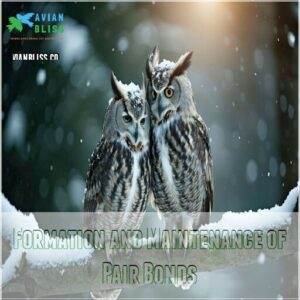
When birds form pair bonds, it’s like a well-choreographed dance of trust and teamwork.
They use rituals like preening, feeding, or singing to cement their bond. Strong pair bond strength boosts cooperative breeding and lowers divorce rates.
Owls, for example, often engage in mutual preening rituals to reinforce their bonds.
- Shared grooming: Preening reinforces trust.
- Gift-giving: Food exchanges demonstrate commitment.
- Synchrony: Singing or nesting in unison strengthens partnerships.
Importance of Monogamy in Bird Species
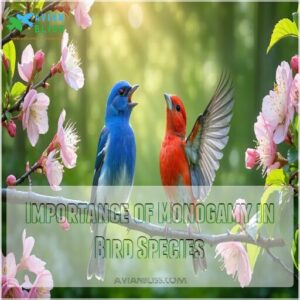
Among avian families, monogamy serves as nature’s blueprint for successful reproduction.
You’ll find that nearly 90% of bird species practice monogamy, ensuring both parents contribute to offspring care.
This partnership improves breeding success by allowing consistent nest protection and feeding routines.
Bird monogamy isn’t always about romance—it’s about evolutionary stability and efficient resource allocation.
In most cases, bird pair bonding guarantees the survival advantage of having two dedicated parents rather than one.
Strategies for Maintaining Pair Bonds
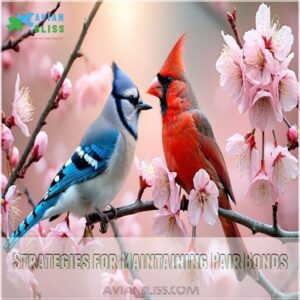
How do birds keep their relationships strong? Through mutual preening, where partners groom each other’s hard-to-reach feathers.
You’ll notice many bird partnerships involve food sharing, with males often bringing treats to females. Nest building together strengthens pair bonds, while vocal communication helps mates stay connected.
Some species use synchronized activities like flying or singing duets. These bird bonding habits guarantee successful mating and cooperation when raising young.
Many resources explore avian relationship dynamics, which can provide deeper insights into bird pairing.
Reproduction Mechanics

You’ll find that birds have some of the most efficient and fascinating reproductive systems in the animal world.
Most birds mate through a simple "cloacal kiss," where they briefly press their reproductive openings together to transfer sperm.
Cloacal Kiss and Sperm Transfer
When two lovebirds get intimate, they don’t kiss with lips but perform a "cloacal kiss" instead. You’ll find this fascinating reproductive behavior in nearly all bird species.
Here’s what happens during this swift encounter:
- Males and females press their swollen cloacas together
- Sperm transfers in less than a second
- The female stores sperm in her oviduct
- Fertilization occurs when sperm swim upward
- This quick process helps birds avoid predators.
Hormones play a key role in avian reproductive physiology, which is crucial for reproductive success and helps ensure the fertilization process is efficient.
Anatomy of Bird Reproductive System
Now that you’ve learned about the cloacal kiss, let’s look at what makes bird reproduction possible.
Unlike mammals, birds have streamlined reproductive systems designed for flight efficiency.
| Feature | Male Birds | Female Birds |
|---|---|---|
| Main Organs | Paired testes (internal) | Single ovary (usually left) |
| Size Changes | Enlarge during breeding | Ovary expands dramatically |
| Sperm Path | Testes → Cloaca | Ovary → Oviduct → Cloaca |
| Special Adaptation | Produce millions of sperm | Sperm storage tubules |
| Transport Method | Direct cloacal contact | Egg moves through oviduct |
Female birds can store sperm in specialized tubules for days or weeks after mating, allowing egg fertilization at the ideal time.
Evolution of Bird Mating Strategies
Beyond the physical mechanisms of reproduction, bird mating strategies have evolved over millions of years through sexual selection. You’ll notice that different environments shape how birds choose mates and reproduce.
- Sexual selection drives the evolution of elaborate courtship displays
- Environmental influences determine resource allocation for mating efforts
- Genetic fitness is communicated through specific behaviors and physical traits
- Behavioral adaptations vary widely between species with similar habitats
- Bird mate choice often reflects trade-offs between parental care and attraction
The variety of strategies and adaptations highlights the complexity of bird mating, influenced by both genetic and environmental factors, including the impact of elaborate courtship displays and the role of genetic fitness.
Frequently Asked Questions (FAQs)
What are some interesting facts about bird mating?
Did you know birds are the Romeos and Juliets of the wild?
You’ll find birds dancing, singing, and building nests to woo mates.
Some pair for life while others juggle multiple partners, with some birds exhibiting a variety of mating behaviors.
What do birds do when they are mating?
When birds mate, they perform a "cloacal kiss" where their reproductive openings touch briefly. Most species do this after courtship displays like singing, dancing, or gift-giving to attract their partners.
What are the mating strategies of birds?
You might think birds keep it simple, but they don’t.
They use elaborate dances, songs, nest-building displays, and gift-giving to attract mates, with strategies ranging from lifelong monogamy to seasonal polygamy, which includes polygamy.
What advantages do mating rituals present for the species of birds?
Mating rituals help you select the healthiest partners, guarantee genetic compatibility, strengthen pair bonds, and coordinate reproduction timing.
They’re nature’s way of making sure only the fittest birds pass their genes along.
How do birds show affection to their mate?
You’ll see birds showing affection through mutual preening, food sharing, gentle touches, and synchronized movements.
They’ll duet in song, build nests together, and perform special dances that strengthen their unique bond.
Do female birds enjoy mating?
While we can’t know birds’ subjective experiences, female birds actively choose mates and participate in courtship.
You’ll notice they’re selective and won’t mate unless physiologically ready and properly stimulated by displays.
What are bird mating rituals?
Just like you might dress up for a date, birds perform elaborate courtship dances, sing songs, and build nests to attract mates.
You’ll see males showing off colorful feathers and offering food gifts.
Why do birds mate before they mate?
Birds perform courtship rituals before actual mating to test compatibility, demonstrate health and strength, and guarantee genetic fitness.
You’ll notice these displays help birds choose the best partner for producing healthy offspring.
Why are courtship rituals important in bird mating?
As intricate as a waltz between lovers, courtship rituals help you identify healthy mates, establish pair bonds, and stimulate the physical changes needed for reproduction.
They’re nature’s way of ensuring successful offspring, which is a crucial aspect of reproduction.
Why do birds perform mating dances?
You’ll see males dancing to showcase their strength and genetic fitness.
These performances help females select the healthiest mates, while also stimulating hormonal changes needed for successful reproduction in both birds.
Conclusion
Have you ever wondered what makes bird facts about their mating rituals so fascinating?
From the peacock’s magnificent tail to the bowerbird’s artistic nest, these behaviors showcase nature’s creativity.
Whether singing complex melodies, performing synchronized dances, or maintaining decades-long partnerships, birds demonstrate that courtship isn’t just functional—it’s an art form.
Next time you spot birds in your backyard, you’re witnessing behaviors perfected over millions of years of evolution, making our dating apps seem rather primitive by comparison, highlighting the complex melodies in their songs.
- https://join.birds.cornell.edu/ea-action/action?ea.client.id=1806&ea.campaign.id=24577&ea.tracking.id=LBO&__hstc=75100365.237ddccf7eb284fb9f6372467aa35c80.1557849168143.1576604739182.1576615806525.398&__hssc=75100365.3.1576615806525&__hsfp=4250418031
- https://academy.allaboutbirds.org/
- https://www.smithsonianmag.com/smart-news/female-budgies-choosing-mates-prioritize-smarts-over-beauty-brawn-180971242/
- https://goo.gl/maps/6NAS9Gn6oVQii3V98
- https://twitter.com/hannahjwaters/status/1095756775243026432