This site is supported by our readers. We may earn a commission, at no cost to you, if you purchase through links.
 Bird facts about bird songs reveal nature’s incredible communication system.
You’ll discover that songbirds produce complex melodies using a specialized voice box called the syrinx, which lets them create two distinct sounds simultaneously.
These feathered performers aren’t born knowing their tunes—they learn songs during a critical period, much like you learned language as a child.
Different bird populations develop unique dialects based on their location, creating regional "accents" that vary across territories.
Males typically sing to defend their turf and attract mates, while the rapid-fire notes can contain dozens of sounds per second.
The science behind these vocal gymnastics gets even more fascinating, with birds using their songs to communicate in complex ways, including to attract mates and defend their turf with intricate melodies.
Table Of Contents
- Key Takeaways
- Birds Sing to Communicate
- What is Bird Song and Why is It Important
- The Unique Characteristics of Songbird Vocalizations
- How Birds Learn to Sing and Develop Their Repertoire
- The Science Behind Bird Song Production
- The Influence of Bird Song on Music and Culture
- Frequently Asked Questions (FAQs)
- Conclusion
Key Takeaways
- You’ll discover that songbirds create complex melodies using a specialized voice box called the syrinx, which lets them produce two distinct sounds simultaneously—something no human singer can match.
- You can witness nature’s sophisticated communication system where birds don’t just sing for pleasure, but use songs to defend territories, attract mates, and signal their health status to other birds in the area.
- You’ll find that young songbirds aren’t born knowing their tunes—they learn songs during a critical period by listening to adult tutors, then practice relentlessly until they’ve mastered their species’ repertoire.
- You can observe how different bird populations develop unique dialects based on their location, creating regional "accents" that vary across territories, similar to how humans develop regional speech patterns.
Birds Sing to Communicate
When you hear a bird’s melodic song at dawn, you’re witnessing one of nature’s most sophisticated communication systems in action.
Every dawn chorus is nature’s daily reminder that the most beautiful conversations happen without words.
Birds don’t just sing for pleasure—they’re sending targeted messages to defend their territories, attract potential mates, and broadcast their health status to the surrounding avian community.
Defending Territories With Song
When you’re listening to morning bird songs, you’re actually eavesdropping on nature’s property disputes. Each melodic territorial defense broadcast establishes clear bird territories through song complexity and aggression signals.
Males use their syrinx to create dialect defense patterns, with territory size often correlating to vocal strength.
These bird vocalization duels determine who gets the prime real estate without physical confrontation, showcasing the importance of territorial defense.
Attracting Mates Through Vocalizations
Beyond defending turf, you’ll discover birds use song complexity to woo partners.
Female preference drives males to perfect intricate melodies, showcasing vocal fitness for mate selection.
Think of it as nature’s talent show—the most elaborate performances win hearts.
Some species even engage in duet singing, creating harmonious partnerships.
These mating calls transform simple sounds into sophisticated avian communication systems that guarantee successful mating.
Signaling Health and Strength
When you hear a bird’s song complexity and vocal stamina, you’re witnessing nature’s fitness test.
Pitch accuracy and trill rate reveal a male’s health status, while repertoire size demonstrates genetic quality.
This avian communication serves as musical bragging rights:
- Strong songs indicate superior immune systems and overall health
- Complex melodies showcase cognitive abilities and neural development
- Consistent bird vocalization proves reliable energy reserves for reproduction
Risks of Singing: Energetic Costs and Predation
While showcasing strength through bird songs attracts mates, it comes with serious downsides.
Think of singing as running a marathon while wearing a neon sign – you’re burning energy and broadcasting your location to every predator nearby.
Bird songs are nature’s high-stakes poker game—revealing your hand while betting everything on the perfect melody.
Here’s what birds risk when they sing:
- Energy expenditure – Vocal fatigue from extended singing duration drains essential resources
- Predator attraction – Loud bird vocalization acts like a dinner bell for hunters
- Territory exposure – Revealing exact locations compromises safety during bird behavior displays
- Risk mitigation becomes essential – Smart birds balance communication needs with survival instincts
What is Bird Song and Why is It Important
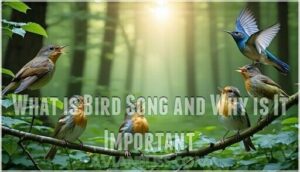
When you listen to a bird’s melody outside your window, you’re hearing one of nature’s most sophisticated communication systems that serves far more complex purposes than simple noise-making.
Bird songs aren’t just pleasant sounds—they’re structured vocalizations that birds use to attract mates, defend territories, establish social hierarchies, and maintain the intricate social networks that keep avian communities functioning smoothly, which is a key aspect of their social networks and helps in establishing social hierarchies.
The Difference Between Songs and Calls
When you’re out bird watching, distinguishing between songs and calls becomes essential for understanding animal communication.
Bird songs showcase intricate vocal structure and song complexity, primarily used during breeding seasons for territory claims and mate attraction.
Meanwhile, bird calls serve immediate call purpose with sharp, simple sounds—think alarm alerts or flock coordination.
Context matters substantially: songs demonstrate elaborate bird vocalizations, while calls prioritize signal clarity for urgent bird communication needs.
Functions of Song in Male and Female Birds
While songs and calls serve different purposes, bird songs function like nature’s dual-purpose toolkit.
You’ll find bird song function operates as both weapon and advertisement – males repel rivals while attracting potential mates.
Female bird songs aren’t just background vocals; they defend territories and maintain pair bonds just like their male counterparts.
In tropical regions, female song function becomes even more prominent, with many species engaging in coordinated duetting roles.
These bird vocalizations showcase fitness levels, with complex melodies serving as song fitness signals that communicate health, strength, and genetic quality to potential partners and competitors alike.
How Birds Use Song to Establish Dominance
Beyond attracting mates, you’ll witness songbirds wielding their vocalizations like musical weapons in territorial battles.
These vocal bragging contests showcase fitness signaling through song complexity, where birds engage in duel singing to establish dominance hierarchies:
- Territorial defense through powerful, sustained melodies
- Volume competitions that demonstrate physical strength
- Song complexity battles showcasing mental prowess
- Counter-singing duels between neighboring rivals
- Vocal endurance tests proving superior stamina
It’s nature’s version of a rap battle!
The Role of Song in Avian Social Structure
Bird songs create intricate social structures that go far beyond simple dominance displays.
You’ll find songbirds using vocalizations for kin recognition, helping family members identify each other in crowded flocks.
Group cohesion strengthens through shared melodies, while alarm signaling protects entire communities from predators.
Duet functions between paired birds reinforce bonds, creating a sophisticated social hierarchy where bird communication orchestrates survival itself.
The Unique Characteristics of Songbird Vocalizations
You’ll discover that songbirds possess a remarkable vocal organ called the syrinx, which allows them to create sounds more complex than any human singer could imagine.
Unlike your single voice box, this specialized structure enables birds to produce two completely different notes at the same time, creating the intricate melodies and rapid trills that make their songs so enchanting, with the ability to produce complex sounds.
The Syrinx: a Specialized Voice Box

What makes a songbird’s voice so special? Their syrinx, nature’s most advanced sound system, sits where the windpipe branches into two tubes.
This remarkable syrinx anatomy gives birds an evolutionary advantage over other creatures:
- Located at the trachea’s split for maximum airflow control
- Contains vibrating tissues called labia for sound production
- Operates independently from mammals’ larynx-based systems
- Enables incredible vocal range spanning multiple octaves
- Powers complex bird song production through specialized bird anatomy
Unlike your voice box, this organ revolutionizes how bird songs emerge, making vocal learning possible through precise anatomical design.
Independent Muscle Control for Complex Songs

You’ve probably wondered how birds create those jaw-dropping songbird melodies that sound impossibly complex.
Their Syrinx Muscle Control works like having two independent sound systems, with Brain Song Control orchestrating each side separately.
The Wood Thrush demonstrates this perfectly—layering mini-trills with sweeping tones requires precise Vocalization Energetics and timing.
This bird song complexity lets them perform vocal learning feats that’d make any musician jealous, creating bird songs through masterful Song Complexity Factors.
Producing Two Distinct Sounds Simultaneously
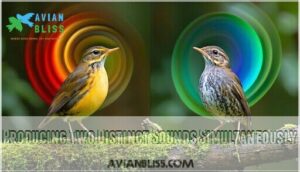
You’ve probably heard a piano, but imagine if it could play two melodies simultaneously—that’s what songbirds do with their syrinx anatomy.
Through independent control of each syrinx side, species like the Wood Thrush and Brown Thrasher create stunning dual harmonies.
This remarkable vocal range transforms simple bird songs into nature’s most sophisticated vocalizations through advanced bird sound production.
Here’s how syrinx mastery works in bird song analysis:
- Each syrinx side operates independently, like having two separate instruments
- Birds can sing rising notes on one side while producing falling tones on the other
- The Wood Thrush creates its signature flute-like trills using this dual-channel system
- Brown Thrashers showcase over 1,000 song types through this anatomical advantage
Rapid Vocalizations: a Key to Songbird Success
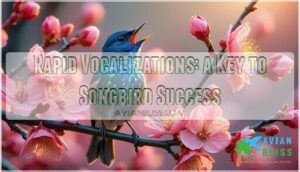
You’ll hear songbirds master rapid vocalizations through remarkable syrinx mechanics, switching between notes faster than you can blink.
Their vocal agility spans an incredible pitch range, with trill speed reaching lightning-fast sequences that’d make pianists jealous.
These energetic demands create complex bird songs that showcase fitness—perfect tools for attracting mates and defending territory through sophisticated song learning techniques.
How Birds Learn to Sing and Develop Their Repertoire
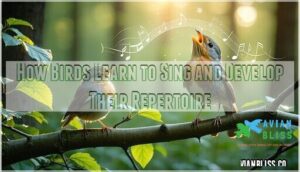
Young songbirds don’t instinctively know their tunes—they learn by carefully listening to adult birds during a critical early period.
Through trial, error, and endless practice, they refine these sounds into the complex songs you hear today.
The Critical Period: a Time for Learning
During the critical period, young birds set out on their song acquisition journey, watching for a "tutor" to copy.
This fleeting window shapes their tunes through:
- Tutor influence: Adult songs guide learning.
- Dialect formation: Regions create unique styles.
- Sensory feedback: Birds adjust by hearing themselves.
- Cognitive development: Fine-tuning builds precision.
Errors? Sure, but practice eventually refines their melodies!
Practice and Refining Song Through Repetition
Songbirds don’t just wake up singing perfectly—they practice.
During song learning, they refine their melodies through repetition and trial-and-error exercises. Think of it like nature’s talent show, where "bird tutors" are the judges.
Here’s how songbirds improve their craft:
- Repetition: Sharpening their vocal practice duration to master every note.
- Feedback mechanisms: They listen for responses from their environment.
- Persistence: Neuroplasticity effects enhance their ability to improve daily.
- Observation: Watching others builds mimicry skill refinement.
A bird’s song repertoire size depends on effort, feedback, and sheer determination!
Vocal Mimicry in Certain Species
You’ll be amazed by nature’s most talented copycats! Mockingbirds and brown thrashers showcase incredible bird mimicry skills, copying sounds from other species with stunning mimicry accuracy.
Northern Mockingbirds can imitate over 200 different sounds, while 24% of corvid species exhibit vocal mimicry.
| Species | Mimicry Skills | Mimicry Purpose |
|---|---|---|
| Lyrebirds | Multiple species during displays | Mate attraction |
| Grey Parrots | Human speech mimicry | Communication |
| Mockingbirds | 200+ different sounds | Territory defense |
Mimicry evolution suggests this ability developed as a cognitive byproduct rather than direct adaptation. Bird song mimicry serves various functions—confusing predators, attracting mates, or establishing territory.
However, mimicry limitations exist, as not all species can master this skill equally well.
Individual Variation in Song Patterns
Just like human voices, each bird’s song carries its own signature sound.
You’ll notice these individual bird song patterns emerge through several fascinating factors:
- Age-related changes: Young birds start rough, refining their bird song repertoire over time
- Habitat influence: Forest birds sound different than meadow singers
- Genetic factors: DNA shapes natural vocal tendencies
- Social learning: Birds copy neighbors, creating unique bird song dialects
The Science Behind Bird Song Production
You can actually see bird songs when scientists transform these complex vocalizations into visual patterns using specialized equipment that captures sound waves and frequency changes.
These scientific tools, including spectrograms and waveform analyzers, reveal the hidden physics behind how birds create their intricate melodies through precise muscle control and air pressure within their unique syrinx organ.
Sound Visualization: a Tool for Analysis
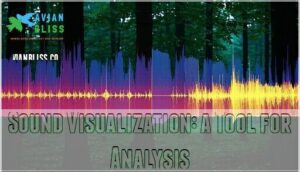
Picture transforming bird songs into visual masterpieces – that’s exactly what sound visualization accomplishes.
Spectrograms turn melodies into colorful charts, revealing hidden patterns in avian communication. These bioacoustic research tools map pitch against time, creating unique acoustic fingerprinting for each species.
Spectrogram analysis reveals song complexity that your ears might miss, showing trills, harmonics, and rapid frequency changes.
Modern bird song spectrogram technology lets researchers decode nature’s secret language, making invisible sounds visible through sophisticated waveform interpretation and detailed song analysis.
Researchers can even find spectrogram related products to aid in their work.
Waveforms: Measuring Changes in Loudness

When scientists analyze bird songs, they use waveforms to track how sound intensity changes over time.
These visual representations show waveform amplitude – basically how loud each note gets.
You’ll see peaks and valleys that reveal the bird’s vocal power, measured through decibel measurement techniques.
Loudness perception varies dramatically between species, with some birds producing whisper-soft calls while others belt out ear-splitting territorial songs.
This sound visualization method helps researchers understand exactly how much energy birds invest in their vocalizations during song analysis.
Spectrograms: Visualizing Pitch and Loudness
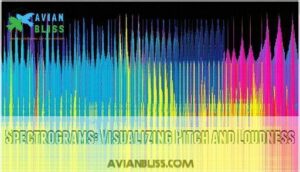
While waveforms show loudness changes over time, spectrograms reveal the complete acoustic picture of bird songs.
These colorful sound maps display both pitch and amplitude visualization across time-frequency dimensions, making sound interpretation incredibly detailed.
Spectrogram analysis transforms bird sound analysis into an art form:
- Watch trills appear as rapid zigzag patterns dancing across the display
- See pure whistles emerge as clean, straight horizontal lines
- Observe complex harmonics stacking like musical layers in a cake
- Notice how different species create unique frequency representation fingerprints
- Discover hidden details your ears might miss in real-time listening
This sound visualization technology revolutionizes bird song identification.
Researchers often utilize specialized spectrogram analysis tools for detailed studies.
The Physics of Bird Song Production

Beyond pitch and loudness patterns, bird song production operates on fascinating physics principles.
You’ll find that syrinx mechanics involve precise muscle contractions creating sound frequency variations.
Songbird aerodynamics help shape acoustic properties as air flows through the trachea.
The syrinx generates oscillations that become complex vocalizations, with vocal range determined by biomechanical parameters working together seamlessly.
The Influence of Bird Song on Music and Culture
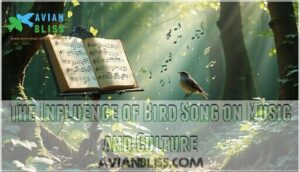
You’ve probably hummed along to a bird’s morning song without realizing you’re experiencing one of humanity’s oldest musical influences.
From classical composers like Beethoven incorporating nightingale melodies into symphonies to modern musicians sampling actual bird recordings, these natural virtuosos have shaped our musical landscape for centuries.
Proving that nature’s concert hall continues to inspire human creativity across all genres and cultures, these influences have been a constant source of inspiration, making human creativity a boundless and ever-evolving entity.
Composers Inspired by Bird Melodies
Throughout musical history, you’ll discover how bird songs have captivated composers, transforming natural melodies into timeless masterpieces.
These feathered virtuosos sparked creative inspiration across centuries.
- Messiaens Birdsong: Olivier Messiaen painstakingly transcribed bird calls into complex orchestral works
- Beethovens Pastorale: Symphony No. 6 features unmistakable cuckoo and nightingale imitations
- Vivaldis Influence: "The Four Seasons" incorporates elaborate birdsong passages
Modern interpretations continue this musical influence today.
Incorporating Bird Song Into Musical Works
When you hear bird songs woven into classical symphonies, you’re experiencing Birdsong Imitation at its finest.
Composers use Melodic Integration and Rhythmic Adaptation to transform natural calls into structured melodies.
This musical influence creates Harmonic Influence through Soundscape Composition, where bird song in music composition becomes pure inspiration.
Musicians layer these natural sounds with instruments, creating pieces that feel both wild and refined—nature’s soundtrack meeting human creativity in perfect harmony.
The Use of Bird Song in Contemporary Music
Contemporary composers are revolutionizing electronic music through sophisticated sampling birdsong techniques, transforming nature’s melodies into digital masterpieces.
Modern avant-garde composition embraces these natural sounds in four key ways:
- Sound art installations featuring live bird recordings
- Birdsong synthesis using digital instruments and software
- Real-time bird music integration during performances
- Environmental creative inspiration driving eco-centric musical storytelling
This bird song in music composition movement connects listeners with nature’s endangered chorus.
Bird Song as a Source of Creative Inspiration
Musicians find their Natures Muse when bird songs trigger fresh Musical Inspiration. These natural melodies spark Artistic Interpretations across genres, from classical composers weaving avian themes into symphonies to modern artists sampling actual bird music.
Creative inspiration flows as bird song in music creates emotional depth, while Birdsong Therapy helps artists connect with nature’s rhythms.
The connection between birdsong and music leads to several creative outcomes, including:
- Literary Symbolism emerges through birdsong metaphors
- Sound textures expand musical palettes
- Natural patterns inspire compositional structures
Frequently Asked Questions (FAQs)
What are bird songs?
Sure, you’ve heard chirping, but bird songs aren’t just noise. They’re complex melodies produced by a specialized voice box called the syrinx, used for attracting mates and defending territories.
What do you know about bird sounds?
Birds create sounds using their syrinx, a unique voice box that lets them sing two notes simultaneously.
You’ll hear songs for mating and territory defense, plus shorter calls for daily communication needs.
Which Bird Sings the most?
You’ll find the Red-eyed Vireo holds the record, singing over 22,000 songs in a single day.
These tireless performers can belt out 40 songs per minute during peak breeding season, earning them the nickname "preacher bird.
Why are bird songs important?
Like nature’s social media, bird songs aren’t just pretty melodies—they’re essential survival tools.
You’ll find they defend territories, attract mates, and communicate danger.
Each chirp carries information about health, strength, and species identity.
How do birds make songs?
You’ll be amazed that songbirds create music using a special voice box called the syrinx.
It’s located where their windpipe splits, letting them sing two different notes simultaneously—like having a built-in harmony machine!
Are bird songs Random?
No, you’ll discover bird songs aren’t random at all.
They’re carefully structured compositions with specific purposes like attracting mates, defending territory, and communicating danger.
Each species follows distinct patterns passed down through generations, with specific purposes that are essential to their survival.
Why do birds use bird songs?
Just as Shakespeare wooed audiences with eloquent verse, you’ll find birds use songs as nature’s ultimate pickup lines and property deeds—defending territories while attracting mates.
Through melodic displays of strength and genetic fitness.
What makes a bird a bird song?
A bird’s song differs from calls through its complexity and purpose.
You’ll recognize songs as longer, melodic vocalizations used for attracting mates and defending territory, while calls are shorter sounds for immediate communication.
How do birds know what song to sing?
Young songbirds learn their melodies by listening carefully to adult tutors, especially their fathers, during a critical learning period while they’re still nestlings.
Then they practice relentlessly until they’ve mastered their species’ repertoire.
What do song birds represent?
Like nature’s poets penning verses at dawn, songbirds represent freedom, hope, and renewal in cultures worldwide.
You’ll find them symbolizing joy, communication, and the soul’s connection to the divine across literature and spiritual traditions, embodying renewal.
Conclusion
Understanding these remarkable bird facts about bird songs opens your eyes to nature’s sophisticated communication network.
You’ve discovered how the syrinx creates dual melodies, learned about territorial dialects, and explored the critical learning periods that shape avian vocals.
From defending territories to attracting mates, these feathered virtuosos use complex vocalizations that rival human music in intricacy.
Next time you hear morning chirping, you’ll appreciate the incredible science behind each note—nature’s own musical masterpiece unfolding right outside your window.