This site is supported by our readers. We may earn a commission, at no cost to you, if you purchase through links.
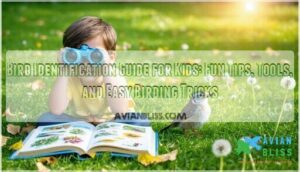 A bird identification guide for kids teaches them to spot and name feathered friends right in their own backyard.
Start with a field guide designed for young birders—look for big pictures, simple descriptions, and fun facts.
Pair it with kid-friendly binoculars so they can see details like a robin’s red chest or a woodpecker’s spotted wings.
Encourage them to notice size, shape, colors, and even bird songs—every chirp tells a story.
Keep it exciting by turning birding into a game or journal project.
With the right tools and a bit of curiosity, they’ll soon be little ornithologists in the making!
Table Of Contents
- Key Takeaways
- Getting Started With Bird Identification
- Best Bird Identification Guide for Kids
- Essential Tools for Young Birders
- Identifying Birds Using Field Guides
- Focus on Identifying Features
- Learning Bird Calls and Songs
- Observing Bird Behavior
- Being a Bird Detective
- Exploring Different Bird Species
- Encouraging Kids to Love Birding
- Frequently Asked Questions (FAQs)
- Can kids identify birds?
- Why does bird identification enrich the experience of birdwatching for kids?
- How to identify garden birds with kids?
- How can I learn to identify birds?
- How can you identify a bird using a field guide?
- What can kids do with a birdwatching checklist?
- What are the 5 S’s of birding?
- Is the Audubon Bird Guide free?
- How to classify birds for kids?
- Is there a free app that identifies birds?
- Conclusion
Key Takeaways
- Help kids identify birds by focusing on size, shape, color patterns, and listening to their songs—these clues make it easier to match species in guides or apps.
- Use kid-friendly tools like colorful field guides, simple journals for tracking discoveries, and lightweight binoculars to make birdwatching exciting.
- Turn bird identification into a family adventure with fun games like bird bingo, scavenger hunts, and creating a bird-friendly backyard with feeders and plants.
- Encourage kids to notice bird behaviors like feeding, nesting, and flying patterns to deepen their connection with nature and spark curiosity.
Getting Started With Bird Identification
When you’re getting started with bird identification, focus on observing the simple details like size, shape, and color.
It’s like solving a mystery—each bird has unique "clues" to discover, and noticing these can make birdwatching both fun and rewarding.
Why Teach Kids Bird Identification
Getting into bird identification for kids is like discovering a nature treasure hunt—it sparks curiosity and hones observation skills.
They’ll start seeing nature like budding scientists, noticing small details.
Plus, it offers so much more:
- Boosts appreciation for nature’s beauty
- Strengthens observation skills through birdwatching
- Encourages scientific skills like classification
- Fosters family activities that connect everyone outdoors
Benefits of Bird Identification for Kids
Discovering bird identification for kids is like handing them a nature treasure map.
A bird guide for kids is like a magic key, unlocking nature’s secrets one feathered friend at a time.
They gain observational skills, deepen their connection with nature, and spark curiosity about the environment.
Birdwatching fosters environmental stewardship and boosts science interest, offering fun ways to bond as a family while exploring the outdoors.
Whether spotting tiny hummingbirds or majestic raptors, kids learn patience and focus.
Here’s a quick table showing benefits:
| Benefit | Why It Matters | Fun Fact |
|---|---|---|
| Nature Connection | Builds love for the environment | Birds live on all seven continents! |
| Skill Development | Encourages keen observation | Identifying birds sharpens memory and focus. |
| Family Bonding | Shared moments outdoors | Birdwatching is a top family-friendly hobby. |
| Science Interest | Inspires curiosity about biology | Many scientists began as young birdwatchers. |
| Environmental Stewardship | Promotes conservation efforts | Watching birds connects kids to local wildlife. |
Best Bird Identification Guide for Kids
Finding the right bird guide for kids can make birdwatching easier and way more fun.
Look for guides with colorful photos, simple descriptions, and lightweight designs to keep young explorers engaged without feeling overwhelmed.
Kid-Friendly Features to Look For
A kid-friendly bird guide should feel like a fun treasure map, not homework.
Look for:
- Simplified layouts that are clutter-free and easy to scroll through.
- Engaging photos and vibrant drawings to make identifying birds exciting.
- Portable guides that kids can easily carry on walks.
- Age-appropriate language that breaks down tricky bird terms into simple nuggets kids will love.
Recommended Bird Guides for Kids
If you’re choosing a bird identification guide, start with one designed for kids’ interests and ages.
“The Young Birder’s Guide to North America” is packed with expert recommendations, while “National Geographic Kids Bird Guide” balances visual preferences with facts.
For a pocket-friendly option, try the “National Society First Field Guide: Birds.”
Pair these with apps like Merlin Bird ID!
Many resources are available for young bird enthusiasts, making it easier to find the perfect guide.
Essential Tools for Young Birders
If you’ve got a budding birder at home, a few essential tools can make their birdwatching adventures extra exciting.
From binoculars that fit small hands to journals for jotting down discoveries, having the right gear keeps the experience fun and rewarding, with essential tools being key to the adventure.
Binoculars for Kids

Not all binoculars are created equal, especially for young birdwatchers! Make sure they fit snugly in small hands.
Here’s what to look for:
- Magnification Power: Stick to 7x or 8x for steady, clear views.
- Ergonomic Design: Lightweight and comfy are key.
- Durability Testing: Rugged models handle drops like pros.
Consider durable options for kids during your selection.
Bird watching for kids just got easier!
Field Guides and Birding Apps
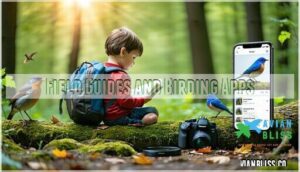
Field guides and birding apps both make bird identification exciting.
Print guides are portable with vibrant illustrations, but apps like Merlin Bird ID add convenience with real-time updates and sound identification.
For young birders, essential guides are available.
Compare these tools in the table below:
| Feature | Print Guide | Birding App |
|---|---|---|
| Portability | Lightweight | Phone-dependent |
| Guide Features | Photos, maps | Songs, real-time |
| App Updates | Nonexistent | Frequent |
| Digital vs. Print | Physical copies | Interactive |
| App Accuracy | Not applicable | Advanced AI |
Books suit offline adventures; apps enhance tech-savvy exploration!
Bird Journals and Notebooks
Bird journaling adds excitement to bird watching while improving observation skills.
Think of it as your bird adventure notebook, perfect for kids’ birds or family outings!
- Note sightings: List every feathered friend.
- Sketch birds: Practice creative expression.
- Record behaviors: What’s the bird up to?
- Track sounds: Write chirps and calls for better identification later.
Identifying Birds Using Field Guides
Using a field guide makes identifying birds simple and fun by showing you what to look for, from colors to habits.
With clear descriptions and pictures, you’ll feel like a bird detective piecing together clues in no time.
How to Use a Field Guide
Think of your field guide as a tool for solving bird mysteries. Flip through its guide layout for vibrant photos, short species descriptions, and always handy range maps.
Spot a feathered friend? Match it by size, color, or visual clues using the index. Here’s a quick look:
| Feature | Purpose |
|---|---|
| Photos | Identify by sight |
| Descriptions | Learn behaviors |
| Range Maps | Spot habitats |
| Visual Clues | Note key markers |
| Quick Reference | Locate efficiently |
Have fun exploring—your kids’ bird adventures just got easier!
Understanding Bird Descriptions and Range Maps
Using a bird guide is like deciphering a mystery, and it starts with mastering description components and range map keys.
Descriptions cover sizes, shapes, colors, and even behaviors—think of them as nature’s cheat sheet! For instance, spotting an American Robin’s bright orange belly or a cardinal’s fiery plumage becomes a thrill.
Next, range maps show where birds live, migrate, or vacation. These map projections highlight seasonal ranges and habitat indicators, helping you predict who’s visiting your backyard.
It’s like discovering birds’ secret hideouts! With practice, bird identification becomes second nature. Grab a guide, get curious, and explore the feathered world with confidence!
Recognizing Common Bird Species
Recognizing birds nearby can feel like solving a backyard puzzle!
Start small by spotting local birds like robins or sparrows in familiar bird habitats such as gardens or parks.
Use bird identification guides or apps for quick tips. Look for patterns: bright feathers, behaviors, or chirps.
Keep things fun by matching seasonal birds to changes around you. With practice, kids can identify bird families like pros—and enjoy every discovery!
Focus on Identifying Features
When you’re watching birds, pay close attention to details like size, shape, and color patterns—these clues help you quickly narrow down the species.
Don’t worry if two birds seem alike at first; even small differences, like beak shape or leg length, can make all the difference.
Size and Shape of Birds

Every bird tells a story with its relative size and body shape.
Is it sparrow-small or eagle-large?
Look at wing shapes—some are broad like umbrellas, others narrow like arrows.
Notice beak sizes—tiny like tweezers or big like pliers.
Add leg lengths to the mix; are they stilt-long or sneaker-short?
These bird identification features sharpen your bird identification skills and make spotting kids’ birds fun!
Color Patterns and Field Marks

Mastering bird identification starts with spotting plumage variation and recognizing unique spotting patterns on feathers.
Does your bird wear stripes or spots? These clues reveal much about species, regional differences, or even seasonal changes.
With practice, you’ll notice cool features like color mutations, helping sharpen your bird identification skills.
Each discovery turns bird watching into an exciting detective game, giving kids birds a story all their own!
Beak Shape and Leg Length

A bird’s beak and legs are like nature’s toolkit, revealing its lifestyle and habitat.
Beaks come in many shapes, each suited for specific tasks like a:
- Hooked beak for tearing meat.
- Thin, long beak for sipping nectar.
- Wide, flat beak for scooping water.
- Short, strong beak for cracking seeds.
Legs offer habitat clues too! Wading birds have long legs to stalk through water, while short legs often mean hopping along branches.
Spot these in your next bird watching adventure!
Learning Bird Calls and Songs
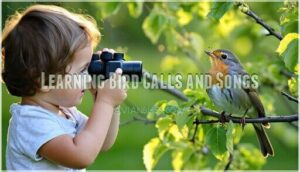
Learning bird calls can feel like deciphering a secret code, helping you identify birds even when you can’t see them.
Start by listening closely to the chirps in your backyard—you might be surprised how quickly your ears become your best birding tool!
Why Bird Calls Are Important
Listening to bird vocalizations is like tuning into nature’s secret language.
Listening to bird songs feels like unlocking nature’s hidden symphony—a secret language that opens a world of discovery!
Bird calls and songs aren’t just pretty sounds—they’re essential for species recognition and understanding behaviors.
Birds use these sounds to defend territories, attract mates, and warn of predators.
For kids, learning bird sounds adds a fun twist to bird identification, turning them into detectives of the natural world.
Imagine hearing a call and knowing, “That’s a cardinal, protecting its space!”
Identifying bird communication brings depth to birding, making every outdoor adventure a richer, more exciting experience, and helping to understand the importance of bird identification.
Tips for Learning Bird Calls
Imagine bird calls as nature’s playlist!
Start with common bird vocalizations, focusing on regional dialects—even backyard birds have accents.
Pair recording calls with field guides to match sounds.
Use call mimicry to remember tricky ones, and spot song variations like a bird detective.
Call mnemonics, such as “cheeseburger” for a chickadee, help too, and embrace mistakes—they’re part of bird identification fun, with key elements being call mimicry, and nature’s playlist.
Observing Bird Behavior
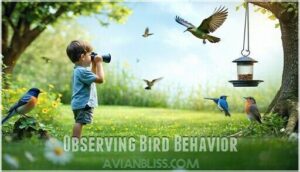
Watching how birds move, eat, and interact with their surroundings reveals clues about their identity and habits.
Pay attention to behaviors like hopping, soaring, or even splashing in water—it’s like solving little birdy mysteries!
The Importance of Bird Behavior
Understanding bird behavior makes birdwatching even more fun, like solving nature’s puzzles.
Birds communicate constantly—watch their feeding habits or quirky mating rituals to learn their secrets.
Their social interactions feel like a bird soap opera! Marvel at migration patterns as they conquer seasons with grace.
Birds are nature’s storytellers, revealing tales if you watch closely.
Common Bird Behaviors to Observe
Ever wondered why birds act the way they do?
Watching feeding habits is fascinating—they’ll peck at seeds or snatch bugs with precision.
Spot their mating rituals, filled with fluttering dances or melodic calls.
Observe social behavior, like playful chases or group preening, that hints at their hidden dynamics.
Their flight patterns are mesmerizing, with loops and glides that show off their skills.
Finally, note their clever habitat use, from building nests to perching perfectly.
Birdwatching for kids turns these small actions into cool discoveries!
Interacting With The Environment
Birds interact with their surroundings in clever and sometimes surprising ways.
Watching them in action sparks curiosity and also teaches kids about habitat preservation and bird conservation.
Whether it’s a chickadee building a nest from twigs or a goldfinch snacking on nyjer seeds, every behavior highlights the ecosystem’s impact.
If you’re observing birds, focus on these three fascinating interactions:
- Feeder Frenzy: Birds love feeders filled with black oil sunflower seeds and suet—perfect for birdwatching from home!
- Nesting Nooks: Birds nest creatively—up in trees, under eaves, even in mailboxes.
- Water Wonders: Splashes in birdbaths show how critical clean water is.
By understanding these behaviors, you’re contributing to protecting bird habitats from pollution effects and climate change!
Being a Bird Detective
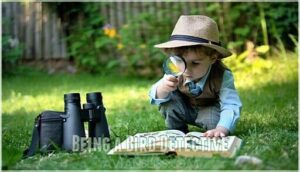
Put on your detective hat and learn to spot fascinating bird clues hiding in plain sight.
From feathers and tracks to nests and even poop, every little detail tells a story about the birds in your area, with complete concepts like these being crucial for understanding.
Feather Evidence and Bird Tracks
When bird watching, don’t overlook feather evidence and track shapes—they’re nature’s clues waiting to be cracked.
Feathers hint at bird ID, from colors to patterns, and they reveal habits like preening or molting.
Look closely at track shapes and foot morphology in mud or snow; kids can learn how birds’ gaits differ—like perching birds hopping versus ground feeders walking.
Habitat clues like bird droppings or feathers near food sources add to the mystery. With a little detective work, bird watching transforms into a fun and scientific adventure!
Nests and Nesting Materials
Take a closer look at bird nests, and you’ll uncover fascinating secrets about their builders!
Birds craft nests in many shapes and locations: cup nests made of grass, platform nests built with sticks, or hidden cavity nests tucked inside tree trunks.
Watch for birds carrying materials—twigs, moss, or even spider webs. These tiny architects know their stuff!
Studying nests helps with bird identification for children and adds excitement to bird watching for kids. Just remember, admire nests from a distance to avoid disturbing the building process or nest defense.
Bird Poop Clues and Scavenger Hunts
Bird poop might seem gross, but it’s like a nature journal you can read! Poop identification helps kids uncover clues about bird diets, health, and habitats.
Make it a scavenger hunt and see what you can find:
- Chalky white droppings? Likely fish-eaters left those behind.
- Purple-stained splats? Somebody’s been feasting on berries!
- Dark smears with seeds? That’s the work of songbirds.
Always wear gloves for dropping analysis—it’s science, not mess. Who knew bird identification could be this fun?
Exploring Different Bird Species
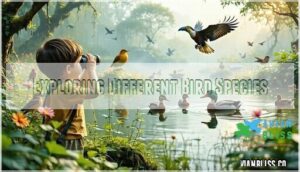
You’ll discover that birds come in all shapes, sizes, and habits, from soaring raptors to tiny, buzzing hummingbirds.
Exploring different species helps you notice their unique features, making birdwatching even more exciting and rewarding.
Raptors and Birds of Prey
Imagine spotting a hawk gliding gracefully above an open field—that’s a raptor in action! These incredible hunters thrive with sharp talons, curved beaks, and keen eyesight, each adaptation fine-tuned for dominance.
Owls use silent flight for stealth, while eagles soar majestically in search of prey.
Study their nesting behaviors and habitats using a field guide or bird identification apps. Raptors also play essential roles in ecosystems, balancing prey populations naturally.
Waterbirds and Seabirds
Waterbirds and seabirds bring the coastal habitats alive with their unique behaviors and adaptations.
Whether you’re exploring wetlands or watching shorebirds along the beach, here’s what to look for as you plunge into bird identification:
- Pelicans scoop fish with expandable throat pouches.
- Plovers perform a quick “foot-trembling dance” to lure worms.
- Cormorants stretch their wings wide to dry after prolonged dives.
- Oystercatchers crack open shellfish with their powerful bills.
- Herons, like statues, patiently wait before striking prey.
Bird guides or apps are excellent bird identification resources—perfect for understanding seabird diets or waterfowl migration patterns!
Hummingbirds and Songbirds
Few birds captivate like hummingbirds, with their dazzling feathers and ability to hover mid-air.
Offer some Hummingbird Nectar in a feeder to draw these acrobatic marvels to your backyard.
Nearby, you might hear songbirds creating a birdsong variety that turns your outdoor space into a lively concert.
From warblers to sparrows, they thrive on diverse songbird diets, including seeds and insects.
Don’t miss identifying their seasonal migration patterns, which add excitement to bird identification for beginners and families.
Backyard habitats offer endless chances for exploration—discover birds with your favorite bird identification books and tips today!
Encouraging Kids to Love Birding
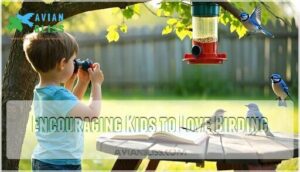
You can spark a love for birding by keeping it fun, easy, and full of discovery.
Simple activities like creating a bird-friendly backyard or joining a local birding group can make it exciting for kids to observe and learn.
Making Birding Fun and Engaging
Turn your birdwatching outings into a joyful adventure! Sprinkle some excitement by trying these fun birding games:
- Organize a bird-themed scavenger hunt, matching photos to actual sightings on nature walks.
- Craft colorful cards to play memory games featuring backyard birding favorites.
- Shout “Bingo!” during playful rounds of **Bird Bingo.
- Challenge kids to friendly birding competitions, spotting species first.
These activities nurture curiosity, strengthen a nature connection, and make bird identification fun!
Creating a Bird-Friendly Backyard
Attracting birds to your backyard is easier than you’d think!
Start with native plants—they’re like a buffet for backyard birds, offering food and shelter.
Add variety with bird feeders filled with seeds, suet, or nectar.
A simple birdbath doubles as a water source and splash zone.
Want more feathered friends? Build or buy DIY bird houses to give them safe nesting spots.
These small changes create backyard habitats birds can’t resist!
Joining a Local Birding Community
Joining a birdwatching community can turn bird identification into a family adventure!
Local clubs offer plenty for young birders:
- Group bird walks: Explore with experienced birders.
- Mentorship opportunities: Kids learn from the pros.
- Community events: Festivals create fun memories.
- Citizen science projects: Contribute to research!
- Local conservation efforts: Teach care for nature.
It’s all about connection, learning, and growing a passion for birdwatching together.
Frequently Asked Questions (FAQs)
Can kids identify birds?
Imagine this: a curious kid spots a colorful bird and wonders what it is.
Yes, kids can identify birds!
Start small—learn shapes, colors, and songs.
With practice, they’ll become confident little bird detectives.
Why does bird identification enrich the experience of birdwatching for kids?
Learning to identify birds adds adventure to birdwatching by transforming it into a discovery game.
You’ll notice unique features, behaviors, and songs, making each sighting memorable while sparking curiosity about nature’s winged wonders.
How to identify garden birds with kids?
Don’t worry if birds all seem like "brown blobs" at first!
Look for details like beak shape, size, and colors.
Use a guide or app together, and listen closely—bird songs are nature’s cheat sheets!
How can I learn to identify birds?
Start by observing size, shape, and color patterns of birds around you.
Pay attention to behaviors and habitats, listen to their calls, and use a field guide or app to match details, focusing on complete concepts.
How can you identify a bird using a field guide?
Think of a field guide as your bird detective manual.
Match the bird’s size, color, and markings to guide photos or descriptions.
Check range maps and habits, then celebrate identifying your feathered suspect!
What can kids do with a birdwatching checklist?
You can track the birds you’ve spotted, feel like a detective cracking nature’s code, and set fun challenges like spotting five new species this month.
It’s a simple way to stay curious and engaged, and by doing so, you can make the experience even more fun.
What are the 5 S’s of birding?
The “5 S’s” of birding—sort, search, study, sketch, and share—help you enjoy birdwatching.
The process involves sorting species by habitat, searching patiently, studying details like markings, sketching observations, and sharing your findings to build connections!
Is the Audubon Bird Guide free?
Yes, the Audubon Bird Guide is free.
You can download their app, which offers detailed species information, photos, and bird calls.
It’s a lightweight, pocket-friendly digital guide perfect for bird enthusiasts of all ages.
How to classify birds for kids?
It’s funny how birds divide themselves into groups naturally—like kids at lunch.
Teach kids to classify birds by size, color, beak shape, and habitat, turning backyard birdwatching into a fun, hands-on science activity!
Is there a free app that identifies birds?
You can try Merlin Bird ID, a free app that identifies birds by answering a few questions or uploading a photo.
It’s intuitive, fun, and perfect for curious beginners—and adults will enjoy it too!
Conclusion
Picture yourself as a birding detective, like Sherlock with binoculars—exciting, right?
A bird identification guide for kids transforms backyard birdwatching into a fun, educational adventure.
By using field guides, kid-friendly binoculars, and honing skills like spotting colors or listening to bird songs, kids get both entertainment and science rolled into one.
Encourage them to jot their findings in a journal, making every observation a story.
With curiosity and the right tools, nature’s wonders are only a chirp away!
- https://www.birds.cornell.edu/k12/teaching-bird-id/
- https://www.allaboutbirds.org/news/
- https://shop.adventurewithkeen.com/product/kids-guide-to-birds-of-new-york/
- https://www.amazon.com/bird-book-kids/s?k=bird+book+for+kids
- https://gibbs-smith.com/products/kid-s-guide-to-backyard-birds?srsltid=AfmBOopTjlHExc8Q2ZMpLQcGtkuJzbYewuIGdT9UyF7S1yYJGt3Sdv7p