This site is supported by our readers. We may earn a commission, at no cost to you, if you purchase through links.
You’ll miss 80% of field marks if your binoculars can’t resolve fine feather details at 30 yards—the difference between identifying a Cooper’s hawk and a sharp-shinned hawk often comes down to millimeters of tail banding that mediocre optics simply blur together.
After two decades of ornithological fieldwork across six continents, I’ve watched countless birders struggle with equipment that undermines their observations, from budget models that fog internally during dawn migrations to heavy European glass that fatigues your arms before the morning warbler wave ends.
The best binoculars for birdwatching balance optical precision with real-world durability, delivering edge-to-edge sharpness in a package you’ll actually carry through mudflats and montane forests without second-guessing the weight.
Table Of Contents
- Key Takeaways
- Essential Features in Birdwatching Binoculars
- Top 7 Binoculars for Birdwatching
- Binocular Price Ranges and Value
- How to Choose Birdwatching Binoculars
- Caring for Your Birdwatching Binoculars
- Frequently Asked Questions (FAQs)
- What strength of binoculars is best for bird watching?
- Which is better for birding, 8×42 or 10×42?
- How far can you see with 10×42 binoculars?
- What are the best birding binoculars?
- Are binoculars good for bird watching?
- Should you buy a binocular below 30mm for bird watching?
- Are budget tier binoculars good for birdwatching?
- Which binoculars are best for wildlife spotting?
- Which binoculars are best for astronomy?
- What strength binoculars are best for bird watching?
- Conclusion
Key Takeaways
- You’ll want 8×42 binoculars for most birding situations because they balance magnification with field of view and hand stability, while 10×42 models work better for distant observations where image shake becomes acceptable
- ED glass with fully multi-coated lenses and phase-corrected roof prisms separates mediocre optics from instruments that reveal subtle plumage details, with premium coatings pushing light transmission above 90 percent
- Waterproof construction with nitrogen or argon purging isn’t optional—internal fogging during temperature shifts will compromise your views exactly when you need sharp optics most
- Mid-range binoculars between $200-$500 deliver professional-grade optical quality with ED glass and durable construction, making them the sweet spot for serious birders who don’t need European flagship models
Essential Features in Birdwatching Binoculars
Your binoculars become an extension of your eyes in the field, so choosing the right features isn’t about specifications alone—it’s about understanding which characteristics actually matter when you’re tracking a warbler through dense foliage or scanning a distant shoreline for shorebirds.
Understanding how binoculars fit your observing style and environment helps you make choices that enhance every moment in the field.
Choose binoculars that reveal field marks in real birding moments, not just impressive specifications on paper
Over years of fieldwork across different habitats, I’ve learned that five specific features consistently separate functional optics from truly outstanding ones. Let’s break down what you should prioritize when selecting binoculars that won’t let you down during those critical identification moments.
If you’re shopping on a budget, my full guide to selecting quality birding binoculars under $300 covers models that nail these features without breaking the bank.
Magnification and Objective Lens Diameter
Magnification and objective lens diameter form the core specification you’ll see stamped on every pair—8×42, 10×42, and so on. These numbers reveal optical tradeoffs that directly shape your field experience:
For a deeper look at how these specs align with different birding scenarios, check out this complete guide to wildlife viewing optics.
- 8x to 10x magnification balances detail and shake resistance for handheld birding
- 42 mm objective lenses gather enough light for dawn and dusk sessions
- Higher magnification demands steadier hands or image stabilization to avoid blur
- Larger lens size impact includes added weight, reducing comfort on long treks
- Exit pupil size (objective divided by magnification) determines brightness in low light
Choose 8×42 binoculars for birding versatility, or 10×42 binoculars when resolving distant warblers matters more than field view effects.
Field of View and Eye Relief
Once you’ve settled on magnification, field of view and eye relief become your next priorities—these specs define how much habitat you can scan at once and whether your glasses interfere with viewing comfort.
Wide angles spanning 300 to 400 feet at 1000 yards let you track flocks in flight, while 15 to 18 mm eye relief prevents vignetting for eyeglass wearers, ensuring optical clarity across the entire image.
Optical Quality and Glass Coatings
Glass quality and coating technology separate mediocre binoculars from optical instruments that reveal subtle plumage details at dawn. You’ll want extra-low-dispersion (ED) glass paired with fully multi-coated lens surfaces to minimize chromatic aberration and boost light transmission—uncoated optics lose nearly 50 percent of incoming light across their air-glass interfaces, while modern anti-reflective coatings push that loss below 0.5 percent per surface.
Here’s what matters most:
- ED glass types reduce color fringing around high-contrast bird edges
- Phase-corrected roof prisms preserve image sharpness and micro-contrast
- Dielectric prism coatings deliver neutral color balance across the visible spectrum
- Multi-layer anti-reflective lens coatings boost brightness in low-light conditions
- Hydrophobic exterior treatments keep your view clear during rain showers
Premium models combine these features to deliver the crisp, high-contrast images you need for identifying distant warblers in dense canopy. For ideal viewing, consider binoculars with ED glass technology to improve your birdwatching experience.
Waterproof and Fog-Proof Construction
Advanced lens coatings mean nothing when internal condensation clouds your view during a marsh survey. That’s where sealed housings and nitrogen or argon gas purging become non-negotiable. Fog proofing prevents condensation on internal elements when temperatures shift, while IPX7 waterproof ratings confirm your optics survive submersion up to one meter for thirty minutes. Here’s what serious birding binoculars deliver:
| Feature | Field Benefit |
|---|---|
| O-ring sealed housings | Blocks moisture at every joint |
| Nitrogen gas purging | Eliminates internal fogging |
| IPX7 waterproof ratings | Withstands rain and splashes |
| Corrosion-resistant alloys | Survives coastal salt exposure |
| Argon filling (premium models) | Enhanced thermal stability |
Aluminum or magnesium housings with rubber armoring provide corrosion resistance during repeated wet-dry cycles, keeping your best binoculars field-ready across seasons.
Understanding how eyeglass wearers can optimize their binocular selection ensures your durable optics deliver clear views regardless of weather conditions.
The best binocular reviews consistently highlight these protective features because they preserve optical performance when conditions turn hostile—exactly when you need sharp views most. Understanding the importance of fog proof binoculars is essential for making informed purchasing decisions.
Weight and Ergonomic Design
You’ll abandon even the finest optics at the trailhead if they hang around your neck like a boat anchor for six hours. Lightweight materials—polycarbonate, magnesium alloy—drop weight to 16-24 ounces in 8×42 configurations without sacrificing durability.
Ergonomic design matters beyond mass: thumb indents, textured rubber armoring, and balance factors that position weight between your palms transform compact designs into all-day companions, letting you focus on birds instead of neck strain.
Top 7 Binoculars for Birdwatching
After years of field testing equipment across wetlands, forests, and coastal habitats, I’ve narrowed down the binoculars that consistently deliver sharp, bright images when you need them most.
The models below represent different price points and design philosophies, but each one excels at tracking fast-moving birds while maintaining optical clarity that reveals field marks you’d otherwise miss.
Whether you’re upgrading from entry-level gear or investing in your first serious pair, choosing the right binoculars for bird watching in forest environments ensures you won’t miss subtle details in low-light canopy conditions.
Here’s what actually works when you’re standing in a marsh at dawn or scanning the canopy for warblers.
1. Nikon Monarch Binoculars
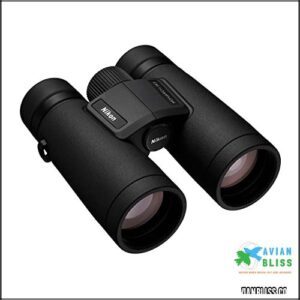
Regarding the best binoculars for serious bird watching, Nikon Monarch models consistently deliver outstanding optical quality that transforms your birding experience. The Monarch M7 8×42 provides an impressive 8.3-degree field of view—reaching 435 feet at 1000 yards—while extra-low dispersion glass eliminates chromatic aberration for razor-sharp identification.
You’ll appreciate the 19.5mm eye relief if you wear glasses, and at 670 grams, these birding binoculars balance power with portability. Waterproof construction and dielectric prism coatings guarantee binocular durability through dawn fog and sudden downpours alike.
| Best For | Serious birdwatchers and nature enthusiasts who need reliable, high-quality optics for all-day field use in varying weather conditions. |
|---|---|
| Magnification | 8x |
| Objective Lens | 42mm |
| Waterproof | Yes |
| Fogproof | Yes |
| Prism Type | Roof |
| Lens Coating | Fully Multi-Coated |
| Additional Features |
|
- Extra-low dispersion glass delivers sharp, color-accurate images with minimal chromatic aberration, making species identification easier even at distance
- Wide field of view (435 ft at 1000 yards on the M7 8×42) lets you track fast-moving birds and scan large areas quickly
- Waterproof and fogproof construction with nitrogen purging means you can count on them in rain, humidity, and temperature swings
- Some users report stiff focus wheels and eye separation adjustments that require a break-in period
- The 8×42 models can feel a bit heavy or clunky during extended use, especially compared to compact alternatives
- Edge sharpness softens slightly compared to premium models, though the blur only becomes noticeable at about 71% of the field radius
2. Celestron Nature Binoculars
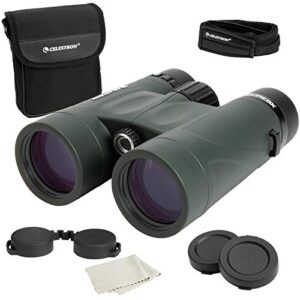
For birders seeking liberation from premium pricing without sacrificing optical quality, Celestron models in their Nature line offer outstanding performance at accessible price points.
The 8×42 configuration—featuring BaK-4 prisms and fully multi-coated lenses—delivers crisp, colorful images across a generous 7.4-degree field of view, perfect for tracking warblers through dense canopy or scanning open landscapes.
Waterproof construction and tripod adaptability extend your nature viewing into challenging conditions, though the close focus of 6.5 feet can’t quite match higher-end birding binoculars for optics and imaging precision.
| Best For | Budget-conscious birders and outdoor enthusiasts who want reliable optical performance for wildlife viewing without the premium price tag. |
|---|---|
| Magnification | 8x |
| Objective Lens | 42mm |
| Waterproof | Yes |
| Fogproof | Yes |
| Prism Type | Roof (BaK-4) |
| Lens Coating | Fully Multi-Coated |
| Additional Features |
|
- Sharp, colorful images thanks to BaK-4 prisms and fully multi-coated lenses that deliver excellent clarity for the price
- Wide 7.4-degree field of view makes it easy to track fast-moving birds and scan expansive landscapes
- Waterproof and fogproof construction with tripod adaptability handles tough outdoor conditions
- Close focus of 6.5 feet isn’t as tight as premium birding binoculars, limiting detailed views of nearby subjects
- Some users report quality control issues like eye cup screws falling out and lower-quality straps
- Performance in low-light conditions doesn’t match more expensive models
3. Zeiss Conquest Hd Binoculars
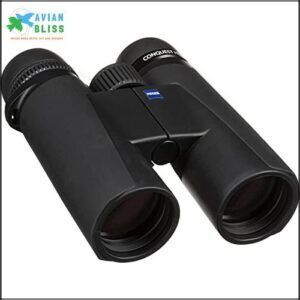
When optical performance meets field-tested durability, the Zeiss Conquest HD binoculars stand as standard birding binoculars for serious observers. The 8×42 configuration—built with SCHOTT HD glass and extensive Z-P coatings—renders plumage colors with striking fidelity while maintaining edge-to-edge sharpness that rivals models twice the price.
Zeiss optics deliver outstanding contrast in low-light conditions through dielectric mirror coatings, and the nitrogen-purged, waterproof housing ensures reliability across demanding habitats.
These Conquest models bridge the gap between premium mid-range investment and professional-grade HD technology for bird watching enthusiasts who refuse to compromise on clarity.
| Best For | Birders and wildlife watchers who want professional-level optics with exceptional color accuracy and edge sharpness without jumping to top-tier pricing. |
|---|---|
| Magnification | 8x |
| Objective Lens | 42mm |
| Waterproof | Yes |
| Fogproof | Yes |
| Prism Type | Roof |
| Lens Coating | HD Lens System |
| Additional Features |
|
- SCHOTT HD glass with Z-P and dielectric coatings delivers true-to-life colors and impressive contrast in both bright and low-light conditions
- Waterproof, nitrogen-purged housing with durable rubber armor stands up to rain, fog, and rough field use
- Lightweight ergonomic design with smooth focus wheel and twist-up eyecups makes extended observation sessions comfortable
- Eye cups can feel stiff or gritty during adjustment, which may frustrate some users
- Lens caps and eyepiece covers feel cheaper than the optics themselves
- Some users notice a rolling globe effect or minor chromatic aberration in certain lighting, though most find it negligible
4. Vortex Diamondback Binoculars
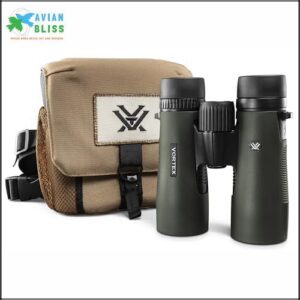
For birders demanding outstanding optical performance without the premium price shock, Vortex Optics delivers with the Diamondback HD 8×42—a model that consistently earns top marks in binocular reviews. The HD optical system, enhanced by dielectric and ArmorTek coatings, produces sharp, color-accurate images across a generous 393-foot field of view at 1,000 yards.
These birding binoculars combine rugged binocular durability with argon-purged waterproofing and Vortex’s unconditional lifetime warranty, making them reliable birding accessories for demanding field conditions where best binoculars must perform season after season.
| Best For | Birders and wildlife watchers who want HD optics and rugged, waterproof construction at a mid-range price, backed by a lifetime warranty. |
|---|---|
| Magnification | 8x |
| Objective Lens | 42mm |
| Waterproof | Yes |
| Fogproof | Yes |
| Prism Type | Roof |
| Lens Coating | Fully Multi-Coated |
| Additional Features |
|
- HD optical system with dielectric coatings delivers sharp, color-accurate images with excellent light transmission
- Wide 393-foot field of view at 1,000 yards makes tracking birds and scanning landscapes easier
- Argon-purged, waterproof design with ArmorTek coating and unconditional lifetime warranty ensures long-term reliability
- At 8 ounces, slightly heavier than some compact alternatives for extended carry
- Barrel hinge can be stiff, making interpupillary distance adjustments challenging for some users
- Glare or distortion may occur in certain lighting conditions despite quality coatings
5. Leica Trinovid Binoculars
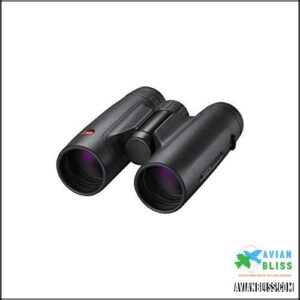
When premium European craftsmanship meets field-proven durability, you’re looking at Leica Trinovid models—binoculars that routinely appear in top binocular reviews for serious bird watching. Leica optics employ high refractive index glass and proprietary coatings that deliver outstanding color fidelity and edge-to-edge sharpness, traits you’ll appreciate when identifying subtle plumage details.
The compact, ergonomic bodies are waterproof and fog-proof, engineered for harsh conditions where proper binocular care and sturdy construction separate best binoculars from compromised alternatives. These birding binoculars represent Leica quality at its most field-ready, offering birding tips-worthy performance.
| Best For | Serious birders and outdoor enthusiasts who want premium European optics with exceptional color accuracy and rugged, waterproof construction for demanding field conditions. |
|---|---|
| Magnification | 10x |
| Objective Lens | 42mm |
| Waterproof | Yes |
| Fogproof | No |
| Prism Type | Roof |
| Lens Coating | Fully Multi-Coated |
| Additional Features |
|
- High refractive index glass and proprietary Leica coatings deliver outstanding color fidelity and edge-to-edge sharpness for identifying fine details
- Compact, lightweight design with ergonomic grip makes them easy to carry and handle during extended birding sessions
- Waterproof, fog-proof, and nitrogen-filled construction ensures reliable performance in harsh weather and challenging environments
- Premium price point of $1016.44 puts them out of reach for casual users or beginners on a budget
- Some customers reported missing advertised accessories like the Adventure-Strap in their shipment
- At 25.75 oz, they may feel heavy for all-day use compared to ultra-lightweight alternatives
6. Vortex Viper Hd Binoculars
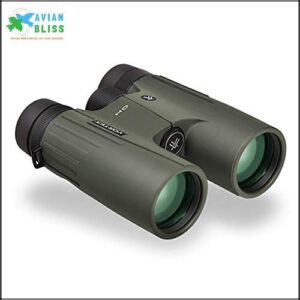
You’ll find Vortex Viper HD binoculars positioned squarely in the mid-priced bracket around $729.99, delivering outstanding brightness and minimal chromatic aberration that rival pricier European glass.
The 10×42 configuration offers roughly 341 feet of field of view at 1000 yards, 17 mm eye relief for eyeglass wearers, and weighs just 24.9 ounces—light enough for all-day treks.
HD glass and dielectric prism coatings produce sharp, color-accurate images with about 87 percent edge-to-edge clarity. Vortex backs these birding binoculars with a transferable, no-time-limit VIP warranty covering repairs except deliberate damage.
| Best For | Birders and wildlife watchers who want near-premium optical performance without the European price tag, especially those who value edge-to-edge sharpness and all-day comfort. |
|---|---|
| Magnification | 10x |
| Objective Lens | 42mm |
| Waterproof | Yes |
| Fogproof | Yes |
| Prism Type | Roof |
| Lens Coating | Enhanced Anti-Reflective |
| Additional Features |
|
- Exceptional brightness and minimal chromatic aberration that punch above the $730 price point, rivaling binoculars that cost significantly more
- Lightweight at under 25 ounces with solid 17mm eye relief, making them comfortable for extended viewing sessions even with glasses
- Transferable lifetime VIP warranty with no time limit covers repairs and replacements, protecting your investment indefinitely
- Field of view at 341 feet (10×42) is narrower than some competitors, which can make tracking fast-moving birds more challenging
- Focus wheel can feel stiff compared to similarly priced models, requiring more effort during frequent adjustments
- Close focus distance around 5 feet isn’t quite tight enough for detailed views of butterflies or nearby wildflowers
7. Celestron Trailseeker Ed Binoculars
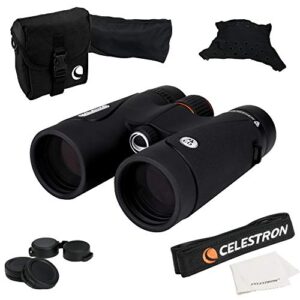
Celestron’s TrailSeeker ED 10×42 binoculars deliver ED glass optics, full multi-coating across all lens surfaces, and BaK-4 prisms with phase and dielectric coatings at a street price often dipping below $400—a serious value proposition when you’re weighing mid-tier performance against your gear budget.
Outdoor testing confirms edge-to-edge sharpness with excellent color correction across varied habitats, while the waterproof, nitrogen-filled chassis and protective armoring handle day hikes reliably.
At 10x magnification, you’ll experience sharper detail than 8x models, though image shake becomes more noticeable without stabilization during extended viewing sessions.
| Best For | Birders, hunters, and outdoor enthusiasts who want premium ED glass optics with edge-to-edge sharpness for day hikes and nature observation without breaking the bank. |
|---|---|
| Magnification | 10x |
| Objective Lens | 42mm |
| Waterproof | Yes |
| Fogproof | Yes |
| Prism Type | Roof (BaK-4) |
| Lens Coating | Fully Multi-Coated |
| Additional Features |
|
- ED objective lenses and fully multi-coated optics deliver exceptional color correction and sharpness across the entire field of view
- Waterproof, nitrogen-filled construction with full-body armoring stands up to demanding outdoor conditions
- Outstanding value under $400 with premium features typically found in higher-priced binoculars
- 10x magnification amplifies hand shake, making extended viewing sessions more challenging without stabilization
- Weight may become noticeable during longer hikes or all-day use
- Included neck strap can dig in and cause discomfort after several hours of wear
Binocular Price Ranges and Value
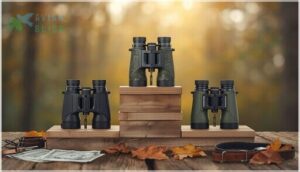
You don’t need to empty your savings account to get quality optics in your hands, but understanding where your money goes at different price points will help you make a smarter choice.
The market spans from capable $150 models that’ll serve beginning birders well to $2,000+ instruments that deliver optical performance you can actually see and feel in the field.
Let’s break down what you can expect at each price tier, so you can find binoculars that match both your budget and your birding ambitions.
Budget-Friendly Options Under $200
You don’t need to drain your savings for quality birding equipment—budget options under $200 deliver surprisingly crisp views. Brands like Celestron, Nikon, and Orion offer entry-level binoculars with multi-coated optics that handle casual bird watching admirably, though you’ll notice softer edges and lighter construction compared to pricier models.
For frugal birding, these affordable optics represent genuine value, particularly if you’re testing the waters before committing to this rewarding pursuit.
Mid-Range Binoculars $200-$500
Step into the $200-$500 range and you’ll discover where serious optical engineering meets attainable pricing, with binoculars featuring ED (extra-low dispersion) glass, phase-corrected prisms, and field-tested durability that won’t quit after a season or two of honest use. These midrange options deliver professional-grade optical quality without the sticker shock, making them ideal birding equipment for committed enthusiasts.
Popular mid-range binoculars include:
- Vortex Diamondback HD 8×42 with outstanding color fidelity
- Celestron TrailSeeker ED models offering impressive light transmission
- Nikon Monarch series combining reliability with performance
You’re getting birding accessories that perform beautifully across varied habitats and lighting conditions.
Premium Models $500-$1000
You’re entering the upper mid-range territory where premium features like T-star sophisticated coatings on the Zeiss Conquest HD 8×42 ($799) and Leica Trinovid HD 8×42 deliver optical clarity approaching high-end optics without crossing the $1,000 threshold.
Models like GPO Passion ED, Hawke Frontier ED, and Maven B1.2 offer outstanding light transmission—often above 90 percent—transforming your birding experience with sharp edge-to-edge resolution and sturdy, nitrogen-purged construction that endures.
High-End Binoculars Over $1000
When you cross the $1,000 mark, you’re not just buying binoculars—you’re investing in handcrafted European optical instruments like the Swarovski NL Pure 8×32 ($2,566) and Zeiss Victory SF 8×42 ($2,799) that reshape what you thought possible in field optics.
These elite binoculars feature high-end materials like magnesium-alloy chassis, fluorite glass elements, and field-flattening lens designs that eliminate chromatic aberration entirely, delivering premium performance that transforms challenging lighting into crystalline detail.
How to Choose Birdwatching Binoculars
Choosing the right binoculars isn’t about finding the most expensive pair—it’s about matching the optics to how you actually bird. Your success depends on understanding three critical factors: how your birding style dictates your gear needs, what magnification power truly works in the field, and how to evaluate optical performance beyond marketing claims.
Let’s break down each consideration so you can make a confident, field-tested decision.
Matching Binoculars to Your Birding Style
Your birding techniques and habitat considerations should drive your optical preferences more than any marketing pitch. If you’re tracking warblers through dense foliage, you’ll want 8×42 binoculars for steadier viewing styles and wider fields, while open-country birders benefit from 10x magnification for distant detail.
Personal comfort matters too—lighter 8×32 configurations suit long hikes, and close-focus specs under six feet let you explore feeders and butterflies without compromising your bird watching.
Choosing the right binoculars for birdwatching means matching glass to ground, not chasing specs alone.
Understanding Magnification Power Options
Magnification isn’t a simple “more is better” equation—it’s a balancing act between image scale and real-world usability in the field. Your magnification choice shapes every aspect of your birding binoculars experience, from image stability to field views.
Here’s what different power selection options mean for your bird watching equipment:
- 8x magnification delivers excellent optical tradeoffs, offering steady handheld views with wider fields that help you track fast-moving targets through dense cover
- 10x binoculars provide roughly 25 percent larger images for distant waterfowl or raptors, though hand shake becomes more noticeable during extended observation
- 7x configurations enlarge field of view and brightness, ideal for forest birding or dawn patrols when light levels drop
- Magnification limits above 12x require tripod support—handheld stability deteriorates rapidly, making them impractical for typical birding scenarios despite their reach
Evaluating Optical Performance and Clarity
Optical resolution matters more than magnification alone—you’re looking for binoculars that maintain contrast across spatial frequencies, preserving fine plumage detail at medium and high resolutions. Modern multilayer lens coatings boost light transmission above 90 percent, dramatically improving brightness and color fidelity.
Check edge-to-edge sharpness by evaluating field flatness; quality optical equipment shows consistent clarity across the entire field of view, not just the center.
Caring for Your Birdwatching Binoculars
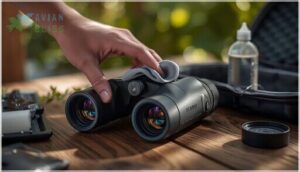
Your binoculars are a serious investment in your birding adventures, and proper care can extend their life from a few years to decades of reliable field performance. Even high-end optics with ED glass and phase-corrected prisms will deteriorate rapidly without basic maintenance, especially when you’re dealing with moisture, dust, and the inevitable bumps that come with outdoor use.
Let’s break down the essential practices that’ll keep your optics sharp, your images crisp, and your gear ready for whatever conditions you encounter in the field.
Proper Cleaning and Maintenance
Your binoculars won’t survive a season in the field if you treat lens care like an afterthought, and I’ve seen too many birders compromise their optics—and their sightings—with careless cleaning habits that scratch coatings or trap moisture inside sealed housings.
Here’s what actually works for maintaining birdwatching binoculars:
- Use microfiber cloths and lens-specific cleaning solutions, never your shirt
- Remove dust with a blower brush before wiping
- Clean eyepieces after every outing to prevent oil buildup
- Avoid household cleaners that strip protective coatings
- Check O-rings annually for waterproof integrity
Storage and Protection Tips
Even spotless lenses mean nothing if you’re tossing your binoculars into a damp backpack or leaving them exposed on a dashboard where temperature swings and UV rays degrade seals, coatings, and internal lubricants over time.
Store your birding binoculars in a padded case with silica gel packets, keep neck straps adjusted for strap security, and prioritize storage solutions that maintain waterproof and fogproof integrity between field sessions.
Handling Techniques for Longevity
How you grip, adjust, and carry your optics in the field matters just as much as where you stash them at home, because rough handling—yanking focus wheels, over-torquing eyecups, or letting them swing freely from your neck—wears down mechanisms and misaligns prisms faster than years of careful use ever could.
Use both hands when adjusting birding binoculars, maintain an ergonomic grip that distributes pressure evenly, and rely on a proper strap instead of letting the full weight dangle from your cervical vertebrae. Lens protection caps should snap on immediately after each observation session, and when you’re moving through dense understory or scrambling over talus, secure your binoculars against your chest rather than letting them bounce.
Waterproof and fogproof seals depend on careful handling—twisting components beyond their designed range compromises O-rings and nitrogen purges that keep internal elements spotless. Treat every interaction with your optics as deliberate rather than automatic, and you’ll preserve close focus accuracy, ergonomic design integrity, and optical alignment for decades of field use.
Frequently Asked Questions (FAQs)
What strength of binoculars is best for bird watching?
Most observers find 8x magnification strikes the sweet spot—you’ll track warblers through dense canopy more easily than with 10x, yet still resolve field marks on distant raptors without excessive shake compromising your view.
Which is better for birding, 8×42 or 10×42?
Picture yourself tracking a fast warbler through dense foliage—8×42 binoculars win with wider field view comparison and handheld stability, while 10×42 birding binoculars excel spotting distant raptors where magnification tradeoffs favor detail over low light performance.
How far can you see with 10×42 binoculars?
With 10×42 binoculars, you’ll see crisp detail on birds out to roughly 800–1,000 yards under clear conditions.
Though atmospheric interference, heat shimmer, and haze usually limit distance clarity well before optical limits do.
What are the best birding binoculars?
In field testing across habitats, the Vortex Viper HD 8×42 and Nikon Monarch M5 8×42 consistently deliver outstanding optical quality for birding.
They balance clarity, durability, and value that birding optics reviews confirm season after season.
Are binoculars good for bird watching?
Absolutely—magnification brings field marks into focus that naked eyes miss, making bird identification certain rather than guesswork.
Quality birding binoculars combine optical quality with wide field visibility, transforming nature observation from frustrating glimpses into steady wildlife observation that captures subtle plumage details and allows confident bird tracking through dense foliage.
Should you buy a binocular below 30mm for bird watching?
You’ll sacrifice Low Light Performance and a narrower field of view with sub-30mm Compact Binoculars, making dawn and dusk birding harder—but if portability trumps Optical Tradeoffs for casual Birdwatching, they work as backup optics.
Are budget tier binoculars good for birdwatching?
Budget binoculars are like learning to fly before you soar—they won’t rival premium optics, but solid budget options deliver surprising clarity and brightness, letting you master birding essentials without major optical tradeoffs or financial sacrifice.
Which binoculars are best for wildlife spotting?
For most wildlife observation techniques beyond birding binoculars, you’ll want the Vortex Viper HD 8×42—it delivers outstanding clarity for mammals and birds alike, or step up to 10×42 configurations for safari binoculars and distant game.
Which binoculars are best for astronomy?
Like ancient astronomers who charted constellations by eye, you’ll want 10×50 or 15×70 astronomy binoculars with wide fields, sturdy tripod mounts, and fully multi-coated optics for stunning stargazing without a telescope’s complexity.
What strength binoculars are best for bird watching?
Most ornithology groups recommend 8x magnification as the sweet spot for birdwatching binoculars—it balances optical quality, field views, and low light performance better than 10x, which amplifies hand shake and narrows your view.
Conclusion
Field-tested optics free you from frustration—when every feather detail matters, settling for subpar glass means missing the birds that make your heart race.
The best binoculars for birdwatching aren’t about prestige; they’re about precision that matches your passion, durability that survives real conditions, and ergonomics that disappear in your hands during that magic hour when warblers move through the canopy.
Choose wisely, because your next rare sighting depends on seeing clearly, not squinting through compromise.