This site is supported by our readers. We may earn a commission, at no cost to you, if you purchase through links.
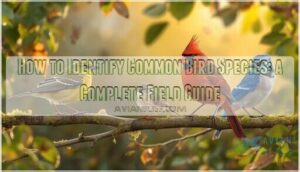
You spot a flash of yellow in the bushes and freeze. A warbler? A goldfinch? Maybe a tanager if you’re lucky. Without knowing how to identify common bird species, that moment of discovery turns into guesswork.
Most beginners focus only on color and miss the details that matter most. Size comparisons reveal whether you’re looking at a sparrow-sized 20-gram ball of feathers or a crow-sized 500-gram powerhouse. Field marks like wing bars and eye rings act as fingerprints that separate lookalikes in seconds. Songs and calls confirm what your eyes suggest, especially when birds hide in dense cover.
This guide breaks down the proven methods ornithologists use to identify birds quickly and accurately in any habitat.
Table Of Contents
- Key Takeaways
- Start With Bird Size and Shape
- Use Field Marks and Plumage Patterns
- Listen to Bird Songs and Calls
- Observe Behavior and Habitat Preferences
- Use Field Guides and Identification Apps
- Frequently Asked Questions (FAQs)
- How do I identify a bird?
- What is the best online guide for identifying birds?
- What is included in the bird identification guide?
- How do I identify an unfamiliar bird?
- What is the comprehensive bird identification guide?
- How do birders find different species?
- How do I tell what kind of bird I found?
- Can I upload a picture of a bird to identify it?
- Is there a free app to identify birds?
- What is the usual method of identifying individual birds?
- Conclusion
Key Takeaways
- Start by comparing a bird’s size to familiar reference species like sparrows, robins, or crows, then examine body proportions, beak shape, tail length, and posture to narrow down identification before considering color.
- Field marks like wing bars, eye rings, and breast patterns act as species fingerprints—over 80% of songbirds have distinctive color patches that boost identification accuracy by 43% when properly observed.
- Bird songs confirm visual identifications and reveal hidden species, with repeated exposure to common backyard birds and the use of sound recording apps like Merlin Bird ID (81% accuracy) accelerating recognition skills.
- Habitat preferences and behavior patterns—including foraging techniques, flight styles, and flocking behaviors—eliminate unlikely species and sharpen identification when combined with modern tools like field guides and eBird’s community verification system.
Start With Bird Size and Shape
When you spot an unfamiliar bird, your first clue is often its size and shape. These basic features help you narrow down possibilities before you even notice colors or behaviors.
Here’s what to focus on when you start identifying a bird in the field.
Estimating Overall Body Size
Size perception biases can trick you in the field, so use reference bird comparisons for accurate identification. Compare your mystery bird to familiar species like a sparrow, robin, or crow. Mass estimation techniques improve with practice, helping you predict species biomass and understand body size variation across different bird families:
- Sparrow-sized birds weigh 10-30 grams with compact bodies
- Robin-sized birds average 70-100 grams with medium bulk
- Crow-sized birds reach 400-600 grams with substantial mass
- Larger waterfowl exceed 1,000 grams with heavy, aerodynamic frames
Researchers can now access a detailed database of bird measurements for all known species.
Observing Body Proportions and Posture
After nailing down overall body size, shift your focus to proportions and posture—these visual identification cues separate similar species quickly. Leg length scales positively with body mass, so larger birds stand more upright while smaller species crouch. Compare wing-to-tail ratios and neck carriage as you watch foraging stance and flight posture. One helpful identifier is the plumage, for example, the male is bright red.
| Body Feature | Identification Value |
|---|---|
| Wing-to-tail ratio | Separates similar woodpeckers |
| Leg length | Predicts upright vs. crouched stance |
| Neck carriage | Distinguishes heron species |
| Body shape (width/length) | Identifies chickadees’ round profile |
These bird identification tips sharpen your bird ID skills in any habitat.
Examining Beak Shape and Length
Your bird identification techniques improve dramatically when you examine beak morphology. Beak shape reveals dietary specialization—insectivores sport thin, pointed bills while seed-eaters display thick, conical ones.
Measurement standards focus on length from head feathers to tip, where genetic influence accounts for over 7% of variation in some species.
These bird ID skills, sharpened through evolutionary trends across latitudes, transform how you identify unfamiliar species in any field setting.
Noting Tail Length and Shape
After noting the beak, shift your focus downward. Tail shape ID matters because forked, square, or graduated patterns distinguish families quickly. Length variation causes include sexual signaling in ornamental species and flight implications—short tails suit migrants while long ones aid maneuverability.
Your bird identification techniques strengthen when you measure tail ratios:
- Compare outer feather length to inner feathers
- Note elongated pins or lyre shapes
- Observe how shape affects flight behavior
These measurement techniques improve your bird species identification instantly.
Use Field Marks and Plumage Patterns
Once you’ve noted a bird’s basic size and shape, you can start looking at the fine details that make each species unique.
Field marks are the distinctive patterns and color patches that act like fingerprints for bird identification. Learning to spot these key features will help you confidently distinguish between similar-looking species in the field.
Identifying Key Color Patches

Think of color patches as nature’s ID tags. You’ll spot them on the crown, throat, breast, or rump—each location matters for bird species identification. Over 80% of songbirds feature at least one distinctive patch. These markings boost identification accuracy by 43% in the field.
Iridescent plumage shifts with light angles, so observe carefully.
| Patch Location | Common Examples |
|---|---|
| Crown/Forehead | Chickadees, finches, kinglets |
| Throat/Gorget | Hummingbirds, warblers, sparrows |
| Breast/Rump | Flickers, harriers, thrushes |
Recognizing Wing Bars and Eye Rings
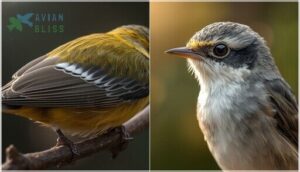
When you scan the wings of a perched bird, look for pale lines called wing bars. These run horizontally across folded wings and appear on roughly 48% of warblers and 60% of vireos in North America.
Eye rings circle the eye with colored feathers—sometimes bright, sometimes subtle. Together, these field marks boost your identification accuracy by up to 85%, making them essential bird identification skills.
Noting Breast Patterns and Markings

When you look down at a bird’s chest, patterns tell stories. Streaks, spots, and color patches work as fingerprints—about 60% of North American songbirds use breast markings for identification. These patterns vary by age and sex, with juveniles showing fainter streaking in 85% of finch and sparrow species.
Field guides list breast pattern types first for quick ID, and knowing camouflage function improves your identification tips in winter.
Distinguishing Seasonal Plumage Changes

Many birds swap outfits with the seasons—and that changes what you see in your field guide. Molt timing drives these shifts, usually after summer breeding ends. Color degradation happens through wear, not just feather replacement.
Hormonal influence triggers breeding plumage in spring, then winter plumage follows. This camouflage evolution aids survival.
Tracking these changes boosts identification accuracy when identifying birds in winter, so note the date during field observations for identification assistance.
Listen to Bird Songs and Calls

Bird sounds are just as important as visual clues for identifying species in the field. Each bird has its own signature songs and calls that can help you confirm what you’re seeing or track down hidden birds you can’t spot.
Here’s how to start using your ears as a powerful identification tool.
Learning Common Backyard Bird Songs
You can master bird song identification faster with the right approach. Studies show that repeated exposure to common backyard species—American Robin, Northern Cardinal, Blue Jay, and Black-capped Chickadee—builds your recognition skills most effectively.
Apps improve learning when you practice multiple sessions with short intervals between them. Early exposure to regional dialects helps you distinguish local variations.
Focus on song memorization tips that emphasize repetition over breadth for better retention and confidence.
Distinguishing Calls From Songs
Bird songs and bird calls serve different functional purposes in avian life. Songs attract mates and defend territories during breeding seasons, while calls coordinate flocks and signal alarms year-round.
You’ll notice acoustic structure varies too—songs display complex patterns and longer durations, but calls remain short and repetitive. Seasonal variation means songs dominate spring breeding, whereas calls increase outside mating periods.
Automated recognition tools now distinguish these bird vocalizations with reliable accuracy.
Using Sound Recording Apps
Sound ID apps turn your phone into an auditory identification tool for real-time bird identification. Merlin Bird ID delivers about 81% accuracy and works offline if you download regional bird sounds and songs packs ahead of time. BirdWeather PUC currently ranks highest for accuracy statistics among recording devices.
Consider these four options:
- Merlin offers live feedback with images
- BirdNET provides confidence scores and user engagement
- ChirpOMatic simplifies interface design
- AI improvement continues through citizen submissions
Check data privacy policies before recording in public spaces.
Practicing Call Recognition in The Field
Apps get you started, but field practice sharpens your auditory identification for real bird sounds and calls. Use spectrogram analysis to visualize pitch and rhythm patterns. Create mnemonic devices like “Who cooks for you” for Barred Owls.
Expect background noise and habitat variation to reduce accuracy by about 23%.
Real-time AI tools now reach 90% detection rates, yet human observers still catch 72% more individual birds than automated systems.
Observe Behavior and Habitat Preferences

Birds reveal their identity through what they do and where they spend their time. You can narrow down your options fast by watching how a bird moves, feeds, and flies.
The sections below cover four behavior and habitat clues that make identification easier.
Watching Foraging and Feeding Techniques
How do you tell a chickadee from a nuthatch when they’re both at your feeder? Watch their foraging strategies. Chickadees grab seeds and fly off, while nuthatches probe bark head-down.
Over 80% of common bird species use multiple feeding techniques. You’ll notice feeding schedules shift with temperature—birds visit feeders more during cold snaps.
Social learning means local populations develop unique feeding traditions you can observe.
Noting Flight Patterns and Wing Beats
You’ll notice each species has a unique flight signature. Small songbirds beat their wings 8 to 20 times per second. Watch how woodpeckers rise and dip in undulating patterns while crows fly straight and steady.
Flight patterns sharpen your bird identification skills during avian identification sessions:
- Wingbeat frequency varies—pigeons pump 10 to 18 times per second
- Flight maneuverability differs between hawks and swallows
- Flock formation reveals species through pattern identification
Identifying Habitat Types and Locations
Habitat preferences narrow down your field options fast. Forestland covers 58.4% of bird landscapes and hosts woodland species at densities reaching 1,993 individuals. Grassland avifauna thrive in open ecosystems spanning 19.3% of surveyed regions. Wetland populations depend on freshwater sites comprising 14.2% of habitats.
Urban landscapes support 18.5% of bird habitats and ranges, while migratory patterns shift species between these regions seasonally.
Observing Social Behavior and Flocking
How do birds shift roles when danger appears? Watch flocking behaviors to decode social structures and defensive tactics. Mixed-species groups spend 80–90% of daily hours together, sharing foraging cues and predator warnings. Larger assemblies reduce individual vigilance while boosting detection speed through information sharing.
- Core species like chickadees lead flock assembly and influence group coordination
- Subordinate birds adjust foraging height based on dominant species presence
- Anti-predator strategies improve as flock density increases during threat responses
Use Field Guides and Identification Apps

You don’t have to identify birds alone anymore. Modern tools make the puzzle-solving process faster and more accurate than ever before.
Let’s look at the resources that will turn your field observations into confident identifications.
Choosing The Right Field Guide
Your field guide choice shapes every outing. Regional coverage beats broad guides—state-specific books trim 25–50% of unlikely species, making identification faster. Print offers battery-free reliability in remote areas, while digital updates within weeks of taxonomic shifts. Prioritize guides with range maps, illustrations highlighting field marks, and seasonal plumage notes. Source quality matters: look for expert-authored resources updated within five years.
| Feature | Print Guides | Digital Apps |
|---|---|---|
| Updates | Every 7–10 years | Weeks after changes |
| Portability | Under 600 grams ideal | Smartphone access |
| Battery | None needed | Requires power |
| Range Maps | 98% include | 98% include |
| Audio | Not available | 85% include sounds |
Using The Merlin Bird ID App
You’ll find the Merlin Bird ID app transforms tricky identifications into confident calls. This free birding app delivers realtime bird identification through three methods:
- Photo ID: Upload images for instant species suggestions backed by machine learning trained on 750 million eBird observations
- Sound ID: Recognize 2,066 species by songs and calls with app accuracy that’s beyond compare
- Bird ID Wizard: Answer five questions about size, color, and behavior for matches suited to you
- Regional Packs: Download location-specific guides covering 338+ species per region
- Data Contribution: Save sightings to your Life List while supporting citizen science research
The user experience stays simple—select your method, follow prompts, and receive curated results within seconds. Feature updates arrive regularly as birders worldwide submit annotated recordings and photos.
Sketching and Taking Field Notes
When bird behavior observation becomes sharper through sketching, memory retention jumps by 53%. Drawing quick field notes in your pocket guide—even rough shapes with labeled colors—boosts data reliability by 37%. Birders who document tail length, beak angle, and behavior annotation see lasting benefits.
Sketching birds in the field—even rough shapes—boosts memory retention by 53% and data reliability by 37%
Here’s what to capture:
| What to Sketch | Why It Matters |
|---|---|
| Body shape and posture | Builds recognition speed |
| Beak and tail dimensions | Confirms species traits |
| Wing bars and eye rings | Captures key field marks |
| Foraging movements | Documents behavior patterns |
Sketching accuracy grows with practice, transforming bird identification resources into personal expertise.
Joining EBird and Local Birding Groups
You multiply your identification skills when you join eBird and connect with local birders. eBird benefits include free data storage and real-time sighting reports. Community birding resources accelerate skill development through group identification sessions and mentorship opportunities.
- Submit checklists to track species and improve accuracy through community verification
- Join regional birding clubs for field trips and shared expertise
- Participate in events like the Great Backyard Bird Count
- Contribute directly to community conservation and scientific research databases
Frequently Asked Questions (FAQs)
How do I identify a bird?
You identify a bird by combining initial observation of size and shape with key characteristics like field marks and behavior.
Beginner tips include using bird identification apps for species identification while practicing patience required for avian identification accuracy.
What is the best online guide for identifying birds?
Like calling up an expert for instant help, the Merlin Bird ID app leads in app accuracy and offline access. It covers over 20,000 species free, making it the top bird identification app.
What is included in the bird identification guide?
This field guide covers anatomical features, plumage variations, behavioral notes, and song reference tools.
You’ll find supplemental resources like bird identification apps and links to eBird for real-time avian identification support.
How do I identify an unfamiliar bird?
You face a visual puzzle each time an unfamiliar bird appears. Start with an initial observation of size and shape, then note a detailed description of field marks and contextual clues before consulting bird identification apps or expert resources.
What is the comprehensive bird identification guide?
An extensive bird identification guide evolves through expert insights and accuracy improvements, addressing ID challenges across North American bird species.
It integrates field marks, behavior, and technology to improve guide extensiveness for identifying diverse bird species.
How do birders find different species?
You track migration patterns and habitat variations using range maps.
Rare bird alerts through apps deliver instant nocturnal species updates.
Weather conditions shape birdwatching success as you scan habitats for diverse bird species information.
How do I tell what kind of bird I found?
You start by noting size, shape, and colors. Take a quick photo for the Merlin app. Listen for sounds. Expert confirmation helps with tricky bird species identification challenges when you’re learning.
Can I upload a picture of a bird to identify it?
You can upload a bird photo to identification apps like Merlin. Photo ID accuracy averages 81%, though image quality affects results.
These tools support offline bird identification and contribute millions of observations annually to research databases.
Is there a free app to identify birds?
Yes. Merlin Bird ID leads the pack with photo ID and sound identification features. Audubon Bird Guide offers offline access and regional guides. Birda adds community features for collaborative identification. All deliver solid app accuracy.
What is the usual method of identifying individual birds?
Researchers distinguish individual birds through leg bands, electronic tagging, DNA fingerprinting, acoustic signatures, and morphological records. Metal bands remain standard, while GPS tags and genetic profiles now enable long-term tracking without physical recapture.
Conclusion
Picture yourself standing at the forest edge at dawn. You hear a three-note whistle, spot a bold eye stripe, and recognize the white-throated sparrow instantly. That’s what mastery looks like.
Learning how to identify common bird species transforms confusion into certainty. Each outing sharpens your skills. Size, shape, field marks, songs, and behavior become second nature. The birds were always there. Now you finally see them clearly. Your field guide stays in your pack more often than your hands.
- https://www.10000birds.com/the-future-of-birding-field-guides-is-giss.htm
- https://www.nature.com/articles/s41598-021-81605-w
- https://norecopa.no/media/7289/guidelines-for-the-identification-birds-in-research.pdf
- https://www.birdcount.org/2024-final-results/
- https://pmc.ncbi.nlm.nih.gov/articles/PMC10575132/