This site is supported by our readers. We may earn a commission, at no cost to you, if you purchase through links.
 Birds inhabit virtually every environment on Earth, from scorching deserts to frozen tundras.
You’ll find desert specialists like roadrunners in arid regions, while wetland birds such as herons thrive near water sources.
Forest environments support diverse species from woodpeckers in coniferous areas to warblers in deciduous trees.
Arctic terns navigate icy landscapes, while tropical parrots flourish in rainforests.
Urban areas host adaptable species like pigeons and sparrows.
Each habitat shapes bird characteristics – webbed feet for waterfowl, curved beaks for nectar feeders, and camouflaged plumage for ground dwellers.
These adaptations reveal fascinating survival strategies that reveal nature’s most remarkable design secrets.
Table Of Contents
- Key Takeaways
- Types of Bird Habitats
- Common Bird Habitats Around The World
- Birds of Different Environments
- Forest Bird Habitats
- Wetland Bird Habitats
- Desert Bird Habitats
- Biodiversity in Bird Populations
- The Role of Birds in Ecosystems
- Threats to Habitats and Biodiversity
- Conservation of Bird Habitats
- Frequently Asked Questions (FAQs)
- What are the habitats of birds?
- How can I identify a bird in my yard?
- Which habitat is known for many species of birds?
- What is the preferred habitat of birds?
- Do birds live in different habitats?
- What is birding by habitat?
- Where do birds live in the world?
- Where do birds live in a forest?
- What is a suitable bird habitat?
- What are some examples of birds?
- Conclusion
Key Takeaways
- You’ll find birds have adapted to every environment on Earth – from desert roadrunners with water-conserving kidneys to Arctic terns with specialized cold adaptations, showing how species evolve unique traits to survive in their specific habitats.
- Your local ecosystem benefits from birds’ essential roles as pollinators, seed dispersers, and pest controllers – a single bird family can consume 150,000 insects per breeding season while helping plants spread across landscapes.
- You’re witnessing serious threats to bird populations through habitat fragmentation, climate change, and pollution – two-thirds of North American species face increased extinction risk as rising temperatures force dramatic range shifts.
- You can actively support bird conservation by creating backyard habitats with native plants and water sources, participating in citizen science projects, and supporting protected areas that serve as vital sanctuaries for diverse species.
Types of Bird Habitats
You’ll discover that birds have adapted to nearly every environment on Earth, from scorching deserts to frozen tundras.
Each habitat shapes unique features in its bird residents, creating amazing diversity across species worldwide, which is a result of birds adapting to their environment.
Deserts
You’ll find desert birds are true survivors in harsh landscapes.
Desert birds master the art of survival where water is precious and shade is scarce.
Desert adaptations include specialized kidneys for water conservation and behavioral changes like becoming nocturnal birds to avoid heat.
Species like Greater Roadrunners thrive in hot deserts, while snowy owls inhabit cold deserts.
Bird survival depends on finding oasis ecosystems for water and food.
Desertification impact threatens these desert habitats, making bird adaptations increasingly essential for species persistence in changing environments.
Wetlands
Wetlands pulse with life as water birds navigate shallow waters and muddy shores.
These aquatic habitats support diverse species through complex food webs that connect insects, fish, and vegetation.
Avian adaptations like long legs and specialized beaks help birds thrive here.
Wetland conservation protects water quality while habitat restoration guarantees waterfowl identification remains possible for future generations studying bird habitat types.
Marshes, swamps, and lakes each provide unique aquatic habitats for various bird species.
Forests
Forests create layers of bird habitats with unique canopy structure supporting diverse species.
Woodpeckers benefit from forest fires that expose insects, while old-growth forests shelter specialized birds like harpy eagles.
Logging impacts disrupt these ecosystems, making forest management essential for habitat diversity.
Different forest types support distinct bird communities from ground-dwelling species to canopy dwellers across varied environments.
Other Important Habitats
Beyond the well-known terrestrial habitats and aquatic habitats, birds colonize remarkable environments worldwide.
Alpine habitats support hardy species like ptarmigan in thin mountain air. Savanna birds such as ostriches roam Africa’s grasslands.
Lakes host diving ducks, while estuaries provide rich feeding grounds for shorebirds. The pelagic zone challenges seabirds like albatrosses over open ocean.
Even urban habitats attract adaptable species. This habitat diversity demonstrates birds’ incredible adaptability across Earth’s varied landscapes.
Common Bird Habitats Around The World

You’ll find birds thriving in diverse habitats across every continent, from steamy tropical rainforests to frozen Arctic landscapes.
Each environment shapes unique bird communities that have evolved remarkable adaptations to survive in their specific homes. Diverse habitats and remarkable adaptations.
Tropical Rainforests
You’ll discover tropical rainforests support incredible canopy diversity with over 1,300 bird species in the Amazon alone.
Tropical bird species showcase unique adaptations – toucans have lightweight bills for fruit-eating while hummingbirds hover for nectar. Insect abundance creates avian symbiosis through mixed-species flocks.
However, deforestation impact threatens these essential bird habitats and habitat diversity. This is especially concerning given the accelerating rates of deforestation in key regions.
Arctic Tundras
Arctic tundras host over 200 bird species during brief summers.
These harsh environments challenge birds with extreme cold and limited food sources.
Tundra Avifauna display remarkable Cold Adaptations like feathered feet and seasonal plumage changes.
Climate Impacts threaten traditional Breeding Strategies as warming disrupts migration timing and habitat availability.
<strong>Permafrost thaw</strong> further alters water availability for these species.
- Snowy Owls remain year-round, hunting lemmings with nomadic breeding patterns
- Bar-tailed Godwits complete 6,000-mile non-stop flights to wintering grounds
- Tundra Swans breed on Arctic lakes before migrating to temperate wetlands
- Conservation Challenges intensify as Arctic warming occurs twice the global average
Coral Reefs
Coral reefs create vibrant aquatic habitats supporting diverse water birds through complex island proximity relationships.
These reef ecosystems provide rich invertebrate diet sources for species like frigatebirds, boobies, and terns who practice reef nesting on nearby islands.
You’ll find Pacific Reef Egrets almost entirely dependent on reef-based food sources.
Climate impacts and habitat degradation threaten these delicate systems, making coastal conservation efforts essential for maintaining healthy bird populations and reef ecosystems.
Threats that’ll break your heart:
- Invasive rats devastate seabird colonies – reducing populations by up to 90% on infected islands
- Ocean warming forces mass coral bleaching – destroying critical feeding grounds for reef-dependent birds
- Rising sea levels flood nesting sites – eliminating safe breeding areas for vulnerable species
Backyard Habitats
Your backyard can become a thriving bird sanctuary with simple planning. Backyard habitats support common backyard birds through strategic placement of native plants, bird feeders, and birdhouses.
Water sources like shallow dishes attract diverse species to urban environments. Following a bird feeding guide and bird house plans creates ideal conditions.
Urban planning that incorporates these elements transforms ordinary yards into wildlife corridors. Native vegetation provides natural food sources while feeders supplement nutrition during harsh seasons, making your space irresistible to feathered visitors.
You can find specialized native plants to enhance your backyard habitat.
Birds of Different Environments
Birds excel at adapting to different environments worldwide.
Each species has evolved unique traits to survive in their specific habitats.
Biodiversity thrives as birds traverse varying challenges across different ecosystems.
Here are five key environmental adaptations birds demonstrate:
- Alpine Adaptations – Mountain birds develop thick feathers and efficient oxygen processing to handle high altitudes and cold temperatures
- Savanna Birds – Grassland species possess strong legs for ground foraging and sharp eyesight to spot predators across open terrain
- Pelagic Species – Ocean birds feature waterproof feathers, salt glands, and excellent diving abilities for marine life
- Rocky Shores – Coastal birds develop specialized beaks for extracting shellfish and strong grip for navigating slippery surfaces
- Estuary Birds – These species filter-feed in brackish water and time feeding with tidal changes
From urban sparrows to desert roadrunners, birds showcase nature’s remarkable ability to thrive anywhere.
Their success depends on matching physical traits with environmental demands across diverse bird habitats.
Forest Bird Habitats

Forests provide homes for countless bird species that have adapted to life among the trees.
You’ll discover how different forest types support unique communities of birds, from tiny warblers flitting through deciduous canopies to massive harpy eagles soaring above tropical rainforests, which is a key aspect of understanding how these ecosystems function with unique communities.
Coniferous Forests
You’ll find coniferous forests host specialized birds perfectly adapted to needle-bearing trees.
Crossbills crack tough pine cones with their unique beaks.
Forest fires actually benefit these habitats by clearing undergrowth and releasing seeds.
Canopy density affects bird distribution throughout different forest layers.
Forest fragmentation reduces bird populations.
| Conifer Adaptations | Examples |
|---|---|
| Cone-cracking beaks | Crossbills, siskins |
| Thick plumage | Grouse, ptarmigan |
| Seed caching behavior | Nutcrackers, jays |
| Fire-adapted nesting | Woodpeckers, flycatchers |
These bird species show remarkable conifer adaptations for survival.
Logging impacts disrupt established territories and nesting sites.
Deciduous Forests
You’ll discover deciduous forests host remarkable bird species that adapt to seasonal changes.
Leaf litter provides rich foraging opportunities where ground-dwelling birds find insects.
Canopy diversity supports warblers and woodpeckers throughout different tree layers.
Forest management practices influence acorn abundance, directly affecting jay populations.
These forest habitats showcase nature’s adaptability as bird species navigate autumn’s transformation and spring’s renewal within these dynamic habitats.
Mixed Forests
Mixed forests blend different tree species together, creating unique bird habitats with exceptional habitat complexity.
Edge effects occur where different forest types meet, supporting diverse bird communities. These forests adapt to seasonal changes throughout the year.
- Canopy diversity provides multiple nesting levels for various bird species
- Edge effects create boundary zones that attract different birds
- Mixed forests support more bird communities than single-species forests
- Habitat complexity offers varied food sources and shelter options
- Seasonal changes bring migrating species through these dynamic habitats
Forest Floor Habitats
You’ll find the forest floor fascinating. It’s like nature’s busy factory floor where decomposition processes turn fallen leaves into rich soil.
Ground-nesting birds such as thrushes and towhees call this level home. They feast on leaf litter invertebrates – beetles, worms, and spiders hiding beneath decaying matter.
Understory vegetation provides perfect cover for nests and feeding. Fungal networks connect trees underground, creating diverse forest habitats.
These bird habitats within forest ecosystems support species that rarely venture into treetops. Dense brush offers protection from predators above.
Wetland Bird Habitats
Wetlands provide some of the richest bird habitats on Earth, supporting everything from towering herons to tiny sandpipers.
You’ll find four main wetland types – marshes, swamps, bogs, and fens – each offering unique conditions that attract different bird species with specialized feeding and nesting needs.
Marshes
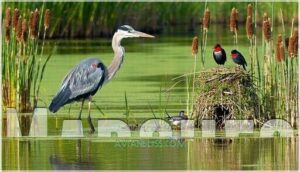
Wetlands like marshes create perfect homes for specialized waterbirds.
These aquatic habitats support diverse bird species through rich food sources and protected nesting areas.
Marsh conservation remains critical as these marsh ecosystems face mounting marsh threats from development and pollution.
Marsh birds showcase remarkable marsh adaptations:
- Great blue herons wade on long legs through shallow waters
- Red-winged blackbirds nest among cattails and rushes
- Marsh wrens build dome-shaped nests in dense vegetation
- Wood ducks find tree cavities near water edges
Swamps

You’ll discover swamps as dynamic wetland ecosystems where swamp birds like herons, egrets, and wood ducks thrive.
These habitats support incredible swamp biodiversity through dense cypress forests and standing water.
Swamp ecology creates perfect conditions for wading birds with abundant fish and insects.
Swamp adaptations include long legs for wading and specialized beaks for hunting.
Swamp conservation protects these essential wetlands for future generations.
Bogs

Bogs present unique challenges for birds with their acidic conditions and sphagnum moss carpets.
These waterlogged wetlands support specialized rare species like curlews and snipe, whose long bills probe deep into peat formation layers for bog invertebrates.
The acidic environment creates a distinct ecosystem where only adapted birds thrive.
Ireland’s blanket bogs once hosted thousands of curlew pairs, but habitat loss reduced numbers by 98%.
These bird habitats require careful protection since their delicate balance supports irreplaceable wildlife communities that can’t survive elsewhere.
Fens

If bogs are the quiet cousins, fens are bustling neighborhoods for birds and plants.
Fen hydrology keeps the ground wet, supporting unique fen vegetation like sedges and sundews.
Fen birdlife includes snipe and curlew, thriving in these habitats.
Here’s what makes fens special:
- Rich fen vegetation
- Diverse fen birdlife
- Importance of fen conservation and restoration
Desert Bird Habitats

You’ll find desert birds living in hot, cold, and coastal deserts, as well as near desert oases.
These birds have special adaptations that help them survive with little water and extreme temperatures.
Hot Deserts
Picture a cactus standing tall under the blazing sun—hot deserts push bird species to their limits.
You’ll find birds like the roadrunner using clever desert adaptations to thrive. Water scarcity and temperature extremes mean every drop counts.
Birds conserve moisture, hunt insects, and nest in shade. Desertification impact threatens these habitats, making oasis ecosystems essential.
In these harsh bird habitats, survival is a game of resourcefulness and resilience.
Cold Deserts
Cold deserts push birds to their limits, demanding clever Cold Adaptations and fierce resilience.
You’ll notice Sparse Resources shape every move, from Avian Predators hunting in open terrain to smart Nesting Strategies that keep eggs safe.
Water Conservation is key, with each species finding ways to survive in dry, chilly habitats.
Here’s what sets cold desert birds apart:
- Tough survival skills
- Ground nesting
- Efficient water use
- Adaptable diets
Coastal Deserts
When you’re exploring coastal deserts, you’ll spot birds working with what little water they find.
Shorebird Adaptations help them thrive where Limited Freshwater is rare.
Seabird Nesting takes place on sandy stretches, sometimes right next to salty plants.
Coastal Erosion and Human Impact change these habitats fast, making survival a balancing act for birds in these tough deserts, where Shorebird Adaptations are crucial.
Desert Oases
Leaving the dry stretches of coastal deserts, desert oases offer a haven of tranquility. These pockets of water spark life, attracting birds seeking hydration and shelter.
Oasis microclimates support unique bird species diversity. You’ll notice:
- Oasis water sources help birds survive.
- Birds adapt to harsh habitats.
- Conservation challenges grow with human impact in deserts.
Bird habitats here need careful protection, especially considering the conservation challenges that come with human impact in these delicate ecosystems.
Biodiversity in Bird Populations

You’ll find that bird populations are made up of many types, including species that live only in one place, those that migrate, and those that stay year-round.
Each group faces unique challenges, and changes to their habitats can affect their survival.
Endemic Species
Endemic species are like hidden treasures in bird habitats.
You’ll find these bird species only in specific places, thanks to island evolution and isolated populations.
Their unique adaptations fit quirky habitats—think cacti or dense forests.
Habitat specificity makes them vulnerable, so conservation status matters.
Protecting endemic species means saving rare songs and colors, keeping nature’s chorus lively and diverse for everyone.
Migratory Birds
Ever wondered how migratory birds cross continents with pinpoint accuracy? Their migration patterns rely on clever navigation strategies, like reading stars or sensing magnetic fields.
Along the way, stopover ecology lets them rest and refuel. But climate impacts and conservation challenges threaten their journeys.
Bird banding helps scientists track:
- Flight routes
- Timing changes
- Habitat use
Protecting migration means safeguarding diverse bird habitats. This is crucial for maintaining the balance of ecosystems and ensuring the survival of migratory birds, which face significant threats from conservation challenges.
Resident Birds
While migratory birds chase warmer weather, resident birds stick to their native habitats year-round.
You’ll notice these birds have clever Local Adaptations—think House Sparrows making the most of city life.
Their Breeding Habits, Diet Variations, and Territory Defense all suit their home turf.
Some fluff up feathers for Winter Survival, others change their diet as seasons shift.
Watching resident birds gives you a peek into how habitats shape species.
When bird habitats shrink, these locals feel it first.
Protecting resident birds helps keep your local ecosystem balanced and thriving.
Habitat Fragmentation
With habitat fragmentation, bird habitats become isolated patches—think of it as Island Biogeography in action.
Birds get trapped by edge effects and genetic isolation, caused by habitat loss from deforestation or urbanization.
This can shrink populations fast.
Conservation strategies like corridors creation help reconnect these patches, giving birds freedom to move, breed, and thrive despite fragmentation.
The Role of Birds in Ecosystems

You’ll see that birds help keep ecosystems healthy by pollinating plants, spreading seeds, and controlling pests. They also aid decomposition, making them important for nutrient cycling in every habitat.
Pollination
Bird Pollinators aren’t just pretty faces—they’re essential for Pollen Transfer in many habitats.
When you spot a hummingbird sipping nectar, it’s helping with Pollination Ecology. Some bird species even show Floral Specialization, while others practice Nectar Robbing.
Here’s how birds support pollination:
- Move pollen between flowers
- Encourage plant diversity
- Maintain ecosystem balance
- Offset pollinator shortages
Seed Dispersal
You’re witnessing nature’s most effective transportation system when birds spread seeds across landscapes.
Through bird-plant mutualism, species like thrushes swallow fruits whole and deposit seeds miles away through defecation.
This dispersal mechanism creates habitat expansion as new plants colonize distant areas.
Jays practice scatter-hoarding, burying seeds they’ll forget, while parrots accidentally drop seeds during feeding.
These ecosystem dynamics prevent seed predation near parent trees and maintain genetic diversity.
Without avian dispersers, many forest habitats would shrink dramatically, limiting bird species diversity and ecosystem health.
Pest Control
Your garden’s unsung heroes work around the clock to keep harmful insects and rodents in check. Natural predators like chickadees, wrens, and swallows consume thousands of pests daily, maintaining ecological balance without chemical intervention.
Bird natural pest control offers three key benefits:
- Insect control – A single bird family consumes up to 150,000 insects per breeding season
- Rodent control – Owls and hawks target mice, rats, and voles that damage crops
- Habitat management – Diverse birds in varied habitats create sustainable pest control systems
This natural approach reduces disease-carrying pests while supporting biodiversity. Strategic bird deterrents can redirect birds from crops while maintaining their pest-fighting presence in surrounding areas.
Decomposition
Through decomposition, Bird Scavengers and Carrion Feeders maintain Ecological Balance by removing dead matter from habitats.
Their droppings accelerate Decomposition Rates through Nutrient Cycling, enriching soil for plant growth.
This process supports Habitat Health by preventing disease spread and creating fertile environments where diverse birds thrive within their ecosystem.
Threats to Habitats and Biodiversity

You’ll find that bird habitats face serious threats from human activities and environmental changes.
These challenges include habitat loss from development, climate change effects, pollution impacts, and overexploitation of natural resources.
Habitat Loss and Fragmentation
When development divides landscapes, habitat fragmentation creates islands of nature surrounded by human activity.
This fragmentation severely impacts bird species through three main effects:
- Population isolation – Small habitat patches can’t support stable breeding populations
- Edge effects – Increased predation and environmental stress at habitat boundaries
- Barrier creation – Roads and buildings block natural movement patterns
Fragmentation Effects particularly harm Island Endemics and disrupt Migration Impacts for traveling species.
Endangered bird species face heightened extinction risks when isolated populations can’t find mates or resources.
Effective Conservation Strategies focus on creating wildlife corridors to reconnect fragmented bird habitats and restore natural movement patterns.
Climate Change
Climate change disrupts migration patterns and causes dramatic habitat shifts as rising temperatures force birds northward.
Two-thirds of North American species face increased extinction risk, with some losing 60% of their range.
Breeding success plummets when food sources don’t align with nesting cycles.
Conservation strategies now focus on creating habitat corridors and protecting northern areas to support these endangered species during their climate-driven relocations.
Pollution
Pollution strikes bird habitats like a slow-acting poison, affecting millions of species worldwide.
Plastic ingestion kills seabirds when they mistake debris for food. Oil spills coat feathers, destroying waterproofing and causing hypothermia. Acid rain changes soil chemistry, reducing insect populations that birds depend on. Heavy metals from industrial waste accumulate in bird tissues, causing reproductive failure.
These pollution types create widespread habitat loss:
- Pesticide effects thin eggshells and reduce fertility rates
- Chemical runoff contaminates water sources birds drink from
- Air pollution damages respiratory systems in urban bird populations
- Microplastics enter food chains through contaminated prey
You’ll find polluted habitats support fewer bird species than clean environments. Bird conservation efforts focus on reducing these toxic threats through stricter regulations and cleanup programs.
Overexploitation
You’re consuming bird species faster than nature can replace them.
Hunting Impacts devastate populations through excessive killing.
Illegal Trade smuggles rare birds internationally for profit.
Egg Collection and Feather Trade target breeding sites and decorative plumes.
Traditional Medicine demands bird parts despite alternatives.
These practices cause severe habitat degradation as bird species face habitat loss.
Multiple threats to habitats compound the problem, pushing species toward extinction.
Bird habitats require immediate protection from overexploitation.
Plastic pollution, a major factor, contributes to bird mortality rates.
Conservation of Bird Habitats
You can help protect bird habitats through supporting protected areas and restoration projects in your community. Sustainable land use practices and community engagement create lasting change for bird conservation efforts.
Protected Areas
Protected areas serve as vital sanctuaries for bird conservation and habitat preservation.
National parks and wildlife reserves protect diverse species through strategic management approaches.
These protected spaces work through:
- Reserve Management that maintains ideal conditions for native birds and habitats
- Buffer Zones that create transitional areas reducing human impact on core wildlife areas
- Wildlife Corridors that connect fragmented habitats allowing bird movement and genetic exchange
Despite funding challenges, community involvement strengthens these conservation efforts substantially.
To monitor wildlife activity, conservationists sometimes utilize remote monitoring devices.
Habitat Restoration
Beyond mere cleanup, habitat restoration transforms degraded landscapes into thriving bird sanctuaries.
Restoration techniques include wetland reconstruction, invasive species removal, and layered vegetation planting. Community involvement drives success through volunteer monitoring and citizen science projects.
Species reintroduction efforts show 80% breeding success within two years. Funding sources from government grants to local partnerships support these initiatives.
To support these efforts, replanting native vegetation is essential for habitat revitalization.
Effective bird habitat restoration requires monitoring success through standardized surveys, ensuring ecosystem recovery benefits both resident and migratory bird conservation efforts across diverse habitats.
Sustainable Land Use
Sustainable land use creates habitat corridors that connect fragmented ecosystems, allowing birds to move freely between areas.
You’ll find bird-friendly farming practices reduce pesticide use while conservation easements protect critical nesting sites.
Urban green spaces provide stepping stones for migrating species.
Responsible development balances human needs with habitat conservation, ensuring ecosystems remain intact for future generations.
Community Engagement
Community engagement transforms conservation efforts into powerful grassroots movements.
You can join citizen science projects and birdwatching groups to monitor local bird habitats. Educational programs connect communities with conservation goals.
To effectively monitor bird populations, consider using specialized monitoring products.
Consider these impactful ways to get involved:
- Participate in habitat monitoring – Track bird populations in your area
- Support local conservation groups – Join efforts protecting nearby habitats
- Share knowledge through educational programs – Teach others about bird conservation
Frequently Asked Questions (FAQs)
What are the habitats of birds?
You’ll find birds thriving in diverse habitats worldwide.
Forests shelter eagles and woodpeckers, while wetlands support herons and shorebirds.
Deserts host roadrunners, grasslands attract meadowlarks, and urban areas welcome adaptable pigeons and sparrows.
How can I identify a bird in my yard?
Picture yourself watching a small feathered visitor hop across your grass at dawn.
Observe the bird’s size, colors, and beak shape.
Note its behavior and habitat preferences.
Use a field guide or bird identification app for confirmation.
Which habitat is known for many species of birds?
Tropical rainforests support the highest bird diversity worldwide. You’ll find hundreds of species in these biodiverse ecosystems, from colorful toucans to powerful harpy eagles thriving in dense canopies.
What is the preferred habitat of birds?
Birds don’t have one preferred habitat—they’ve adapted to virtually every environment on Earth.
You’ll find species thriving in deserts, wetlands, forests, grasslands, mountains, and oceans, each perfectly suited to their specific niche.
Do birds live in different habitats?
Like nature’s apartment complex, birds choose from forests to deserts, each species finding their perfect home.
You’ll discover birds scattered across diverse habitats worldwide, from tropical rainforests to arctic tundras, each adapted to their unique environment.
What is birding by habitat?
You’ll observe birds by focusing on specific environments like wetlands, forests, or grasslands. Each habitat hosts unique species with specialized adaptations, making targeted birding more rewarding and educational.
Where do birds live in the world?
You’ll find birds everywhere on Earth except Antarctica’s interior. They’ve adapted to deserts, forests, wetlands, grasslands, mountains, and oceans. From tropical rainforests to arctic tundra, birds make themselves at home.
Where do birds live in a forest?
Forests offer varied layers where you’ll discover different bird species.
Canopy dwellers like harpy eagles hunt from treetops, while woodpeckers nest in tree trunks.
Ground-dwelling birds forage on forest floors for insects and seeds, which can include varied layers of vegetation.
What is a suitable bird habitat?
Suitable habitats flow like puzzle pieces meeting birds’ needs. You’ll want areas with food sources, fresh water, nesting sites, and shelter from predators and weather.
What are some examples of birds?
You’ll find incredible diversity among birds, from desert-dwelling Greater Roadrunners and wetland herons to forest Harpy Eagles and grassland Meadowlarks.
Tropical toucans, Arctic owls, urban pigeons, and backyard songbirds showcase nature’s remarkable adaptability.
Conclusion
Like a well-orchestrated symphony, understanding types of birds and their habitats reveals nature’s incredible diversity and adaptability.
You’ve discovered how desert specialists, wetland waders, and forest dwellers each possess unique features perfectly suited to their environments.
These adaptations showcase millions of years of evolution at work.
By recognizing different types of birds and their habitats, you’re better equipped to appreciate the delicate balance that sustains our planet’s ecosystems.
Protecting these diverse environments guarantees future generations will witness this remarkable natural heritage.
- https://en.wikipedia.org/wiki/Birds_of_North_American_boreal_forests
- https://www.nps.gov/articles/000/ncr-forest-interior-birds.htm
- https://www.birds-of-north-america.net/forest-birds.html
- https://dogwoodalliance.org/2024/05/5-wetland-wading-birds/
- https://www.wwt.org.uk/news-and-stories/blog/11-top-wetland-bird-plumages