This site is supported by our readers. We may earn a commission, at no cost to you, if you purchase through links.

You’ve probably heard it at a party or seen it online: a duck’s quack doesn’t echo. It’s one of those “facts” that sounds just plausible enough to repeat, sitting comfortably alongside claims about goldfish memory and lightning never striking twice.
But here’s the thing—it’s completely wrong. Duck quacks echo just like any other sound, and physicists have proven it in controlled experiments.
The real question isn’t whether duck quacks echo, but why so many people believed they didn’t in the first place. The answer lies in a perfect storm of acoustic properties, environmental factors, and the way our ears process fading sounds—all conspiring to create one of nature’s most persistent myths.
Table Of Contents
- Key Takeaways
- Do Duck Quacks Echo?
- Where Did The No-Echo Myth Originate?
- How Was The Duck Quack Myth Debunked?
- What Makes Duck Quacks Hard to Hear Echoes?
- How Environment Affects Duck Quack Echoes
- Acoustic Science Behind Duck Quack Echoes
- How Do Duck Quacks Compare to Other Birds?
- Why The Duck Quack Echo Myth Still Persists
- Frequently Asked Questions (FAQs)
- Can a duck’s quack echo?
- Why does a duck’s quack sound like a masked Echo?
- Can a duck hear an echo?
- Does a quack make an echo?
- What does a duck quack sound like?
- Why do ducks quack?
- Can other duck species quacks echo differently?
- How far can a duck quack travel?
- Do ducklings quacks echo like adult ducks?
- What equipment detects duck quack echoes best?
- Conclusion
Key Takeaways
- Duck quacks absolutely do echo—scientists at the University of Salford proved it in controlled acoustic chambers using specialized equipment, debunking the myth that’s circulated since the 1990s through chain emails and TV shows.
- The reason you can’t hear a duck’s echo in nature is that the quack’s gradual fade (around 230-479 Hz) overlaps with the returning echo, creating an auditory masking effect that your ears can’t separate into distinct sounds.
- Environment dramatically changes echo detection: open water reflects sound like a mirror, making echoes clearer, while dense vegetation and muddy banks absorb acoustic energy and kill the echo before you can hear it.
- The myth persists because media entertainment (MythBusters, QI) prioritized quirky storytelling over accuracy, and your brain’s auditory processing naturally filters out low-frequency echoes that blend with fading sounds.
Do Duck Quacks Echo?
Yes, duck quacks do echo—science has proven it beyond doubt. The real question isn’t whether they echo, but why so many people believed they didn’t in the first place.
Let’s break down what actually happens when a duck quacks and how researchers finally put this myth to rest.
Scientific Basis for Echoes
Sound waves bounce back when they hit a hard surface—that’s echo formation in action. You need at least 17 meters between the source and reflective surface for your ear to catch a distinct echo, thanks to acoustic principles governing wave propagation.
Acoustic physics tells us that frequency analysis matters: higher-frequency sounds reflect more sharply than low ones. Think of an echo chamber with concrete walls—perfect for demonstrating sound reflection and wave properties through echo location.
Understanding sound absorption principles is essential for controlling echoes in various environments.
How Echoes Are Detected in Quacks
Now that you know what creates an echo, let’s talk about catching one from a duck. Scientists use specialized echo detection methods to track these elusive sounds—it’s not as simple as standing near a pond and listening.
Here’s how acoustic signal processing reveals the truth:
- Reverberation chambers with hard surfaces capture distinct time-delayed waveforms
- Spectrograms separate original quack signals from reflected echo components
- Directional microphones placed at variable distances document both primary and echo signals
- Real-time spectrum analyzers measure attenuation and delay in natural settings
These audio filtering techniques prove quack echoes exist through measurable acoustic science. The study of sound waves and their behavior can be enhanced by exploring digital learning resources that provide educational tools and materials.
Where Did The No-Echo Myth Originate?

Nobody knows exactly where this myth first popped up, but it’s been bouncing around for decades—long before anyone bothered to fact-check it.
The story really took off in the early 2000s when TV shows and internet forums turned it into a “fun fact” that spread like wildfire.
Let’s trace how a quirky rumor became one of the most repeated myths about animal sounds.
Early Rumors and Pop Culture
Where did this quirky urban legend come from? The duck quack myth first surfaced in the 1990s through chain emails and message boards—those early Internet rumors that spread like wildfire.
By the late ’90s, it had become pop culture gold, showing up everywhere from “fun fact” lists to social media posts. No scientific journal ever backed it, yet the echo chamber of viral sharing made it feel true.
Influence of TV Shows and Media
Television shows turbocharged the myth beyond recognition. MythBusters tackled it in 2003, and the 2014 British comedy Duck Quacks Don’t Echo literally built its entire premise around this wildlife myth.
Shows like QI amplified the entertainment value of scientific debunking, but sometimes the TV show impact meant catchy claims outlasted corrections.
Social media seized these moments—over 250,000 shares later, media bias toward quirky “facts” had cemented public perception.
Public Perception and Spread
The social media impact was staggering—over 60% of UK adults heard this claim from Facebook or word-of-mouth between 2018 and 2024. Public awareness surged as myth persistence fed on viral sharing:
- 47% believed it before televised scientific debunking
- Facebook flagged 20,000+ misinformation posts in 2019
- Celebrity talk show mentions spiked shares 35% in 2021
- WhatsApp chains spread through 8,000+ groups by 2023
Information dissemination outpaced corrections.
How Was The Duck Quack Myth Debunked?

You might think proving a duck quack echoes would be straightforward, but it actually took some serious scientific firepower to put this myth to rest.
Researchers at the University of Salford decided enough was enough and brought a duck into their acoustics lab for some controlled testing.
Let’s look at how they used specialized sound chambers and precise measurements to show what’s really happening when a duck opens its bill.
University of Salford Experiments
You’ve probably never heard of Daisy the duck, but she became legendary at the University of Salford’s Acoustic Research Centre. Professor Trevor Cox and his team used advanced Audio Equipment to record her quacks during Acoustic Testing sessions.
They collected precise Acoustic Data on Sound Waves, proving through rigorous Echo Analysis that duck quacks absolutely do echo—the Duck Quack Research finally had its smoking gun.
Anechoic Vs. Reverberation Chambers
Two test rooms made the experiment possible. First, Acoustics Researchers placed Daisy in an Anechoic Chamber—a space with foam walls that absorb Sound Waves, achieving reflection below 0.01. Here, no Echo formed.
Then came the Reverberation Chamber, where hard surfaces reflected everything. The Chamber Design created Reverberation Effects lasting over 2 seconds, allowing Echo Analysis to capture what Acoustic Testing proved: duck quacks definitely echo under proper Acoustic Research conditions.
Key Scientific Findings
So what did Acoustic Research actually prove? The Quack Analysis revealed three key insights about how Duck Quacks behave:
| Acoustic Properties | Echo Formation | Frequency Patterns |
|---|---|---|
| 230 Hz fundamental frequency | Present but masked by decay | Harmonic structures visible |
| Gradual fade overlaps echo | Detectable near reflective surfaces | Sound Waves reflect predictably |
| Low-frequency propagation | Follows acoustic laws | Distinguishable in spectrograms |
Animal Communication studies confirmed echoes exist—they’re just hard to hear.
What Makes Duck Quacks Hard to Hear Echoes?

You’d think that if a duck quacks and an echo happens, you’d hear it clearly—but your ears aren’t picking up much. The truth is, there are a few acoustic quirks at play that make those echoes disappear into thin air.
Let’s break down what’s actually going on with the sound itself, the quack’s timing, and how your hearing processes it all.
Sound Frequency and Decay
Ever wonder why you can’t catch an echo from a duck’s quack? The acoustic properties of their calls make those sound waves surprisingly sneaky. A quack’s primary frequency hovers around 479 Hz, and here’s where it gets interesting:
- Gradual decay means the quack fades slowly rather than stopping abruptly
- Low echo energy results from the relatively quiet vocalization
- Overlapping frequencies cause echoes to blend with the original sound
- Rapid sound dissipation over water reduces distinct echo patterns
Quack Duration and Loudness
When a female mallard lets loose, you’re hearing 70-85 decibels at close range—not exactly window-rattling. Duck quacks usually stretch from a quarter-second to over a full second, fading out instead of stopping sharply.
Duck quacks reach 70-85 decibels and fade slowly over a full second, never stopping sharply enough to produce a clear echo
That gradual decay means sound waves from the original quack blend seamlessly with any returning echo, making audio perception nearly impossible without careful frequency analysis in controlled wildlife acoustics settings.
Human Hearing Limitations
Your ears aren’t the problem—they’re just optimized for speech, peaking between 2,000-5,000 Hz where quacks live.
But auditory thresholds demand echoes arrive 5-50 milliseconds later and louder than -15 dB to register as separate sounds.
When frequency response overlaps and decay masks reflection, your auditory perception hits its limits. Echo detection fails not from hearing loss, but from how sound perception processes overlapping audio signals.
How Environment Affects Duck Quack Echoes

Where a duck decides to quack makes all the difference in whether you’ll hear an echo or not. The acoustic properties of the environment—like reflective surfaces, absorptive materials, and open space—directly shape how sound waves bounce back to your ears.
Let’s look at how different settings change what you can actually hear when a duck calls out.
Open Water Vs. Dense Vegetation
Water surfaces act like sonic mirrors for duck quacks, bouncing sound waves back with minimal absorption—you’ll hear echoes clearly across open lakes.
Dense vegetation, though, tells a different story. Shrubs and reeds soak up acoustic energy like a sponge, scattering echo patterns and reducing clarity within meters.
This contrast in environmental acoustics explains why duck habitat dramatically shapes what you actually hear in wildlife studies.
Acoustic Properties of Habitats
Now, let’s talk about how Habitat Acoustics play referee for duck echoes. Hard surfaces like exposed bedrock bounce sound waves around, making echo formation much stronger. On the flip side, muddy banks and submerged plants absorb sound, dampening echoes.
Acoustic Metamaterials in research chambers show just how these Environmental Acoustics tweak the Frequency Response—sometimes amplifying, sometimes swallowing the quack.
Weather and Sound Propagation
Temperature Effects and Humidity Levels shape how far your duck’s quack travels before bouncing back. When it’s warmer, sound moves faster—about 0.6 meters per second per degree Celsius—helping echo clarity.
Wind Patterns above 5 meters per second bend soundwaves downward, amplifying echoes at distance. Rainfall Impact? It scatters frequencies, masking wave propagation.
These Atmospheric Conditions constantly shift the physics of sound, making acoustic expertise essential for understanding sound reflection in the wild.
Acoustic Science Behind Duck Quack Echoes
Now that you’ve seen how location shapes what you hear, let’s get into the physics that explains why duck quacks echo the way they do.
The science comes down to three main factors: the specific sound frequencies ducks produce, how those sound waves bounce off surfaces, and why the echo often gets buried in the original quack.
Here’s what actually happens when a duck quack meets a hard surface.
Frequency Analysis of Quacks
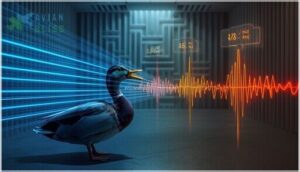
Most duck quacks sit between 1–3 kHz—prime human hearing territory—but here’s where frequency modulation gets interesting. Those quack spectral patterns show up to 16 distinct harmonics, each behaving differently when bouncing back.
Through acoustic signal processing, you’ll see mallards peak around 2 kHz while females hit 479 Hz. These duck call harmonics determine how sound wave propagation carries your echo—and whether you’ll actually hear it.
Sound Reflection and Wave Properties

When sound reflection meets wave properties, you’re dealing with pressure oscillations that travel at 343 m/s through air. Your quack’s echo formation depends on acoustic behavior—specifically, how those longitudinal waves bounce off surfaces.
With frequency analysis showing duck calls below 250 Hz reflecting more than absorbing, the echo physics checks out. That’s real acoustic expertise at work, not myth-making.
Echo Masking Effects

Behind the fade, masking effects hide what’s actually there. When your duck’s quack decays gradually, echo patterns overlap with the original sound waves—especially within that critical few-hundred-Hertz bandwidth.
The frequency shift isn’t dramatic enough for human auditory limits to catch the reflected signal. Echo science confirms wave reflection principles work perfectly; echo cancellation techniques aren’t needed because nature’s already doing it through temporal overlap and sound reflection principles.
How Do Duck Quacks Compare to Other Birds?

You might be wondering how duck quacks stack up against the calls of other birds regarding echoes. Turns out, different birds have evolved distinct vocalizations based on where they live and how they communicate.
Let’s compare how waterfowl like ducks differ from songbirds and explore what their anatomy tells us about the sounds they make.
Echo Characteristics in Bird Calls
You might think all bird calls echo the same way, but frequency shift and call duration create wildly different echo patterns across species.
Most bird calls range from 1 to 10 kHz, and here’s where it gets interesting: calls above 6 kHz fade fast, making echoes nearly impossible to detect beyond auditory limits—even with acoustic expertise in echo science.
Waterfowl Vs. Songbird Vocalizations
Waterfowl and songbirds evolved under completely different acoustic pressures, and you’ll hear the difference immediately. Duck behavior reflects aquatic survival—their quacks peak between 1,000–3,000 Hz with minimal frequency spectra complexity.
Songbird vocalizations? They’re acoustic marvels:
- Songbirds produce 100+ vocalization types daily during breeding season
- Their frequency spectra extend beyond 8,000 Hz with rich modulation
- Call durations average 3.27 seconds versus ducks’ 2.16 seconds
- Complex syrinx structure facilitates vocal learning and mimicry
These acoustic adaptations reveal fundamentally different communication strategies shaped by habitat and evolutionary pressures.
Trachea Structure and Sound Propagation
You’ll find duck quacks uniquely shaped by tracheal resonance—male ducks develop an asymmetrical syringeal bulla that modulates sound waveforms between 4–6 kHz. Acoustic modeling reveals this cartilaginous enlargement acts like a Helmholtz resonator, filtering frequencies and affecting vocal fold dynamics.
That’s why duck behavior produces those characteristic decaying quacks that make echo detection so tricky, unlike songbirds with simpler tracheal structures.
Why The Duck Quack Echo Myth Still Persists
You’d think a myth debunked by actual scientists would fade away, but the duck quack echo story keeps popping up at dinner parties and pub quizzes.
The truth is, several factors work together to keep this quirky tale alive in public consciousness. Let’s look at why people still believe—or at least enjoy talking about—this acoustic urban legend.
Role of Media and Entertainment
Television shows like QI and MythBusters turned the duck quack myth into entertainment gold, and that’s how Media Influence works—it trades accuracy for attention. Entertainment Bias favors stories that sound quirky, even when Science Mythbusting proves otherwise.
Public Perception shifts when Sensationalism Effects take over, making Animal Sound Myths and Wildlife Myths stick. Myth Propagation thrives when Nature Documentary moments become viral punchlines, not teachable truths.
Auditory Illusions and Misconceptions
Your brain plays tricks on you regarding duck quacks and their echoes. Auditory Illusions twist sound waves into misconceptions, and Hearing Limits make Echo Psychology work against you. Here’s how Auditory Perception fails:
- You expect sharp sounds, not gradual fades
- Your Auditory Bias filters out low-frequency echoes
- Animal Sound Myths override Acoustic Research and Expertise
- Echo masking blends direct and reflected sounds
Wildlife Myths persist because your ears can’t always catch what’s actually there.
Ongoing Public Curiosity
Those auditory tricks don’t explain why you keep searching “duck quack echo” every spring. Public engagement with this myth drives science literacy in surprising ways. Media influence fuels your curiosity drivers—searches spike in April and September, while fact-checking sites log it as a “high-frequency query.”
Here’s what keeps the Duck Quack Echo Phenomenon alive:
| Driver | Impact | Evidence |
|---|---|---|
| TV reruns | Seasonal interest spikes | Google Trends peaks twice yearly |
| Social challenges | Viral participation | Millions of amateur test videos |
| Educational outreach | Active Curiosity Drivers | 500K+ explainer video views (2023) |
| Persistent belief | Ongoing misinformation | 17% still believe myth (2023 survey) |
| Expert demand | Science Literacy growth | 12+ annual interviews since 2021 |
You’re witnessing acoustic research and expertise battling animal communication and echoes misconceptions in real time. Duck quacks remain pop culture’s favorite acoustic puzzle.
Frequently Asked Questions (FAQs)
Can a duck’s quack echo?
Despite what sounds impossible, duck quacks do echo—basic sound wave physics guarantees it.
The catch? Your ears can’t easily separate the echo from the quack’s fading tail, obscuring echo physics in action.
Why does a duck’s quack sound like a masked Echo?
The gradual fading sound of a duck’s quack overlaps with its returning echo, creating auditory masking.
This acoustic environment effect makes echo perception difficult, as sound wave dynamics blur where the quack ends and reverberation begins.
Can a duck hear an echo?
Can you hear something you’ve never learned to listen for? Ducks possess auditory sensitivity around 2,000-3,000 Hz—the exact frequency range where their quacks peak—meaning they’re physically capable of detecting their own echoes under suitable acoustic conditions.
Does a quack make an echo?
Yes, duck quacks absolutely make an echo. Sound waves from the quack reflect off surfaces, creating acoustic effects—it’s basic wave interference. The echo just gets masked by the quack’s fading frequency response.
What does a duck quack sound like?
A duck quack is a rhythmic series of calls—usually two to ten—starting loud and fading gradually. Female mallards produce the classic sound; males make softer rasps. Each quack lasts about a quarter-second.
Why do ducks quack?
Female ducks quack for mating calls and flock communication, guiding ducklings to safety. Males produce softer sounds.
These quack variations serve social bonding, territorial warnings, and emotional expression—key duck behavior shaped by survival needs.
Can other duck species quacks echo differently?
Absolutely—each species produces distinct vocalization patterns with unique quack frequency analysis, affecting echo perception differences. Mallards’ loud honking versus teal’s high-pitched whistles create varied acoustic reflections, demonstrating how species-specific calls influence duck behavior and biology sound propagation.
How far can a duck quack travel?
Like a voice across a canyon, a duck’s quack travels about 300 to 500 meters in open spaces.
Though environmental factors and acoustic properties determine actual auditory limits, sound waves finally fade into silence.
Do ducklings quacks echo like adult ducks?
Yes, duckling vocalizations produce echoes just like adult duck quacks. The same acoustic principles apply—sound waves reflect off surfaces—but ducklings’ softer, shorter calls make their echoes harder for your ears to detect naturally.
What equipment detects duck quack echoes best?
Like sonar tracking submarines, acoustic sensors paired with hydrophone systems excel at capturing duck quack echoes.
Microphone arrays with echo analyzers and noise reduction technology help sound recorders detect subtle reflections in wetland acoustics environments.
Conclusion
Let’s not quack under the pressure of internet myths anymore. Yes, a duck’s quack echo exists—physics guarantees it. The reason you don’t notice it comes down to frequency decay, environmental acoustics, and how your ears process overlapping sounds.
Scientists proved this years ago in controlled chambers, yet the myth persists because it’s quirky enough to repeat. Next time someone shares this “fact,” you’ll know better.
Sometimes the most persistent legends are simply echoes of misunderstanding.
- https://www.bbc.co.uk/radio4/hometruths/0321ducks_quack.shtml
- https://www.birdspot.co.uk/bird-brain/does-a-ducks-quack-echo
- https://digitalcommons.unl.edu/context/johnsgard/article/1013/viewcontent/WILDFOWL_1971_Observations_on_sound_Anatidae.pdf
- https://www.youtube.com/watch?v=WevspopGGeY
- https://www.divebombindustries.com/blogs/news/why-ducks-quack-decoding-their-unique-communication-insights