This site is supported by our readers. We may earn a commission, at no cost to you, if you purchase through links.
Texas sits at a crossroads for migrating birds—two major flyways merge here, funneling millions of travelers through the state twice a year. That geography turns an ordinary backyard or morning trail into something impressive, especially when the warblers and goldfinches arrive.
Some yellow birds in Texas stay year-round; others pass through on tight schedules, appearing for just a few weeks before moving on. Knowing which species you’re watching—and where to find them—transforms a fleeting flash of yellow into a real connection with the bird’s story, from the pine forests of East Texas to the mesquite flats of the west.
Table Of Contents
- Key Takeaways
- Common Yellow Birds in Texas
- Distinctive Features and Identification
- Habitats of Yellow Birds Across Texas
- Migration Patterns and Seasonal Visitors
- Conservation and Birdwatching Tips
- Frequently Asked Questions (FAQs)
- What are the yellow birds in Texas?
- How do I identify yellow birds in Texas?
- How many yellow birds are there in Texas?
- What birds are most common in Texas?
- What is the smallest yellow bird in Texas?
- How do you attract yellow birds in Texas?
- Is a goldfinch a yellow bird in Texas?
- What is the most common yellow bird?
- What is the yellow songbird in Texas?
- What does a female yellow warbler look like?
- Conclusion
Key Takeaways
- Texas sits at the convergence of the Central and Mississippi Flyways, making it one of North America’s most important migration corridors—millions of yellow birds, from warblers to goldfinches, pour through twice a year.
- Each species locks into a specific habitat niche: Pine Warblers (Setophaga pinus) favor East Texas Pineywoods, the Golden-cheeked Warbler (Setophaga chrysoparia) breeds exclusively in Hill Country juniper-oak, and Common Yellowthroats hug Gulf Coast marshes.
- Quick field ID comes down to five cues—bill shape, tail proportion, plumage pattern, seasonal molt stage, and vocalizations—because the same bird can look dramatically different in January versus June.
- The federally endangered Golden-cheeked Warbler is the clearest reminder that habitat loss is the real threat here, and simple actions like planting native coneflowers, running Nyjer feeders, and supporting riparian restoration directly help keep these species around.
Common Yellow Birds in Texas
Texas has more than a few yellow birds worth knowing — some show up all year, others just pass through. The species below range from tiny warblers to bold, stocky finches, each with its own look and favorite hangout.
From striking warblers to the flame-throated Altamira Oriole in Texas and Mexico, the region’s yellow-orange birds span an impressive range of sizes, habits, and habitats.
Here are six you’re most likely to spot.
American Goldfinch
The American Goldfinch (Spinus tristis) is one of winter’s best surprises in Texas. Males arrive wearing bright yellow plumage with crisp black wings and a bold cap — hard to miss at a feeder.
Here’s what makes them worth watching:
- Their conical bill mechanics let them crack thistle and sunflower seeds with surprising precision.
- They’re built for upside-down feeding, gripping nyjer feeders effortlessly.
- Seed preference shifts happen seasonally — they follow available food.
- Soft winter vocalizations, a gentle "po-ta-to-chip" call, often reveal them before you see them.
For comparison, the Lesser Goldfinch is recognized by its black cap, a key field mark noted in the black cap identification guide.
Yellow Warbler
If goldfinches own winter, the Yellow Warbler (Setophaga petechia) owns summer — and it announces itself loudly. That bright, sweet song structure — a rapid "sweet-sweet-sweet, I’m so sweet" — rings out from willow thickets and streamside brush across Texas from April through July.
Males are stunning: lemon-yellow all over, with soft chestnut streaks across the chest. Here’s what makes them stand apart in your identification guide for yellow birds in Texas:
- Insect diet drives nest site selection near water-rich riparian zones
- Territory size stays small, roughly half an acre per pair
- Molting schedule shifts plumage noticeably heading into fall
- Migration routes of Texas warblers follow river corridors south by August
- Backyard birdwatching tips: plant native willows to attract breeding pairs
Effective conservation hinges on permanent protection of habitat.
Pine Warbler
Where Yellow Warblers hug the waterways, Pine Warblers (Setophaga pinus) go deeper into the trees — specifically, Texas’s eastern Pineywoods. Watch for that yellow belly flashing high in the pine canopy from late March onward.
Their nesting behavior is remarkably tidy: compact cups woven from pine needles and spider silk, tucked into needle clusters.
Feeding preferences lean toward pine seeds, suet, and cracked corn — making them reliable backyard visitors in winter.
Yellow-breasted Chat
Unlike the Pine Warbler’s open canopy perch, the Yellow-breasted Chat (Granatellus venustus) plays hide-and-seek in dense shrub tangles. You’ll hear it first — whistles, clucks, cackles — before spotting that bold yellow chest.
- Dense Shrub Preference: breeds in riparian thickets across eastern Texas
- Heavy Bill Foraging: handles insects and berries with ease
- Secretive Behavior: long tail display flashes briefly before it vanishes
Lesser Goldfinch
Meet the Lesser Goldfinch (Spinus psaltria) — Texas’s smallest goldfinch and a year-round resident worth knowing. Males sport a glossy black cap and bright yellow underparts; females run olive-drab but equally charming.
| Feature | Detail |
|---|---|
| Conical bill adaptation | Cracks sunflower and nyjer seeds |
| Upside-down feeding | Clings to feeders in any orientation |
| Streamside nesting | Favors trees near water and urban feeder use |
| Habitat and range | Western Texas, lightly wooded areas |
| Seasonal abundance trends | 10.5% of summer checklists |
Stock your tube feeders — they’ll find you.
Common Yellowthroat
The Common Yellowthroat (Geothlypis trichas) is the masked bandit of Texas marshes — that bold black face stripe on males makes identification instant. Females skip the mask but keep the warm yellow throat.
If you want to sharpen your skills before heading to the marsh, this Common Yellowthroat field identification guide breaks down exactly what to look for beyond that unmistakable mask.
Here’s what makes this species tick:
- Song Variations shift by region, helping you locate males in thick cover.
- Territory Size stays small — dense marsh vegetation is prime real estate.
- Breeding Timing peaks in eastern Texas during spring and early summer.
- Winter Range extends across southern Texas, especially Gulf coastal wetlands.
- Predator Avoidance drives their low, secretive movement through reeds.
Listen before you look.
Distinctive Features and Identification
Spotting a yellow bird is one thing — knowing exactly which one you’re looking at is another. Texas hosts dozens of yellow species, and each has its own set of giveaways once you know where to look.
Here are the key features that’ll help you tell them apart.
Plumage Patterns and Coloration
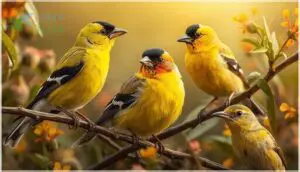
Each Texas yellow bird wears its colors for a reason. Carotenoid pigmentation — pulled straight from the food they eat — drives that electric yellow you see on American Goldfinch males. Melanin edge contrast darkens their wing tips and adds structural durability. Structural feather color adds gloss without any pigment at all.
| Species | Key Plumage Feature |
|---|---|
| American Goldfinch | Black wings, bright yellow body |
| Yellow Warbler | Rusty breast streaks on vivid yellow |
| Pine Warbler | Olive back, white wing bars |
| Lesser Goldfinch | Glossy black cap, yellow underparts |
| Common Yellowthroat | Black mask against yellow throat |
Barred wing patterns and seasonal molt shifts mean the same bird can look completely different in January versus June. That’s your first real field identification tip — note the season before you name the species.
Size and Shape Differences
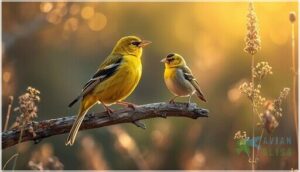
Size is one of your sharpest field identification techniques for yellow birds. The Yellow‑breasted Chat (Granatellus venustus) stretches to 20 cm — nearly twice the Lesser Goldfinch’s 9 cm frame.
Here’s what to clock fast:
- Bill Length Variation — conical goldfinch bills crush seeds; slim warbler bills catch insects
- Tail Proportion Ratios — the Chat’s long tail versus a warbler’s compact one
- Wing Span Range and Body Mass Comparisons — bigger birds fly slower, more deliberately
Seasonal Plumage Changes
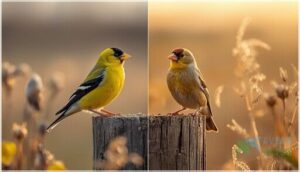
Watch a male American Goldfinch (Spinus tristis) in September — he looks nothing like his summer self. Molt timing drives that shift, with complete feather replacement running six to eight weeks in fall. Breeding plumage returns by late April.
Seasonal plumage variation in Texas yellow birds follows predictable patterns:
- Molt Timing — goldfinch males start fall molt a week before females
- Breeding Plumage — rich yellows peak in spring, fueled by carotenoid pigments
- Winter Drabness — olive-brown tones reduce predator visibility
- Juvenile Coloration — first-year birds stay noticeably duller all winter
Unique Markings by Species
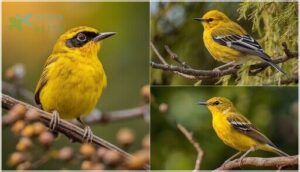
Each yellow bird wears its own field badge — you just need to know where to look.
The Common Yellowthroat (Geothlypis trichas) flashes a bold black mask, while wing bar contrasts help you split Pine Warblers from Yellow Warblers instantly.
Eye ring highlights mark the Chat, and bill color variations tell the story too — the Chat’s thick, curved bill versus a warbler’s fine, needle-point tip.
Habitats of Yellow Birds Across Texas
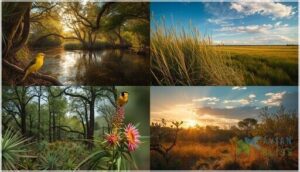
Texas is a big state, and yellow birds have figured out how to thrive in almost every corner of it. Each region offers something different — different trees, different grasses, different water sources — and the birds sort themselves out accordingly.
Here’s a look at four key habitats where you’re most likely to spot a flash of yellow.
Piney Woods and Eastern Forests
Eastern Texas’s Piney Woods punch above its weight in terms of yellow birds. Mature Loblolly Pines tower over a rich riparian understory, creating edge habitat diversity that few ecosystems can match. Pine Warblers nest 9–15 meters up on horizontal limbs, while Yellow-rumped Warblers and Northern Parula work the canopy in waves. Fire-dependent succession keeps understory open — exactly what these species need.
Watch for:
- Pine Warbler foraging along pine bark in mature coniferous forest habitat
- Yellow-rumped Warbler flashing that signature rump patch at forest edges
- Northern Parula singing from moss-draped branches near streams
- Cedar Waxwing foraging flocks stripping fruiting shrubs in winter
- Field identification techniques for yellow plumage: look for wing bars, throat color, and tail patterns first.
Hill Country and Central Texas
From the Piney Woods, head west and the landscape shifts fast — limestone ridges replace sandy soil, and juniper-oak woodlands take over.
This is Hill Country territory, and it’s where Texas keeps one of its best‑kept secrets: the Golden‑cheeked Warbler (Setophaga chrysoparia), the only bird that nests exclusively here.
These warblers arrive mid‑March from Central America, threading into Ashe juniper and oak canopies along geologic formations carved by ancient seabeds and Hill Country waterfalls.
Their insect prey — mostly caterpillars — hides in the bark strips they peel for nesting material.
Smart feeder placement near native oaks can round out your Texas birdwatching guide experience.
Key spots for your identification guide for yellow birds in Texas:
- Balcones Canyonlands Refuge near Marble Falls protects core Golden‑cheeked habitat
- Lost Maples State Natural Area draws Yellow‑rumped Warblers and Yellow‑breasted Chats
- Mo‑Ranch in Kerr County tops eBird hotspot lists for warbler diversity
- Enchanted Rock near Fredericksburg sits within prime habitat preferences of Texas yellow birds
- Live Oak Trail offers riparian zones teeming with yellow bird species in Texas
Prairies, Plains, and Grasslands
Swap the oaks for open sky, and Texas grasslands hit differently. These wide-open spaces — shaped by soil types ranging from the Blackland Prairie’s clay Vertisols to sandy High Plains flats — once covered two-thirds of the state. Fire management and native grass diversity kept them humming. Now? Less than 1% of original Blackland Prairie survives.
Still, grassland habitats reward patient birders. Lesser Goldfinches (Spinus psaltria) work sunflower patches year-round across the Edwards Plateau, and Eastern Meadowlarks flash that bold black chest-band from fence posts in agricultural fields. Grazing impacts and land use change have squeezed both species hard — but knowing their habitat preferences sharpens every field ID.
| Species | Grassland Habitat | What to Look For |
|---|---|---|
| Lesser Goldfinch | Edwards Plateau shrublands | Bright yellow belly, glossy black cap |
| Eastern Meadowlark | Farmlands, open prairie | Lemon-yellow chest, bold black "V" |
| Western Meadowlark | Roadsides, mixed grasslands | Yellow belly, melodic flute-like song |
| American Goldfinch | Open fields, weedy edges | Bright yellow with black wings (male) |
| Yellow-headed Blackbird | Wet meadows, field margins | Vivid yellow hood, white wing patches |
Riparian Zones and Wetlands
From open plains to river’s edge — the shift is dramatic. Riparian thickets as habitat for yellow-bellied chats and wetland warblers rival any grassland hotspot. Dense willow and hackberry corridors shelter Common Yellowthroats and Yellow Warblers year-round.
punch above their weight ecologically:
- Sediment filtration cleans runoff before it hits the main channel
- Bank stabilization benefits stream edges through deep-rooted trees
- Groundwater recharge sustains surrounding upland habitats
- Hydrology impacts from dams have reduced critical flood pulses
- Invasive plant management remains urgent, as salt cedar crowds out native bottomland hardwoods
Migration Patterns and Seasonal Visitors
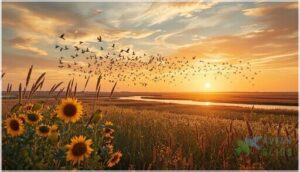
Texas is one of the best places in North America to watch yellow birds come and go with the seasons. Some species pass through only briefly, while others stick around all year.
Here’s what you need to know about when and where to find them.
Spring and Fall Migratory Species
Texas acts like a giant funnel during spring and fall migration — millions of birds pour through, and yellow species lead the charge. spring and fall migration peaks from March to May, then August to October. Weather influences everything: warm fronts push birds north fast, while cold snaps stall them in your local park.
| Species | Migration Window | Stopover Food Sources |
|---|---|---|
| Yellow Warbler | April – early May | Insects, caterpillars |
| American Goldfinch | Late March – April | Thistle, sunflower seeds |
| Wilson’s Warbler | April – May | Small insects, berries |
| Magnolia Warbler | April – May | Insects, spiders |
| Common Yellowthroat | August – October | Marsh insects, seeds |
Banding studies confirm Texas’s role at the crossroads of the Central and Mississippi Flyways. Smart fueling strategies matter — birds double their body weight at key stopover sites along riparian corridors before continuing north.
Year-Round Residents Vs. Seasonal Visitors
Not every yellow bird in Texas is just passing through — some are true year‑round residents. Lesser Goldfinches (Spinus psaltria) and Audubon’s Orioles stay put all year, creating steady, predictable community engagement levels for backyard birders.
American Goldfinches shift from bright summer yellow to dull winter brown, but remain present.
Seasonal visitors like Yellow Warblers arrive April through October, then vanish — causing real service demand fluctuations at feeders and notable habitat preference shifts across riparian zones.
Notable Migratory Routes in Texas
Few places on Earth funnel migrants like Texas does. The Gulf Coast Flyway channels birds north after exhausting Overwater Gulf Crossings — some songbirds fly 500+ miles nonstop from the Yucatán.
Texas’s Gulf Coast Flyway drives songbirds 500+ miles nonstop from the Yucatán, making it one of Earth’s greatest migration funnels
The Rio Grande Valley merges two major flyways, creating exceptional diversity at every stopover.
The Big Bend Passage funnels species down from the Rockies, while Coastal Bend Transit concentrates nocturnally migrating landbirds along the shore.
These seasonal migration routes are precisely why Texas birdwatching hotspots for yellow birds — warblers especially — deliver jaw-dropping variety across every corner of the state.
Timing of Key Migrations
Timing really is everything for catching yellow birds in Texas. The Early Spring Arrival window kicks off in mid‑March, when Yellow‑throated Warblers and Common Yellowthroats start to filter in ahead of the crowd. The Mid‑Spring Peak — roughly April 22 to May 12 — is when migration hits full throttle.
Here’s a quick cheat sheet for your field notebook:
- Yellow Warblers move through April–May and again mid‑August–October
- Common Yellowthroats arrive mid‑March, depart by late October
- American Goldfinches dominate wintering habitats from December through March
- Late Fall Passage runs September through late October for most warblers
- Migration Timing Gaps between spring and fall can shift two weeks earlier than in past decades
Watch those Winter Departure Windows — goldfinches often linger well into spring.
Conservation and Birdwatching Tips
Spotting yellow birds is rewarding — keeping them around takes a little more intention. Texas has some species worth watching closely, and knowing where to look makes all the difference.
Here’s what you need to know about protecting these birds and finding the best spots to enjoy them.
Threatened and Endangered Yellow Birds
The Golden-cheeked Warbler (Setophaga chrysoparia) holds a sobering legal status — federally endangered since 1990 and the only bird that breeds exclusively in Texas.
Habitat fragmentation across Hill Country juniper-oak woodlands is the core threat.
Recovery efforts include land protection and cowbird control, and a 2025 review recommended downlisting it to threatened.
Citizen involvement in reporting sightings genuinely shapes population trends and conservation measures for these endangered warblers going forward.
Best Locations for Birdwatching
Texas is a birder’s jackpot — and knowing where to look makes all the difference. For yellow‑bellied birds, a few spots rise above the rest. High Island on the upper coast is legendary: when south winds stall spring migrants, thousands of warblers and orioles drop into the first trees north of the Gulf.
Beyond that, the birdwatching hotspots for yellow‑bellied birds spread across the state:
- Guadalupe River corridor draws goldfinches and warblers year‑round through riparian forests.
- Garner State Park mixes cypress groves and juniper slopes with rich songbird diversity.
- Port Aransas concentrates migrants along coastal woodlots during peak migration windows.
- Big Bend layers desert washes, river floodplains, and mountain canyons into one impressive mosaic.
Attracting Yellow Birds to Your Backyard
After visiting those hotspots, you can pull yellow birds straight into your own yard. tube feeders with Nyjer seed are your best bet for attracting American and Lesser Goldfinches — sock feeders work especially well in the Hill Country.
platform feeders with sunflower chips draw Pine Warblers in winter.
For native plantings, try coneflowers and milkweed; they’re free seed sources that keep giving.
Add a shallow birdbath or dripper, space feeders ten feet from windows, and keep cats indoors.
Habitat Preservation Efforts in Texas
Your backyard feeders connect to something much larger. Across Texas, conservation work — coastal prairie restoration near Laguna Atascosa, riparian forest protection along the Rio Grande, grassland management with prescribed burns — is rebuilding the habitats that yellow birds depend on.
Coastal wetland stewardship and smart land use planning reduce habitat fragmentation that quietly fragments bird populations.
Supporting these efforts keeps both the birds and their ranges intact.
Frequently Asked Questions (FAQs)
What are the yellow birds in Texas?
If you spend any time outdoors in the Lone Star State, you’ll notice a surprising number of yellow bird species of Texas flashing through fields, forests, and backyards alike.
How do I identify yellow birds in Texas?
Identifying yellow birds comes down to five quick cues: bill structure, tail shape, flight silhouette, plumage coloration, and vocal identification. Nail those, and any species clicks into place fast.
How many yellow birds are there in Texas?
Texas is home to at least 29 yellow bird species — roughly 4% of the state’s 664 recorded birds. That’s impressive species richness, spanning warblers, goldfinches, and orioles across wildly different regional distributions.
What birds are most common in Texas?
Northern Cardinals, Blue Jays, and Mourning Doves rule feeders statewide year-round. But during migration, warblers flood Texas by the millions—making it North America’s busiest avian highway.
What is the smallest yellow bird in Texas?
Meet the Lesser Goldfinch — the smallest true finch in the world. At just 5 to 3 inches long and barely 8 grams, it’s tinier than even the American Goldfinch (Spinus tristis).
How do you attract yellow birds in Texas?
Offer Nyjer and black oil sunflower seeds in clean feeders, add a shallow dripping birdbath, and plant native coneflowers. Timing matters — start filling feeders in late July for goldfinches.
Is a goldfinch a yellow bird in Texas?
Absolutely — both the American Goldfinch and Lesser Goldfinch are yellow bird species of Texas.
Breeding males flash vivid canary-yellow plumage, making them unmistakable visitors at Nyjer and sunflower feeder types statewide.
What is the most common yellow bird?
Like clockwork every winter, the American Goldfinch floods Texas feeders — observer reports place it on 19% of seasonal checklists, making it the state’s most reliably spotted yellow bird.
What is the yellow songbird in Texas?
Texas is home to dozens of yellow songbirds.
The American Goldfinch (Spinus tristis) and Yellow Warbler (Setophaga petechia) top the list — bright, vocal, and surprisingly easy to find once you know where to look.
What does a female yellow warbler look like?
She’s softer than the male—greenish-yellow above, pale yellow below, plain-faced with a dark standout eye. No bold breast streaks.
Yellow tail spots and feather edge hues clinch the American Yellow Warbler ID fast.
Conclusion
Vibrant visitors voyage through Texas skies, each yellow bird is a fleeting marvel. From goldfinches to warblers, you’ve decoded their secrets—plumage clues, favorite haunts, and migratory rhythms.
These sun-hued travelers don’t just brighten branches; they stitch life into ecosystems. Your backyard feeder or quiet trail walk becomes a front-row seat to their epic journeys.
Protecting habitats ensures their songs persist. So keep watching, learning, and advocating—every sighting weaves hope into the tapestry of Texas’ natural legacy.
- https://www.britannica.com/animal/American-goldfinch
- https://avibirds.com/yellow-birds-in-texas/
- https://www.allaboutbirds.org/guide/Yellow-breasted_Chat/lifehistory
- https://txtbba.tamu.edu/species-accounts/common-yellowthroat/
- https://peecnature.org/learn/nature-guides/featured-critters/lesser-goldfinch/