This site is supported by our readers. We may earn a commission, at no cost to you, if you purchase through links.
A friend once told me she could identify thirty bird species without ever seeing them—just by listening to the woodland symphony on her morning walks. I was skeptical until she proved it, rattling off names as invisible warblers and thrushes sang from the canopy above.
Identifying birds by their songs isn’t just a party trick for expert birders; it’s a skill that transforms how you experience the outdoors, revealing a hidden world that exists beyond what your eyes can catch. Whether you’re tracking a shy species tucked in dense foliage or simply trying to know which neighbor is serenading you at dawn, learning to decode avian vocalizations opens up possibilities that binoculars alone can’t deliver.
With the right techniques and a bit of practice, you’ll start recognizing the acoustic signatures that make each species unmistakable.
Table Of Contents
- Key Takeaways
- Why Identify Birds by Their Songs?
- Key Features of Bird Songs
- Effective Techniques for Learning Bird Songs
- Top Tools for Bird Song Identification
- Advancing Skills and Supporting Conservation
- Frequently Asked Questions (FAQs)
- Can you identify birds by their songs?
- Is there an app that can identify birds by their song?
- Is there a Shazam for bird sounds?
- Can you identify a bird from its song?
- What is the website that identifies bird songs?
- What is the best free bird song identifier?
- Can Google identify bird sounds?
- Can I upload a picture of a bird to identify it?
- Can weather affect bird songs?
- How do regional dialects impact identification?
- Conclusion
Key Takeaways
- Learning to identify birds by their bird songs reveals hidden species in dense foliage, low light, and challenging conditions where visual identification fails, transforming ordinary walks into rich acoustic adventures that sharpen your awareness of the natural world.
- Breaking down bird vocalizations into pitch patterns, rhythm, and tone—plus distinguishing territorial songs from functional calls—builds your mental library faster than memorizing individual species, especially when you start with common local birds and use mnemonics like “Drink your tea!” for the Eastern Towhee.
- Modern apps like Merlin Bird ID combine real-time sound recognition with offline databases, letting you identify species in remote areas without cell service while contributing your observations to citizen science projects that support actual conservation research.
- Birding by ear isn’t just a hobby—it reduces stress, creates inclusive opportunities for people with limited vision, and directly supports habitat preservation when you choose native plants, participate in local restoration efforts, or fund conservation through eco-tourism.
Why Identify Birds by Their Songs?

Learning to identify birds by their bird songs opens up a whole new dimension to watching wildlife—one that turns every walk into an acoustic adventure.
For trickier species like sparrows that sound similar, learning to distinguish their subtle call differences helps you confirm identifications even when the bird stays hidden.
Sound reveals birds you’d otherwise miss entirely, from warblers hidden in dense foliage to species that look nearly identical but sing completely different tunes.
Here’s why tuning your ears to birdsongs is worth the effort.
Benefits of Birding by Ear
Birding by ear transforms your time outdoors—it sharpens Environmental Awareness, reduces stress through focused audio learning, and deepens your nature connection in ways sight alone can’t match. You’ll discover hidden species, aid bird conservation through citizen science, and build skills that last a lifetime.
Birding by ear sharpens your senses, reveals hidden species, and turns every walk into a lifetime skill that supports conservation
Why birding by ear matters:
- Stress reduction – Listening to bird songs slows your breathing and calms your mind during field sessions
- Enhanced discovery – You’ll detect species in dense foliage, fog, or twilight when visuals fail
- Inclusive practice – Audio learning assists birders with limited vision, broadening participation
- Seasonal stability – Bird vocalizations provide reliable clues even when plumage changes across seasons
- Conservation impact – Your sound-based observations strengthen habitat monitoring and biodiversity inventories
Embracing a mindful practice like further deepens your ability to connect with nature, enhancing both focus and self-acceptance.
Situations Where Sound is Essential
You know bird songs matter in the field—but sound-based ID unlocks insights far beyond birding. Alarm Systems warn of danger, Emergency Response teams coordinate rescues, and Maritime Navigation depends on audible cues when visibility drops.
Hearing-based techniques drive everything from echolocation to Soundscape Analysis in wildlife corridors, proving Sound ID and Bird Song Recognition aren’t just hobbies—they’re survival skills. The essential role of sound in daily activities and brain processing can’t be overstated, as it impacts both instinctive reactions and deliberate actions.
| Situation | Why Sound Matters | Example Application |
|---|---|---|
| Dense Habitats | Vision blocked by foliage | Rainforest bird calls reveal hidden species |
| Low Light | Dawn, dusk, or fog limits sight | Nocturnal migrants detected by flight calls |
| Emergency Response | Rapid coordination needed | Sirens and radio chatter guide rescues |
| Maritime Navigation | Collision prevention at sea | Ship horns signal position in heavy fog |
| Wildlife Monitoring | Track elusive or cryptic species | Audio sensors log owl activity overnight |
Enhancing Outdoor Experiences
Once you’ve grasped why sound is vital, you’ll want to actually apply birding by ear on your next outing. Bird Song Recognition transforms ordinary Nature Walks into Wildlife Encounters rich with discovery—eco tourism operators and Outdoor Guides know this well.
Start by identifying common bird calls in your area, then gradually build your mental library of songs and alarm notes with each walk.
Listening on Birding Trails:
- Reduces stress after just 15 minutes of tuning in
- Sharpens your awareness of trail conditions and hazards
- Engages families through guided bird identification activities
- Slows your pace for deeper, more immersive experiences
- Builds memory anchors tied to specific habitats
Bird calls turn hikes into adventure.
Key Features of Bird Songs
Every bird song tells a bird song story—if you know what to listen for.
The trick isn’t memorizing thousands of melodies but learning to break down what makes each one distinct.
Understanding pitch patterns, recognizing the difference between songs and calls, and tuning into species-specific quirks will sharpen your ear faster than you’d think.
Pitch, Tone, and Rhythm Patterns
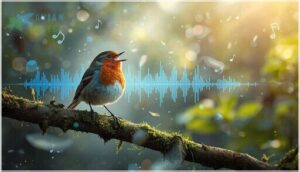
When you tune in to bird song, you’re deciphering a three-dimensional soundscape—pitch (frequency range from 1 to 8 kHz), tone recognition (that flute-like or buzzy quality), and rhythm patterns (steady trills versus staccato bursts).
Once you’ve learned to recognize these acoustic cues, you can identify which birds live in your area and start matching songs to specific species in your local habitat.
Frequency analysis reveals how smaller birds hit higher notes, while syllable structure and acoustic contour—those rising crescendos—help you nail vocalizations during birding by ear adventures using Sound ID technology.
Differences Between Songs and Calls

Understanding the nuance between calls and songs sharpens your birding by ear skills dramatically. Songs—those longer, melodic vocalizations—advertise territory and attract mates during breeding season, showcasing complex song structures males learn through vocal learning.
Calls? Short, instinctive audio cues for immediate bird communication: alarms, flock coordination, danger alerts. Both sexes produce calls year-round, while songs peak seasonally. Sound ID technology helps distinguish these audio recognition patterns effortlessly.
Species-Specific Vocalizations
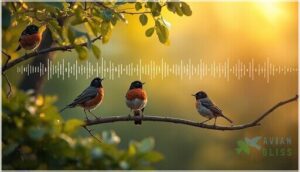
Every species carries its own acoustic fingerprint—those signature Song Patterns you’ll recognize once you tune your ear through Vocal Learning. Birding by ear reveals how acoustic analysis separates a robin’s rippling phrases from a blackcap’s fluty notes, sharpening your species recognition instincts.
- Blackbirds deliver confident, low-pitched verses that carry across open ground
- Robins weave rippling whistles into crystal-clear melodies you won’t mistake
- Song thrushes repeat bold phrases 2-4 times—nature’s way of drilling identification into your memory
- Dunnocks offer sweet, high-pitched melodies in short bursts, distinct from louder territorial singers
Effective Techniques for Learning Bird Songs

Learning to identify birds by their bird songs doesn’t require a photographic memory—just the right approach. The key is breaking down the learning process into manageable steps that work with how your brain naturally stores sound patterns.
Here are three proven techniques that’ll help you build a mental library of bird songs faster than you might expect.
Using Mnemonics and Memory Aids
Bird songs can feel like a blur when you’re starting out—that’s where mnemonics shine. Pair each species with a catchy phrase: the Eastern Towhee’s “Drink your tea!” or the Barred Owl’s “Who cooks for you?”
Visual associations work too—imagine a robin’s cheerful red breast as it delivers its caroling phrases. These acronym strategies and song mnemonics transform birding by ear from guesswork into confident bird identification techniques.
Practicing Active Listening in Nature
When you slow down and let environmental acoustics wash over you, birding techniques shift from rushed observation to genuine nature awareness. Try five-minute daily walks in quiet spots—unplugged, breathing slowly—to sharpen your auditory skills and sound tracking abilities.
Early mornings offer cleaner acoustics and more active singers. This bird identification technique builds birding skills that reveal bird behavior patterns you’d otherwise miss, deepening your connection to wildlife conservation efforts.
Starting With Common Local Species
You’ll accelerate Species Recognition by zeroing in on your backyard regulars—Northern Cardinals, American Robins, Song Sparrows. Regional Guides and birding app databases highlight what’s actually singing in your county right now, not exotic rarities.
Focus on five widespread bird species first, using Local Bird Calls as your baseline. Birding Communities often share Beginner Tips on common bird behavior patterns, turning wildlife identification from overwhelming to achievable through strategic, localized bird watching practice.
Top Tools for Bird Song Identification
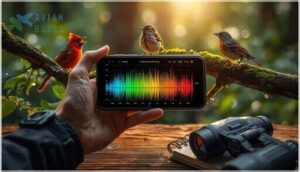
You don’t need to master bird songs alone—technology has made identification easier than ever.
Modern tools can listen alongside you, analyze what they hear, and show you exactly which species is singing. Let’s look at the apps and features that’ll help you identify birds by sound, even when you’re miles from an internet connection.
Mobile Apps and Sound ID Technology
You’ve got powerful birding apps like Merlin Bird ID that use audio and image recognition technology to turn your phone into a field companion.
Sound Recognition works through real-time Audio Analysis—capturing songs, matching patterns via Mobile Calibration, and cross-referencing eBird’s massive database.
Some tools even create Hearing Profiles with Custom EQ settings, adapting to your unique auditory strengths for sharper bird identification in the field.
Offline Identification Capabilities
What happens when you’re deep in the backcountry with no cell service? Offline Tools like Merlin Bird ID store audio samples and trained models directly on your phone—Device Storage means Real-time Verification continues through on-device Audio Analysis, matching songs against Local Databases without internet.
You’ll identify species in remote habitats where connectivity fails, keeping your birding momentum alive no matter how far off-grid you wander.
Advancing Skills and Supporting Conservation

Once you’ve gotten the hang of identifying birds by their bird songs, there’s a whole world beyond just personal enjoyment.
Combining what you hear with what you see sharpens your birding skills considerably, while sharing your observations can actually contribute to real scientific research. Your birding hobby can also become a meaningful way to support conservation efforts that protect the species you’ve come to know and love.
Combining Visual and Audio Identification
Pairing what you see with what you hear transforms your birding—visual cues like plumage and posture alongside audio patterns create a powerful identification strategy.
When you’re using the Bird ID Wizard or birding apps and tools like the Audubon Bird Guide, combine field observations with species identification methods that include both bird photos and song tempo. This multimodal learning sharpens accuracy and deepens your connection to each sighting.
Contributing to Citizen Science Projects
Your observations can fuel real research when you submit them to platforms like eBird—volunteer roles in data collection help scientists track migration patterns, population trends, and conservation impact across continents.
Using birding apps and tools alongside species identification methods, you’re not just learning ornithology; you’re joining a research collaboration where every recording strengthens community engagement and protects the birds you’re working to know.
Supporting Bird Conservation Through Birding
Beyond logging sightings, your birdwatching directly fuels wildlife conservation efforts—choosing bird friendly gardens with native plants creates habitat preservation right in your yard, while eco tourism dollars fund nature conservation programs protecting stopover sites.
When you join a birding series or support local habitat restoration, you’re not just learning ornithology; you’re actively participating in the wildlife protection work that keeps those songs alive.
Frequently Asked Questions (FAQs)
Can you identify birds by their songs?
Yes, with ear training and audio analysis of bird song patterns, you’ll recognize species by vocal learning.
Developing these species recognition skills transforms how you experience avian ecology and behavior outdoors.
Is there an app that can identify birds by their song?
Absolutely—think of them as field guides in your pocket.
Merlin Bird ID and BirdNET use audio recognition to match recordings against massive species databases, delivering mobile identification even offline in many regions.
Is there a Shazam for bird sounds?
BirdNET, ChirpOMatic, and Chirpity work like Shazam for birds—analyzing vocalizations with audio recognition and sound analysis to suggest species matches.
These birding technology apps combine species identification methods with image recognition for thorough ornithology field studies.
Can you identify a bird from its song?
With audio recognition tools like Sound ID and the Audubon Bird Guide, you can identify birds from their songs by analyzing sound wave analysis and vocal learning patterns—matching species identification methods to unique bird song patterns in avian ecology.
What is the website that identifies bird songs?
Several websites offer bird song identification, but the BirdNET Tool stands out—it analyzes uploaded audio guides using AI-powered sound analysis, matching recordings against an extensive species database for accurate avian ecology and behavior research.
What is the best free bird song identifier?
Merlin Bird ID by Cornell Lab stands out as the top free choice—it recognizes over 2,000 species, works completely offline, and combines real-time Sound ID with photo tools and detailed species accounts.
Can Google identify bird sounds?
While Google doesn’t have a standalone bird identifier, its machine learning algorithms power apps like Merlin—using audio pattern recognition and species identification tech to analyze bird call analysis through advanced sound processing.
Can I upload a picture of a bird to identify it?
Yes—you can upload a clear photo ID to apps with Photo ID features, which generate possible species matches. These tools work offline and let you save identifications to a digital scrapbook for nature observation.
Can weather affect bird songs?
Absolutely—weather patterns drive song variation through atmospheric effects on sound transmission.
Temperature shifts vocal pace, humidity alters acoustic ecology, and seasonal climate impact reshapes how birds adapt their communication within changing habitats.
How do regional dialects impact identification?
You’d think a UK bird sounds the same everywhere—but regional accents skew recognition.
Dialect variations in a blackcap’s song create accent bias, causing misidentification even when you know the species well.
Conclusion
Your friend probably wasn’t born distinguishing a wood thrush from a veery—she learned through patient practice, just like you’ll. Identifying birds by their songs starts with curiosity and sharpens into a skill that rewrites your relationship with every forest path and backyard morning.
The invisible becomes known, the overlooked becomes essential, and suddenly you’re fluent in a language that’s been playing overhead all along. All it takes is listening—really listening—to what’s already there.