This site is supported by our readers. We may earn a commission, at no cost to you, if you purchase through links.
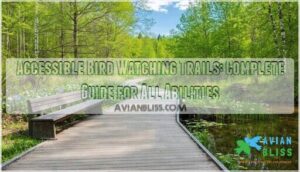 You’ll find accessible bird watching trails with paved paths, wheelchair-friendly surfaces, and thoughtfully designed viewing areas that welcome everyone.
Look for trails featuring boardwalks with handrails, barrier-free observation platforms, and comfortable benches positioned at prime birding spots.
National parks and local nature centers increasingly offer inclusive spaces with accessible parking, clear signage, and adaptive equipment options.
These trails prove that mobility challenges shouldn’t limit your connection to nature’s feathered performers.
Many locations provide bird blinds with wheelchair access and rest areas designed for extended comfortable viewing.
The key features that transform ordinary trails into welcoming birding destinations might surprise you, as they often include accessible parking, clear signage, and adaptive equipment options, making them perfect for nature’s feathered performers.
Table Of Contents
- Key Takeaways
- Accessible Trails Features
- Birding Location Accessibility
- Inclusive Birding Space Design
- Birding for People With Disabilities
- Enhancing Accessibility and Inclusion
- Frequently Asked Questions (FAQs)
- What birds live in Shenandoah National Park?
- What animals can you see from the boardwalk at Huntley Meadows Park?
- Is Huntley Meadows boardwalk wheelchair accessible?
- What is not allowed on the Huntley Meadows boardwalk?
- Are boardwalk hikes safe?
- Where can I walk through the woods in Fairfax County?
- What are the 5 S’s of birding?
- What colors not to wear when birding?
- What is the best month for bird watching?
- What’s the difference between birding and bird watching?
- Conclusion
Key Takeaways
- You’ll find accessible bird watching trails feature paved paths at least 36 inches wide, wheelchair-friendly boardwalks with handrails, and barrier-free observation platforms that eliminate mobility barriers.
- You can access national parks and nature centers with fee waivers for disabled visitors, accessible parking, and specialized equipment like GRIT Freedom Chairs available at no cost.
- You’ll discover strategically placed benches every 200-300 feet, accessible bird blinds with wide entrances and low viewing windows, and rest areas designed for extended comfortable observation.
- You can join inclusive birding communities through organizations like Birdability that provide accessibility maps, adaptive equipment loans, and welcoming spaces for all abilities and perspectives.
Accessible Trails Features
When you explore accessible birding trails, you’ll find features designed to welcome everyone, from paved surfaces to comfortable viewing areas.
These thoughtful elements guarantee you can focus on spotting your next favorite bird rather than traversing challenging terrain.
Paved Paths and Wheelchair Accessibility
Three key features make paved trails your gateway to accessible birding.
Wide paths spanning at least 36 inches accommodate wheelchairs comfortably, while smooth surfaces eliminate bumps and barriers.
Wheelchair ramps with gentle slopes under 5% connect different trail levels seamlessly.
These accessible routes transform ordinary walks into birding adventures, ensuring everyone can pursue feathered friends without mobility constraints limiting their outdoor exploration.
The design of these trails incorporates accessible birding principles to create an inclusive environment for all bird watchers, making it a perfect setting for birding adventures.
Barrier-Free Viewing Areas and Benches
Barrier-free viewing areas transform your birding experience by removing physical obstacles that might prevent close wildlife observation.
These strategically placed view points offer unobstructed sightlines to prime birding locations.
- Seating options include backrest benches positioned at ideal heights for wheelchair users
- Accessible viewing areas feature wide platforms with non-slip surfaces and clear approach paths
- Rest areas provide shade structures and multiple seating configurations for extended comfort
Well-designed accessible birding trails incorporate these accessibility features to guarantee everyone can enjoy nature’s spectacle without barriers limiting their experience.
The inclusion of bird watching benches with proper bird watching equipment enhances the overall birding experience.
Boardwalks and Handrails for Comfort
Elevated boardwalks create stable platforms over wetlands and uneven terrain, letting you glide smoothly to prime birding spots.
Quality handrail safety features provide steady support while maintaining open sight lines.
Well-designed birding rails incorporate comfortable gripping surfaces and proper heights.
Access ramps connect different elevation levels seamlessly.
These accessible hiking paths transform challenging landscapes into welcoming wheelchair accessible trails, guaranteeing trail comfort for extended nature walks.
The construction of these trails often involves understanding complex trail system designs to guarantee accessibility and safety.
Trail Surfaces and Widths for Easy Navigation
You’ll find firm surfaces like concrete or asphalt work best for wheelchair accessible trails.
Look for path widths of at least 36 inches—this gives you room to maneuver comfortably.
Trail materials should provide stable footing without loose gravel or sand that creates obstacles.
Navigation aids like clear markers help you stay oriented while focusing on the birds overhead, utilizing wheelchair accessible trails.
Birding Location Accessibility
You’ll find accessible birding opportunities at national parks, nature centers, and local preserves that increasingly prioritize inclusive design.
Many locations now offer fee waivers for disabled visitors, wheelchair-accessible parking, and specialized observation platforms designed for all abilities, which support accessible birding experiences.
National Parks and Nature Centers Accessibility
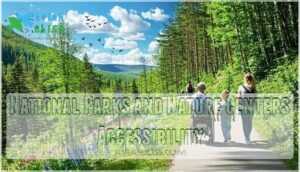
Most national parks welcome bird enthusiasts with paved nature trails and wheelchair-accessible visitor centers featuring tactile exhibits and captioned videos.
Great Smoky Mountains provides GRIT Freedom Chairs free of charge, while the America the Beautiful Access Pass grants lifetime entry to over 2,000 sites for visitors with permanent disabilities, covering all vehicle passengers.
Visitors can learn more about the free access program to plan their trips accordingly, utilizing the free access and lifetime entry benefits.
Local Preserves and Inclusive Spaces
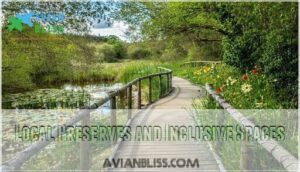
Local preserves offer accessible birding opportunities right in your backyard.
They prioritize inclusive design, featuring disability-friendly trails with smooth surfaces and gentle grades.
Urban sanctuaries often provide better accessibility than remote locations, supporting conservation efforts while fostering inclusive birding communities.
Many preserves engage volunteers in eco tourism initiatives, creating accessible nature reserves that welcome all abilities through thoughtful community engagement and barrier-free access.
Observation Platforms and Bird Blinds Accessibility
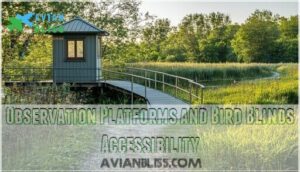
Well-designed viewing platforms and accessible observation structures transform your birding experience.
Platform height matters – viewing platforms positioned 8-12 feet high offer clear sightlines over vegetation while maintaining comfortable viewing angles.
Blind designs feature wide 32-inch entrances and low window sizes starting 2-2.5 feet from the floor for wheelchair users.
Ramp access replaces stairs, creating inclusive birding havens where everyone can enjoy unobstructed bird observation.
Many birding locations now offer accessible birding options to enhance the experience for all participants, promoting an accessible environment.
Parking and Entrance Fees for Disabled Birdwatchers
Many accessible birding trails offer fee waivers and reduced rates for disabled birdwatchers.
You’ll find accessible parking spaces near entrances, often with free admission or discounted entry fees.
Check for disability access permits that provide additional benefits.
Some locations waive entrance fees entirely for wheelchair accessibility needs, making accessible outdoor recreation more affordable and removing financial barriers to enjoying nature’s winged wonders.
The availability of these accommodations makes it easier for everyone to enjoy birdwatching, regardless of their abilities, and helps to promote inclusive outdoor activities.
Inclusive Birding Space Design
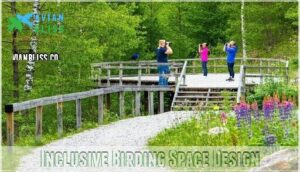
Creating inclusive birding spaces requires thoughtful design that removes barriers and welcomes everyone.
When you incorporate essential features like proper ramps, accessible bathrooms, strategic seating, and clear signage, you’ll transform ordinary trails into spaces where all birders can enjoy nature’s wonders.
You’ll transform ordinary trails into spaces where all birders can enjoy nature’s beauty by incorporating these features, making birding inclusive.
Ramps and Handrails for Safe Navigation
You’ll find proper ramps and handrails make all the difference when exploring birding trails.
Slope Guidelines recommend gradients no steeper than 1:20 for wheelchair accessibility.
Handrail Heights should sit between 34-38 inches, with ADA compliance requiring sturdy construction.
Quality Ramp Materials like concrete or composite decking resist weather damage.
Safety Features include non-slip surfaces and continuous handrails.
These Navigation Aids transform challenging terrain into welcoming accessible trails for everyone.
Accessible Bathrooms and Clear Signage
Accessible restrooms with proper turning radius and manageable doors complement your birding experience.
Clear signage using high-contrast colors and sign language symbols guides you effortlessly along accessible birding trails.
Bathroom layout should include appropriate sink heights and grab bars meeting accessibility standards, and strategic placement of directional signs creates clear sightlines, helping you navigate wheelchair accessibility features without confusion during your accessible nature walks.
Benches and Rest Areas for Enhanced Comfort
Strategic Rest Area Design transforms ordinary trails into welcoming sanctuaries.
Position benches every 200-300 feet along paths, incorporating armrests and back support for maximum comfort.
Choose shaded locations under trees or install shelter structures.
Proper bench placement near bird viewing areas allows extended observation.
Smart seating options include varying heights and orientations.
Well-designed rest stops enhance trail accessibility.
By incorporating native plant gardens with bird friendly features, trails can attract a diverse range of bird species, further enriching the bird watching experience with welcoming and diverse environments.
Essential Design Elements for Welcoming Spaces
Creating welcoming spaces requires thoughtful universal design principles that break down barriers.
You’ll need accessible restrooms with proper turning radius, inclusive signage featuring braille and large print, and sensory gardens that engage multiple senses.
Community engagement drives successful projects—local input shapes features that truly serve diverse needs.
The Birdability Map showcases how wheelchair accessibility transforms ordinary trails into inclusive birding destinations where everyone can enjoy accessible nature outings together.
Birding for People With Disabilities
Bird watching welcomes everyone, regardless of physical abilities or health conditions.
Organizations like Birdability work to remove barriers and create inclusive communities where mobility challenges, visual or hearing impairments, and chronic illnesses don’t prevent you from enjoying nature’s feathered residents, making it accessible to all with inclusive communities.
Mobility Challenges and Assistive Devices
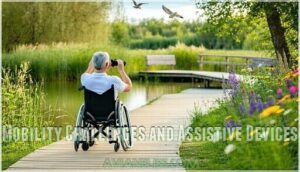
Mobility challenges shouldn’t keep you grounded when birds are calling.
Wheelchairs, walkers, and scooters open up accessible birding trails designed with your needs in mind.
Many parks now feature wheelchair accessibility with smooth surfaces and gentle grades.
Adaptive equipment like lightweight binoculars with stabilizers and smartphone apps help you spot and identify birds without strain.
Disability support services at nature centers provide mobility aids and trail maps highlighting handicap accessible routes, making every birding adventure possible.
The use of optical tools with portable binoculars can enhance the birding experience for people with disabilities.
Visual and Hearing Impairments Accommodations
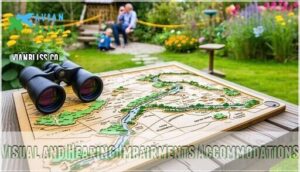
Beyond mobility solutions, sensory accommodations open birding to those with visual and hearing challenges. Audio guides provide bird identification through smartphone apps, while tactile maps help you navigate trails independently. QR codes link to detailed species information that screen readers can access.
- Braille signs and large-print materials at accessible birding sites offer essential trail information
- Sensory gardens feature fragrant plants and textured surfaces that enhance the birding experience
- Sign language interpreters at organized events guarantee hearing-impaired participants can fully engage
Rope-guided paths let visually impaired birders explore disability-friendly trails safely. Hearing assistance devices amplify bird calls, making accessible outdoor activities possible for everyone.
Chronic Illness and Mental Health Benefits
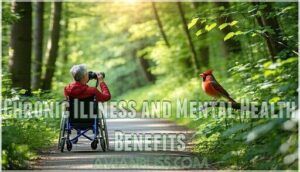
Birding offers powerful mental health benefits through nature therapy and stress relief.
Finding peace in the flutter of wings and the melody of bird calls naturally soothes both mind and body.
When you’re dealing with chronic illness, mindful birding provides gentle exercise and mood improvement without demanding intense physical activity.
The rhythmic sounds of bird calls naturally reduce anxiety and create wellness benefits that support your overall healing journey, providing stress relief.
Inclusive Birding Communities and Diverse Perspectives
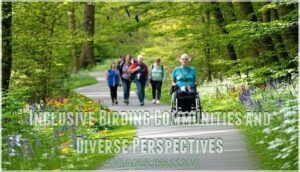
You’ll discover vibrant inclusive birding communities that welcome everyone, regardless of ability.
Organizations like Birdability create safe spaces where diverse perspectives enrich the birding experience for all participants.
- Community Outreach programs connect disabled birders with local clubs and mentorship opportunities
- Disability Awareness training helps birding groups understand accessibility needs and remove barriers
- Inclusive Policies guarantee equal participation through adaptive equipment loans and transportation assistance
- Social Inclusion initiatives foster belonging through affinity groups and culturally responsive programming
- Birding Equity efforts address representation gaps through targeted outreach to underrepresented communities
These disability-friendly trails and accessible bird watching trails create birding for all experiences that celebrate every perspective.
Enhancing Accessibility and Inclusion
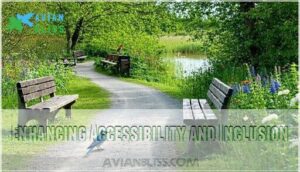
You’ll find that successful accessibility efforts depend on three key approaches: education, collaboration, and community engagement.
Organizations like Birdability work with local groups and parks to create thorough resources, maintain crowdsourced accessibility maps, and foster welcoming birding communities that celebrate diverse perspectives and remove barriers for everyone.
Educating on Accessible Trail Features
Understanding what makes trails truly accessible empowers you to advocate for better birding infrastructure.
You’ll recognize quality features that transform ordinary paths into inclusive spaces for everyone.
| Feature Category | What to Look For | Impact on Birders |
|---|---|---|
| Trail Surfaces | Concrete, asphalt, or compacted gravel | Smooth wheelchair navigation, reduced fatigue |
| Accessible Routes | 36-inch minimum width, gentle slopes under 5% | Easy passage for mobility devices, walking aids |
| Birding Infrastructure | Low viewing windows, wide blind entrances | Clear sightlines for seated users, equipment access |
| Inclusive Designs | Frequent benches, shade structures, handrails | Rest opportunities, stability support, comfort |
| Disability Awareness | Clear signage, distance markers, surface indicators | Informed decisions, safe planning, confidence building |
When you spot these accessible bird watching trails features, you’re seeing thoughtful planning in action.
Accessible nature trails with proper infrastructure create opportunities where none existed before.
Disability-friendly trails aren’t just about compliance—they’re about opening doors to nature’s wonders for everyone.
Collaborating With Organizations for Accessible Outings
Partnership models with Audubon chapters and adaptive sports organizations create powerful outreach strategies for accessible birding trails.
These disability support networks reach diverse communities through established community engagement channels.
Together Outdoors connects 100+ organizations, while rehabilitation hospitals partner for inclusive events targeting disability birding groups.
Community support groups distribute event information, ensuring inclusive birding communities thrive through accessible outdoor education initiatives.
Promoting Inclusive Birding Practices and Community Support
Community outreach programs expand birding equity by connecting with disability organizations and local groups.
You’ll find inclusive policies emerge when birding communities actively engage diverse participants through workshops and mentorship programs.
Disability awareness training transforms traditional clubs into welcoming spaces where accessible birding trails become standard practice.
Social inclusion flourishes when experienced birders share knowledge with newcomers facing mobility challenges, creating disability friendly trails through collective advocacy.
By incorporating features like accessible birding locations, communities can promote a culture of inclusivity and diversity in bird watching activities.
Frequently Asked Questions (FAQs)
What birds live in Shenandoah National Park?
While forests offer shelter, open meadows provide hunting grounds—Shenandoah’s diverse habitats support over 200 bird species.
You’ll spot warblers, hawks, woodpeckers, thrushes, and vireos throughout the park’s varied elevations and ecosystems year-round, which makes it an ideal place to see a wide variety of birds, including vireos.
What animals can you see from the boardwalk at Huntley Meadows Park?
You’ll spot beavers, river otters, great blue herons, wood ducks, painted turtles, and various songbirds from Huntley Meadows‘ accessible boardwalk, making wildlife viewing effortless for everyone.
Is Huntley Meadows boardwalk wheelchair accessible?
You’ll find Huntley Meadows’ half-mile boardwalk is completely wheelchair accessible, offering smooth navigation through the wetlands. The trails feature firm surfaces and gentle gradients that accommodate wheelchairs perfectly.
What is not allowed on the Huntley Meadows boardwalk?
You can’t bring dogs, bikes, or jogging onto the boardwalk. Fishing and netting aren’t permitted anywhere in this wildlife sanctuary to protect the wetland ecosystem.
Are boardwalk hikes safe?
Boardwalk hikes offer remarkable safety benefits, remarkable peace of mind. You’ll find stable surfaces prevent slips, while elevated platforms keep you above wet terrain and wildlife encounters.
Where can I walk through the woods in Fairfax County?
You’ll find excellent wooded walking opportunities at Burke Lake Park’s nature trails, Great Falls Park’s riverside paths, and Huntley Meadows Park’s boardwalk sections through forested wetlands.
What are the 5 S’s of birding?
Preparation prevents poor performance" rings true for birding success.
You’ll master the five S’s: Silence (move quietly), Stillness (avoid sudden movements), Slowness (take deliberate steps), Smallness (minimize your presence), and Separation (maintain respectful distance from birds).
What colors not to wear when birding?
Avoid bright white, neon colors, and stark contrasting patterns that’ll spook birds and ruin your viewing chances.
You’ll want muted earth tones like browns, greens, and grays that blend naturally with outdoor environments for successful birding adventures.
What is the best month for bird watching?
While you might think spring migration steals the spotlight, fall actually offers the year’s best birding opportunities.
You’ll spot peak diversity from August through October when migrants mix with residents, creating spectacular viewing experiences.
What’s the difference between birding and bird watching?
Birding and bird watching describe the same hobby but reflect different levels of commitment.
"Birding" suggests you’re actively seeking species, keeping lists, and using field guides, while "bird watching" implies casual observation of backyard visitors.
Conclusion
Like a bridge connecting nature lovers to their feathered friends, accessible bird watching trails open doors that once seemed closed.
You’ll discover these inclusive spaces transform ordinary outings into memorable adventures for everyone.
Quality accessible bird watching trails feature paved surfaces, wheelchair-friendly boardwalks, and strategically placed benches that welcome all abilities.
You’ve got the tools to explore nature’s avian wonders regardless of mobility challenges, making birding truly universal, with inclusive spaces that cater to all.