This site is supported by our readers. We may earn a commission, at no cost to you, if you purchase through links.
 Birds use remarkable avian migration behavior tips to complete journeys spanning thousands of miles.
They rely on magnetic fields, celestial cues like the sun and stars, and specialized proteins in their eyes that detect polarized light.
You’ll find they also use landmarks, wind patterns, and even infrasound from ocean waves.
Birds time their migrations based on daylight changes and food availability, while some species follow ancient flyways passed down through generations.
Weather conditions can force them into "migrant traps" where they concentrate at stopover sites.
These navigation secrets reveal how birds master one of nature’s most impressive travel feats.
Table Of Contents
- Key Takeaways
- Bird Migration Patterns
- Avian Navigation Methods
- Migrant Trap Formation
- Bird Friendly Habitats Creation
- Threats to Bird Migration
- Birding and Conservation Tips
- Frequently Asked Questions (FAQs)
- What is one thing that you will do to help the migrating birds?
- What are the challenges birds face during migration?
- How do birds prepare physically for migration?
- What happens when migration routes get blocked?
- Do all bird species migrate the same distance?
- How do injured birds handle migration journeys?
- Can birds change migration timing within generations?
- Conclusion
Key Takeaways
- You’ll master bird navigation by understanding how they combine magnetic field detection, celestial cues like stars and sun positions, and specialized eye proteins to create nature’s most sophisticated GPS system.
- You can support migrating birds by creating pesticide-free habitats with native plants like asters and goldenrods, while turning off unnecessary lights from 11 p.m. to dawn to prevent deadly window collisions.
- You’ll recognize that climate change disrupts migration timing by up to 14 days earlier in spring and 4-7 days later in fall, creating dangerous mismatches between food availability and breeding cycles.
- You can become a better birder by using eBird’s real-time data and digital range maps to track migration patterns, identify local species, and plan your birding adventures around peak migration times.
Bird Migration Patterns
You’ll discover that birds don’t migrate simply to escape winter’s chill, but instead follow an ancient compass pointing toward abundant food sources.
When daylight hours shift and temperatures drop, these remarkable travelers respond to internal triggers that have guided their species for thousands of years.
Launching epic journeys that can span entire continents in search of the insects, seeds, and nesting sites they need to survive.
Migration Triggers and Cues
When daylight hours shift even slightly, you’ll notice birds responding with incredible precision to these photoperiod changes.
When daylight shifts, birds’ internal clocks tick with precision you wouldn’t believe.
Their circannual clock triggers migratory syndrome through genetic triggers, while weather patterns and magnetic fields provide additional food cues that synchronize populations for ideal departure timing during migration.
Food Availability and Breeding
You’ll discover that food availability drives migration timing more than temperature changes.
Birds follow nature’s buffet—heading north when insects, seeds, and nesting sites become abundant during breeding seasons.
Spring migration peaks align perfectly with protein-rich caterpillar hatches, while fall departures match declining food sources.
Understanding these feeding habits helps you predict when migratory birds will visit your area along established avian migration routes.
The energy demands of migration rely heavily on strategic food source planning to guarantee successful journeys.
Celestial Navigation and Magnetic Fields
You’ll find that birds possess remarkable celestial navigation abilities, using the sun by day and star patterns at night as their primary compass.
These feathered travelers also detect geomagnetic fields through specialized photoreceptor proteins in their eyes, creating an internal magnetic map.
This dual-system approach—combining celestial cues with magnetic orientation—gives birds incredibly precise spatial memory for their epic journeys across continents.
Avian Navigation Methods
You’ll discover that birds possess remarkable navigation abilities that seem almost supernatural to human observers.
These feathered travelers use a combination of built-in compass systems, celestial landmarks, and specialized proteins that detect Earth’s magnetic field to find their way across thousands of miles.
Innate Compass Sense and Spatial Memory

Young birds possess remarkable innate compass navigation abilities that kick in during their first migration journey.
Without any prior experience, juvenile migrants rely on built-in magnetic orientation systems and genetic programming to find their way.
As they mature, these feathered navigators develop sophisticated spatial recall abilities, creating detailed mental maps of migratory bird routes and stopover locations.
This spatiotemporal memory allows experienced birds to remember specific migration routes year after year, proving that "bird brain" is actually a compliment when discussing navigation mechanisms and migratory behavior.
The use of advanced bird navigation tools has also helped researchers understand these complex avian migration patterns.
Use of Celestial Cues and Geomagnetic Fields

Birds master navigation by combining celestial cues with magnetic fields like nature’s GPS system.
Nocturnal migrants use star patterns, especially Polaris, while day travelers follow the sun’s arc.
Their magnetic sensors detect Earth’s field through specialized proteins in beaks and eyes, creating backup navigation when skies turn cloudy.
- Star Compass: Night-migrating songbirds reference North Star positions for directional guidance
- Solar Navigation: Daytime fliers track sun movement using internal circadian clocks for accuracy
- Magnetic Field Detection: Specialized cells in beaks sense Earth’s magnetic field for positioning
- Multi-Cue Integration: Birds combine stellar, solar, and geomagnetic information to correct navigation errors
- Overcast Backup: Geomagnetic navigation remains active in total darkness or cloudy conditions
Advanced Photoreceptor Proteins for Navigation

Beyond the stars and magnetic fields, you’ll discover that birds possess specialized photoreceptor proteins called cryptochromes.
These remarkable protein structures act as biological magnetic sensors, allowing birds to literally see magnetic fields through visual cues.
| Navigation Component | Function | Location | Timing |
|---|---|---|---|
| Cryptochrome Proteins | Detect magnetic fields | Eye retina | During photoperiod |
| Circadian Clock | Regulate migration timing | Brain | 24-hour cycles |
| Clock Genes | Control protein production | Multiple tissues | Seasonal changes |
| Photoreceptors | Process light information | Eyes | Daylight hours |
These navigation systems work with your bird’s circadian clock and clock genes to create precise bird orientation capabilities for migratory navigation.
The combination of these systems enables birds to navigate effectively, using biological magnetic sensors to guide their way.
Migrant Trap Formation
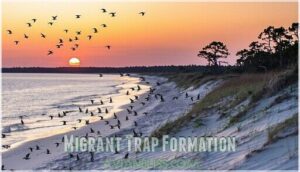
When weather turns harsh during migration, exhausted birds concentrate at specific geographical features called migrant traps.
These locations, including barrier islands along the Gulf Coast and peninsulas like Point Pelee and Cape May, become temporary refuges where thousands of birds gather to rest and refuel before continuing their journey to find refuges.
Concentration of Exhausted Birds
When avian migration patterns create perfect storms of geography and timing, you’ll witness nature’s most spectacular traffic jams.
Migrant traps form when exhausted flocks encounter barriers like coastlines or mountain ranges, forcing thousands of birds into concentrated stopover sites.
These fatigue factors create incredible bird concentration events, where migration distance and energy depletion converge to showcase remarkable stopover ecology in action.
Adverse Weather Conditions and Stopover Sites
When storms strike during migration, you’ll find birds making vital decisions about Weather Patterns and stopover sites.
When nature unleashes its fury, exhausted migrants seek shelter wherever they can find it.
Storm Effects force exhausted travelers to seek immediate Habitat Refuges, disrupting normal Migration Routes.
Critical factors for Stopover Ecology include:
- Food availability – insects and seeds for energy recovery
- Shelter quality – dense vegetation protecting from wind
- Water access – essential for rehydration after nocturnal migration
These migration challenges test bird navigation strategies across varying migration distance requirements.
Peninsula and Barrier Island Effects
When exhausted migrants encounter these natural bottlenecks, peninsulas and barrier islands create powerful migrant traps that concentrate thousands of birds.
You’ll find incredible diversity at places like Point Pelee and Cape May, where geography funnels weary travelers into small areas.
These coastal migration hotspots become island stopovers packed with birds refueling after crossing vast water barriers, making them prime locations for studying avian migration patterns and migratory routes during peak migration timing.
The Gulf Coast is home to many notable migrant songbird traps that provide essential stopover points for birds.
Bird Friendly Habitats Creation
You’ll create the most welcoming stopover spots for migrating birds by planting native species like asters and goldenrods that provide essential food sources.
Your pesticide-free yard with minimal intervention becomes a safe haven where exhausted travelers can rest and refuel during their incredible journeys.
Native Plant Species and Agroforestry

You’ll create thriving bird habitats by planting native species like asters, goldenrods, and viburnums that provide essential food and shelter.
Agroforestry systems, including shade-grown coffee and cacao farms, preserve forest canopies while supporting sustainable farming practices.
These eco-friendly approaches maintain natural corridors that migrating birds desperately need during their incredible journeys.
By incorporating native plant species into your garden, you can substantially enhance the local bird habitat and support avian migration patterns with native species and eco-friendly approaches.
Pesticide-Free Zones and Minimal Intervention

Beyond native plants, you’ll supercharge bird conservation by ditching pesticides and embracing organic gardening methods.
Your minimal lawn approach creates wildlife habitat where insects thrive, providing essential protein for nestlings.
This eco friendly strategy supports birdfriendly practices naturally – when you skip chemicals, beneficial bugs multiply, feeding migrating birds.
Habitat conservation means letting nature handle pest control while birdfriendly environments flourish through bird migration behavior patterns.
By utilizing organic gardening tools, individuals can effectively create and maintain pesticide-free zones.
Shade-Grown Coffee and Cacao Preservation

You’ll discover that shade-grown coffee and cacao offer migratory birds critical winter refuges.
These agroforestry systems support up to 180 bird species compared to just 61 in sun-grown alternatives, creating eco-friendly conservation efforts that benefit both farmers and wildlife through sustainable farming practices.
The use of sustainable farming methods is essential for preserving biodiversity.
- Bird-friendly coffee certification requires 40% native canopy cover
- Shade-grown farms host four times more species than monocultures
- Migratory birds like Scarlet Tanagers depend on these winter habitats
- Birds reduce pest insects by 80% while providing natural pest control
- Carbon sequestration reaches 10.2 million metric tons annually in cocoa farms
Threats to Bird Migration

While migrating birds possess remarkable navigation abilities, they face increasing dangers during their epic journeys that threaten their survival.
You’ll discover how human activities create deadly obstacles that disrupt these ancient travel patterns, forcing millions of birds into perilous situations they haven’t evolved to handle.
Window Collisions and Artificial Lighting
City lights act like deadly beacons, drawing migrating birds off course during nighttime flights.
You can help reduce these Urban Lighting hazards by turning off non-essential lights from 11 p.m. until dawn.
Window Safety becomes critical as artificial lights create reflections that birds perceive as open sky, leading to fatal window collisions.
| Light Pollution Impact | Collision Prevention Solution |
|---|---|
| Attracts birds to cities |
Turn off lights 11 p.m.
-dawn
Cat Predation and Plastic Pollution
Your backyard’s biggest threats aren’t always visible from above.
Cats kill an estimated 2.4 billion birds annually across North America, with feral cats responsible for most bird deaths.
Meanwhile, plastic pollution creates deadly traps when birds mistake colorful fragments for food or become entangled in discarded materials.
Pet safety measures like indoor housing and bird shields around feeding areas substantially reduce cat attacks while supporting migratory bird conservation efforts.
Climate Shifts and Disrupted Migration Cycles
Climate change is throwing a wrench into centuries-old migration cycles, creating a domino effect that’s reshaping avian migration patterns worldwide.
Temperature changes now trigger earlier spring departures—up to 14 days ahead of schedule—while seasonal shifts delay autumn migration by 4-7 days per decade.
These migration delays create dangerous mismatches between insect emergence and nesting, reducing reproductive success by 35%.
Habitat disruption forces birds to find new stopover sites, increasing energy costs by 24%, making climate adaptation essential for survival.
Understanding the climate change impacts is essential to address these disruptions effectively.
Birding and Conservation Tips

You can become a better birder and conservation advocate by learning to identify local species using field guides and eBird’s digital range maps.
Creating bird-friendly yards with native plants while reducing threats like window collisions and cat predation helps protect the millions of birds that navigate our neighborhoods during migration.
Learning Local Bird Species and Identification
Start with species guides like Sibley or Peterson to master bird identification through feather patterns and beak shapes.
Focus on overall body forms rather than just colors, since lighting changes appearance.
Study behavior and preferred habitats—woodpeckers cling to bark while warblers flit through branches.
Learning migration routes helps you anticipate which bird species appear seasonally in your area during bird watching adventures.
Utilizing EBird and Digital Range Maps
Beyond traditional field guides, you’ll gain access to powerful EBird Tools and Digital Mapping resources that transform bird monitoring into precise science.
These platforms offer real-time Range Tracking data that’s revolutionizing how we comprehend Migration Patterns. By utilizing advanced eBird Tools researchers can make more accurate predictions.
Here’s how to maximize these digital resources:
- Access live eBird observations to spot recent arrivals in your area
- Study range maps showing seasonal bird migration routes and timing
- Identify migration hotspots using concentration data from community reports
- Track unusual species with verified sighting alerts and geographic patterns
- Plan outings using predictive models based on historical bird migration patterns
Creating Bird-Friendly Yards and Reducing Threats
Transforming your outdoor space into birdfriendly habitats requires strategic plant choices and sustainable landscaping practices.
Native plants like asters and goldenrods provide essential food sources, while proper yard maintenance includes leaving fallen branches for insect habitat.
Clean bird feeders weekly, eliminate pesticides, and reduce artificial lighting to support wildlife conservation and protect migratory bird education efforts along migration patterns.
By incorporating native plant gardens and minimizing lawn areas, homeowners can create a bird friendly backyard that supports local wildlife and conservation efforts.
Frequently Asked Questions (FAQs)
What is one thing that you will do to help the migrating birds?
You’ll turn off unnecessary lights from 11 p.m. until afternoon, preventing disoriented birds from colliding with windows during their nighttime migration journeys.
What are the challenges birds face during migration?
Migrating birds face deadly obstacles including window collisions that kill up to one billion birds yearly.
Cat predation claiming 4 billion lives annually, and artificial lights that disorient night travelers, causing fatal crashes, are also significant threats, with artificial lights being particularly hazardous.
How do birds prepare physically for migration?
Birds build fat reserves by eating up to 40% more food daily, increasing their body weight by 20-50%.
They’ll molt old feathers for fresh, strong ones and strengthen flight muscles through increased activity before departure.
What happens when migration routes get blocked?
When routes become blocked by development or storms, you’ll see birds facing detours that drain energy reserves.
They’re forced to find alternate paths, often leading to exhausted arrivals at breeding grounds.
Do all bird species migrate the same distance?
Like nature’s gentle ballet, different feathered performers take vastly different journeys.
You’ll find some species barely flutter a few hundred miles while others set out on epic transcontinental odysseys spanning thousands of miles annually, which can be considered transcontinental.
How do injured birds handle migration journeys?
When you’re injured, you’ll likely delay or skip migration entirely since the journey demands enormous energy reserves you simply can’t spare while healing from wounds or illness.
Can birds change migration timing within generations?
Yes, you’ll find birds can adjust their migration timing within their own lifetimes through phenotypic plasticity.
Climate change and environmental cues trigger these adaptations, allowing individual birds to shift departure dates by days or weeks to optimize survival and breeding success.
Conclusion
Mastering nature’s GPS system isn’t rocket science when you understand these avian migration behavior tips.
You’ve discovered how birds combine magnetic fields, celestial navigation, and specialized eye proteins to complete incredible journeys.
By creating bird-friendly habitats and reducing threats like window collisions, you’re supporting these remarkable travelers.
Understanding migration patterns helps you appreciate the complex challenges birds face and empowers you to make conservation choices that protect their ancient flyways for future generations.