This site is supported by our readers. We may earn a commission, at no cost to you, if you purchase through links.
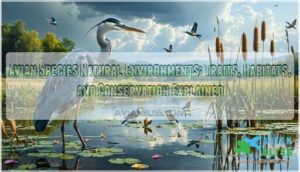 When you spot a peregrine falcon diving at 240 miles per hour through a city canyon or watch warblers navigate thousands of miles to precise breeding grounds they’ve never seen, you’re witnessing adaptations honed across millions of years in avian species’ natural environments.
Birds don’t just occupy habitats—they’ve evolved intricate physiological and behavioral traits matched to specific ecological niches, from the hollow bones that enable hummingbird hovering to the salt-excreting glands that let albatrosses drink seawater.
Understanding how birds interact with forests, wetlands, deserts, and even urban landscapes reveals why habitat loss poses such urgent conservation challenges and what you can do to protect these extraordinary creatures.
Table Of Contents
Key Takeaways
- Birds possess specialized physical adaptations like hollow bones, salt-excreting glands, and high metabolic rates that enable them to survive in specific ecological niches ranging from forests and wetlands to deserts and urban environments.
- Over 40% of avian species face population declines primarily due to habitat loss and fragmentation, with North America losing 2.9 billion birds since 1970—a 29% decline that highlights urgent conservation needs.
- Avian research using genomic analysis and laboratory techniques has revealed that mutation rate spikes following mass extinctions drove rapid adaptive radiation, particularly in Neoaves around 70.6 million years ago, fundamentally advancing our understanding of evolutionary biology.
- Conservation efforts combining habitat restoration, captive breeding programs, and citizen science initiatives have proven effective, with protected bird populations increasing 624% since 1968 while generating significant economic benefits through activities like birding, which supports 1.4 million U.S. jobs annually.
What Defines Avian Species?
If you’ve ever wondered what makes a bird an avian, you’re not alone. Understanding these defining features is the first step to appreciating their diversity.
Let’s look closer at the traits and categories that shape this fascinating group.
Definition and Etymology of Avian
When you hear the word “avian,” think of everything that makes a bird a bird—from their feathers down to their scientific roots in language and biology.
The avian origins trace back to the Latin avis, meaning bird, which evolved into modern avian terminology.
In scientific naming and common usage, Merriam-Webster and others define avian simply as “birdlike,” encompassing all avian species.
Examples and Usage of “Avian”
After grasping the basics of the word "avian," it helps to see how this scientific term pops up in real-world examples and everyday talk.
You’ll hear "avian species" in research publications, "avian flu" in health news, and even "avian imagery" in literature and culture.
Sometimes, people confuse avian terminology, wrongly using it for any winged creature.
Differences Between Avian and Non-Avian Animals
Spotting the differences between avian and nonavian animals isn’t just academic—it’s the start of understanding nature’s variety. Birds are shaped by their own avian adaptations. Think about these key distinctions:
- Lightweight skeletal structure built for flight
- High metabolic rates compared to most nonavians
- Egg-laying reproductive strategies
- Uric acid-based excretory systems
- Enhanced sensory perception, especially sight
Birds also require adaptations for avian thermoregulation to maintain their internal body temperature.
Importance of Biological Classification
If you’ve ever wondered why we bother sorting animals into groups like avian and non-avian, it’s because these labels help us make sense of how birds fit into the bigger story of life on Earth.
Biological classification highlights evolutionary relationships, taxonomic significance, and phylogenetic diversity, guiding conservation prioritization and revealing the distinct ecological roles each animal species plays.
Key Characteristics of Avian Species
Understanding what makes birds unique starts with a look at their most important features. These traits shape how birds live, move, and interact with their world.
Let’s walk through the key characteristics that set avian species apart.
Physical Traits (Feathers, Beaks, Skeleton)
Think about what makes a bird a bird—feathers, beaks, and lightweight bones all come together in a design as exceptional as any found in the natural world. These physical characteristics set avian species apart.
From intricate feather morphology and bold plumage coloration to the diversity of beak adaptations and specialized skeletal adaptations, nature engineers versatility that bolsters each bird’s unique life and niche.
Adaptations for Flight
Nothing about a bird’s design is accidental—each part plays a role in flight. Wing Morphology varies by habitat, with high-altitude avians showing expanded wings for greater lift.
Powerful Muscle Physiology, paired with Respiratory Efficiency and sharp Flight Strategies, let birds defy gravity. Waterfowl use a system of air sacs and lungs to maintain a constant oxygen supply.
Metabolic Adaptations fuel these journeys, making flight a signature adaptation within their physical characteristics.
Avian Anatomy and Physiology
Crack open the story of any bird, and you’ll find a blueprint built for efficiency, from its hollow bones to its finely tuned heart. Skeletal Adaptations lighten the load, while a specialized Respiratory System powers long flights. Feather Structure streamlines aerial movement. Digestive Processes work rapidly, and their Sensory Perception is sharply honed—each trait illustrating the marvel of avian physiology.
Behavior and Communication
How do birds turn a sunrise into a symphony or warn neighbors with a call you can’t mistake for anything else? Their behavior and communication run deep—woven from instinct and experience.
Birds express identity, defend territory, and build social structures through:
- Vocalizations
- Mating Rituals
- Social bonding
- Bird Intelligence in signals
- Avian Learning by imitation
Natural Environments and Habitats
When you think about where birds live, the world suddenly feels bigger and more varied. Each avian species carves out its own space, from deep forests to busy city blocks.
Let’s look at the different places birds call home.
Forests, Grasslands, and Deserts
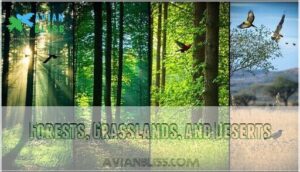
From the cool shade of dense forests to wide-open grasslands and the stark beauty of deserts, each landscape draws its own cast of avian characters ready to play their parts.
Forest Avian Diversity thrives where canopies offer safety, while Grassland Birdlife relies on camouflage and speed. Desert Adaptations allow survival amid extremes, but habitat loss challenges these ecosystems, demanding creative conservation strategies.
Aquatic and Wetland Habitats
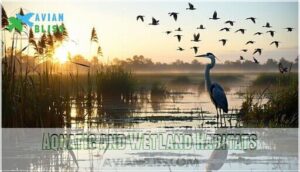
Step near a marsh at dawn, and you’ll find that water and reeds create a stage where herons, ducks, and songbirds reveal behaviors you won’t see anywhere else. Wetland Conservation matters here.
Consider these:
- Aquatic Adaptations help birds thrive in fluctuating water levels.
- Migratory Waterfowl rely on healthy wetlands.
- Habitat Degradation threatens entire ecosystems, pushing urgent conservation efforts and habitat preservation for coastal avian communities.
Urban Environments and City Birds
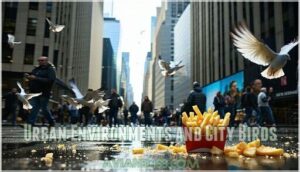
Even as you trade the quiet of wetlands for the energy of a city block, you’ll notice sparrows and pigeons carrying on as if high-rises and sidewalks were just another kind of wilderness.
City bird diets shift to what’s available; urban nesting sites pop up in gutters and signs.
Light pollution and city noise impact communication, while avian-building collisions remain a continued threat.
Migratory Routes and Seasonal Movements
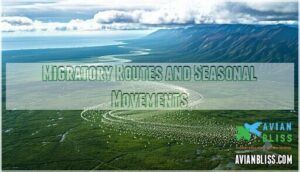
Step outside city limits, and you’ll find skies marked by invisible highways: avian migratory routes crossing continents—each a clear illustration of migration navigation and route flexibility.
Billions of migratory birds rely on stopover ecology, gathering at critical sites as they journey between breeding grounds. But as climate impacts worsen, Flyway Conservation grows essential just to keep these journeys possible.
Avian Health and Conservation Challenges
Bird populations face mounting pressures that threaten their survival and well-being. From infectious diseases to shrinking habitats, these challenges require immediate attention and coordinated conservation action.
Let’s examine the key threats affecting avian species and the efforts underway to protect them.
Common Avian Diseases and Threats
When you encounter wild birds, you’re witnessing potential avian hosts for numerous diseases that threaten avian health globally. Avian poxvirus affects juvenile populations greatly, while disease transmission occurs through direct contact and shared habitats.
Habitat impact from human activities compounds these emerging threats, making public awareness essential for developing effective conservation strategies that protect avian welfare across diverse ecosystems.
Conservation Status and Efforts
You’re looking at a turning point for avian welfare worldwide. The Endangered Species Act has driven population recovery—protected birds increased 624% since 1968. Here’s what’s working:
- Habitat restoration planted 7.7 million trees globally, creating refuges for threatened species
- International collaboration through initiatives like Conserva Aves protects critical sites from Mexico to Chile
- Economic impacts prove conservation pays off—birding generates $279 billion annually while supporting 1.4 million U.S. jobs
These conservation efforts show measurable success, though 229 U.S. species still need urgent action against ongoing threats.
Impact of Habitat Loss and Urbanization
You’ve watched North America lose 2.9 billion birds since 1970—a stark 29% decline driven by habitat loss and urbanization. Building collisions alone kill over 1 billion birds annually in the U.S.
Urban noise pollution and light pollution effects disorient migrants and fragment critical habitats. Habitat fragmentation now prevents four in five bird species from thriving in cities, making conservation strategies essential for protecting avian populations and supporting urban birding communities.
Avian Welfare in Zoos and Research Settings
When you step into a zoo’s aviary or research facility, you’re witnessing decades of evolving welfare standards that now prioritize behavioral enrichment, social structures, and species-specific care protocols.
The Avian Scientific Advisory Group advocates for:
- Zoo enrichment programs that mimic natural foraging behaviors
- Captive breeding initiatives supporting threatened species recovery
- Research impact studies balancing scientific advancement with animal welfare
These captive management practices guarantee avian programs meet rigorous welfare standards while advancing conservation science.
The Role of Avian Research and Advocacy

Understanding how avian research advances conservation starts with knowing where science meets action. Ornithologists use laboratory techniques to diagnose diseases, track evolutionary patterns, and develop evidence-based protection strategies.
You’ll find that advocacy groups and research institutions work together to translate scientific findings into real-world programs that protect bird populations and their habitats.
Laboratory Techniques and Scientific Studies
You’ll find that modern laboratory techniques have revolutionized avian biology research in ways that seemed impossible just decades ago. DNA-based sexing now identifies bird gender with over 99.9% accuracy, while disease detection protocols screen for viruses and parasites rapidly.
Statistical power calculations help determine sample sizes needed for population studies, and biomedical models using avian embryos advance cancer research.
Genomic integration techniques even extract DNA from museum specimens over 150 years old, revealing historical population trends that inform conservation strategies today.
Avian Biology in Evolutionary Research
You’ll discover that avian biology research has become central to understanding evolution itself. A 2025 study analyzing 218 genomes revealed that clutch size, generation length, and tarsus length drive genomic evolution, with mutation rate spikes after the K–Pg extinction enabling adaptive radiation.
Phylogenetic patterns show Neoaves diversified rapidly around 70.6 million years ago, while methodological advances from the B10K consortium—representing 87% of avian families—now link trait adaptation to specific gene pathways in meiotic, cardiac, and ribonuclear machinery.
Conservation Programs and Community Support
You can’t protect what you don’t understand—and that’s where conservation programs bridge the gap between scientific insight and community action, turning avian research into real-world habitat restoration, breeding initiatives, and public engagement.
Bird conservation thrives when citizen science projects, funding initiatives, and policy advocacy unite—supporting avicultural community networks while conservation efforts for avian species gain momentum through avian program advocacy that transforms conservation and education into measurable ecological outcomes.
Education, Information Exchange, and Advocacy
Knowledge sharing transforms conservation into a living dialogue
Frequently Asked Questions (FAQs)
How do avian species select nesting sites?
Avian species choose nesting sites based on predator avoidance, microclimate preferences, and material availability.
Competition impact varies by habitat, with bird behavior shaped by reproduction success and site quality factors throughout diverse environments.
What plants attract birds to specific habitats?
Native plantings provide seed availability and nectar sources that draw diverse bird species.
Shelter provision through strategic habitat restoration strengthens local avian community ecology, creating sustainable environments where birds naturally congregate and thrive.
How does climate change affect bird territories?
Climate change reshapes avian habitats through warming temperatures, altering migration patterns and breeding cycles. Territory size shifts as birds track suitable conditions, while food scarcity from ecological mismatches threatens populations, demanding urgent conservation efforts.
Which predators threaten birds in different environments?
Raptors like hawks and owls hunt across open grasslands, while foxes and snakes target ground nests in forests.
Introduced predators—cats, rats, and mongooses—devastate island avian populations.
Habitat vulnerability increases with human impact, altering predation patterns and threatening nest survival.
How do avian species compete for resources?
Competition unfolds through Resource Partitioning and Interspecific Competition, where birds divide habitats by foraging strategies. Notably, avian behavior shifts with Habitat Degradation and Climate Impacts, intensifying competition.
Predation pressure further shapes these ecology-driven interactions.
Conclusion
Over 40% of avian species face population declines driven by habitat fragmentation, yet you can reverse local trends by preserving native vegetation and reducing window collisions.
Every action you take to protect avian species’ natural environments—whether planting keystone trees, advocating for wetland restoration, or supporting conservation programs—strengthens the ecological networks these birds depend on.
Their survival hinges not on distant policies alone but on the choices you make in your own backyard.
- https://docs.google.com/forms/d/1GAQr3Kn1cURCVHUA82hAga1Wv8DCH0IuqDLRUrOpN7M/viewform?ts=63f4f653&entry.1515682415=https://www.merriam-webster.com/dictionary%2Favian
- https://premium.britannica.com/mw-unabridged/?utm_source=mw&utm_medium=inline-def&utm_campaign=evergreen
- https://pmc.ncbi.nlm.nih.gov/articles/PMC9016154/
- https://avesbiology.com/birdmetabolism.html
- https://seas.umich.edu/news/body-measurements-all-11000-bird-species-released-open-access-database