This site is supported by our readers. We may earn a commission, at no cost to you, if you purchase through links.
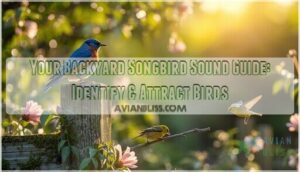
Most people live within earshot of a dozen songbird species and couldn’t name a single one by sound.
That’s not a criticism—birdsong identification is a genuine skill, and nobody hands you a roadmap when you set up your first feeder.
A Northern Cardinal’s clear downslurred whistle and an American Robin’s cheer-up melody might fill your mornings, but without a reference point, they blur into pleasant background noise.
A backyard songbird sound guide changes that. It gives you a way to match what you hear to what’s actually out there, turning vague awareness into sharp recognition—one species at a time.
Table Of Contents
- Key Takeaways
- What is a Backyard Songbird Sound Guide?
- Essential Songbird Species and Their Calls
- Top Bird Song Identification Apps
- Techniques for Learning and Recognizing Birdsong
- Attracting and Supporting Songbirds in Your Yard
- Frequently Asked Questions (FAQs)
- How do you find out what bird it is by sound?
- What is the small loud songbird?
- What is the best sounding songbird?
- How do weather conditions affect songbird activity?
- Can songbirds recognize individual human voices?
- Do songbirds communicate differently with their young?
- Which predators pose the biggest threat to songbirds?
- How long do common backyard songbirds typically live?
- Conclusion
Key Takeaways
- Apps like Merlin Bird ID and BirdNET can identify birds in real‑time using your phone’s microphone, making it easier than ever to put a name to what you’re hearing.
- Learning to read spectrograms — visual maps of sound — gives you a powerful way to study and compare birdsongs even when the bird isn’t singing.
- Seasonal changes in daylight trigger hormonal shifts that make birdsong louder and earlier in spring, so understanding this pattern sharpens your ability to read the soundscape year‑round.
- Small yard changes — native berry shrubs, a water dripper, window decals, and cats kept indoors — can dramatically increase the number and variety of songbirds you’ll hear each morning.
What is a Backyard Songbird Sound Guide?
A backyard songbird sound guide is exactly what it sounds like — a tool that helps you put a name to every chirp, trill, and whistle floating through your yard.
Once you can name what you’re hearing, you’ll want to take the next step and attract more songbirds to your backyard year-round so there’s always something worth listening for.
Whether it’s a printed handbook or a smart app on your phone, the right guide can completely change how you experience the birds around you.
Here’s what you need to know about how these guides work and which format might suit you best.
Purpose and Benefits for Bird Watchers
A backyard songbird sound guide gives you a real foothold in bird song identification. It turns casual listening into confident birding. Here’s what it does for you:
- Builds Confidence Building through repeated, focused listening sessions
- Trains Mindful Listening as a daily nature habit
- Facilitates Conservation Participation by sharpening your ear for population changes
- Provides access to Community Engagement with fellow birders
- Accelerates Skill Development in backyard bird watching
Think of it as your personal environmental education resource. The guides feature built‑in players loaded with Macaulay Library recordings.
How Sound Guides Enhance Bird Identification
Sound guides sharpen your bird song identification skills by layering real-time feedback with spectrogram training. You hear a song, see its shape on screen, and connect both instantly.
Interactive quizzes with adaptive difficulty push your audio recognition further each session.
Contextual clues — habitat, time of day, season — anchor each call in memory, making bioacoustics feel less like science and more like second nature. For example, female robin singing in autumn shows how females also contribute to the soundscape.
Differences Between Printed and Digital Guides
Printed guides need no battery — just flip to the page. But they can’t play a single note. Digital tools change that completely.
Here’s how they compare for everyday birding:
- Portability weight: phones stay under 250 grams, lighter than most field books
- Battery dependence: printed guides work when your phone dies
- Audio quality: mobile apps for birding stream real multi-recording audio files
- Search filters: digital bird identification tools narrow by color, size, and season instantly
- Update frequency: apps refresh species data without buying a new edition
Essential Songbird Species and Their Calls
Some birds are louder than you’d expect, and others are surprisingly easy to miss.
If you’re curious which species fall into each camp, this guide to birds with unique and distinctive calls breaks it down in a way that might genuinely surprise you.
Getting familiar with a handful of common species is the best place to start.
Here’s a closer look at who’s singing in your backyard, what their songs sound like, and how the seasons shape what you hear.
Common Backyard Songbirds in North America
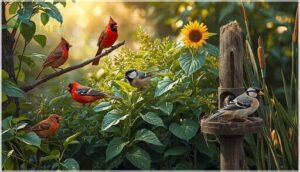
Five species show up in nearly every North American yard.
The American Robin (Turdus migratorius) covers all lower 48 states, while the Northern Cardinal favors dense shrubs east of the Rockies. Black-capped Chickadees thrive in mixed woods and suburban feeders. House Finches nest in eaves, and Song Sparrows hug wetland edges.
Knowing their habitat preferences, feeding habits, nesting behaviors, and plumage identification sharpens your bird identification skills fast.
Unique Song Traits and Audio Descriptions
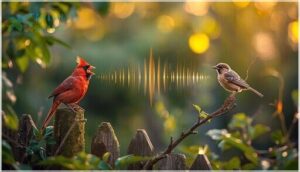
bird song carries its own signature. A Northern Cardinal‘s pitch contour patterns drop in clean, downslurred whistles, while a Carolina Wren’s phrase repetition hammers "teakettle" with surprising force.
timbre texture matters too — pure flute versus raspy buzz tells species apart fast.
Bioacoustics training your ear to these frequency range cues and rhythm syncopation patterns makes backyard birds instantly recognizable, even before you spot them.
Seasonal Variations in Birdsong
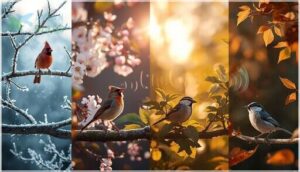
As winter light stretches longer each day, something shifts inside your backyard songbirds.
Daylength effects trigger hormone-driven changes that swell their brain’s song regions, and suddenly dawn chorus timing creeps earlier, louder, and more urgent.
Lengthening days flood songbirds with hormones, rewiring their brains until dawn erupts earlier and louder
Spring songs claim territory; summer songs fade to soft calls.
Tracking these seasonal song purpose shifts helps you read your local soundscape and sharpen season identification all year.
Top Bird Song Identification Apps
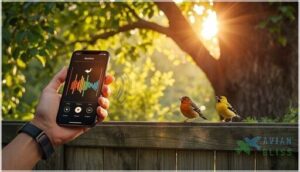
Your phone can do more than you think regarding birdsong. A well-built apps make identifying calls faster and surprisingly accurate.
Here are the ones worth keeping on your home screen.
Merlin Bird ID Features and Use
Merlin Bird ID App, built by the Cornell Lab of Ornithology, makes birdwatching remarkably simple. Hold your phone up and Sound ID listens in real time, naming every bird it hears.
Spot something you can’t name? Try Photo ID or Step-by-Step ID. Explore Birds shows what’s likely near you, and eBird Sync logs your sightings automatically.
BirdNET’s Global Database and Accuracy
BirdNET uses machine learning and bioacoustics to recognize over 6,000 species — impressive species coverage for a free app. Its AI model training draws on millions of real recordings from eBird and Xeno-canto, so data growth keeps improving accuracy over time.
Set your confidence thresholds carefully, though. Regional bias exists, meaning common species get flagged more reliably than rare backyard visitors.
Smart settings make species identification noticeably sharper.
Song Sleuth’s Interactive Learning Tools
Song Sleuth turns your phone into an interactive handbook for backyard birdsong. Its Auto-Recording Capture grabs audio a few seconds before you tap, so you won’t miss a quick bird song. Real-time Spectrograms show each call as a scrolling visual pattern — helpful for bird identification at a glance.
- Playback Speed Controls let you slow down tricky songs
- Geotagged Sharing maps every recording to its exact spot
- Interactive Quiz Mode sharpens your ear over time
ChirpOMatic’s Sound Detection Capabilities
ChirpOMatic works even when you’re miles from cell service. Its Offline Audio Engine stores regional bird calls right on your phone, so Bird Identification happens in seconds — no Wi‑Fi needed.
Short‑Clip Identification captures just 10–12 seconds of Bird Song, then Artificial Intelligence does the rest.
Wind Detection Alerts tell you when to re‑record, and Bird‑Safe Listening mode keeps wildlife undisturbed while Sensitivity Tuning catches even faint, distant calls.
Techniques for Learning and Recognizing Birdsong

Learning birdsong takes practice, but the right techniques make it click faster than you’d expect.
There’s a handful of methods that experienced birders rely on — from reading sound visually to recording what you hear in the field.
Here’s what actually works.
Using Spectrograms for Song Analysis
Reading a spectrogram turns bird song into a picture you can actually study. The frequency axis shows pitch — low sounds sit at the bottom, high ones at the top. Time resolution runs left to right. Color mapping reveals volume. These bird identification techniques sharpen your songbird identification skills fast.
- Spot pure whistles as flat horizontal lines
- Look for stacked lines indicating nasal calls
- Notice upslurs as rising diagonal marks
- Use noise reduction settings for cleaner images
- Apply comparative features to match song patterns
Tips for Memorizing Bird Calls
Once you can read a spectrogram, the next step is making those songs stick.
Mnemonic phrases help — the Carolina Wren’s "teakettle teakettle" is one you won’t forget.
Use chunking strategies to group similar backyard birding tips together.
Practice spaced repetition by reviewing three to five calls daily.
Habitat context seals the memory: hearing a song in your own yard makes it yours.
Field Practice and Recording Methods
Taking your memorized calls into the field is where everything clicks.
Head out at dawn or dusk — birds sing loudest then.
Stand still, point your mic directly at the singing bird, and record away from traffic noise.
Choose calm mornings for cleaner audio files.
Name your recordings by date and species, and consider uploading to eBird to support citizen science.
Attracting and Supporting Songbirds in Your Yard
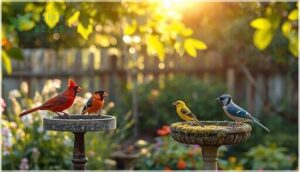
Getting songbirds to visit your yard is simpler than you might think. A few small changes can make your outdoor space genuinely welcoming for local species. Here’s what works best.
Creating a Bird-Friendly Habitat
Think of your yard as a living room for birds — what you set up determines who shows up.
Keep indoor cats inside, and mount feeders on poles fitted with squirrel baffles. Add window decals to prevent glass strikes.
Leave a dead tree standing for cavity nesters. Dim outdoor lights at night.
Smart bird-friendly gardening and thoughtful garden design for birds make all the difference.
Native Plants and Water Sources
Native plants do more than look good — they feed birds through every season.
Berry Shrub Planting with serviceberry or dogwood brings cardinals and bluebirds back year after year. Pair that with Seed-Grass Timing using switchgrass left standing through winter. Add Rippling Water Features like a dripper or wiggler for Seasonal Water Availability, and your bird-friendly environment becomes a year-round destination.
Conservation Tips for Healthy Songbird Populations
Small actions add up. Window Collision Prevention starts with simple dot patterns on glass — birds see them, you don’t mind them.
Cat Management Practices mean keeping cats indoors, especially at dawn. Feeder Hygiene, Nest Box Safety, and Light Pollution Reduction round out the basics. Together, these habits support wildlife conservation and bird-friendly gardening better than any single fix ever could.
Frequently Asked Questions (FAQs)
How do you find out what bird it is by sound?
Hear an unfamiliar song? Notice its pitch, rhythm, and length.
Apps like Merlin Bird ID and BirdNET use spectrogram analysis and confidence scoring to match what you hear to real species instantly.
What is the small loud songbird?
Two wrens earn that title — the Northern House Wren and Carolina Wren.
Despite weighing under an ounce, both fill your yard with bold, repeating songs that seem impossible for birds so small.
What is the best sounding songbird?
Poets wrote about it for centuries — the Common Nightingale (Luscinia megarhynchos) remains the supreme acoustic reference point.
Its melodic diversity, emotional impact, and 200-plus song types make it birdsong’s yardstick worldwide.
How do weather conditions affect songbird activity?
Weather shapes bird song more than you’d think.
Temperature Timing shifts the dawn chorus earlier on mild mornings. Rain Influence quiets singers during downpours. Wind Suppression pushes songbirds lower into shrubs.
Can songbirds recognize individual human voices?
some songbirds do recognize individual human voices.
Through vocal learning and neural mechanisms, urban birds link specific voice cues to safety or danger — a handy bird identification insight for backyard birding.
Do songbirds communicate differently with their young?
Songbirds absolutely communicate differently with their young.
Maternal call signatures, begging call plasticity, and parental teaching cues all shape how parent and chick stay connected — seasonal call sensitivity makes these bonds even stronger during breeding months.
Which predators pose the biggest threat to songbirds?
Free-ranging cats kill up to 7 billion birds yearly in the U.S. Hawk ambushes, corvid nest raids, and night-time owl attacks add pressure. Window collision hazards compound the threat substantially.
How long do common backyard songbirds typically live?
Most common backyard songbirds live just 2 to 5 years.
Average lifespan varies by species — robins and cardinals average around 3 years, with survival rates shaped by predation risks, habitat influence, and seasonal mortality.
Conclusion
Learning birdsong is like developing a new sense—suddenly, mornings feel richer and your yard feels alive in ways you hadn’t noticed before. backyard songbird sound guide is the key that unlocks it all.
one species. Listen closely, then listen again.
Over time, blended morning sounds separate into individual voices you recognize like old friends. The birds haven’t changed. You have.
- https://birdfeederhub.com/backyard-bird-sounds/
- https://apps.apple.com/us/app/merlin-bird-id-by-cornell-lab/id773457673?utm_source=chatgpt.com
- https://play.google.com/store/apps/details?hl=en-US&id=com.labs.merlinbirdid.app&utm_source=chatgpt.com
- https://www.woodlandtrust.org.uk/blog/2024/02/identify-bird-song/
- https://www.allaboutbirds.org/news/whats-the-best-book-or-field-guide-for-bird-identification/