This site is supported by our readers. We may earn a commission, at no cost to you, if you purchase through links.
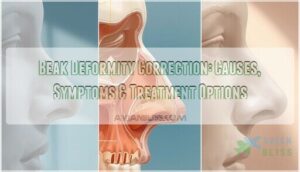
When surgeons first noticed the parrot-like profile emerging in revision rhinoplasty cases during the 1970s, they borrowed ornithological terminology to describe what would become one of cosmetic surgery’s most persistent challenges. Beak deformity correction tackles this convex supratip irregularity—a pronounced nasal hump that develops when surgical modifications fail to maintain proper structural balance.
Unlike primary rhinoplasty complications, this deformity usually reveals itself gradually as post-operative swelling resolves, transforming what appeared to be a successful procedure into an aesthetic concern requiring specialized intervention.
Understanding the biomechanical causes behind cartilage collapse and excessive supratip fullness proves essential before pursuing corrective options, whether through revision surgery or temporary management strategies.
Table Of Contents
- Key Takeaways
- What is Beak Deformity in Rhinoplasty?
- Common Causes of Beak Deformity
- Recognizing Symptoms and Characteristics
- Diagnosing Beak Deformity Accurately
- Surgical Correction Techniques Explained
- Non-Surgical Management Options
- Who is a Candidate for Correction?
- Recovery Process After Correction Surgery
- Risks and Potential Complications
- Expected Outcomes and Costs
- Frequently Asked Questions (FAQs)
- Conclusion
Key Takeaways
- Pollybeak deformity manifests as a convex supratip prominence, creating a beak-like nasal profile, typically emerging 4-12 weeks post-rhinoplasty as swelling resolves, though 12-15% of cases don’t appear until six months or later.
- Surgical correction through revision rhinoplasty achieves 60-85% success rates when performed by specialists using cartilage grafting techniques, with patients advised to wait 12-18 months after initial surgery for optimal tissue maturation.
- Non-surgical options like dermal fillers provide temporary aesthetic camouflage lasting 6-9 months but can’t address underlying structural deficiencies, leaving only 30-60% of patients satisfied compared to definitive surgical reconstruction.
- Recurrence affects 5-15% of corrected cases within 6-24 months, with smoking increasing risk by 2.5-3.5 times, while strategic cartilage grafts reduce recurrence rates to just 3-8% when combined with proper postoperative care.
What is Beak Deformity in Rhinoplasty?
If you’ve undergone rhinoplasty and noticed an unusual fullness above your nasal tip—a contour that resembles a bird’s beak—you’re likely encountering what surgeons call pollybeak deformity. This post-surgical complication can compromise both the aesthetic outcome you hoped for and, in some cases, your ability to breathe comfortably.
Understanding what defines this deformity, how it alters your nasal profile, and what distinguishes it from other nasal concerns will help you recognize whether revision may be warranted.
Definition of Beak (Pollybeak) Deformity
Pollybeak deformity is a nasal contour irregularity you’ll recognize by its characteristic beak-like profile. It develops when excess supratip height creates a convex dorsal irregularity, with your nasal tip projecting downward relative to the elevated supratip area.
This supratip deformity distinguishes itself from other nasal deformities through its pronounced convexity on profile analysis, making supratip management critical during beak correction procedures.
How Beak Deformity Affects Nasal Appearance
Your nasal contour shifts dramatically when this supratip deformity emerges, disrupting facial harmony through an unintended beak nose profile. The aesthetic impact centers on:
- Exaggerated dorsal convexity that overshadows your nasal tip
- Flattened columella creating visual imbalance
- Symmetry issues affecting your nose’s overall silhouette
- Cosmetic concerns from altered proportions that undermine natural nasal reshaping goals
This polly beak deformity changes how others perceive your facial structure entirely. Understanding the importance of a thorough literature review process is essential for addressing complex aesthetic issues.
Differentiating Beak Deformity From Other Nasal Issues
You’ll need accurate beak diagnosis to avoid confusing this rhinoplasty complication with other nasal deformity treatment scenarios. Dorsum analysis reveals the convex supratip deformity’s fullness, while supratip assessment confirms the rounded profile distinguishing polly beak deformity from simple tip ptosis or midvault collapse.
Understanding these rhinoplasty errors through proper nasal contour evaluation and nasal tip examination prevents misattributing your concerns to unrelated issues. Effective study habits, including AP study guides, can help medical students better comprehend complex topics like rhinoplasty.
Common Causes of Beak Deformity

Understanding why pollybeak deformity develops after rhinoplasty gives you the power to avoid it—or correct it if it’s already happened. The root causes fall into three distinct categories: what happens during surgery, the unique characteristics you bring to the operating table, and how your body responds during healing.
Let’s break down each factor so you know exactly what you’re dealing with.
Surgical Factors Leading to Deformity
You deserve to know what goes wrong during surgery. Improper caudal septum adjustment—a critical step in revision rhinoplasty—triggers Pollybeak Deformity Correction needs in 12-20% of cases.
Over-reduction of dorsal structures collapses the nasal vault, while weak columellar support and poor cartilage grafting destabilize your tip.
Even seemingly minor errors in surgical correction of nasal deformities can reshape your profile into that telltale beak.
Patient-Specific Risk Factors
Your body carries its own blueprint for surgical complications. Age factors matter—patients under 18 and over 40 face heightened risks of polly beak deformity due to structural changes.
Ethnic variations in nasal anatomy, smoking risks that sabotage wound healing, and connective disorders like Ehlers-Danlos syndrome all increase rhinoplasty complications.
Prior nasal obstruction and breathing difficulties predict postoperative challenges you can’t ignore.
Post-Surgical Healing Complications
Recovery doesn’t always follow the script. Infection rates after revision rhinoplasty hover between 0.5% and 4%, while scarring issues and persistent nasal crusting affect up to 40% of patients in early months. Your healing trajectory determines revision outcomes—factors like:
- Cartilage resorption occurring in 3–8% of cases
- Synechiae developing when postoperative care falters
- Prolonged numbness affecting 8–12% of individuals
These rhinoplasty complications shape surgical correction strategies for polly beak deformity and other plastic surgery complications.
Recognizing Symptoms and Characteristics

Identifying pollybeak deformity early can make all the difference in your treatment outcome. You’ll notice specific changes in how your nose looks and functions after rhinoplasty, and understanding these signs helps you know when to seek correction.
Let’s break down the key symptoms you should watch for and when they usually appear.
Visible Nasal Changes
You’ll notice polly beak deformity through a pronounced beak-like nasal profile—your nasal tip elevates unnaturally, and the supratip area bulges forward.
Watch for dorsal irregularities, nasal asymmetry, or uneven fullness along your nasal contouring following dorsal hump removal. Cartilage resorption or displaced grafts can create visible bumps or indentations, disrupting the smooth line you expected post-rhinoplasty.
Functional Breathing Issues
Beyond visible changes, you may struggle with nasal obstruction—airflow restriction caused by structural collapse or tissue displacement in the supratip region.
Breathing difficulties often signal compromised sinus function or internal valve narrowing, prompting consideration of septoplasty, turbinate reduction, or targeted nasal reconstruction.
Airway management improves when polly beak deformity correction restores proper internal architecture, delivering breathing difficulty solutions alongside aesthetic refinement.
Timing of Symptom Onset Post-Rhinoplasty
You won’t always see polly beak deformity right away—nearly half of patients notice changes within the first three months, usually between 4 and 12 weeks as postoperative swelling subsides. Symptom visibility tracks edema resolution; deformity onset clarifies when inflammation fades.
Late-onset cases emerge beyond six months in roughly 12–15% of patients, making early assessment critical for ideal revision timing after rhinoplasty involving the nasal tip.
Diagnosing Beak Deformity Accurately

A thorough diagnosis of pollybeak deformity requires a comprehensive approach that combines direct observation with sophisticated clinical assessment. Your surgeon won’t rely on visual inspection alone—understanding the underlying structural changes demands multiple diagnostic tools working together.
Three essential components form the foundation of proper diagnosis: physical examination techniques, medical imaging modalities, and your complete surgical history.
Physical Examination Techniques
Your surgeon’s hands reveal the truth about polly beak deformity through deliberate, methodical examination. Nasal tip assessment and dorsum contour palpation detect irregular cartilaginous prominences in the supratip area—present in 67% of cases.
Active alar base manipulation exposes positional instability affecting the nasal bridge and nasal anatomy.
Acoustic rhinometry quantifies reduced airflow, while endonasal endoscopy visualizes internal structural changes that external inspection alone can’t capture.
Role of Medical Imaging
CT and MRI imaging techniques capture high-resolution nasal anatomy, serving as your surgeon’s blueprint for supratip area correction. Virtual planning simulates cartilage grafts before your rhinoplasty revision, while diagnostic metrics measure airway resistance to predict breathing improvements.
These tools distinguish polly beak deformity from misaligned bone structures.
Imaging followup at three to six months documents how your nasal tip heals and whether grafts integrate successfully.
Importance of Patient History
Your medical record review isn’t just paperwork—it’s the difference between guesswork and precision. History analysis reveals why your primary rhinoplasty created that supratip fullness, what grafting materials failed, and how your tissue responded. This preoperative assessment guides surgical planning for revision rhinoplasty, turning past mistakes into your roadmap for pollybeak deformity correction.
- Prior surgical technique documentation shows exactly where nasal tip support collapsed
- Healing timeline patterns predict how your tissue will respond to surgical revision for pollybeak deformity
- Patient profile details flag airway complications before they derail your outcome
Surgical Correction Techniques Explained
Correcting a pollybeak deformity requires surgical intervention, and your surgeon will tailor the approach based on the specific anatomical factors contributing to your nasal profile.
Most correction procedures involve revision rhinoplasty, which corrects the underlying structural issues that created the beak-like appearance in the first place.
You’ll encounter three primary technical strategies that surgeons employ to restore proper nasal contour and function.
Revision Rhinoplasty Approaches
Correcting polly beak deformity demands precision, and your revision rhinoplasty approach matters. Open rhinoplasty techniques provide improved exposure for graft placement in 55-75% of cases, while endonasal revisions achieve satisfactory results in 40-60% when combined with structural reinforcement. Specialists in nasal reconstruction report success rates climbing to 60-85%, making surgical planning and revision techniques critical for rhinoplasty outcomes.
| Approach Type | Success Rate | Best Application |
|---|---|---|
| Open Rhinoplasty | 55-75% | Complex reconstructions requiring graft placement |
| Endonasal Revision | 40-60% | Less extensive corrections with cartilage support |
| Specialist-Led Revision Surgery | 60-85% | All pollybeak deformity cases needing surgical revision |
Cartilage Grafting Methods
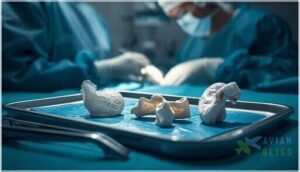
Building on your surgeon’s approach, the choice of grafting material shapes your outcome. Cartilage harvest from your nasal septum offers 90% graft take and stable dorsal augmentation in 30-60 patient studies, while rib grafts provide sturdy nasal reconstruction techniques for complex polly beak deformity cases. Graft fixation through precise suturing ensures 85-92% structural integrity at one year.
Three primary graft materials for revision techniques:
- Septal cartilage — preferred when available, minimal donor site morbidity, ideal for subtle corrections
- Auricular cartilage — suitable for moderate defects, though 8-12% warping rates warrant careful consideration
- Costal cartilage — maximum structural support for extensive reconstruction, despite 10-18% donor site complications
Suture and Reshaping Techniques
You’ll find suture mechanics deliver precise nasal reshaping with under 3% complication rates—interdomal stitches reduce tip slighting by 1.0–1.5 degrees within three months. When combined with cartilage grafting and soft tissue management, these revision techniques achieve stable polly beak deformity correction.
Rhinoplasty nose surgery techniques utilizing reinforced sutures produce measurable dorsal height reductions while preserving nasal reconstruction integrity in facial plastic surgery outcomes.
Non-Surgical Management Options

While surgical revision remains the definitive treatment for pollybeak deformity, you may wonder if less invasive options exist before committing to another operation.
Non-surgical approaches can offer temporary aesthetic improvements in select cases, though they come with important limitations you need to understand.
Let’s examine what these alternatives can—and can’t—accomplish for your specific situation.
Temporary Injectable Fillers
When you’re seeking a gentler path forward, dermal fillers offer a strategic pause button for polly beak deformity. Hyaluronic acid filler materials provide nasal contouring through precise injection techniques along deeper planes, smoothing dorsal irregularities without nose surgery.
These dermal filler injections deliver immediate aesthetic outcomes in rhinoplasty refinement cases, with results stabilizing within 2–4 weeks and lasting approximately 8–12 months in aesthetic medicine practice.
Limitations of Non-Surgical Correction
Despite visible improvements in nasal contouring, fillers won’t address the structural realities underneath—you’re smoothing surfaces, not rebuilding foundations. Filler longevity averages just 6–9 months, requiring repeated treatments that never tackle cartilage support deficiencies or scar tissue accumulation. For true polly beak deformity correction after dorsal hump removal complications, revision rhinoplasty remains your definitive path forward.
Why non-surgical approaches fall short:
- Fillers mask rigid cartilaginous deformities without correcting underlying architectural problems from previous nasal surgery
- Temporary results fade predictably, leaving you back where you started within a year
- Patient satisfaction hovers around 30–60% because aesthetic camouflage can’t restore compromised nasal function
- Revision outcomes depend on structural reconstruction—injectable materials simply can’t provide that framework
- Progressive deformity continues beneath temporary improvements, potentially complicating future revision rhinoplasty
Candidacy for Non-Surgical Approaches
You’re suited for non-surgical nose contouring if your polly beak deformity is mild to moderate and you’re comfortable with temporary results.
Dermal filler injections restore contour but won’t rebuild cartilage support, and steroid injections reduce scar tissue modestly. Filler efficacy hovers around 54% patient satisfaction in cosmetic surgery options.
Patient selection matters: functional breathing issues or severe deformity demand revision rhinoplasty, not aesthetic medicine for the nose alone.
Who is a Candidate for Correction?

Not everyone who experiences pollybeak deformity will need—or qualify for—surgical correction. Your candidacy depends on a combination of physical health factors, emotional preparedness, and practical timing considerations.
Let’s examine the key qualifications that determine whether you’re ready for corrective intervention.
Health and Age Considerations
Your age factors heavily into revision rhinoplasty outcomes. Patients over 50 show reduced cartilage graft success rates, while cardiovascular risks like hypertension increase infection odds during plastic surgery correction.
Hormonal influence affects tissue quality and wound healing, extending nose job recovery by 6–12 weeks in older adults.
Understanding how these variables impact polly beak deformity correction helps you make informed decisions about nose surgery timing.
Psychological Readiness and Expectations
Your mental preparation matters as much as your physical health when considering polly beak deformity correction. Structured preoperative screening reveals that 57% of patients show greater satisfaction after psychological assessment, while patient counseling clarifies realistic expectations and reduces postoperative distress by addressing aesthetic confidence concerns early.
- Expect explicit goal-setting discussions about facial rejuvenation outcomes and plastic surgery risks
- Benefit from emotional support resources that reduce anxiety by 32% before aesthetic enhancement
- Understand that 41% cite unresolved expectations as revision motivators—honest communication prevents this
Timing After Previous Rhinoplasty
Your body needs time to tell its truth. Most surgeons recommend waiting 12–18 months after your primary rhinoplasty before pursuing polly beak deformity correction—this healing period allows complete scar maturation and stable tissue remodeling. Rushing revision rhinoplasty within six months increases your risk of complications, while thoughtful surgical planning beyond a year yields stronger postoperative care outcomes and lasting revision strategies.
Most surgeons recommend waiting 12–18 months after primary rhinoplasty before pursuing pollybeak correction—your tissues need time to fully mature and stabilize
| Timing Window | Why It Matters for You |
|---|---|
| 6–12 months | Tissue still unstable; higher revision rates risk your results |
| 12–18 months | Prime healing period; surgical planning becomes predictable |
| Beyond 24 months | Complexity increases, but satisfaction peaks for late corrections |
| Recovery timeline | Full settling takes up to 12 months—patience protects your investment |
Recovery Process After Correction Surgery

Your recovery after pollybeak deformity correction isn’t just about waiting—it’s about understanding what your body will go through and how you can support the healing process. The timeline varies from person to person, but knowing what to expect helps you prepare mentally and physically.
Let’s break down the typical recovery stages, how to manage the inevitable swelling and discomfort, and practical ways to give yourself the best shot at ideal healing.
Typical Postoperative Timeline
Following Polly Beak Deformity Correction through Revision Rhinoplasty, your recovery time usually unfolds across distinct healing phases. Initial swelling management proves critical during the first two weeks of postop care, while your followup schedule extends through several months as tissues remodel.
Most patients undergoing Plastic Surgery Revision for Polly Beak Deformity experience meaningful improvement within three to twelve months, depending on graft integration and individual healing responses.
Managing Swelling and Discomfort
Your Plastic Surgeon will guide you through Postoperative Care, addressing swelling and discomfort after Revision Rhinoplasty for Polly Beak Deformity.
Pain Management usually requires simple analgesics for three to seven days, with moderate pain declining quickly. Swelling Reduction peaks within 48–72 hours, then subsides over two to three weeks—though lymphatic puffiness on your nasal dorsum may linger a month.
These Recovery Strategies ease Discomfort Alleviation without altering your final Nose Surgery outcome.
Tips for Optimal Healing
Beyond Pain Management and Swelling Reduction, you’ll protect your Revision Rhinoplasty investment with diligent Wound Care—keep incisions dry, avoid trauma, and sleep elevated for two weeks.
Your Recovery Timeline shortens when you skip strenuous activity for six weeks, preventing Scar Tissue buildup that risks recurrent Polly Beak Deformity.
Postoperative Comfort improves as you follow surgeon instructions, ensuring your Polly Beak Deformity Correction settles beautifully.
Risks and Potential Complications

Revision rhinoplasty carries inherent risks that you’ll want to understand before committing to correction surgery. While most patients experience successful outcomes, complications can occur during the healing process or due to technical challenges during the procedure.
Let’s examine the primary risks you may encounter when seeking treatment for polly beak deformity.
Recurrence of Beak Deformity
Even after skillful correction, your pollybeak deformity can return—a reality that affects 5% to 15% of revision rhinoplasty cases. Recurrence patterns usually emerge within 6 to 24 months, though you might notice changes up to five years later.
Several factors influence surgical outcomes and deformity rates:
- Graft failure from cartilage resorption occurs in 20–40% of inadequately supported repairs
- Smoking multiplies your recurrence risk by 2.5 to 3.5 times
- Severe preoperative deformity increases relapse probability to 10–18%
- Postoperative trauma within three months raises likelihood by 5–11%
Structural grafts and revision strategies using septal or auricular cartilage dramatically reduce recurrence to just 3–8%, while suture-based reinforcement techniques lower rates further. If you’re over 40 or experienced prior infection, expect modestly higher risks.
That’s why choosing a surgeon experienced in polly beak deformity correction and following postoperative guidelines carefully matters—your long-term result depends on both surgical revision precision and your commitment to healing.
Scarring and Aesthetic Concerns
Scar tissue management after cosmetic surgery for nasal deformities presents real challenges—studies show 15–25% of you might face hypertrophic scarring within a year. While skin remodeling usually reduces redness by 60–80% over 12–18 months, aesthetic symmetry concerns persist.
Strategic facial cosmetic surgery techniques and tension-reducing sutures can improve nasal contouring outcomes by 10–35%, though pollybeak recurrence affects visual harmony despite careful aesthetic medicine approaches.
Functional Complications (Breathing, Infection)
Obstruction after polly beak deformity correction affects your airway in measurable ways—nasal obstruction from altered valve dynamics occurs in 28% of revision rhinoplasty cases, while infection control challenges arise in 4–7% requiring targeted intervention.
Your breathing issues may improve with airflow improvement strategies, yet infection and respiratory complications demand vigilant airway management and structured nasal surgery techniques for best possible postoperative outcomes.
Expected Outcomes and Costs

You deserve to know what you’re investing in—not just financially, but emotionally and physically. Correcting a pollybeak deformity through revision rhinoplasty can restore both form and function, but outcomes vary based on your unique anatomy and surgical approach.
Let’s break down what improvements you can realistically expect, how long those results will last, and what factors drive the cost of this complex procedure.
Aesthetic and Functional Improvements
When you pursue revision rhinoplasty for polly beak deformity, you’re reclaiming both form and function. Studies show dorsal refinement through cartilage grafting and suture techniques improves external nasal contouring in 78% of cases.
Revision outcomes demonstrate that 70–85% of patients report significant satisfaction with nasal appearance, while breathing pathways are restored through these nasal surgery techniques in aesthetic medicine for nose correction.
Longevity of Results
You’ll see correction stability vary widely—graft longevity in revision rhinoplasty holds firm at five years for 70–85% of patients, depending on surgical techniques and patient factors.
Revision rates hover around 15–20% within two years post-surgical revision, reflecting outcome predictors like tissue thickness and surgeon expertise.
Cartilage grafts retain 60–80% volume long-term, making nose reshaping corrections durable when structural support resolves polly beak deformity comprehensively.
Factors Influencing Procedure Cost
Your rhinoplasty revision costs hinge on multiple variables: surgeon fees climb 20–50% above primary procedures, facility costs absorb 40–60% of totals, and graft materials—whether septal, ear, or rib cartilage—add $1,000–$4,000.
Insurance coverage rarely extends to cosmetic surgery for polly beak deformity, leaving reconstructive surgery patients facing surgical revision expenses that range from $6,000–$22,000 nationwide.
Frequently Asked Questions (FAQs)
Can beak deformity develop years after rhinoplasty?
Years can slip by, then you catch your profile and notice something’s off—that subtle peak that wasn’t there before.
Yes, beak deformity can emerge long after rhinoplasty, driven by late deformity processes like scar contracture and cartilage remodeling.
How do I choose a qualified revision surgeon?
Look for board certification in otolaryngology or plastic surgery, documented revision experience exceeding 20 cases yearly, patient reviews highlighting outcomes, and expertise in cartilage grafting—the cornerstone of facial reconstruction surgery techniques.
Will insurance cover beak deformity correction procedures?
Coverage depends on whether your policy classifies correction as reconstructive surgery or cosmetic nose surgery.
Medical necessity—like breathing obstruction from polly beak deformity—improves approval odds, but policy exclusions and coverage denials remain common for outpatient costs.
Can steroid injections help reduce supratip fullness?
Steroid injections may offer short-term supratip reduction, but evidence remains inconsistent. Facial fillers usually provide more predictable nasal contouring.
For definitive cosmetic outcomes addressing polly beak deformity or persistent supratip fullness after rhinoplasty, surgical revision is generally preferred.
What lifestyle changes support better healing outcomes?
Your body needs proper fuel to repair itself. Focus on nutrition planning with adequate protein, sleep optimization for tissue recovery, stress management to support healing, consistent hydration, and diligent wound care to minimize scar tissue and supratip fullness after rhinoplasty or facial plastic surgery involving polly beak deformity.
Conclusion
Consider the 34-year-old patient who watched her nasal profile worsen six months post-rhinoplasty—what appeared as residual swelling crystallized into pronounced supratip fullness.
Her journey through beak deformity correction required understanding biomechanical failure points before pursuing revision surgery.
Your nasal architecture demands this same analytical approach: recognizing whether structural collapse or soft tissue excess drives your deformity determines whether cartilage grafting or conservative reshaping offers liberation from this persistent aesthetic challenge.
- https://www.mouradnyc.com/services/revision-rhinoplasty/
- https://www.franckmd.com/enso/understanding-polly-beak-deformity-and-its-relationship-with-rhinoplasty
- http://ref-3/
- https://itunes.apple.com/us/app/plastic-surgery-w-dr-miller/id403375108?mt=8
- https://dictionary.cambridge.org/dictionary/english/subtopic