This site is supported by our readers. We may earn a commission, at no cost to you, if you purchase through links.
Imagine this: you’re standing at dawn on a Louisiana bayou, binoculars in hand, when suddenly the sky erupts with thousands of neotropical migrants—warblers, tanagers, and orioles—all desperate for rest after their 600-mile Gulf crossing.
This spectacle, repeated across dozens of flyways worldwide, draws birding enthusiasts to migration hotspots every spring and fall; yet most travelers miss the peak action simply because they don’t know when or where to look.
The best bird migration tours eliminate that guesswork, placing you in the right habitat at precisely the right moment, whether that’s watching Sandhill Cranes funnel through Nebraska’s Platte River or catching shorebird swarms along the Pacific coast. From budget-friendly group expeditions to luxury private guides, the right tour transforms casual birdwatching into front-row seats for one of nature’s most dramatic performances.
Table Of Contents
- Key Takeaways
- Best Bird Migration Tours Worldwide
- Choosing The Right Bird Migration Tour
- Best Seasons and Locations for Bird Migration
- Top Bird Migration Tour Essentials
- Frequently Asked Questions (FAQs)
- What is the birding capital of the United States?
- What country is best for bird watching?
- Where is the best place to go birding in the world?
- What is the best field guide for birds of North America?
- What is the best time of year for birding?
- What cancellation policies do bird migration tours offer?
- Are binoculars and equipment included in tour packages?
- How physically demanding are typical bird migration tours?
- Do tours accommodate photographers with special equipment needs?
- What group sizes can I expect on tours?
- Conclusion
Key Takeaways
- The best bird migration tours position you at critical flyway hotspots during peak migration windows—like Louisiana’s Gulf Coast in April-May or Nebraska’s Platte River for Sandhill Cranes—eliminating the guesswork of timing and location that causes most travelers to miss the spectacle entirely.
- Tour selection hinges on three key factors: guide expertise, whether you’re targeting rare endemics or classic migration routes, and budget (with options ranging from group tours at 20-60% discounts to luxury private expeditions with premium optics included).
- North America’s migration highways—the Mississippi River Flyway, Atlantic Coastal Estuaries, and Pacific Northwest corridors—funnel millions of waterfowl, shorebirds, and songbirds through protected wetlands and stopover habitats that serve as essential refueling stations between breeding and wintering grounds.
- Successful migration birding requires precise seasonal timing (spring peaks in late April to mid-May, fall peaks in September-October), optimal weather conditions (under 20% cloud cover and winds below 10 mph), and destination-specific field guides that help you identify the 340-400+ species passing through top birding capitals like Washington DC and New York City.
Best Bird Migration Tours Worldwide
Bird migration is one of nature’s greatest spectacles, and you’ll find outstanding opportunities to witness it on every continent.
From the smallest hummingbirds to massive cranes, different bird species use remarkable navigation abilities to complete their annual journeys.
From the sweeping wetlands of Louisiana to the remote corners of Australia and the Solomon Islands, migration routes connect ecosystems in ways that’ll leave you breathless.
Let’s explore some of the world’s most extraordinary destinations where you can experience these winged journeys firsthand.
Top Birding Destinations Across Continents

You’re about to break free from the ordinary and discover birding destinations that’ll reshape your wildest travel dreams!
From Asian Flyways teeming with waders to African Wetlands hosting flamingo flotillas, and European Migration corridors where raptors soar—global birding introduces you to ecotourism adventures across island habitats and continental routes.
Wildlife tourism meets bird migration patterns in ways that’ll transform how you see our interconnected world! For more details on remarkable locations, check out these top birding destinations globally.
Notable Migration Hotspots in North America

Now let’s zero in on North America—where flyway patterns create natural highways that transform migration routes into jaw-dropping spectacles! The Gulf Coast acts as your front-row seat to millions of birds riding these ancient corridors, with habitat conservation efforts protecting bird sanctuaries from the Mississippi River delta to the Chesapeake Bay.
- Mississippi River Flyway: Waterfowl and shorebirds linking Gulf wetlands to Great Lakes ecosystems
- Prairie Pothole Region: Millions of ducks refueling between breeding and wintering grounds
- Atlantic Coastal Estuaries: Globally significant stopover sites for wading birds and waterfowl
- Pacific Northwest Corridors: Columbia River and Puget Sound hosting diverse shorebird concentrations
Recent studies emphasize the importance of safeguarding crucial stopover hotspots across the eastern United States to sustain healthy migratory landbird populations.
Unique Birding Experiences in Louisiana

Louisiana’s cypress swamps and bird sanctuaries offer you unmatched migration patterns that rival anywhere in the hemisphere. The Cypress Island Preserve near Breaux Bridge hosts 100,000 nesting snowy egrets—a spectacle that defines avian conservation in action.
Louisiana’s cypress swamps host 100,000 nesting snowy egrets—migration patterns that rival anywhere on the hemisphere
Ecotourism in Louisiana thrives through wetland tours at Bayou Sauvage and Peveto Woods Sanctuary, where you’ll witness spring and fall migration peaks transforming coastal marshes into avian crossroads.
International Bird Migration Routes and Tours

Beyond Louisiana’s coastal marshes, global routes like the Afro-Eurasian and East Asian-Australasian flyways guide billions of migratory birds across continents each year. You’ll find birding tours tracking these migration patterns through satellite technology and flyway conservation efforts, connecting Arctic breeding grounds to southern wintering areas.
Ecotourism impact grows as wildlife conservation and ornithology partnerships protect critical stopover habitats spanning multiple countries and offshore marine corridors.
Choosing The Right Bird Migration Tour
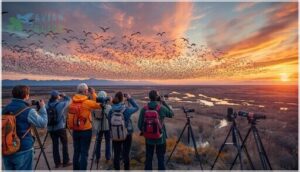
Finding the right bird migration tour can feel like charting your own course through a wilderness of choices, but it doesn’t have to be overwhelming.
Many tours let you tailor your itinerary around specific species or habitats, especially if you want to focus on how birds help the environment in different ecosystems.
You’ll want to weigh factors like the expertise of guides, whether you’re chasing down rare species or sticking to classic routes, and how much you’re willing to invest in the experience.
Let’s break down what separates a good tour from an unforgettable one, so you can pick the adventure that matches your birding dreams.
Comparing Tour Operators and Guides
Choosing the right birding tours starts with knowing what you’re actually paying for—a tour operator coordinates your entire journey, while a birding guide brings the birds to life right before your eyes! WINGS Birding Tours and Rockjumper Birding Tours both offer guided birding tours with exceptional expertise.
You’ll want to compare a few key factors when selecting a tour operator:
- Guide credentials and birding expertise in species identification and habitat knowledge
- Logistical quality, including transparent pricing, group sizes, and safety protocols
- Customer reviews highlighting on-ground performance versus overall trip organization
Specialty Tours for Rare and Endemic Species
If you’re chasing unicorns of the bird world—think Night Parrots or Banggai Crows—specialty tours for Rare Birding and Endemic Species are your ticket to conservation-driven ecotourism benefits.
Companies like WINGS Birding Tours and Rockjumper Birding Tours craft itineraries around 10 to 40 Target Species, pairing expert birding guides with ethical field practices.
These birdwatching adventures support conservation efforts while delivering unforgettable encounters with species found nowhere else on Earth.
Budget-Friendly and Luxury Tour Options
Your wallet doesn’t dictate your Louisiana Birding experience—eco lodges and group discounts slash tour costs by 20 to 60 percent, while scheduled tours deliver birdwatching brilliance without the luxury packages price tag.
Crave tailormade tours with private guides and gourmet meals? Budget travel meets birding brilliance through semi-private options that balance intimacy with smart savings on your migration adventure.
Best Seasons and Locations for Bird Migration

Timing is everything when you’re chasing the bird migration; show up in the wrong season, and you’ll miss the show entirely.
The rhythm of migration shifts across continents and coastlines, with each region offering its own peak windows and weather sweet spots. Let’s break down when and where you’ll catch the best action, so you can plan your adventure around the birds you’re dying to see.
Peak Migration Times in The US and Globally
Timing is everything when you’re tracking migratory bird patterns across the globe! Spring migration sweeps across the Northern Hemisphere from March through June, peaking spectacularly in late April to mid-May as songbirds flood flyway routes;
fall migration reverses the journey from late August through early November, with September and October delivering the densest waves along major bird habitats worldwide.
Seasonal Highlights in Louisiana and The Gulf Coast
Louisiana wetlands transform with the seasons, creating stunning windows for birdwatching in Louisiana along the Gulf Coast migration flyways. Spring migration from March to May fills cypress swamps and coastal marshes with roseate spoonbills and nesting herons.
Fall migration brings shorebird flocks to estuaries from August through October, while winter months concentrate 40,000 waterfowl in places like Lacassine NWR, showcasing impressive bird species diversity.
Optimal Weather and Viewing Conditions
Clear skies with under 20 percent cloud cover and calm winds below 10 mph create prime conditions for tracking migratory bird patterns during spring migration. You’ll want to optimize birding quality by watching for:
- Atmospheric stability with temperature ranges within 5°C for reduced air turbulence
- Light pollution-free zones at rural reserves for sharper silhouettes
- Terrain features like elevated marsh edges that frame distant flocks
These factors dramatically improve birdwatching in Louisiana while supporting habitat conservation efforts.
Planning Around Specific Bird Species
Once the weather cooperates, you can zero in on individual species habitat and bird behavior to optimize encounters.
Align your schedule with migration patterns—Roseate Spoonbills favor cypress swamps during spring pulses, while Snowy Egrets cluster at coastal rookeries in early summer.
Respecting wildlife ethics and supporting conservation efforts means observing from recommended distances, letting ornithology research and avian biodiversity thrive without human interference disrupting critical migratory bird patterns.
Top Bird Migration Tour Essentials
You’re about to venture into some of the world’s most remote birding locations, and trust me, the right gear can make or break your experience.
From swampy bayous in Louisiana to sun-scorched trails in Australia, you’ll need equipment that keeps you safe, hydrated, and ready to identify every species that crosses your path.
Here are five essential items that’ll help you make the most of your bird migration adventure.
1. LifeStraw Water Filter Bottle

You’re going to encounter streams, springs, and questionable taps during migration tours, so hydration that you can trust becomes critical.
The LifeStraw Go bottle offers you a two-stage filtration system that blocks 99.999% of bacteria and parasites while improving taste with activated carbon; the membrane microfilter processes up to 1,000 gallons (4,000 liters), making it a reliable companion for five years of daily field use.
At just 8.7 ounces and holding 22 ounces of water, it’s lightweight enough for backpacking yet durable enough for rugged outdoor adventures across continents.
| Best For | Travelers, hikers, and outdoor enthusiasts who need reliable water filtration on the go without carrying single-use plastic bottles. |
|---|---|
| Primary Use | Water filtration |
| Weight | 8.7 ounces |
| Portability | High |
| Target User | Travelers |
| Material/Format | Plastic bottle |
| Maintenance Required | Filter replacement |
| Additional Features |
|
- Two-stage filter handles bacteria, parasites, microplastics, and improves taste while the membrane lasts up to 1,000 gallons
- Lightweight at 8.7 ounces with a 22-ounce capacity, making it perfect for backpacking and long trips
- Made from 50% recycled plastic and eliminates the need for disposable water bottles
- Drinking requires strong suction and the straw doesn’t always reach the bottom of the bottle
- Can leak or drip if squeezed or if the bottle becomes pressurized after filling
- Not compatible with water mixes or flavorings, limiting versatility
2. Steripen Ultralight Water Purifier

If you want a faster, filter-free alternative on the trail, the Steripen Ultralight delivers UV-C purification that inactivates 99.9% of viruses, bacteria, and protozoa in just 90 seconds per liter.
Weighing only 2.6 ounces and recharging via USB, it’s the lightest option for serious birders covering remote territory; the built-in lithium-ion battery powers up to 8,000 treatments, giving you years of safe hydration without consumable filters, though you’ll want to pre-filter turbid water for best results.
| Best For | Ultralight backpackers and travelers who need fast, reliable water purification without carrying bulky filters or replacement cartridges. |
|---|---|
| Primary Use | Water purification |
| Weight | 0.21 kilograms |
| Portability | High |
| Target User | Backpackers |
| Material/Format | Plastic device |
| Maintenance Required | USB recharging |
| Additional Features |
|
- Purifies water in just 90 seconds with no pumping, waiting, or filter maintenance required
- Incredibly lightweight at 2.6 oz and rechargeable via USB for thousands of uses
- Effective against 99.9% of bacteria, viruses, and protozoa that can make you sick
- Doesn’t remove chemicals, heavy metals, or sediment from water sources
- Some users report durability concerns and the device may be less effective in cloudy water
- Requires regular recharging and won’t work if the battery dies in the field
3. National Geographic Bird Field Guide

Once you’ve secured safe drinking water, you’ll need the National Geographic Bird Field Guide to identify what you’re seeing in the field.
Featuring over 1,000 North American species with color-coded indexing and thumb tabs, this 448-page powerhouse offers 600 range maps, high-quality illustrations showing multiple plumages, and a full-color visual index on the inside covers—making it perfect for confirming those quick glimpses of migrants through your binoculars, even when conditions get challenging!
| Best For | Beginner to intermediate birders exploring Western North America who want a comprehensive field guide that’s easy to navigate with quick-reference features. |
|---|---|
| Primary Use | Bird identification |
| Weight | 1.53 pounds |
| Portability | Medium |
| Target User | Bird watchers |
| Material/Format | Paperback book |
| Maintenance Required | None |
| Additional Features |
|
- Over 1,000 species with 600 range maps and color-coded indexing make identification fast and straightforward
- Durable design with thumb tabs and visual index on inside covers helps you find birds quickly in the field
- Clear annotated artwork shows multiple plumages and key features for accurate identification
- At 1.53 pounds and 448 pages, it’s hefty for extended hiking or backpacking trips
- Paperback version doesn’t lay flat, which can be frustrating when you’re trying to compare a bird to the page
- Broad coverage means you’ll flip past many species that don’t live in your specific area
4. Louisiana Birdwatching Field Guide

For Louisiana-specific adventures, you’ll want the Louisiana Birdwatching Field Guide in your pack—this 122-page companion delivers 50 stunning full-color images, essential ID facts including habitat and behavior notes, and doubles as a logbook to track your sightings from coastal marshes to inland forests.
At just 8.5 ounces and measuring 6 x 9 inches, it’s compact enough for long days in the field while covering species like Snowy Egret and Pine Warbler with Louisiana-specific range maps and seasonal presence details!
| Best For | Beginner and experienced birdwatchers exploring Louisiana’s diverse habitats—from swamps and wetlands to forests and coastal areas—who want a portable guide that combines species identification with space to log their sightings. |
|---|---|
| Primary Use | Bird identification |
| Weight | 8.5 ounces |
| Portability | High |
| Target User | Beginners |
| Material/Format | Paperback book |
| Maintenance Required | None |
| Additional Features |
|
- 50 full-color bird images with essential ID details like habitat, behavior, and field marks make species recognition straightforward in the field
- Doubles as both a field guide and logbook, letting you document your birdwatching adventures without carrying extra notebooks
- Compact and lightweight at 8.5 ounces and 6 x 9 inches, so it fits easily in a daypack without weighing you down
- Louisiana-specific content limits its usefulness if you’re birding outside the state or traveling to other regions
- Previous editions had geographical errors (now corrected), which might make some buyers hesitant about accuracy
- Lower popularity ranking (#562 in Birdwatching Travel Guides) suggests it’s less widely recognized than competing field guides
5. Louisiana Birding Guide Book

For a more thorough resource, the Louisiana Birding Guide Book—published by the American Birding Association—covers over 100 prime birding sites with detailed maps, species lists, and precise directions to help you chase painted buntings through pine flatwoods or prothonotary warblers along bayou edges.
At 286 pages (5.5 x 8.5 inches), it’s your gateway to exploring marshes, coastal zones, and bottomland hardwoods; color-coded plumage sections and habitat glossaries make field identification quick, though you won’t find color bird photos inside.
| Best For | Serious birders who want comprehensive coverage of Louisiana’s top birding locations with detailed site descriptions and species lists, even without color photos. |
|---|---|
| Primary Use | Birding locations |
| Weight | 11.8 ounces |
| Portability | Medium |
| Target User | Bird watchers |
| Material/Format | Paperback book |
| Maintenance Required | None |
| Additional Features |
|
- Covers over 100 birding sites across Louisiana with maps, directions, and expected species lists
- Compact size (5.5 x 8.5 inches) makes it easy to carry in the field
- Helps you plan targeted trips to find specific species in different habitats like marshes, coastal zones, and pine flatwoods
- No color photos of birds, which some users find disappointing for field identification
- Pricey compared to other regional birding guides
- Doesn’t cover every potential birding spot in Louisiana, so some lesser-known locations are missing
Frequently Asked Questions (FAQs)
What is the birding capital of the United States?
Picture a birder tallying 340 species in a single metro area—that’s Washington DC.
However, New York City claims the crown with over 400 recorded species, thanks to Central Park and the Atlantic Flyway.
What country is best for bird watching?
Colombia takes the crown with over 1,900 recorded species! Its diverse habitats—from Amazon rainforest to Andean cloud forests—create year-round opportunities for remarkable sightings you won’t find anywhere else.
Where is the best place to go birding in the world?
You’ll find outstanding birding across continents—from the Galapagos Islands’ fearless endemics to Kenya’s flamingo-filled rift valleys—but Colombia consistently ranks highest, offering cloud forests, Amazonian zones, and hundreds of hummingbirds and tangers in incredibly compact areas.
What is the best field guide for birds of North America?
The National Geographic Field Guide to the Birds of North America stands out for its color photographs, up-to-date range maps, and compact portability—perfect for quick matching in the field.
What is the best time of year for birding?
Spring delivers peak birding from April to May when warblers flood eastern forests.
Fall migration runs August through October as shorebirds and raptors journey south along coastal flyways and inland corridors.
What cancellation policies do bird migration tours offer?
Most tours require a 10–30% non-refundable deposit at booking, with full payment due 60–90 days before departure; operators usually offer complete refunds only if they cancel the trip themselves.
Are binoculars and equipment included in tour packages?
Most luxury packages supply premium optics like Swarovski binoculars at no extra charge.
While mid-range tours often include standard field glasses, entry-level adventures usually require you to bring your own equipment or rent locally.
How physically demanding are typical bird migration tours?
Most tours involve moderate walking—usually 2 to 5 miles daily over varied terrain—plus extended standing at observation points, so you’ll want decent cardiovascular fitness and comfortable, sturdy footwear for those adventure-filled days.
Do tours accommodate photographers with special equipment needs?
Most operators welcome your camera gear—they’ll arrange secure storage, vehicle positioning for long lenses, and early access permits.
Just notify them beforehand about tripods or oversized equipment to guarantee smooth accommodations.
What group sizes can I expect on tours?
Most birding tours run between 12 and 16 participants, giving you enough camaraderie without crowding the spotting scope. Smaller expeditions cap at 6 to 8 travelers, while standard coach tours can reach 30 to
Conclusion
Here’s the irony: while millions of birds navigate entire continents using nothing but instinct and starlight, we humans need guidebooks, tour operators, and dawn alarms just to witness their journey.
Yet that’s precisely what makes the best bird migration tours so valuable—they bridge the gap between our earthbound routines and nature’s rhythms, positioning you where warblers fall from the sky exhausted and cranes blacken prairie sunsets. The spectacle was always there; you just needed someone to show you when to look up.