This site is supported by our readers. We may earn a commission, at no cost to you, if you purchase through links.
A single air sac mite—invisible to the naked eye—can trigger respiratory failure in a finch within days. Most bird owners won’t notice anything wrong until the damage is already done.
Parasites operate quietly, suppressing immune function and degrading tissue long before visible symptoms appear. That’s why best practices for bird parasite control depend less on reacting to obvious illness and more on systematic identification, early diagnosis, and disciplined prevention.
From microscopic gut nematodes to scaly-leg mites burrowing under keratinized tissue, each parasite demands a specific response. The protocols that follow turn that fragmented knowledge into a workable system.
Table Of Contents
- Key Takeaways
- Identifying Common Bird Parasites
- Diagnosing Bird Parasite Infestations
- Effective Parasite Treatment Options
- Preventing Parasite Reinfestation
- Optimizing Bird Environment for Parasite Control
- Biosecurity Measures for Flock Protection
- When to Seek Veterinary Diagnostics
- Frequently Asked Questions (FAQs)
- How to prevent parasites in birds?
- What are the best methods of controlling parasites?
- What do birds do to get rid of parasites?
- How often should birds be treated for parasites?
- Can birds pass parasites to humans?
- Do seasonal changes affect parasite prevalence in birds?
- Are certain bird species more parasite-resistant than others?
- How long do parasites survive outside a bird?
- Can a healthy bird become a carrier without symptoms?
- Conclusion
Key Takeaways
- Most bird parasites suppress immune function and damage tissue long before visible symptoms appear, making routine fecal testing every 90 days and systematic quarantine protocols more critical than reactive treatment after illness manifests.
- Effective parasite control requires species-specific precision—ivermectin at 0.2 mg/kg treats nematodes in most birds, but the same dose becomes lethal in finches at 0.4 mg/kg, proving that weight-based dosing under veterinary supervision isn’t optional.
- Environmental management—30-minute post-cleaning dry times, 4-8 week outdoor run rotations, and HEPA-filtered mechanical debris removal—directly disrupts parasite life cycles more reliably than medication alone.
- Early diagnostic intervention through fecal floats, blood smears, and PCR testing catches infections before gut damage or respiratory failure becomes irreversible, turning detection speed into your strongest prevention tool.
Identifying Common Bird Parasites
Bird parasites fall into distinct categories—some attack the respiratory system, others burrow into skin, and many hide inside your bird’s digestive tract. Recognizing which parasite you’re dealing with determines whether your bird needs topical treatment, systemic medication, or immediate veterinary intervention.
Since birds tend to mask signs of illness until a parasite has already taken hold, brushing up on common parasitic diseases in pet birds can help you catch trouble early.
Here’s what you need to identify in pet birds, poultry, and wild species.
Air Sac Mites in Pet Birds

Air sac mites are respiratory parasites that invade the airways and air sacs of canaries, finches, and budgies—causing airway irritation, breathing difficulties, and characteristic clicking or wheezing sounds.
Your avian veterinarian can confirm infestation through clinical signs, airway swabs, or response to parasite treatment options; early detection protects respiratory health, disrupts the mite life cycle, and prevents stress-related complications in bird health management.
Birds showing air sac mite symptoms such as open-mouth breathing or excessive salivation should be examined promptly by a professional.
Scaly-Leg Mites and Chickens
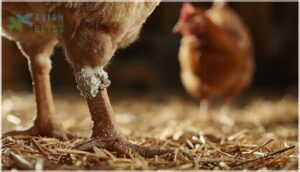
While air sac mites target airways, scaly leg mites — Knemidocoptes mutans — attack from the outside in. These ectoparasites burrow beneath leg scales, disrupting chicken behavior and triggering scaly skin, leg deformities, and lameness over time.
Understanding mite transmission, the mite life cycle, and early signs is your foundation for effective bird parasite control and smart parasite treatment options with your avian veterinarian.
If left untreated, these parasites can lead to more severe cases of crusty, scabby feet and legs.
Feather Lice and Wild Birds

Shifting from skin-burrowing mites, feather lice present a different challenge entirely—they live on the bird, not under it. These ectoparasites feed on feather debris and skin flakes, clinging to feather shafts with specialized claws.
Understanding lice transmission and parasite ecology is foundational to effective bird parasite control and broader avian health management across wild and captive flocks.
Internal Parasites Like Nematodes and Coccidia
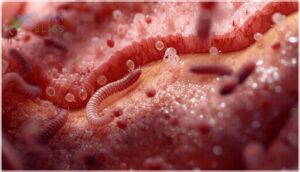
While lice remain on the surface, internal parasites like nematodes and coccidia infiltrate deeper—compromising gut health and triggering harmful immune responses.
Nematode infections cause malabsorption and wasting; coccidia transmission happens fast in poor sanitation, with oocysts becoming infective within one to two days.
Understanding these parasite life cycles is non-negotiable for effective bird parasite control, deworming, and long-term avian health.
Recognizing Parasite Symptoms in Birds
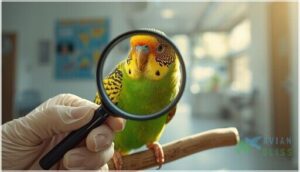
Symptom recognition—your first defense in avian disease prevention—demands attention to detail. Watch for respiratory issues like rapid, noisy breathing, and inspect feather condition closely; frayed, dull plumage reveals parasite behavior patterns.
Skin lesions, crusty beak problems, and behavioral shifts all signal bird parasites. Master these parasite symptoms early, and parasite identification becomes your strongest tool for long-term bird health.
Diagnosing Bird Parasite Infestations
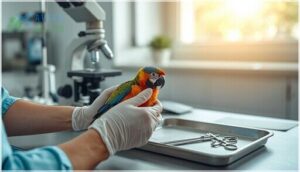
Spotting symptoms is only half the battle—knowing what’s actually going on inside your bird requires proper diagnostics.
The good news is that veterinary science gives us several reliable tools to confirm a parasite infestation before it does real damage.
Here’s what each method involves and when you’ll want to use it.
Fecal Float and Microscopic Examination
Fecal testing remains your sharpest, least invasive tool for bird parasite diagnosis. The fecal float technique works by suspending a dense flotation solution prep mixture—specific gravity must exceed egg density—so parasite eggs rise to the surface for microscopic techniques capture under a coverslip.
Nail your fecal sample prep and parasite egg identification with these steps:
- Collect at least 2 grams of formed feces for reliable diagnostic testing
- Strain debris through cheesecloth before adding flotation solution—clarity matters during microscopic techniques
- Allow adequate surface time before coverslip placement; rushed slides miss eggs
- Document egg type and concentration—repeat tests on multiple days catch intermittent shedders
Follow strict lab safety protocols throughout. A single negative result doesn’t rule out infection. Consistent parasite management and avian disease prevention depend on repeated, careful fecal testing.
Blood Tests for Haemosporidian Parasites
Blood tests are your window into hidden haemosporidian infections—Plasmodium, Haemoproteus, and Leucocytozoon circulating where fecal floats can’t reach. Blood smears, stained with Giemsa, reveal parasite loads during acute phases, though chronic infections keep parasitemia deceptively low.
That’s why veterinary diagnostics increasingly rely on Haemosporidian DNA detection. As an Avian Veterinarian, I prioritize blood-based bird parasite diagnosis for accurate, targeted parasite management.
Molecular PCR and Advanced Diagnostics
PCR Techniques don’t just detect parasites—they magnify the evidence. DNA Analysis through Nucleic Acid Amplification Methods identifies infections standard Diagnostic Tools miss entirely. These sophisticated Diagnostic Testing platforms are reshaping Parasite Identification and Treatment across Avian Veterinary Care and veterinary medicine.
- Multiplex PCR targets several parasites simultaneously in one blood sample
- Fluorescent probes enable real-time monitoring of each amplification cycle
- Standard curves allow absolute quantification of parasite load
- Portable PCR devices bring veterinary diagnostics directly to your aviary
Monitoring for Hidden Parasites
Many bird parasites hide long before symptoms surface—making routine Parasite Surveillance your strongest tool.
Fecal Testing establishes baseline parasite loads, while Environmental Sampling of bedding catches contamination early.
Pair these with Quarantine Protocols for new birds and Molecular Diagnostics when microscopic signs remain ambiguous.
This layered approach to diagnostic testing drives effective parasite identification and treatment, anchoring your parasite control and ectoparasite control strategies in measurable data.
Effective Parasite Treatment Options

Once you’ve confirmed a parasite infestation, the next step is choosing the right treatment — and getting it wrong can do more harm than the parasites themselves.
The options available to you depend on whether you’re dealing with internal parasites, external ones, or both. Here’s what you need to know before you start.
Medications for Internal Parasites
Anthelmintic Drugs are your frontline defense—but wrong choices accelerate Parasite Resistance. Effective Bird Deworming demands precision. Your veterinarian selects Internal Treatments based on parasite type and species-specific dosing:
- Ivermectin — targets threadworms and nematodes
- Fenbendazole — broad-spectrum nematicide for roundworms and hookworms
- Praziquantel — eliminates tapeworms and flukes
- Metronidazole — treats protozoan infections like giardia
- Moxidectin — controls nematodes with extended activity
Medication Safety isn’t optional—it’s non-negotiable.
Safe Use of External Parasite Sprays
While internal treatments handle what’s inside, external parasites demand a different arsenal. Product Selection starts with pyrethrin sprays—like Vetafarm Avian Insect Liquidator—proven safe for avian use.
Your Application Method matters: spray in short bursts with Proper Ventilation, keeping birds away until surfaces dry. Post-Spray Monitoring catches any adverse reactions early.
Follow Storage Guidelines religiously—cool, dry, away from birds—to maintain parasite control efficacy.
Veterinary Supervision and Dosage Guidelines
Once you’ve chosen your spray, dosage becomes the next battleground. Weight Based Dosing isn’t optional—Ivermectin at 0.2 mg/kg is standard, but Species Sensitivity changes everything.
Finches can’t tolerate 0.4 mg/kg; it’s toxic. Dose Calculation errors kill birds. Fenbendazole carries its own risks in raptors.
Veterinary Advice for Birds isn’t a luxury here—it’s the safeguard between your bird and a fatal miscalculation. Never self-prescribe Parasite Treatments in Avian Medicine without professional Drug Residues and Treatment Monitoring guidance.
Monitoring Treatment Effectiveness
Your vet’s dosage plan means nothing if you don’t track results. Behavioral Improvements — renewed appetite, steadier weight, clearer breathing — show up within 7 to 14 days of effective Parasite Treatment.
Pair those signs with Lab Marker Trends: Fecal testing should turn negative within 21 days. Symptom Resolution, confirmed Post-treatment, anchors your Flock Health Monitoring and long-term Avian Health through consistent Parasite Control.
Preventing Parasite Reinfestation
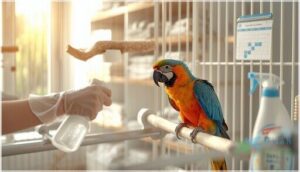
Clearing parasites is only half the battle—keeping them gone is where most bird owners slip up.
The good news is that reinfestation is largely preventable if you nail down a few consistent habits.
Here’s what actually works.
Quarantine Procedures for New Birds
Your first line of defense against bird parasites is a well-structured quarantine setup. New Bird Intake demands 30 days of Bird Isolation—non-negotiable. Health Screening within the first week catches coccidia, mites, and blood parasites before they reach your flock.
A 30-day quarantine with prompt health screening is the surest way to block bird parasites before they hit your flock
Enforce these biosecurity measures:
- Use dedicated footwear, clothing, and cleaning tools exclusively in the quarantine area.
- Conduct daily inspections for sneezing, discharge, or lethargy.
- Maintain separate ventilation to block airborne parasite transmission.
Proper Cleaning and Disinfection Techniques
Beyond quarantine, effective Cleaning Protocols and Disinfectant Selection form your cage’s true barrier. Surface Sanitizing starts with scrubbing away visible debris—then apply an EPA-registered, bird-safe disinfectant at the labeled concentration. Maintain full contact time; don’t rush it.
These Biosecurity Measures and Equipment Sterilization steps, combined with consistent environmental cleanup and pest control methods, keep your parasite control airtight.
Replacing Substrate, Perches, and Bowls
Cage Maintenance hinges on timely swaps—not a fixed calendar. Avian Hygiene checkpoints, such as Substrate Replacement, Perch Cleaning, and Bowl Sanitizing, are directly tied to effective parasite control and bird parasite treatment outcomes.
- Remove all old substrate; seal it immediately to block pest control methods from failing at disposal
- Replace natural wood perches—diameters 1.0–2.5 cm—weekly, discarding any cracked or moldy sections
- Sanitize stainless steel or ceramic bowls daily; swap them every 6–12 months
- Schedule full replacements post-treatment to strengthen biosecurity measures against reinfestation
- Document each swap and note bird health changes to fine-tune your bird care routine
Optimizing Bird Environment for Parasite Control

Your bird’s environment is just as important as any medication or treatment in terms of parasite control. The way you maintain, clean, and manage their living space directly affects whether parasites take hold — or stay gone for good.
Here’s what actually works, broken down into four practical strategies you can start using right away.
Cage and Aviary Cleaning Protocols
Your cage is a parasite’s ideal breeding ground—unless cage sanitation becomes non-negotiable. Daily droppings removal cuts ammonia buildup by up to 60 percent.
Deep cleaning schedules every 7–14 days, paired with aviary disinfection protocols, form the backbone of effective parasite control. These biosecurity measures protect bird safety through consistent environmental cleanup—your first defense in serious pest control and long-term bird care.
Environmental Drying and Mechanical Removal
Moisture is your enemy here—parasites thrive where damp surfaces linger. Air Drying within 30 minutes post-cleaning, combined with Mechanical Removal via HEPA-filtered vacuums, eliminates eggs and debris effectively.
Surface Preparation using microfiber cloths absorbs 90 percent of residual moisture before ambient drying begins. Substrate Management and Environmental Monitoring with humidity meters complete your biosecurity framework, tightening overall parasite control and environmental cleanup.
Rotating Outdoor Runs and Managing Soil Parasites
Soil Rotation is your strongest tool against both external parasites and internal parasites—rest periods of 4 to 8 weeks break the Parasite Life cycle decisively. Proper Run Management demands structured Outdoor Sanitation to sustain Flock Hygiene and prevent Parasite Infestation.
- Divide runs into smaller paddocks to reduce localized manure buildup.
- Rest each paddock 4–8 weeks between use.
- Replace substrate every 6–12 months.
- Make certain drainage dries surfaces within 24–48 hours.
- Log rotation dates for consistent Parasite Control.
Limiting Contact With Wild Birds
Wild birds are your flock’s most unpredictable parasite vector—and without structured Contact Minimization, zoonotic disease risk escalates fast. After rotating your outdoor runs, tighten Wild Bird Barriers and enforce Biosecurity Protocols to complete your Outdoor Access strategy.
| Measure | Action | Why It Matters |
|---|---|---|
| Enclosure Design | Install fine mesh; use solid roofs | Blocks droppings and avian parasites |
| Feed Storage | Seal indoors; remove standing water | Cuts attractants for wild species |
| Hygiene Control | Dedicate gear; disinfect after contact | Promotes Environmental Sanitization |
| Monitoring | Log sightings; inspect surfaces daily | Facilitates early parasite prevention |
| Access Limits | Supervise outdoor time; rotate runs | Protects wildlife conservation balance.” |
Keep bird parasites out before they arrive.
Biosecurity Measures for Flock Protection

Once you’ve dialed in your environment, the next layer of protection is biosecurity—keeping parasites out before they ever get a foothold. Think of it as the system of habits and tools that stops cross-contamination between your birds and anything they come into contact with.
Here’s what that looks like in practice.
Dedicated Equipment and Cleaning Tools
Cross-contamination is the silent enemy of Parasite Control. Your Biosecurity Measures start with dedicated Cleaning Tools—color-coded by zone. Red grips tackle waste areas; blue ones stay in living spaces.
Tool Sanitation and Equipment Maintenance aren’t optional. Follow strict Cleaning Protocols, store tools dry, and label everything. Sloppy Biosecurity invites Bird Parasites back into your Flock Management routine.
Disinfectants Safe for Birds
Once your tools are sorted, the next layer of defense is what you use on them. Bird Disinfectants built on Non Toxic Formulas—quaternary ammonium or hydrogen peroxide bases—are your go-to for Safe Cleaning across cages and perches.
These Cage Sanitizers support Avian Hygiene without respiratory irritation. Dilute correctly, rinse thoroughly, and dry completely before reintroducing your birds. That’s parasite prevention done right.
Reducing Stress and Enhancing Enrichment
Clean products alone won’t protect your flock—Stress Reduction matters just as much for Parasite Control. A stressed bird’s immune defenses drop, making it vulnerable to Bird Parasites.
Environmental Enrichment through Foraging Strategies and Social Interaction keeps cortisol low. Practice Behavioral Monitoring weekly: reduced feather-picking confirms your Avian Health and Wellness plan is working. That’s Bird Care and Management done right.
Annual Vet Exams and Weight Checks
Stress management pairs directly with Weight Monitoring and routine Veterinary Care—your next layer of Flock Management. Annual Vet Visit Prep should include Health Trends tracking: weigh birds weekly to the nearest tenth, catching deviations before symptoms surface.
A head-to-tail exam screens for parasites, skin changes, and Bird Nutrition gaps. Early detection keeps Avian Health and Wellness and Bird Parasite Treatment firmly under your control.
When to Seek Veterinary Diagnostics

At some point, home remedies and over-the-counter fixes just won’t cut it—your bird needs a professional eye. Knowing when to make that call is one of the most important skills you can develop as an owner.
Here’s what to watch for, why DIY treatments can backfire, and how early vet intervention actually saves lives.
Signs That Require Immediate Veterinary Care
Parasite complications don’t always announce themselves gradually. Watch for sudden Eye Changes—squinting, discharge, or corneal cloudiness—alongside Breathing Distress like open-mouth breathing or audible wheezing.
Severe Vomiting, blood in droppings, or Acute Trauma demand same-day Veterinary Care. Seizures with collapse may signal toxin exposure or severe infection. Early intervention remains your strongest tool for effective Parasite Control and Prevention and long-term Bird Health.
Risks of Home Treatments Without Professional Advice
Unsupervised home treatments quietly undermine your parasite control efforts. Misdiagnosis Dangers arise when subtle symptoms mask co-occurring infections, while improper ivermectin deworming dosages trigger Adverse Reactions—neurologic or organ damage—escalating Toxicity Risks dangerously.
Repeated self-treatment accelerates Resistance Development, rendering future therapies ineffective. These Ineffective Therapies compromise long-term bird health, and some parasites carry zoonotic diseases that spread without proper veterinary oversight.
Benefits of Early Diagnosis and Targeted Therapy
Early detection is the backbone of effective parasite control. Targeted therapy—metronidazole for trichomonads, sulfa drugs for coccidia—delivers Faster Recovery and Improved Survival by preventing gut damage and anemia before they become irreversible.
Reduced Transmission follows naturally, lowering Resistance risks. In parasitology, Better Health and long-term bird disease prevention start with one step: get your bird diagnosed early.
Frequently Asked Questions (FAQs)
How to prevent parasites in birds?
Quarantine new arrivals, maintain cage sanitation through weekly disinfection, rotate outdoor runs every 30 days, and schedule annual fecal exams—these biosecurity measures form your integrated pest management foundation for a parasite-free diet and healthy flock.
What are the best methods of controlling parasites?
Effective parasite control relies on Integrated Pest Management: combining fecal testing every 90 days, targeted Ivermectin protocols under veterinary supervision, stress reduction through enrichment, and rigorous biosecurity to safeguard flock health and minimize parasite resistance.
What do birds do to get rid of parasites?
Prevention is worth a pound of cure—birds instinctively deploy preening behaviors, dust bathing, and anting habits to dislodge external parasites, while feather shedding during molt and nest hygiene reduce parasite loads naturally.
How often should birds be treated for parasites?
Treatment frequency depends on housing and exposure: indoor birds need parasite screening every 6–12 months, while outdoor aviaries require deworming every 3–4 months, with fecal testing confirming clearance after medication schedules.
Can birds pass parasites to humans?
Yes—zoonotic diseases from bird parasites pose real human infection risks, especially for bird handlers.
Parasite transmission occurs through contaminated droppings, dust inhalation, or direct contact, making public health awareness and zoonotic disease prevention essential.
Do seasonal changes affect parasite prevalence in birds?
Seasonal vector activity drives transmission dynamics year-round. Warmer months boost mosquito populations and haemosporidian parasites, while host immune response fluctuates with breeding cycles—habitat effects and parasite life cycles create predictable peaks requiring targeted parasites in birds control.
Are certain bird species more parasite-resistant than others?
Species resistance varies greatly—swallows show stronger antibody responses than bluebirds against identical parasites, while thick plumage and denser feather oils deter ectoparasites, reducing parasite load through host defense mechanisms shaped by bird genetics.
How long do parasites survive outside a bird?
Survival factors—warmth, humidity, substrate—determine how long parasites persist: bird mites endure weeks in favorable conditions, while feather lice eggs last about one week and nematodes die within days in dry surroundings.
Can a healthy bird become a carrier without symptoms?
A bird appearing perfectly healthy can harbor latent diseases—acting as a carrier bird with asymptomatic infection—shedding parasite eggs intermittently while showing zero clinical signs, enabling subclinical transmission that jeopardizes flock-wide parasite control.
Conclusion
A necropsy on a backyard flock once revealed coccidia in every bird—yet none had shown clinical signs until three died within 48 hours. That’s the paradox: parasites compound silently until intervention is too late.
Implementing best practices for bird parasite control means you don’t wait for symptoms—you schedule fecal exams, enforce quarantine, and disinfect methodically. The difference between a thriving aviary and a medical crisis isn’t luck. It’s disciplined prevention before the microscope confirms what you feared.
- https://www.merckvetmanual.com/exotic-and-laboratory-animals/pet-birds/parasitic-diseases-of-pet-birds
- https://poultrydvm.com/drugs/ivermectin
- https://www.backyardchickens.com/threads/ivermectin-dosage.1504612/
- https://www.dvm360.com/view/knemidocoptiasis-birds
- https://clinicalavianpathologyservices.com/endoparasites/