This site is supported by our readers. We may earn a commission, at no cost to you, if you purchase through links.

You don’t need a telescope to discover the night sky’s treasures. A good pair of binoculars for astronomy reveals Jupiter’s four largest moons, the Andromeda Galaxy’s spiral structure, and hundreds of star clusters invisible to your naked eye, all while maintaining a wider field of view that makes celestial navigation far easier than peering through a telescope’s narrow tunnel.
The 7×50 configuration remains the astronomer’s secret weapon for a reason: those 50mm objective lenses gather enough light to transform faint smudges into recognizable deep-sky objects, while the moderate 7x magnification keeps your view steady without requiring a tripod.
Whether you’re starting your observational journey or adding versatility to your existing setup, understanding aperture size, optical coatings, and prism quality separates binoculars that merely magnify from those that genuinely perform under dark skies.
Table Of Contents
- Key Takeaways
- Best Binoculars for Astronomy in 2026
- 1. Celestron Cometron Astronomy Binoculars
- 2. Nikon Aculon Binoculars
- 3. Nikon Action Extreme Binoculars
- 4. Athlon Optics Midas Binoculars
- 5. Nikon Monarch Binoculars
- 6. Bushnell Falcon Binoculars
- 7. SkyGenius Binoculars For Adults
- 8. Uscamel Binoculars For Bird Watching
- 9. UncleHu High Power Binoculars
- 10. Gosky Roof Prism Binoculars
- Key Features to Consider for Stargazing
- Magnification: What Works Best for Astronomy
- Aperture Size and Light Gathering
- Binocular Prism Types and Glass Quality
- Astronomical Objects Visible With Binoculars
- Essential Accessories for Astronomy Binoculars
- Maintenance and Proper Use Tips
- Best Binoculars for Astronomy in026
- 1. Celestron Cometron Astronomy Binoculars
- 2. Nikon Aculon Binoculars
- 3. Nikon Action Extreme Binoculars
- 4. Athlon Optics Midas Binoculars
- 5. Nikon Monarch Binoculars
- 6. Bushnell Falcon Binoculars
- 7. SkyGenius Binoculars For Adults
- 8. Uscamel Binoculars For Bird Watching
- 9. UncleHu High Power Binoculars
- 10. Gosky Roof Prism Binoculars
- Frequently Asked Questions (FAQs)
- Conclusion
Key Takeaways
- The 7×50 configuration remains the optimal starting point for astronomy binoculars because it balances light-gathering power with handheld stability, while apertures of 50mm or larger reveal faint deep-sky objects that smaller optics miss entirely.
- BaK-4 prisms with multi-coated optics deliver superior contrast and light transmission compared to BK-7 glass, making the optical quality of your prism and coating system more critical than magnification alone for successful stargazing.
- Magnifications between 7x and 12x work best for handheld astronomy viewing, since higher powers beyond 15x magnify hand shake and atmospheric turbulence to the point where tripod mounting becomes necessary for usable image quality.
- Budget-friendly models under $150 can reveal Jupiter’s moons, lunar craters, and hundreds of star clusters when properly supported, proving that aperture size and optical coatings matter more than premium branding for productive night-sky observation.
Best Binoculars for Astronomy in 2026
You don’t need a telescope to explore the night sky in meaningful ways, and choosing the right pair of binoculars can open up views of lunar craters, star clusters, and even distant galaxies.
The models we’ve selected balance aperture size, optical quality, and practical usability for both beginners and experienced observers.
Here are ten binoculars that deliver reliable performance for astronomy in 2026.
1. Celestron Cometron Astronomy Binoculars
If you’re just starting your stargazing journey, the Celestron Cometron astronomy binoculars offer a solid foundation without draining your wallet. The 7×50 configuration delivers a generous 6.6° field of view, making constellation scanning straightforward, while the 50mm objectives gather enough light for moon craters and bright star clusters.
You’ll appreciate the multi-coated BaK-4 glass optics that boost contrast, though the plastic focuser feels less sturdy than premium models. The tripod-adaptable design helps steady your views during extended sessions, and the water-resistant housing manages typical observing conditions, though serious moisture may challenge the basic sealing.
| Best For | Beginner astronomers and casual skywatchers who want an affordable, portable option for scanning constellations, viewing the moon, and enjoying bright deep-sky objects without investing in expensive equipment. |
|---|---|
| Magnification | 7x |
| Objective Lens | 50mm |
| Tripod Adaptable | Yes |
| Waterproof | Water-resistant |
| Prism Type | Not specified |
| Weight | Not specified |
| Additional Features |
|
- Wide 6.6° field of view with 7x magnification makes it easy to locate and track celestial objects across the night sky
- Multi-coated BaK-4 glass optics deliver solid light transmission and contrast for the price point
- Tripod-adaptable design lets you stabilize views during longer observing sessions, reducing hand shake
- Plastic focuser can feel flimsy and may wobble during use, affecting precise adjustments
- Basic water resistance struggles with heavy dew or moisture, leading to potential fogging issues
- Edge sharpness declines toward the periphery, and quality control inconsistencies have been reported by some users
2. Nikon Aculon Binoculars
The Nikon Aculon 8×42 binoculars strike an appealing balance between optical quality and handling ease, making them well-suited for astronomy beginners. You’ll find the multilayer coatings improve light transmittance noticeably during stargazing, while the 12mm eye relief adjustment accommodates eyeglass wearers comfortably.
The aspherical eyepiece lens minimizes edge distortion across that 140m field at 1,000m, though the stiff diopter adjustment has frustrated some users. At 755g, they’re manageable for handheld viewing, and the tripod socket provides stability during extended lunar observations.
Watch for occasional internal debris—binocular maintenance requires careful inspection before purchase. A quality cleaning kit for birding binoculars helps you spot and safely remove dust particles that could otherwise settle into vulnerable optical surfaces.
| Best For | Amateur astronomers and nature enthusiasts who want reliable optics without breaking the bank, especially if you wear glasses or plan longer viewing sessions. |
|---|---|
| Magnification | 8x |
| Objective Lens | 42mm |
| Tripod Adaptable | Yes |
| Waterproof | No |
| Prism Type | Not specified |
| Weight | 755g |
| Additional Features |
|
- Multilayer coatings and aspherical lenses deliver bright, sharp images right to the edge of the field
- 12mm eye relief and adjustable eyecups make them comfortable for eyeglass wearers
- Tripod-adaptable design helps with steady views during extended stargazing
- Diopter adjustment can be stiff and awkward to operate, particularly with larger hands
- Some units arrive with internal debris or lens imperfections that can’t be cleaned
- Not fully weatherproof, so you’ll need to protect them in damp or dusty conditions
3. Nikon Action Extreme Binoculars
For rugged field astronomy viewing, the Action Extreme series delivers reliable waterproof performance and multicoated optics that boost light transmission during twilight observations. The 10×50 configuration you’ll encounter most often provides reasonable magnification for lunar crater details and brighter star clusters, though you may notice some image shake without tripod support. The same rugged build quality makes these models popular choices among birders seeking affordable all-weather binoculars under $300 for coastal and wetland observations.
Rubber armor protects the all-metal chassis while improving your grip during extended stargazing sessions, and the BaK-4 prisms maintain acceptable edge-to-edge sharpness. Watch for reduced clarity outside the center field—a common trade-off in this price bracket.
| Best For | Amateur astronomers and outdoor enthusiasts who need durable, weather-resistant binoculars for lunar observation, bright deep-sky objects, and general field use without breaking the bank. |
|---|---|
| Magnification | 10x |
| Objective Lens | 50mm |
| Tripod Adaptable | Yes |
| Waterproof | Yes |
| Prism Type | BaK-4 |
| Weight | 34.2 oz |
| Additional Features |
|
- Waterproof, fogproof, and shockproof construction with rubber armor makes them reliable in harsh weather conditions
- BaK-4 prisms and multicoated optics deliver good light transmission and sharpness for the price point
- Tripod-adaptable design helps reduce image shake at 10x magnification during extended viewing sessions
- Noticeable image degradation outside the center field of view limits edge-to-edge clarity
- 34.2 oz weight may cause fatigue during hand-held use over long periods
- Hand shake at 10x magnification can make steady viewing difficult without tripod support
4. Athlon Optics Midas Binoculars
The Athlon Optics Midas 8×42 brings ED glass and ESP dielectric coating to your nighttime observations, improving image stabilization and optical quality over basic models. You’ll appreciate the phase-corrected BaK-4 prisms that sharpen lunar detail and boost contrast across the 8.1° field of view, while the 17.2mm eye relief accommodates eyeglass wearers comfortably. Its roof prism design delivers the durability and compact form serious birders need for extended field sessions without sacrificing portability.
Argon purging ensures waterproof reliability during dew-prone sessions, and at 25 ounces, the magnesium-alloy chassis won’t fatigue your arms during extended star cluster sweeps—solid binocular ergonomics for serious astronomical viewing.
| Best For | Stargazers and birdwatchers who want ED glass clarity and phase-corrected optics without jumping to premium price brackets. |
|---|---|
| Magnification | 8x |
| Objective Lens | 42mm |
| Tripod Adaptable | No |
| Waterproof | Yes |
| Prism Type | Bak-4 |
| Weight | 25 oz |
| Additional Features |
|
- ED glass and dielectric coatings deliver sharp, color-accurate views of lunar craters and star clusters
- 17.2mm eye relief and adjustable eyecups work well for eyeglass wearers during long observing sessions
- Argon-purged waterproofing and magnesium chassis handle dew and outdoor conditions without adding bulk
- 8x magnification may feel limiting for detailed planetary observation compared to 10x or 12x options
- 426-foot field of view at 1,000 yards is decent but not exceptional for wide star-field sweeps
- Some users report the included strap feels flimsy for a 25-ounce binocular
5. Nikon Monarch Binoculars
Versatility stands out in the Nikon Monarch line, making these binoculars for astronomy a wise choice if you value both Optical Quality and comfort. The Monarch’s phase-coated roof prisms and ED glass sharpen night-sky details, while dielectric coatings boost contrast for richer star fields.
Waterproof, fog-proof Binocular Design means you won’t worry about dew or drizzle during stargazing. Image Stabilization isn’t built-in, but their ergonomic grip and balanced weight allow steady Astronomy Viewing—ideal for sweeping the Milky Way or pinpointing clusters. For those just starting out, exploring beginner-friendly binocular options can help you match magnification and aperture to your stargazing goals.
| Best For | Stargazers and outdoor enthusiasts who want reliable, all-weather binoculars that deliver sharp images without breaking the bank. |
|---|---|
| Magnification | 8x |
| Objective Lens | 42mm |
| Tripod Adaptable | Yes |
| Waterproof | Yes |
| Prism Type | Not specified |
| Weight | 1.3 lbs |
| Additional Features |
|
- Phase-coated prisms and ED glass produce bright, high-contrast views of star clusters and the Milky Way
- Waterproof and fog-proof construction handles dew and light rain during night observing sessions
- Comfortable ergonomic design with twist-up eyecups works well for extended viewing, with or without glasses
- Lens caps can be loose and may fall off during use
- No built-in image stabilization, so higher magnifications might need a tripod for steadier views
- Some users report minor build quality issues like logos coming off over time
6. Bushnell Falcon Binoculars
Budget-conscious observers often overlook the Bushnell Falcon, though its 10×50 configuration delivers solid Optical Quality for lunar and planetary viewing. You’ll appreciate the fully multi-coated Optics that boost light transmission, while the Porro prism design offers a forgiving exit pupil under handheld use.
Waterproof and fog-proof construction protects your investment during damp observing sessions, and the rubber armor housing ensures a secure grip.
Most Binocular Reviews note these Astronomy Binoculars lack Image Stabilization, yet their balance makes sweeping star clusters manageable without a mount—practical Astronomy Tips for stargazers on a tight budget. For those exploring celestial objects without breaking the bank, essential bird watching equipment guides often recommend similar 8×42 configurations that excel in low-light observation.
| Best For | Beginner astronomers and casual stargazers who want affordable binoculars for moon and planet viewing without breaking the bank. |
|---|---|
| Magnification | 7x |
| Objective Lens | 35mm |
| Tripod Adaptable | No |
| Waterproof | No |
| Prism Type | Porro |
| Weight | 21 oz |
| Additional Features |
|
- Fully multi-coated optics and Porro prism design deliver clear, bright images with good depth perception for the price point.
- Waterproof and fog-proof construction means you can observe in damp conditions without worrying about damage.
- Well-balanced 10×50 configuration lets you sweep across star clusters by hand without needing a tripod or mount.
- No image stabilization makes it harder to hold steady during extended viewing sessions at 10x magnification.
- Build quality uses more plastic components compared to higher-end models, which may not hold up to heavy or professional use.
- Lens covers can fall off easily and the soft case doesn’t offer much protection for rough outdoor conditions.
7. SkyGenius Binoculars For Adults
At 10×50, the SkyGenius delivers Optical Quality suitable for Binoculars for Beginners who want Adult Astronomy without breaking the bank. You’ll find its aspherical lenses and multi-layer coating improve light transmission during Astronomy and Stargazing sessions, while the BaK-4 prisms reduce edge distortion.
These Astronomy Binoculars lack Image Stabilization, yet the rubberized armor and adjustable eye cups make extended stargazing comfortable. SkyGenius Features include a diopter system for vision balance—essential Stargazing Tips—and proper Binocular Care keeps those optics sharp for moon and cluster observation.
| Best For | Beginners and casual stargazers who want a solid, affordable binocular for moon watching, planets, and bright star clusters without investing in heavy-duty gear. |
|---|---|
| Magnification | 10x |
| Objective Lens | 50mm |
| Tripod Adaptable | No |
| Waterproof | No |
| Prism Type | Not specified |
| Weight | 1.8 lbs |
| Additional Features |
|
- 10x magnification with a 50mm objective lens captures plenty of light for clear views of the night sky, making it easier to spot lunar craters and brighter celestial objects.
- Multi-coated aspherical lenses and BaK-4 prisms deliver good image quality and reduce edge blur, giving you sharper stargazing sessions.
- Rubberized armor, adjustable eye cups, and a diopter system provide comfortable handling during longer observation periods, even if you wear glasses.
- At 1.8 pounds, the binoculars can feel bulky and tiring to hold for extended periods without a tripod or neck strap support.
- The included carry bag and neck strap often feel cheaply made, with some users finding the strap difficult to attach or too short.
- Low-light performance is limited to dusk or dawn conditions—these won’t work in complete darkness, so true night viewing has its limits.
8. Uscamel Binoculars For Bird Watching
Though marketed for Wildlife and Bird Watching, Uscamel’s 10×42 configuration adapts well to Astronomy and Stargazing when you understand its limitations. The BAK4 prism and FMC optics deliver Optical Quality comparable to entry-level Binoculars for Astronomy, though you’ll miss Image Stabilization during high-magnification lunar sweeps.
Uscamel Features include waterproofing and upward-rotating eyecups—useful Bird Watching Tips that translate to dew-prone observing sessions.
For Binoculars for Beginners seeking dual-use optics, proper Binocular Maintenance and Birding Accessories like a tripod adapter compensate for the loose lens covers some users report.
| Best For | Beginners and casual users who want affordable binoculars that work for both birdwatching during the day and stargazing at night without breaking the bank. |
|---|---|
| Magnification | 10x |
| Objective Lens | 42mm |
| Tripod Adaptable | No |
| Waterproof | Yes |
| Prism Type | BAK4 |
| Weight | Not specified |
| Additional Features |
|
- 10×42 setup with BAK4 prism and multi-coated optics gives you sharp, bright images that punch above the price point for wildlife and basic astronomy use.
- Waterproof build and rotating eyecups handle wet conditions and work well whether you wear glasses or not.
- Comes with all the basics—neck strap, carrying case, and lens covers—so you’re ready to go right out of the box.
- Lens covers tend to fall off easily, which can be annoying when you’re out in the field.
- Image stability suffers at high magnification, especially for distant objects like stars, so you might need a tripod for serious stargazing.
- Focusing can be tricky compared to pricier brands, and beginners may need some practice to get crisp images consistently.
9. UncleHu High Power Binoculars
UncleHu’s 20×50 configuration pushes High Power boundaries for handheld stargazing, though you’ll quickly discover why experienced observers pair these binoculars with astronomy accessories like tripod mounts. Without Image Stabilization, even braced viewing at 20× magnification proves challenging—a critical Stargazing Tips lesson for beginners exploring Binoculars for Astronomy beyond the typical 10× range.
The 26mm exit pupil and BaK-4 prism deliver respectable Optical Clarity on lunar craters, yet reports of alignment issues raise Binocular Durability concerns that contradict the waterproof claims.
| Best For | Budget-conscious stargazers and wildlife watchers who own a tripod and want high magnification without spending a fortune on premium optics. |
|---|---|
| Magnification | 20x |
| Objective Lens | 26mm |
| Tripod Adaptable | No |
| Waterproof | Yes |
| Prism Type | Bak-4 |
| Weight | 1.98 lbs |
| Additional Features |
|
- 20x magnification brings distant objects remarkably close, perfect for detailed lunar observations and long-range nature viewing
- Large 26mm objective lenses and BaK-4 prism gather plenty of light for clear, bright images even in dim conditions
- Waterproof and fog-proof construction with rubber armor protects your investment during outdoor adventures
- 20x magnification makes handheld use almost impossible without serious shake—you’ll need a tripod for steady viewing
- Some users report lens alignment problems and build quality issues that undermine the otherwise solid feature set
- Weighing nearly 2 pounds, these binoculars get heavy fast during extended observation sessions
10. Gosky Roof Prism Binoculars
At $69.99, Gosky’s 10×42 roof prism configuration delivers surprisingly competent Optical Quality for Stargazing, though you’ll notice the compact Prism Design trades some light-gathering capacity for portability—a classic astronomy binoculars compromise.
The fully multi-coated HD optics and BaK-4 glass boost light transmission for lunar craters and brighter deep-sky targets, while the included smartphone adapter opens basic astrophotography opportunities.
Without Image Stabilization, proper Binocular Maintenance and steady-hold Stargazing Tips become essential; leaning against a post or using the tripod adapter transforms these Binoculars for Astronomy into surprisingly capable instruments for beginning observers exploring Gosky Features on a budget.
| Best For | Budget-conscious beginners who want decent optics for moon watching, planet spotting, and brighter celestial objects without breaking the bank. |
|---|---|
| Magnification | 10x |
| Objective Lens | 42mm |
| Tripod Adaptable | Yes |
| Waterproof | No |
| Prism Type | Roof |
| Weight | 1.54 lbs |
| Additional Features |
|
- Fully multi-coated HD optics with BaK-4 glass deliver solid light transmission for the price point, making lunar craters and bright planets pop
- Comes with useful extras like a smartphone adapter for basic astrophotography and a tripod mount to reduce hand shake during longer viewing sessions
- Compact roof prism design keeps weight down to 1.54 pounds, so it won’t tire out your arms during casual stargazing trips
- Lacks image stabilization, so you’ll need steady hands or a tripod for comfortable viewing at 10x magnification
- Not built for extreme conditions or professional use—the weather resistance is limited and optical performance won’t match higher-end models
- Some users report quirks with the phone mount and tripod adapter, plus you might notice chromatic aberration or edge distortion on dimmer targets
Key Features to Consider for Stargazing
When you’re shopping for astronomy binoculars, knowing what matters most can save you from expensive mistakes and frustrating nights under the stars. The right combination of features will determine whether you’re squinting at blurry smudges or marveling at crisp views of Jupiter’s moons and the Andromeda Galaxy.
Choosing the right astronomy binoculars separates frustrating nights under the stars from clear views of Jupiter’s moons and distant galaxies
Here are the essential specifications you’ll want to evaluate before making your purchase.
Magnification and Aperture
When selecting astronomy binoculars, you’ll find magnification limits and aperture size work hand in hand to determine your viewing experience. Moderate magnification between 7x and 12x balances light gathering with handheld stability, while apertures of 42 mm or larger collect sufficient light for faint celestial objects. Higher magnification beyond 15x demands tripod mounting to maintain usable sharpness under dark skies.
Understanding language patterns is also essential for effective communication about astronomy equipment.
Optical Quality and Coatings
Optical quality depends directly on your binocular’s lens coatings, prism types, and glass selection. Multi-coated optics boost light transmission by reducing reflections at each air-glass surface, delivering brighter images of faint nebulae and star clusters. Look for these proven features:
- Fully multi-coated lenses for best light throughput
- BaK-4 glass prisms offering excellent image clarity
- Phase correction coatings on roof prisms for contrast
- Nitrogen-purged, waterproof housings preventing internal fogging
Field of View and Eye Relief
Beyond glass coatings, your astronomy binoculars need generous field of view and comfortable eye relief to perform reliably. Field size dictates how much sky you capture at once—wider view angles, usually 5° to 8°, let you locate constellations faster with minimal panning.
Eye comfort matters during extended sessions; aim for 15mm or more eye relief if you wear glasses. Adjustable eyecups on quality optics accommodate different observers, balancing focus adjustment with a stable, vignette-free image.
Weight and Portability
Carrying heavy binoculars for astronomy through a dark field gets old fast, so weight distribution and ergonomic design matter as much as aperture. Models between 700 and 1,500 grams balance light-gathering power with portability:
- Compact sizes under 800 grams reduce arm fatigue during stargazing.
- Balanced models distribute mass evenly for steadier handheld views.
- Portable options with tripod threads stabilize high-magnification use.
- Rubber armor improves grip in cool observing conditions.
- Image stabilization or binocular mounts offset heavier builds.
Waterproof and Fog-Proof Design
Moisture wreaks havoc on internal optics, so waterproof materials and sealed housings with O-rings protect against rain and humidity during night sessions. Nitrogen purging eliminates internal air, preventing fog-proof failures when temperatures drop rapidly between -5 and 40 degrees Celsius.
Astronomy binoculars rated IPX7 or higher guarantee your investment survives dew-soaked mornings, while proper sealing maintains image stabilization and optical clarity across thousands of observing hours.
Magnification: What Works Best for Astronomy
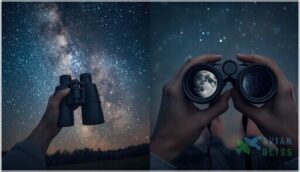
Choosing the right magnification for astronomy isn’t as simple as going for the highest number you can find, since higher power often introduces stability challenges and narrows your field of view.
Most astronomers find that magnifications between 7x and 15x offer the best balance of image brightness, steadiness, and sky coverage for handheld observing.
Let’s look at how low and high magnifications compare, and which ranges work best for different stargazing situations.
Low Vs. High Magnification
Choosing between low and high magnification in astronomy binoculars involves understanding several key tradeoffs that directly affect your observing experience. Lower powers like 7x–10x deliver wider fields of view and brighter images, making star-hopping easier and reducing stability issues when you’re holding binoculars by hand. Higher magnification, generally 12x–15x, reveals finer lunar detail and optical clarity but magnifies hand shake and atmospheric turbulence, often requiring image stabilization or a tripod mount for comfortable viewing sessions.
Here’s what changes as magnification increases:
- Field of view narrows, making it harder to locate celestial targets quickly
- Exit pupil shrinks, reducing apparent brightness under dark skies
- Viewing comfort decreases without proper support, causing arm fatigue
- Optical clarity demands better coatings and glass quality to maintain sharpness
For beginners exploring binoculars for astronomy, starting with 7x or 10x models lets you learn constellations and sweep the Milky Way without wrestling with image shake. Meanwhile, experienced observers using tripods can leverage 12x–15x astronomy binoculars to study planetary features and double stars with impressive detail.
Recommended Magnification Ranges
You’ll find the sweet spot for astronomy binoculars falls between 7x and 12x magnification for handheld use, balancing field of view with adequate exit pupil and viewing comfort. Magnification limits around 10x keep optical tradeoffs manageable without image stabilization, while stability factors become critical above 12x.
Higher powers demand tripod mounting to overcome shake, though they reveal impressive lunar detail when properly supported.
For best results, consider the importance of scientific study validation in astronomy research.
Aperture Size and Light Gathering
Aperture size determines how much light your binoculars can collect, which directly affects what you’ll see in the night sky. A larger objective lens diameter means more light reaches your eyes, revealing fainter stars, nebulae, and deep-sky objects that smaller apertures simply can’t capture.
Understanding the relationship between aperture and visibility will help you choose binoculars that match your stargazing goals.
Importance of Objective Lens Diameter
The objective lens diameter you choose sets the upper limit on your binoculars’ light-gathering power, which is vital for astronomy. Measured in millimeters, aperture directly controls how much starlight reaches your eye, making faint nebulae and galaxies visible.
Larger optics—usually 50 mm to 70 mm for handheld use—collect more photons, though they add weight and demand steadier support for best performance.
Impact on Night Sky Visibility
When you point astronomy binoculars toward dark skies, aperture transforms your night sky observing experience by boosting light transmission and revealing celestial objects invisible to the naked eye.
Larger objectives improve optical clarity and night sky contrast, pushing your limiting magnitude deeper—typically one to two luminous magnitudes per 10-mm increase—so you’ll spot faint nebulae and star clusters that smaller optics miss entirely.
Recommended Aperture Sizes for Stargazing
For casual stargazing from suburban areas, you’ll find 10×50 binoculars deliver bright views and comfortable eye relief without overwhelming weight.
When you’re ready to explore Milky Way structure and star clusters, 15×70 models mounted on a tripod reveal fainter targets through enhanced light gathering.
Dedicated deep-sky observers benefit from 25×100 optics paired with stable support, maximizing astronomical visibility and optical quality under dark skies.
Binocular Prism Types and Glass Quality
The optical components inside your binoculars determine how much light reaches your eyes and how sharp your images appear, which directly affects your ability to spot faint celestial objects. Prism design and glass quality represent two of the most significant factors in optical performance, yet manufacturers don’t always make these specifications easy to understand.
Here’s what you need to know about prism types, glass materials, coating technologies, and mounting options to guarantee you’re getting truly capable optics for stargazing.
Porro Vs. Roof Prism Designs
You’ll notice two main prism designs in binoculars for astronomy: porro prisms deliver wider apparent fields and enhanced depth perception through their offset optical path, making them excellent for sweeping star fields, while roof prisms offer compact, straight-through optics with better portability.
Porro designs generally provide stronger light transmission in budget models, though roof prisms excel when you need durability and image stabilization during extended observing sessions.
BaK-4 Vs. BK-7 Glass
Glass quality in your binoculars’ prisms directly affects optical clarity—BaK-4 exhibits a higher refractive index and lower dispersion rates than BK-7, reducing spectral fringing and delivering crisper star images across the field.
Consider these differences:
- BaK-4 provides enhanced edge sharpness and contrast for astronomy
- BK-7 offers good performance at lower cost for casual stargazing
- Higher refractive index in BaK-4 improves light transmission
- BK-7 suits budget-conscious beginners exploring the night sky
- BaK-4 works best with both porro prism and roof prism designs
Multi-Coated Optics Benefits
Once you’ve selected high-quality glass, coatings on those optics become your next performance lever. Multi-coated lenses reduce glare across multiple air-to-glass surfaces, boosting light transmission above 85% and sharpening dim star fields. That coating efficiency translates directly into better contrast for lunar terminator detail and nebulae, while protecting your investment from moisture and wear during extended observing sessions under the night sky.
| Coating Type | Light Transmission | Primary Benefit |
|---|---|---|
| Anti-Reflective | >95% per surface | Reduces glare and ghosting |
| Phase Correction | 80–90% system | Improves planetary contrast |
| Dielectric | 90–95% system | Enhances color neutrality |
| Protective Layer | Maintains baseline | Guards against scratches |
| Multilayer Stack | 80–92% total | Maximizes dim-object visibility |
Mounts and Adapters for Binoculars
After you’ve optimized your optics, a mount transforms how you use those binoculars for astronomy. Tripod stability eliminates hand tremor above 10× magnification, letting you study lunar craters and star clusters for minutes instead of seconds. Adapter compatibility matters—confirm that 1/4-20 thread before your first observing session—and balance techniques center the load, reducing gear fatigue while vibration damping preserves sharp views during windy nights.
- Alt-azimuth mounts offer simple up-down and left-right motion for casual observing.
- Quick-release plates enable rapid switching between handheld and mounted viewing.
- Berlebach wooden tripods provide vibration-damping stability for higher magnifications.
- Universal clamps fit most standard binocular bodies and diopter-adjustment eyepieces.
- Weight-rated mounts guarantee compatibility with binoculars for astronomy above 10× power.
Astronomical Objects Visible With Binoculars
Binoculars open up a surprising amount of the night sky, revealing details and objects that remain invisible to the naked eye. You don’t need a telescope to observe craters on the Moon, track Jupiter’s moons, or spot distant star clusters glowing in the darkness.
Here’s what you can realistically expect to see with a decent pair of astronomy binoculars.
Viewing The Moon and Planets

The Moon acts as your gateway to planetary astronomy, revealing major craters like Copernicus and Tycho at 7x–10x magnification during lunar phases when the terminator emphasizes shadow relief.
You’ll spot bright planets—Venus, Jupiter with its Galilean moons, and Saturn’s ring structure—using quality binoculars for astronomy from Celestron or similar makers, especially during favorable planetary alignment and astronomical events when image stabilization aids steady celestial navigation while stargazing.
Star Clusters and Nebulae
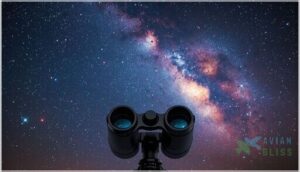
Binoculars for astronomy reveal the Pleiades’ roughly 1,000 stars spanning 110 arcminutes, while the Orion Nebula (M42) displays a fuzzy celestial mist showing active star formation and cosmic dust, best viewed through low-power optics for wider nebula views.
You’ll detect the Andromeda Galaxy’s bright galactic centers with satellite star-forming regions under dark skies, plus the Hyades’ V-shaped cluster types showing 10–15 bright members in Taurus for rewarding deep sky objects and galaxy viewing.
Deep Sky Objects for Beginners
Your celestial navigation starts with easy astronomical targets like the Orion Nebula (M42), Andromeda Galaxy (M31), and Pleiades cluster, all visible through binoculars for astronomy under dark skies.
Cosmic observing techniques improve when you allow 20–30 minutes for eye adaptation, while star mapping apps like Stellarium guide your galaxy exploration through Messier catalog stargazing destinations perfect for astronomy for beginners.
Essential Accessories for Astronomy Binoculars
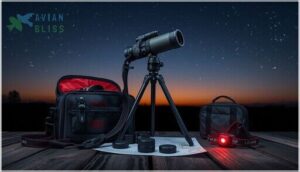
Getting the most out of your astronomy binoculars means pairing them with the right accessories, which can dramatically improve your observing experience and protect your investment.
You’ll find that a few well-chosen additions make the difference between frustrating viewing sessions and comfortable, productive nights under the stars.
Here’s what you should consider adding to your stargazing toolkit.
Carry Cases and Neck Straps
Protecting your investment starts with choosing the right gear to shield your optics from the elements and everyday wear. Case materials like impact-resistant nylon with padded interiors prevent lens misalignment during transport, while water-resistant fabrics guard against dew during stargazing sessions.
Strap designs for Celestron and Nikon binoculars should distribute weight evenly across your neck, with wide, padded options reducing fatigue and quick-release buckles offering convenient accessory storage and carry options for extended astronomy observations.
Lens Cleaning Kits
Clear optics transform your astronomy binoculars into precision optical instruments, which is why dedicated lens care tools matter as much as image stabilization features. Quality cleaning solutions paired with proper technique preserve multi-coated elements and prevent costly damage during your stargazing sessions.
- Microfiber cloths designed for optics remove dust without scratching delicate coatings, unlike household fabrics that leave fibers or cause abrasion.
- Pre-moistened optical wipes with alcohol-free formulas clean fingerprints and dew from your binoculars for astronomy without damaging anti-reflective treatments.
- Storage cases with soft-bristled brushes let you dislodge particles before wiping, reducing micro-scratch risk on your optical instruments’ surfaces.
Smartphone Adapters for Astrophotography
Capturing lunar craters through your astronomy binoculars requires stable phone mounting, which specialized adapters deliver through universal clamps or L-bracket configurations. These telescope alternatives transform optical instruments into astrophotography tools when paired with remote shutter control and stacking apps that improve planetary detail through frame averaging.
| Feature | Entry-Level | Premium |
|---|---|---|
| Adapter Compatibility | Universal fit, 1-2 adjustments | Multi-phone models, quick-release |
| Phone Mounting | Basic clamp, manual align | Precision axis control, vibration dampening |
| Image Stabilization | App-dependent only | Mechanical damping + software |
| Mobile Editing | Standard camera apps | Dedicated stacking software, metadata logging |
Windless conditions and proper alignment optimize your astrophotography tips success, especially for bright targets like the Moon where even minor drift degrades sharpness during captures.
Eyepiece Filters and Apps
Beyond hardware, filters like OIII or UHC improve contrast for deep-sky objects, though filter compatibility depends on eyepiece thread size and may require step-up rings.
Sky mapping apps with augmented reality overlays identify constellations through your binoculars for astronomy, while dedicated astrophotography software stacks frames for sharper planetary detail—transforming stargazing into documented exploration with proper image stabilization and astronomy guides.
Maintenance and Proper Use Tips
Taking care of your astronomy binoculars isn’t complicated, but a few key habits will keep them performing at their peak for years of stargazing. Proper cleaning techniques, correct adjustments, and steady viewing methods can make the difference between frustrating sessions and crystal-clear views of celestial wonders.
Let’s walk through the essential maintenance steps and usage tips that every astronomy enthusiast should know.
Cleaning and Storing Binoculars
Your binoculars for astronomy deserve careful optical care to maintain peak performance during observing sessions. Proper binocular maintenance protects expensive coatings and ensures crisp views for years to come.
- Lens cleaning requires microfiber cloths and appropriate cleaning solutions—apply liquid only to the cloth, never directly onto glass surfaces, and use gentle circular motions from center outward.
- Remove loose dust by gently blowing across optics before wiping, which prevents abrasive particles from scratching delicate multi-coated surfaces during routine maintenance.
- Storage tips include keeping binoculars in padded cases with desiccant packs, placed in dry areas away from direct sunlight and extreme temperatures that degrade rubber armor.
- Clean only when visibly dirty or after exposure to moisture, since excessive wiping accelerates coating wear and risks introducing fine scratches that affect image quality.
Adjusting for Eye Relief and Focus
Getting the sharpest views from your astronomy binoculars depends on proper eye relief tips and focus mechanics. Start by twisting the eyecup adjustments to position your eyes at the correct distance—eyeglass wearers need longer relief to see the full field of view without blackouts.
Next, use the central focus wheel and right-eye diopter settings to achieve crisp star images, ensuring viewing comfort during extended optics sessions.
Techniques for Steady Viewing
Once you’ve dialed in eye relief and focus, stable viewing becomes your next challenge. Tuck your elbows against your chest, lean into a solid surface, or rest the binoculars on a fence rail to reduce shake.
For magnifications above 10x, a tripod adapter transforms shaky images into rock-steady views, making image-stabilized binoculars worth considering if you’re serious about stargazing techniques and observing faint deep-sky targets.
Best Binoculars for Astronomy in026
You’ve learned what features matter and how to use binoculars effectively, so now it’s time to look at specific models that deliver real results under the stars.
Each of these ten binoculars has been selected based on optical performance, build quality, and practical value for stargazing.
Let’s examine the top options that will help you explore the night sky in 2026.
1. Celestron Cometron Astronomy Binoculars
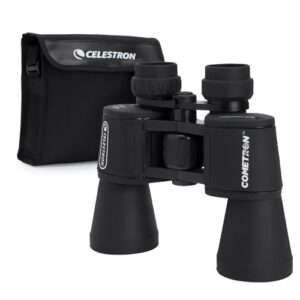
If you’re just starting your stargazing journey, the Celestron Cometron astronomy binoculars offer a solid foundation without draining your wallet. The 7×50 configuration delivers a generous 6.6° field of view, making constellation scanning straightforward, while the 50mm objectives gather enough light for moon craters and bright star clusters.
You’ll appreciate the multi-coated BaK-4 glass optics that boost contrast, though the plastic focuser feels less sturdy than premium models. The tripod-adaptable design helps steady your views during extended sessions, and the water-resistant housing manages typical observing conditions, though serious moisture may challenge the basic sealing.
Best For: Beginner astronomers and casual skywatchers who want an affordable, portable option for scanning constellations, viewing the moon, and enjoying bright deep-sky objects without investing in expensive equipment.
Pros:
- Wide 6.6° field of view with 7x magnification makes it easy to locate and track celestial objects across the night sky
- Multi-coated BaK-4 glass optics deliver solid light transmission and contrast for the price point
- Tripod-adaptable design lets you stabilize views during longer observing sessions, reducing hand shake
Cons:
- Plastic focuser can feel flimsy and may wobble during use, affecting precise adjustments
- Basic water resistance struggles with heavy dew or moisture, leading to potential fogging issues
- Edge sharpness declines toward the periphery, and quality control inconsistencies have been reported by some users
2. Nikon Aculon Binoculars
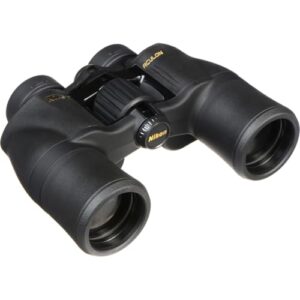
The Nikon Aculon 8×42 binoculars strike an appealing balance between optical quality and handling ease, making them well-suited for astronomy beginners. You’ll find the multilayer coatings improve light transmittance noticeably during stargazing, while the 12mm eye relief adjustment accommodates eyeglass wearers comfortably.
The aspherical eyepiece lens minimizes edge distortion across that 140m field at 1,000m, though the stiff diopter adjustment has frustrated some users. At 755g, they’re manageable for handheld viewing, and the tripod socket provides stability during extended lunar observations.
Watch for occasional internal debris—binocular maintenance requires careful inspection before purchase.
Best For: Amateur astronomers and nature enthusiasts who want reliable optics without breaking the bank, especially if you wear glasses or plan longer viewing sessions.
Pros:
- Multilayer coatings and aspherical lenses deliver bright, sharp images right to the edge of the field
- 12mm eye relief and adjustable eyecups make them comfortable for eyeglass wearers
- Tripod-adaptable design helps with steady views during extended stargazing
Cons:
- Diopter adjustment can be stiff and awkward to operate, particularly with larger hands
- Some units arrive with internal debris or lens imperfections that can’t be cleaned
- Not fully weatherproof, so you’ll need to protect them in damp or dusty conditions
3. Nikon Action Extreme Binoculars
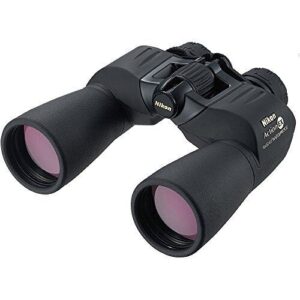
For rugged field astronomy viewing, the Action Extreme series delivers reliable waterproof performance and multicoated optics that boost light transmission during twilight observations. The 10×50 configuration you’ll encounter most often provides reasonable magnification for lunar crater details and brighter star clusters, though you may notice some image shake without tripod support.
Rubber armor protects the all-metal chassis while improving your grip during extended stargazing sessions, and the BaK-4 prisms maintain acceptable edge-to-edge sharpness. Watch for reduced clarity outside the center field—a common trade-off in this price bracket.
Best For: Amateur astronomers and outdoor enthusiasts who need durable, weather-resistant binoculars for lunar observation, bright deep-sky objects, and general field use without breaking the bank.
Pros:
- Waterproof, fogproof, and shockproof construction with rubber armor makes them reliable in harsh weather conditions
- BaK-4 prisms and multicoated optics deliver good light transmission and sharpness for the price point
- Tripod-adaptable design helps reduce image shake at 10x magnification during extended viewing sessions
Cons:
- Noticeable image degradation outside the center field of view limits edge-to-edge clarity
- 34.2 oz weight may cause fatigue during hand-held use over long periods
- Hand shake at 10x magnification can make steady viewing difficult without tripod support
4. Athlon Optics Midas Binoculars
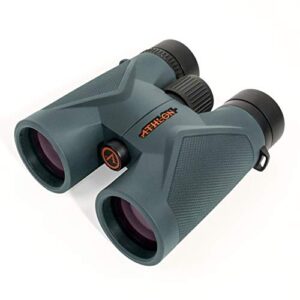
The Athlon Optics Midas 8×42 brings ED glass and ESP dielectric coating to your nighttime observations, improving image stabilization and optical quality over basic models. You’ll appreciate the phase-corrected BaK-4 prisms that sharpen lunar detail and boost contrast across the 8.1° field of view, while the 17.2mm eye relief accommodates eyeglass wearers comfortably.
Argon purging ensures waterproof reliability during dew-prone sessions, and at 25 ounces, the magnesium-alloy chassis won’t fatigue your arms during extended star cluster sweeps—solid binocular ergonomics for serious astronomical viewing.
Best For: Stargazers and birdwatchers who want ED glass clarity and phase-corrected optics without jumping to premium price brackets.
Pros:
- ED glass and dielectric coatings deliver sharp, color-accurate views of lunar craters and star clusters
- 17.2mm eye relief and adjustable eyecups work well for eyeglass wearers during long observing sessions
- Argon-purged waterproofing and magnesium chassis handle dew and outdoor conditions without adding bulk
Cons:
- 8x magnification may feel limiting for detailed planetary observation compared to 10x or 12x options
- 426-foot field of view at 1,000 yards is decent but not exceptional for wide star-field sweeps
- Some users report the included strap feels flimsy for a 25-ounce binocular
5. Nikon Monarch Binoculars
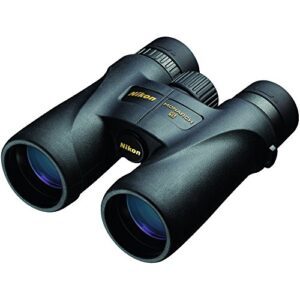
Versatility stands out in the Nikon Monarch line, making these binoculars for astronomy a wise choice if you value both Optical Quality and comfort. The Monarch’s phase-coated roof prisms and ED glass sharpen night-sky details, while dielectric coatings boost contrast for richer star fields.
Waterproof, fog-proof Binocular Design means you won’t worry about dew or drizzle during stargazing. Image Stabilization isn’t built-in, but their ergonomic grip and balanced weight allow steady Astronomy Viewing—ideal for sweeping the Milky Way or pinpointing clusters.
Best For: Stargazers and outdoor enthusiasts who want reliable, all-weather binoculars that deliver sharp images without breaking the bank.
Pros:
- Phase-coated prisms and ED glass produce bright, high-contrast views of star clusters and the Milky Way
- Waterproof and fog-proof construction handles dew and light rain during night observing sessions
- Comfortable ergonomic design with twist-up eyecups works well for extended viewing, with or without glasses
Cons:
- Lens caps can be loose and may fall off during use
- No built-in image stabilization, so higher magnifications might need a tripod for steadier views
- Some users report minor build quality issues like logos coming off over time
6. Bushnell Falcon Binoculars
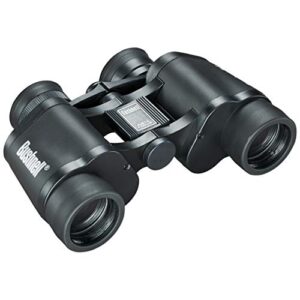
Budget-conscious observers often overlook the Bushnell Falcon, though its 10×50 configuration delivers solid Optical Quality for lunar and planetary viewing. You’ll appreciate the fully multi-coated Optics that boost light transmission, while the Porro prism design offers a forgiving exit pupil under handheld use.
Waterproof and fog-proof construction protects your investment during damp observing sessions, and the rubber armor housing ensures a secure grip.
Most Binocular Reviews note these Astronomy Binoculars lack Image Stabilization, yet their balance makes sweeping star clusters manageable without a mount—practical Astronomy Tips for stargazers on a tight budget.
Best For: Beginner astronomers and casual stargazers who want affordable binoculars for moon and planet viewing without breaking the bank.
Pros:
- Fully multi-coated optics and Porro prism design deliver clear, bright images with good depth perception for the price point.
- Waterproof and fog-proof construction means you can observe in damp conditions without worrying about damage.
- Well-balanced 10×50 configuration lets you sweep across star clusters by hand without needing a tripod or mount.
Cons:
- No image stabilization makes it harder to hold steady during extended viewing sessions at 10x magnification.
- Build quality uses more plastic components compared to higher-end models, which may not hold up to heavy or professional use.
- Lens covers can fall off easily and the soft case doesn’t offer much protection for rough outdoor conditions.
7. SkyGenius Binoculars For Adults
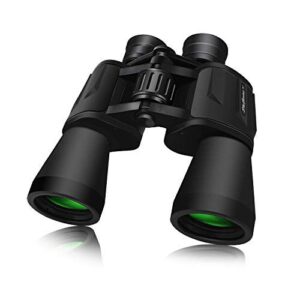
At 10×50, the SkyGenius delivers Optical Quality suitable for Binoculars for Beginners who want Adult Astronomy without breaking the bank. You’ll find its aspherical lenses and multi-layer coating improve light transmission during Astronomy and Stargazing sessions, while the BaK-4 prisms reduce edge distortion.
These Astronomy Binoculars lack Image Stabilization, yet the rubberized armor and adjustable eye cups make extended stargazing comfortable. SkyGenius Features include a diopter system for vision balance—essential Stargazing Tips—and proper Binocular Care keeps those optics sharp for moon and cluster observation.
Best For: Beginners and casual stargazers who want a solid, affordable binocular for moon watching, planets, and bright star clusters without investing in heavy-duty gear.
Pros:
- 10x magnification with a 50mm objective lens captures plenty of light for clear views of the night sky, making it easier to spot lunar craters and brighter celestial objects.
- Multi-coated aspherical lenses and BaK-4 prisms deliver good image quality and reduce edge blur, giving you sharper stargazing sessions.
- Rubberized armor, adjustable eye cups, and a diopter system provide comfortable handling during longer observation periods, even if you wear glasses.
Cons:
- At 1.8 pounds, the binoculars can feel bulky and tiring to hold for extended periods without a tripod or neck strap support.
- The included carry bag and neck strap often feel cheaply made, with some users finding the strap difficult to attach or too short.
- Low-light performance is limited to dusk or dawn conditions—these won’t work in complete darkness, so true night viewing has its limits.
8. Uscamel Binoculars For Bird Watching
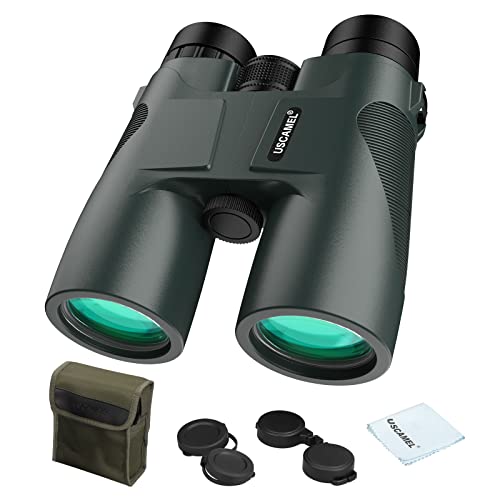
Though marketed for Wildlife and Bird Watching, Uscamel’s 10×42 configuration adapts well to Astronomy and Stargazing when you understand its limitations. The BAK4 prism and FMC optics deliver Optical Quality comparable to entry-level Binoculars for Astronomy, though you’ll miss Image Stabilization during high-magnification lunar sweeps.
Uscamel Features include waterproofing and upward-rotating eyecups—useful Bird Watching Tips that translate to dew-prone observing sessions.
For Binoculars for Beginners seeking dual-use optics, proper Binocular Maintenance and Birding Accessories like a tripod adapter compensate for the loose lens covers some users report.
Best For: Beginners and casual users who want affordable binoculars that work for both birdwatching during the day and stargazing at night without breaking the bank.
Pros:
- 10×42 setup with BAK4 prism and multi-coated optics gives you sharp, bright images that punch above the price point for wildlife and basic astronomy use.
- Waterproof build and rotating eyecups handle wet conditions and work well whether you wear glasses or not.
- Comes with all the basics—neck strap, carrying case, and lens covers—so you’re ready to go right out of the box.
Cons:
- Lens covers tend to fall off easily, which can be annoying when you’re out in the field.
- Image stability suffers at high magnification, especially for distant objects like stars, so you might need a tripod for serious stargazing.
- Focusing can be tricky compared to pricier brands, and beginners may need some practice to get crisp images consistently.
9. UncleHu High Power Binoculars
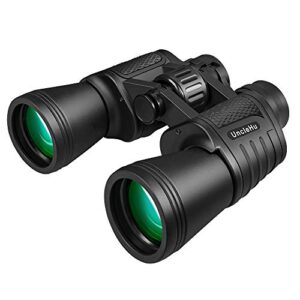
UncleHu’s 20×50 configuration pushes High Power boundaries for handheld stargazing, though you’ll quickly discover why experienced observers pair these binoculars with astronomy accessories like tripod mounts. Without Image Stabilization, even braced viewing at 20× magnification proves challenging—a critical Stargazing Tips lesson for beginners exploring Binoculars for Astronomy beyond the typical 10× range.
The 26mm exit pupil and BaK-4 prism deliver respectable Optical Clarity on lunar craters, yet reports of alignment issues raise Binocular Durability concerns that contradict the waterproof claims.
Best For: Budget-conscious stargazers and wildlife watchers who own a tripod and want high magnification without spending a fortune on premium optics.
Pros:
- 20x magnification brings distant objects remarkably close, perfect for detailed lunar observations and long-range nature viewing
- Large 26mm objective lenses and BaK-4 prism gather plenty of light for clear, bright images even in dim conditions
- Waterproof and fog-proof construction with rubber armor protects your investment during outdoor adventures
Cons:
- 20x magnification makes handheld use almost impossible without serious shake—you’ll need a tripod for steady viewing
- Some users report lens alignment problems and build quality issues that undermine the otherwise solid feature set
- Weighing nearly 2 pounds, these binoculars get heavy fast during extended observation sessions
10. Gosky Roof Prism Binoculars
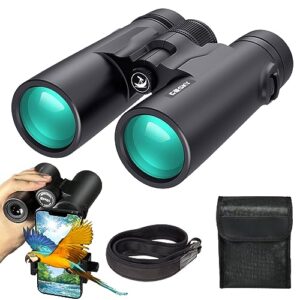
At $69.99, Gosky’s 10×42 roof prism configuration delivers surprisingly competent Optical Quality for Stargazing, though you’ll notice the compact Prism Design trades some light-gathering capacity for portability—a classic astronomy binoculars compromise.
The fully multi-coated HD optics and BaK-4 glass boost light transmission for lunar craters and brighter deep-sky targets, while the included smartphone adapter opens basic astrophotography opportunities.
Without Image Stabilization, proper Binocular Maintenance and steady-hold Stargazing Tips become essential; leaning against a post or using the tripod adapter transforms these Binoculars for Astronomy into surprisingly capable instruments for beginning observers exploring Gosky Features on a budget.
Best For: Budget-conscious beginners who want decent optics for moon watching, planet spotting, and brighter celestial objects without breaking the bank.
Pros:
- Fully multi-coated HD optics with BaK-4 glass deliver solid light transmission for the price point, making lunar craters and bright planets pop
- Comes with useful extras like a smartphone adapter for basic astrophotography and a tripod mount to reduce hand shake during longer viewing sessions
- Compact roof prism design keeps weight down to 1.54 pounds, so it won’t tire out your arms during casual stargazing trips
Cons:
- Lacks image stabilization, so you’ll need steady hands or a tripod for comfortable viewing at 10x magnification
- Not built for extreme conditions or professional use—the weather resistance is limited and optical performance won’t match higher-end models
- Some users report quirks with the phone mount and tripod adapter, plus you might notice chromatic aberration or edge distortion on dimmer targets
Frequently Asked Questions (FAQs)
Can binoculars replace a beginner astronomy telescope?
Like swapping a carriage for an automobile, many newcomers find binoculars excel at stargazing basics, offering wider views than beginner telescopes, though planets reveal fewer details without higher magnification.
What budget should I expect for astronomy binoculars?
You’ll encounter entry-level astronomy binoculars starting around $50 to $150, midrange models from $150 to $350, and premium optics exceeding $800, with cost factors including aperture size, coatings, and optical quality rather than magnification alone.
Are image stabilization binoculars worth the extra cost?
Image stabilization can slash shake by up to 90%, transforming jittery views into rock-steady stargazing—but you’ll pay 20–60% more and carry extra weight, making the cost benefit clearest at 15× magnification or higher.
How do I choose between 10×50 and 15×70?
Your choice hinges on stability requirements and observing style. The 10×50 offers wider field views and easier handheld use, while 15×70 provides enhanced light gathering and detail but demands a tripod for steady viewing.
Whats the best time of year for binocular astronomy?
The night sky is a stage that shifts with the seasons, and your best seat arrives during autumn through early spring, when longer darkness meets clearer skies and stable atmospheric conditions for ideal stargazing.
Conclusion
The universe waits patiently while we overthink equipment choices, yet picking the right binoculars for astronomy often matters less than simply stepping outside and looking up.
Armed with proper aperture, quality optics, and realistic magnification expectations, you’ll discover that those photons traveling millions of years to reach your eyes don’t discriminate between budget-friendly glass and premium lenses.
Your next clear night holds more wonder than any specification sheet ever could.