This site is supported by our readers. We may earn a commission, at no cost to you, if you purchase through links.
Most birders don’t realize that a sparrow 15 feet away in dappled forest light tests your binoculars harder than a hawk at 100 yards in open sky. The canopy filters roughly 80% of available light, branches constantly interrupt your sightlines, and warblers refuse to sit still long enough for you to fumble with focus wheels.
That’s why choosing binoculars for bird watching in forest conditions demands different priorities than general-purpose optics. You need glass that gathers maximum light, focuses close enough to catch movement in the understory, and delivers a wide enough view to track erratic flight paths through cluttered vegetation. The right pair transforms frustrating glimpses into crisp, detailed observations that make identification possible.
Table Of Contents
- Key Takeaways
- Best Binoculars for Forest Bird Watching
- 1. Nikon Monarch Binoculars
- 2. Celestron Nature Binoculars
- 3. Zeiss Conquest Hd Binoculars
- 4. Leica Trinovid Binoculars
- 5. Vortex Optics Viper Binoculars
- 6. Celestron Trailseeker Ed Binoculars
- 7. Vortex Razor Hd Binoculars
- 8. Swarovski El Binoculars
- 9. Vanguard Endeavor Ed Binoculars
- 10. Athlon Optics Midas Binoculars
- Key Features for Forest Birding Binoculars
- Choosing The Right Magnification
- Importance of Field of View in Forests
- Optics Quality and Light Transmission
- Durability and Ergonomics for Outdoor Use
- Essential Binocular Accessories for Birders
- Maintenance Tips for Bird Watching Binoculars
- Budget Considerations for Birding Binoculars
- Frequently Asked Questions (FAQs)
- What strength of binoculars is best for bird watching?
- What magnification is best for birdwatching?
- Are 10×32 binoculars good for bird watching?
- What are the best binoculars for safari and bird watching?
- How do forest canopy conditions affect binocular performance?
- What binocular settings work best for dawn birding?
- Can binoculars damage from tree branch impacts?
- How does humidity affect binocular lens clarity?
- What weight causes fatigue during long forest hikes?
- How do I adjust diopter for eyeglasses?
- Conclusion
Key Takeaways
- Forest birding demands 8x or 8.5x magnification with 42mm objectives because dense canopy blocks 80% of light and requires wide fields of view (340-420 feet at 1,000 yards) to track fast-moving warblers through cluttered branches.
- Close focus capability under 6.6 feet separates effective forest binoculars from general-purpose models, letting you identify eye rings and wing bars on nearby birds without spooking them or losing critical detail.
- Fully multi-coated lenses with BaK-4 prisms and ED glass are essential for maintaining sharp, color-accurate images in dappled shade, where inferior optics produce chromatic aberration and blur that obscure field marks.
- Nitrogen-purged, waterproof construction with rubber armor protects your investment during humid mornings and sudden weather shifts while ensuring fog-free performance across temperature changes that routinely fog cheaper models.
Best Binoculars for Forest Bird Watching
Finding the right binoculars for forest birding means balancing magnification, field of view, and light-gathering ability in a package that won’t weigh you down on the trail.
For a comprehensive breakdown of optical performance across different price ranges, check out our guide to the best binoculars for birdwatching to see how models stack up in real forest conditions.
The dense canopy and quick movements of woodland birds demand optics that can track fast and focus close, while still delivering sharp images in low light.
Here are ten binoculars that excel in forest environments, each offering a different combination of features to match your birding style and budget.
1. Nikon Monarch Binoculars
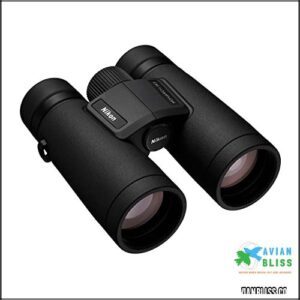
The Nikon Monarch M7 8×42 delivers dielectric prism coatings that boost light transmission, turning those shadowy understory perches into crisp, vibrant scenes. With a close focus down to 6.6 feet, you can identify eye rings and wing bars without spooking birds.
You’ll appreciate the ED glass optics, which minimize chromatic aberration so warblers don’t blur into green halos against bright leaves. The turn-and-slide eyecups accommodate glasses wearers, while waterproof, fog-proof construction withstands humid forest mornings when songbirds are most active.
| Best For | Birdwatchers and nature enthusiasts who need sharp optics for spotting details in low light and want durable binoculars that work whether you wear glasses or not. |
|---|---|
| Magnification | 8x |
| Objective Lens | 42mm |
| Waterproof | Yes |
| Fogproof | Yes |
| Weight | 1.48 lbs |
| Prism Type | Dielectric |
| Additional Features |
|
- ED glass and dielectric coatings deliver bright, color-accurate images even at dawn or dusk
- Close focus at 6.6 feet lets you study details on nearby subjects without losing clarity
- Waterproof and fogproof build holds up in rain, humidity, and temperature swings
- At 1.48 pounds, they can feel heavy during long hikes or all-day birding sessions
- Focus wheel and eye separation can be stiff out of the box, requiring break-in time
- Chromatic aberration may appear in harsh backlighting despite the ED glass
2. Celestron Nature Binoculars
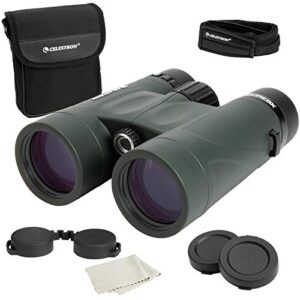
For dense forests where light gets scarce, Celestron Nature ED binoculars bring Extra Low Dispersion glass that cuts chromatic aberration and keeps those tanagers sharp against tangled branches.
The phase-coated BaK-4 prisms improve contrast, so you won’t lose subtle plumage details in dappled shade. At 8x magnification with 42mm objectives, they balance brightness and stability when you’re tracking movement through the understory.
Fully multi-coated optics optimize light transmission, while waterproof, fog-proof construction manages humid mornings. The rubber-armored body grips well, and tripod adaptability steadies longer viewing sessions.
| Best For | Birdwatchers and hikers who need reliable optics in low-light forest conditions and want sharp, color-accurate views without breaking the bank. |
|---|---|
| Magnification | 8x |
| Objective Lens | 42mm |
| Waterproof | Yes |
| Fogproof | Yes |
| Weight | 1.75 lbs |
| Prism Type | BaK-4 |
| Additional Features |
|
- Extra Low Dispersion glass and phase-coated prisms deliver sharp, high-contrast images even in dim, dense foliage
- Waterproof and fogproof construction handles humid mornings and unpredictable weather
- Tripod-adaptable design with comfortable rubber armor makes long observation sessions easier
- Eye cup screws can fall out, which is frustrating during extended field use
- Included strap feels cheap and may need upgrading right away
- Limited warranty doesn’t cover normal wear and tear, so long-term durability isn’t guaranteed
3. Zeiss Conquest Hd Binoculars

If you’re ready to step up your glass game, Zeiss Conquest HD 10×32 binoculars deliver 90% light transmission through HD lenses that practically eliminate color fringing, even when you’re picking out warblers against backlit leaves. The LotuTec coating sheds rain and fingerprints, keeping your view clear through humid forest air.
At a fairly light weight with a compact body, they won’t drag you down during all-day outings, though the $1,480 price tag means you’re investing seriously in optical precision and that signature Zeiss T coating contrast.
| Best For | Serious birders and nature enthusiasts who want professional-grade optics and don’t mind paying premium prices for exceptional clarity and low-light performance. |
|---|---|
| Magnification | 10x |
| Objective Lens | 32mm |
| Waterproof | Yes |
| Fogproof | Yes |
| Weight | Lightweight |
| Prism Type | Roof |
| Additional Features |
|
- 90% light transmission with Zeiss T coating delivers incredibly bright, high-contrast images even in dim conditions
- LotuTec coating repels water and dirt, keeping your view clear in rain or humid weather
- Compact, lightweight design makes them comfortable for all-day use in the field
- $1,480 price point puts these well beyond casual users’ budgets
- Eye cups can feel stiff or gritty, and the included caps feel cheaply made for the price
- Some users notice chromatic aberration or a rolling globe effect depending on viewing conditions
4. Leica Trinovid Binoculars
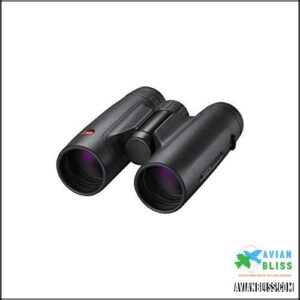
Leica Trinovid HD 10×42 binoculars combine a 340-foot field of view with a close focus under 5.25 feet, letting you track flitting songbirds through understory tangles without losing sight.
Phase-corrected roof prisms and fully multi-coated optics deliver natural color rendering with minimal chromatic aberration, even when you’re scanning backlit canopies.
The ergonomic grip stays secure in sweaty hands, and nitrogen filling prevents internal fogging during humid dawn patrols. At 25.75 oz, they’re manageable for long treks, though the premium price reflects Leica’s exacting German engineering.
| Best For | Serious birders and wildlife watchers who want top-tier optics and don’t mind paying for German precision. |
|---|---|
| Magnification | 10x |
| Objective Lens | 42mm |
| Waterproof | Yes |
| Fogproof | Yes |
| Weight | 25.75 oz |
| Prism Type | Roof |
| Additional Features |
|
- Sharp, color-accurate images with minimal distortion, even in tricky lighting
- Close focus under 5.25 feet lets you spot detail on nearby birds and butterflies
- Rugged, fog-proof build holds up through rain and temperature swings
- Premium price puts them out of reach for casual users
- Some buyers received units missing the advertised Adventure-Strap
- Field of view is decent but not class-leading for the magnification
5. Vortex Optics Viper Binoculars
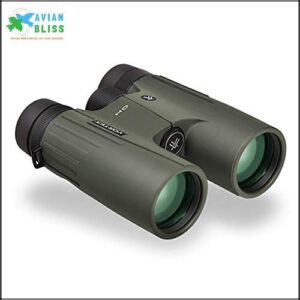
You’ll appreciate the Vortex Viper HD 10×42 when it brings sharp, color-accurate images to life in dense canopy, thanks to dielectric prism coatings and XR fully multi-coated optics that boost light transmission.
The multi-position eyecups adjust smoothly for comfortable viewing with or without glasses, while argon purging keeps internal optics fog-free during humid forest mornings.
At just 1.5 pounds, this rubber-armored chassis won’t weigh you down, and Vortex’s unlimited lifetime warranty adds reassuring peace of mind for adventurous birders.
| Best For | Birders and hunters who need sharp, reliable optics in varying weather conditions and want a lightweight binocular that won’t fog up during early morning or humid outings. |
|---|---|
| Magnification | 10x |
| Objective Lens | 42mm |
| Waterproof | Yes |
| Fogproof | Yes |
| Weight | 0.7 kg |
| Prism Type | Dielectric multi-layer |
| Additional Features |
|
- Dielectric prism coatings and multi-coated lenses deliver bright, color-accurate images even in dense cover
- Argon-purged and O-ring sealed construction keeps optics fog-free and waterproof in challenging conditions
- Lightweight at 1.5 pounds with rubber armor for durability, plus Vortex’s unlimited lifetime warranty
- Performance drops in low light situations despite good optical coatings
- Short focal plane means you’ll need to refocus frequently when switching between distances
- Narrower field of view and borderline eye relief can be limiting for eyeglass wearers
6. Celestron Trailseeker Ed Binoculars
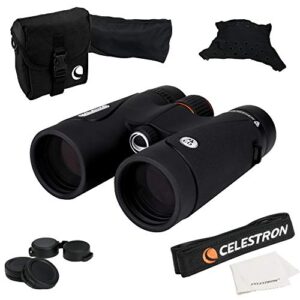
When you’re scanning tangled branches for warblers, the Celestron TrailSeeker ED 10×42 delivers edge-to-edge sharpness through Extra Low Dispersion glass that minimizes color fringing around high-contrast subjects.
Keeping your optics safe in the field is just as important as the glass itself, which is why pairing them with a dedicated birdwatching backpack ensures quick access and full protection.
Fully multi-coated optics and dielectric-coated BaK-4 prisms boost light transmission, keeping details crisp even in forest shade.
The magnesium alloy body stays light enough for all-day rambles at 1.47 pounds, while nitrogen purging and waterproof construction handle humid mornings without internal fogging.
Twist-up eyecups accommodate glasses, and tripod adaptability aids extended viewing sessions when you’ve found that elusive species.
| Best For | Birdwatchers and nature enthusiasts who need sharp, color-accurate optics for scanning dense foliage and spotting wildlife details in varied lighting conditions. |
|---|---|
| Magnification | 10x |
| Objective Lens | 42mm |
| Waterproof | Yes |
| Fogproof | Yes |
| Weight | 1.47 lbs |
| Prism Type | Phase/dielectric BaK-4 |
| Additional Features |
|
- ED glass and fully multi-coated optics deliver edge-to-edge sharpness with minimal color fringing, making it easier to identify birds in complex environments
- Lightweight magnesium body at 1.47 pounds won’t weigh you down during long hikes or all-day observation sessions
- Waterproof and nitrogen-filled construction handles humid conditions and morning fog without internal condensation
- 10x magnification can amplify hand shake, making steady viewing harder without a tripod
- Neck strap comfort issues reported during extended wear sessions
- Lightweight carrying case may not provide adequate protection for serious field use
7. Vortex Razor Hd Binoculars
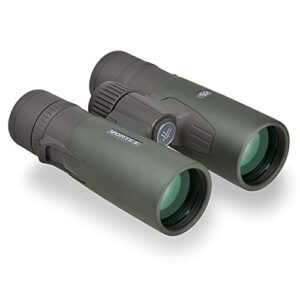
If you’re chasing uncompromising optical quality in dense hardwoods, the Vortex Razor HD 8×42 pairs an APO system with HD lens elements that virtually eliminate chromatic aberration, delivering razor-sharp detail from center to edge.
XR Plus fully multi-coated lenses and dielectric prism coatings boost light transmission, so you’ll catch subtle plumage patterns even in canopy shadows.
The open-hinge magnesium chassis weighs just 24.2 ounces yet feels tank-solid, while argon purging and ArmorTek coating handle downpours and rough trails without compromise.
| Best For | Serious birders and wildlife watchers who demand elite optical performance and won’t compromise on edge-to-edge clarity, even in challenging low-light forest conditions. |
|---|---|
| Magnification | 8x |
| Objective Lens | 42mm |
| Waterproof | Yes |
| Fogproof | Yes |
| Weight | 24.2 oz |
| Prism Type | Premium |
| Additional Features |
|
- APO system with HD glass virtually eliminates color fringing and delivers exceptionally sharp, true-to-life images across the entire field of view
- Premium coatings and dielectric prisms maximize light transmission for excellent performance in early morning or shaded woodland settings
- Rugged yet lightweight magnesium build (24.2 oz) with full waterproof/fogproof protection handles serious field use without adding fatigue
- Some users report minor edge blur or chromatic aberration despite the premium optics
- Focus wheel may need fine-tuning out of the box to achieve optimal sharpness
- Eyecup and diopter adjustments can be fussy and may require patience to dial in perfectly
8. Swarovski El Binoculars
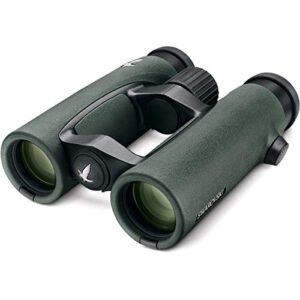
When you demand the absolute summit of forest optics, the Swarovski EL 8.5×42 sets the standard with Swarovision technology that delivers breathtaking contrast and color fidelity across every inch of its 399-foot field at 1,000 yards.
Fluoride-containing HD glass and field-flattener lenses eliminate chromatic aberration and edge distortion, while Swarobright coatings push light transmission near 90 percent—critical for spotting warblers in shadowed understory.
The magnesium chassis weighs just 29.5 ounces, balancing ergonomic brilliance with rugged, nitrogen-purged weatherproofing that laughs at rain and fog.
| Best For | Serious birders, wildlife observers, and outdoor professionals who need the sharpest optics available and don’t mind paying premium prices for top-tier performance. |
|---|---|
| Magnification | 8.5x |
| Objective Lens | 42mm |
| Waterproof | Yes |
| Fogproof | Not specified |
| Weight | 29.5 oz |
| Prism Type | Not specified |
| Additional Features |
|
- Exceptional image quality with Swarovision technology that eliminates edge distortion and chromatic aberration for edge-to-edge clarity
- Lightweight magnesium body at 29.5 oz makes extended use more comfortable than competing alpha-class binoculars
- Outstanding low-light performance with near 90% light transmission, perfect for dawn and dusk observation
- Expensive at $1,999, putting them out of reach for casual users or those on a budget
- No protective carrying case included despite the high price point, requiring additional purchases
- Some users report customer service issues and find the proprietary strap system less convenient than standard designs
9. Vanguard Endeavor Ed Binoculars

The Vanguard Endeavor ED II 8×42 delivers outstanding value for forest birders who want ED glass clarity without premium pricing. It pairs HOYA extra-low dispersion optics with phase-corrected BaK4 prisms, rendering warblers in true color across a generous 377-foot field at 1,000 yards.
Fully multi-coated lenses boost transmission in dappled shade, while the open-bridge design keeps weight at 27.2 ounces for comfortable all-day scanning. Nitrogen purging ensures fog-proof reliability, and the 6.6-foot close focus lets you observe thrushes foraging just steps away.
| Best For | Budget-conscious birders and wildlife watchers who want ED glass quality and reliable performance without spending top dollar. |
|---|---|
| Magnification | 8x |
| Objective Lens | 42mm |
| Waterproof | Yes |
| Fogproof | Yes |
| Weight | 27.16 oz |
| Prism Type | Phase-corrected Bak4 |
| Additional Features |
|
- HOYA extra-low dispersion glass delivers true color and sharp detail across a wide 377-foot field of view
- Open-bridge design keeps weight manageable at 27.2 ounces while providing a secure, comfortable grip for long observation sessions
- Strong low-light performance thanks to fully multi-coated lenses and phase-corrected BaK4 prisms, plus waterproof and fogproof construction
- Some users still report minor chromatic aberration despite the ED glass upgrade
- At over 27 ounces, these may feel heavy during extended hikes compared to lighter compact models
- Screw-on eyepiece covers are prone to getting lost or damaged in the field
10. Athlon Optics Midas Binoculars
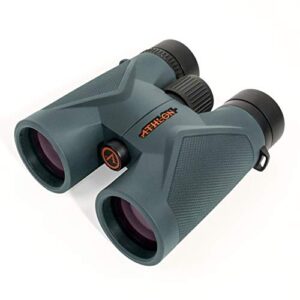
The Athlon Optics Midas 8×42 punches well above its weight class, delivering ED glass optics and ESP dielectric coating in a magnesium chassis that keeps the scales at just 25 ounces. You’ll track flycatchers through tangled understory with its impressive 426-foot field of view at 1,000 yards, while phase-corrected BaK4 prisms render every feather detail sharply.
Argon purging guarantees waterproof performance in drizzle, and the 6.5-foot close focus brings woodpeckers into breathtaking clarity—all backed by Athlon’s lifetime warranty for peace of mind on every forest outing.
| Best For | Birdwatchers and nature enthusiasts who want premium optical performance without the premium price tag, especially if you wear glasses. |
|---|---|
| Magnification | 8x |
| Objective Lens | 42mm |
| Waterproof | Yes |
| Fogproof | Yes |
| Weight | 25 oz |
| Prism Type | Phase corrected |
| Additional Features |
|
- ED glass and phase-corrected prisms deliver sharp, color-accurate images that rival pricier models
- Incredibly close 6.5-foot minimum focus lets you study details other binoculars miss
- Argon purging and lifetime warranty mean these can handle real-world conditions for years
- 8x magnification won’t cut it for spotting distant wildlife or astronomical viewing
- Black border issue if positioning isn’t perfect can be annoying until you get the hang of it
- Included neck strap feels cheap compared to the quality of the optics themselves
Key Features for Forest Birding Binoculars
Forest birding demands binoculars built for low light, tangled branches, and birds that vanish in seconds. You can’t just grab any pair off the shelf and expect to track a warbler through dense canopy without frustration.
Let’s break down the five features that separate binoculars that work in the woods from those that don’t.
Ideal Magnification (8x Vs. 10x)
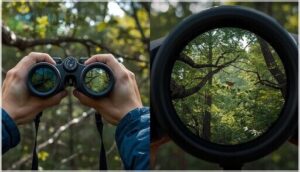
Your choice between 8x magnification and 10×42 bird watching binoculars hinges on magnification tradeoffs that shape your forest birding experience. While 10x magnification power reveals finer feather details at distance, 8x binoculars for birding deliver enhanced image stability, wider field views for bird tracking through dense branches, and brighter images in shaded canopy—making them the go-to choice for most forest environments where optical quality meets practical handling.
For an in-depth explanation of, consider how light transmission and objective size affect your selection.
Objective Lens Diameter

Once you’ve settled on magnification, the objective lens diameter determines how much light your birding binoculars gather in the dim forest understory. The 42mm objective lenses found in most forest-optimized optical equipment strike a winning balance between image brightness and portability, collecting enough photons for clear views without turning your binoculars for birdwatching into shoulder-aching anchors. For further details on how objective lens diameter impacts performance, see this clear overview of Fieldscope size and weight factors.
Why diameter effects matter for your forest adventures:
- Light transmission jumps dramatically as you move from 32mm to 42mm, revealing cryptic warblers lurking in shadowed branches
- Optical quality stays crisp at dawn and dusk when larger lenses feed more information to your eye
- Lens size impact on weight remains manageable at 42mm, unlike bulkier 50mm models that fatigue you on long trails
Wide Field of View
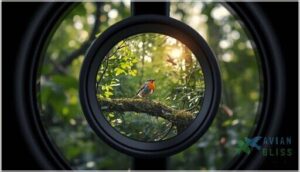
A generous field of view transforms forest viewing from constant reframing into fluid bird tracking. Look for binoculars offering 340 to 420 feet at 1,000 yards—this wide angle lets you scan dense canopies quickly while following songbirds through tangled branches. Six to seven degrees of apparent field keeps fast movers in sight, cutting eye fatigue during long sessions.
| FOV Range | Scanning Speed | Tracking Ease |
|---|---|---|
| 340–380 ft | Moderate | Good for perched birds |
| 380–410 ft | Fast | Excellent for active flocks |
| 410+ ft | Very Fast | Ideal for erratic flight |
Wide field optics for birdwatching deliver optical clarity edge-to-edge, so you won’t miss cryptic warblers lurking near the periphery.
Close Focus Capability
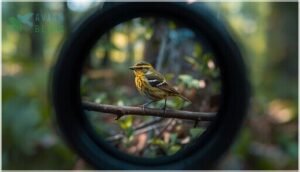
Close focus brings nearby perched birds into crystal clarity without forcing you to step back. The best birding binoculars lock onto subjects at 2 to 5 meters, letting you admire intricate plumage details on warblers hugging low branches. Internal focusing mechanisms maintain balance while you dial in that diopter adjustment for sharp edge-to-edge viewing.
Follow these field tips:
- Steady your stance to keep tiny subjects centered
- Fine-tune focus slowly to avoid losing fast movers
- Clean lenses regularly for crisp close-range detail
- Practice mid-to-near transitions for smooth observation
Optical design featuring BaK-4 prisms and multi-coated elements ensures bright, clear images even at close quarters, so you’ll catch every feather pattern.
Weatherproof and Fog-proof Design
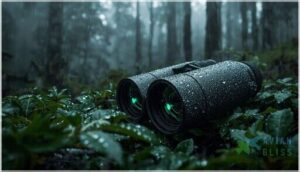
Through rain-soaked canopies and sudden temperature swings, waterproof binoculars sealed with NBR o-rings keep moisture out while nitrogen purging prevents internal fogging. You’ll face rapid sun-to-shade transitions in dense forests, so thermal compensation and active anti-fog coatings maintain clarity when humidity spikes. IP-rated seal integrity ensures weather resistance across 10,000 cycles, protecting your investment.
| Feature | Technology | Birding Benefit |
|---|---|---|
| Fog proofing | Nitrogen purge, desiccant packs | Clear optics during temperature shifts |
| Moisture control | Double-seal design, silicone plugs | Prevents condensation in humid forests |
| Water resistance | IPX4+ seals, hydrophobic coatings | Functions in rain without damage |
| Thermal compensation | Optical air cushions, liquid housing | Stable performance -10°C to 40°C |
| Seal integrity | FKM compounds, micro-gap damping | Long-term reliability in wet conditions |
Choosing The Right Magnification
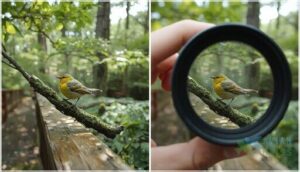
Magnification isn’t just a number on the box—it’s the difference between tracking a warbler through tangled branches and losing it in a blurry shake.
Magnification determines whether you’ll track that warbler through the branches or lose it in a blur of hand shake
In dense forests, you’ll face unique challenges that make choosing between 8x and 10x power more critical than most birders realize.
Let’s break down how each magnification performs in the field and what trade-offs you’re actually making.
Benefits of 8x for Dense Forests
When you’re moving through tangled understory and dense canopies, 8x magnification becomes your secret weapon for forest birding. These best binoculars for birding deliver steadier viewing with less hand shake, preserve depth perception through foliage, and maintain contrast preservation even in dappled shade.
The habitat versatility of 8x birdwatching optics means reduced fatigue during long treks, while their wide field helps you track elusive species through cluttered branches.
When to Consider 10x Power
When mid-canopy warblers or high-perch hawks demand feather detail at distance, 10×42 birding binoculars deliver extra reach that 8x models can’t match. Consider high-powered binoculars for birding when:
- Distance considerations favor 30+ yard targets where magnification limits of 8x leave you squinting at field marks
- Bird size factors include smaller species requiring fine detail resolution in forest lighting
- Power versus stability can be managed with tripod adapters or solid bracing techniques during observation
Trade-offs Between Magnification and Stability
Higher magnification pulls distant warblers closer, but every hand tremor multiplies at 10x, turning steady branches into shaky blurs during handheld use. Image stabilization helps birding binoculars tame shake, though it adds weight—most birders find 8x strikes the sweet spot for birdwatching without constant wobble.
You’ll face optical tradeoffs: magnification limits brightness while stability factors demand deliberate breathing or tripod support in forest viewing.
Importance of Field of View in Forests
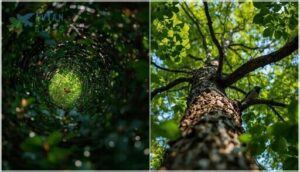
Field of view can make or break your birding experience in dense forests, where birds appear suddenly and vanish just as fast. A wider field of view lets you track movement through tangled branches and scan more canopy at once, giving you precious extra seconds to identify that elusive warbler.
Let’s break down why this spec matters so much and how to read those measurements on the box.
Tracking Fast-Moving Birds
When you’re tracking fast-moving birds through tangled branches, a wide field of view becomes your secret weapon for keeping warblers and thrushes in sight. Binoculars with 340 to 420 feet of view at 1,000 yards let you follow rapid wingbeat analysis and unpredictable bird flight patterns without constantly repositioning.
Optical stabilization helps, but nothing beats that generous viewing window for wildlife viewing when birds dart between forest layers during avian migration.
Scanning Dense Canopies
Dense canopies block up to 70 percent of sunlight, creating shadowed gaps that make canopy mapping a puzzle for forest birding enthusiasts.
Your birding binoculars need a wide field of view—340 feet or more at 1,000 yards—to reveal hidden perches through those tangled layers.
Scan techniques that sweep slowly across crown heights help with bird tracking, especially when waterproof binoculars cut through the forest dynamics of shifting light and leaf clutter.
Field of View Measurements Explained
Field of view gets listed two ways on binoculars: angular measurements in degrees—usually 7 to 8 for birdwatching optics—or linear calculations like 340 feet at 1,000 yards.
FoV geometry ties magnification and sensor size together, so an 8x model beats a 10x in width.
Optical distortion near edges can bend tree lines, but quality glass keeps birds sharp across your entire view.
Optics Quality and Light Transmission
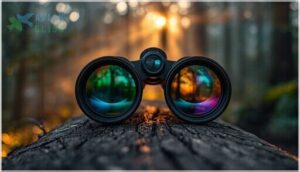
When you’re tracking warblers through shadowy understory or scanning canopy edges at dawn, the optical quality of your binoculars makes the difference between a clear ID and a frustrating guess. The best forest birding optics deliver bright, sharp images even when light is scarce, thanks to sophisticated lens coatings and premium prism materials.
Here’s what separates superior glass from mediocre optics in low-light woodland conditions.
Fully Multi-Coated Lenses
You’ll notice that fully multi-coated lenses make a dramatic difference in how your binoculars handle forest light. These coatings cover every air-to-glass surface, boosting light transmission to around 90-95 percent, so you’re seeing brighter, more natural images even under dense canopy. Here’s what that means for your birding:
- Better contrast – flare drops, so birds pop against busy backgrounds
- True color fidelity – greens and earth tones stay accurate from canopy to forest floor
- Sharper details – reduced internal reflections reveal fine feather patterns at distance
Models like the Nikon Monarch M7, Celestron Nature DX, and Vortex Optics lines use FMC optics to deliver image enhancement that holds up in dim dawn light, and the coating durability means fewer smudges during your most critical observations.
BaK-4 Prisms for Clarity
BaK-4 prisms take optical quality beyond coating alone by transmitting more light through each reflection. You’ll spot subtle plumage detail and color accuracy that BK-7 glass simply can’t match, especially in low-light brightness situations common to forest birding. This higher refractive index sharpens your image clarity from center to edge, making birdwatching binoculars noticeably brighter when dawn canopy filters most available light.
| BaK-4 Advantage | Forest Birding Benefit |
|---|---|
| Higher light transmission | Brighter views in dim canopy |
| Reduced internal loss | Sharper fine feather features |
| Better edge definition | Clear wing patterns at distance |
| Stronger color contrast | Natural greens and plumage tones |
Edge-to-Edge Brightness in Low Light
Prism geometry and coating impact work together to keep optical quality uniform across your entire view. When vignetting reduction is handled well, you’ll maintain low light uniformity that reveals perched warblers at the field’s edge just as sharply as center subjects.
Excellent light transmission in birdwatching binoculars designed for forest birding preserves detail from dawn through dusk without those frustrating dark corners.
Durability and Ergonomics for Outdoor Use
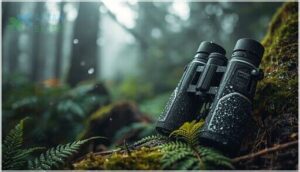
When you’re tracking warblers through dense understory or scanning canopy gaps in unpredictable weather, your binoculars need to handle whatever the forest throws at them. Beyond optical performance, the physical construction and design determine whether your gear survives years of field use while staying comfortable during long observation sessions.
Let’s examine the build characteristics that separate reliable forest companions from gear that won’t last a season.
Waterproof and Fog-Proof Construction
When rain hits mid-hike or dew blankets the forest at dawn, your binoculars need to hold up without fogging or leaking. That’s where seal technology and nitrogen purging save the day, turning standard optics into reliable outdoor gear.
Here’s what makes waterproof and fogproof birdwatching binoculars essential for forest conditions:
- O-ring seals around lenses and eyepieces block water from entering during downpours or brief immersion
- Nitrogen purging displaces internal moisture, preventing condensation when you move between warm and cold zones
- Tested waterproof materials guarantee your investment survives sudden weather shifts and humid canopy environments
- Internal desiccants absorb residual moisture, maintaining clear views even after rapid temperature changes
- Airtight barriers keep fog at bay from -5 to -20 degrees Celsius, so you won’t miss that elusive warbler
Moisture control isn’t just a bonus—it’s your ticket to uninterrupted observation when conditions get messy.
Shock Resistance and Build Quality
You’ll bump binoculars against branches, drop them on rocks, and jostle them through brush—shock resistance separates reliable gear from cracked optics.
Magnesium alloy bodies in models like the Nikon Monarch M7 and Vortex Optics absorb impacts up to 5 g, while internal shock mounts protect prisms from misalignment.
Rubberized armor cushions blows, reinforced collars prevent denting, and rigorous impact testing confirms your binoculars survive two-meter drops without losing focus.
Comfortable Grip and Lightweight Design
Your hands deserve gear that won’t quit after an hour of scanning canopies—ergonomic grips with contoured profiles reduce fatigue when you’re tracking warblers through dense understory.
Lightweight materials like magnesium alloy in the Nikon Monarch M7 and Vortex Optics models shave critical ounces, while grip texture and balanced design keep binoculars steady even with sweaty palms during humid forest sessions.
Essential Binocular Accessories for Birders
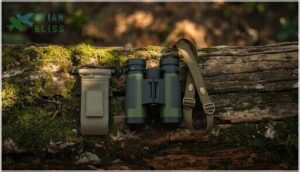
You’ve invested in quality binoculars, but the right accessories can transform your field experience from frustrating to seamless. The difference between a tangled strap and a well-supported support often determines whether you’ll spot that elusive warbler or miss it entirely.
Here are three essential accessories that’ll keep your optics protected, accessible, and performing at their best when you’re deep in the forest.
Binocular Harnesses and Straps
During long forest sessions, your neck and shoulders take a beating without proper support—that’s where a good chest rig transforms your birding experience. Chest designs with padded straps distribute weight across your shoulders and sternum, keeping your binoculars stable and accessible through dense undergrowth.
- Chest rig materials like neoprene or breathable mesh reduce chafing and vent heat during extended hikes
- Quick releases with Uni Loop or magnetic closures enable one-handed operation when you spot movement
- Strap adjustments with elastic cores absorb bounce while scrambling over logs and roots
- Ergonomic fits position binos high on your chest for rapid viewing without fumbling through layers
Lens Cleaning Kits and Cases
Fingerprints and forest mist will fog your optics faster than you’d expect. A proper cleaning kit with 15 to 30 milliliters of alcohol-free solution, a lint-free microfiber cloth (6 to 8 inches square), and a soft-bristle brush protects your fully multi-coated lenses from scratches.
Keep everything in a water-resistant case with compartments—blowers, wipes, and solution stay organized and accessible when condensation strikes mid-hike.
Smartphone and Tripod Adapters
Capturing the moment a cerulean warbler flicks through the canopy demands stability your hands can’t provide. Phone mounts with 1/4-inch thread compatibility lock your device to any standard tripod, while 360-degree rotation and 180-degree tilt let you frame quick shots without fumbling.
Choose aluminum adapters—they’ll survive forest humidity better than plastic, and cold shoe mounts give you room for extra accessories during extended birding sessions.
Maintenance Tips for Bird Watching Binoculars

Your binoculars are a serious investment in your birding adventures, and keeping them in peak condition doesn’t require a PhD in optics. A few simple habits will protect those precision lenses and keep you spotting warblers for years to come.
Let’s break down the essential maintenance practices every forest birder should know.
Proper Cleaning Techniques
Your binoculars deserve care that matches the wilderness you explore. Start by removing loose dust with a blower bulb, then apply optics cleaner to a microfiber cloth—never directly on the lens. Wipe in gentle circles from center outward, protecting those anti-reflective coatings.
Here’s your maintenance schedule for optical equipment:
- Clean after every field session in dusty or wet conditions
- Use only lens-safe solutions approved for multi-coated optics
- Wipe both lenses and body weekly during heavy birdwatching use
- Dry thoroughly to prevent mineral spots on coatings
- Keep a dedicated cleaning kit in your case for quick field fixes
Safe Storage Practices
Where you keep your birding binoculars between adventures matters just as much as cleaning them. Store them in a padded case on a sturdy shelf, away from sunlight and heat sources that degrade materials.
Humidity control through silica gel packets prevents internal fogging, while sealed cases provide lens protection from dust. Maintain temperature between 50-70°F and keep birdwatching equipment in locked, secure storage—especially when traveling to remote birding locations.
Regular Inspection and Care
Once you’ve got storage sorted, build a monthly inspection routine so your birdwatching gear stays field-ready. Check focus mechanisms for smooth operation, examine o-ring seals for waterproof integrity, and test diopter adjustment stability after each outing.
- Optical Cleaning: Inspect lenses for halos or color fringing indicating misalignment
- Strap Adjustment: Verify belt remains snug without excessive wear
- Fog Prevention: Expose binoculars to humidity briefly, watching for internal condensation
- Case Storage: Examine protective case for cracks or moisture damage
Budget Considerations for Birding Binoculars
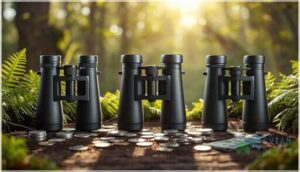
You don’t need to drain your savings to find solid binoculars for forest birding, but understanding where your money goes helps you make smarter choices.
The good news is that quality optics exist at nearly every price point, from budget-friendly models that won’t let you down to premium glass that transforms every outing.
Let’s break down what you can expect in three key price ranges so you can find the sweet spot for your needs and wallet.
Binoculars Under $300
You don’t need to empty your wallet to grab solid birding binoculars that perform in forests. Budget options under $300 like the Nikon Monarch 5 8×42, Vortex Diamondback HD 10×42, and Athlon Midas 8×42 deliver impressive optical quality with fully multi-coated lenses and BaK-4 prisms.
User reviews consistently praise these compact designs for their bright images and rugged waterproof construction during birdwatching adventures.
Mid-Range Options ($300-$700)
Step up to the $300-$700 range, and you’ll access forest viewing performance that hits the sweet spot between value and capability. Mid range features like phase-coated BaK-4 prisms, 8x or 10x magnification with 42-50 mm objectives, and fully waterproof housings appear across models from Vortex Optics, Celestron Nature DX, and Zeiss Conquest.
- Field of view generally spans 340 to 430 feet at 1000 yards for tracking birds through dense canopy
- Close focus reaches 6 to 9 feet, letting you observe perched warblers without stepping closer
- Eye relief around 15 to 18 millimeters accommodates glasses wearers comfortably
- Multiple anti-reflective lens coatings boost light transmission in dim understory conditions
- Ergonomic housings reduce hand fatigue during extended forest sessions
Premium Choices ($700 and Up)
When you invest $700 or more, high-end optics from Swarovski Optics, ZEISS Conquest HD, and Leica Trinovid deliver 90 to 95 percent light transmission, edge-to-edge sharpness across 6.5 to 7.5 degrees, and premium materials like magnesium alloy bodies.
Sophisticated features—phase correction coatings, nitrogen purging, and generous warranties—guarantee enhanced durability and long-distance viewing performance in demanding forest environments.
Frequently Asked Questions (FAQs)
What strength of binoculars is best for bird watching?
Magnification power between 8x and 10x delivers the sweet spot for birding, balancing optical clarity with image stability.
Eight-power binoculars shine in dense habitats, offering excellent viewing comfort and bird visibility without hand shake.
What magnification is best for birdwatching?
For most birding situations, 8x offers the best balance between image detail and field of view, while 10x helps resolve finer plumage when birds pause at viewing distance.
Are 10×32 binoculars good for bird watching?
Think of them as a precision tool—10×32 binoculars excel for detailed plumage checks at distance but narrow your field of view, making fast-tracking harder in dense canopies where 8x models shine.
What are the best binoculars for safari and bird watching?
Safari and wildlife viewing demand 8×42 or 10×42 binoculars with wide fields of view, exceptional optical quality, and rugged weatherproofing—essential outdoor adventures gear for tracking distant birds across open plains and dense bush.
How do forest canopy conditions affect binocular performance?
Dense canopy creates low light and uneven illumination, demanding fully multi-coated lenses for brightness.
Optical scattering from cluttered branches reduces edge clarity, requiring premium coatings to maintain sharp images during nature observation.
What binocular settings work best for dawn birding?
At dawn, 8x magnification steadies your view in low light optics while fully multi-coated lenses and BaK-4 prisms enhance brightness.
Adjust your diopter beforehand, then use gentle focus techniques to track birds emerging from roosts.
Can binoculars damage from tree branch impacts?
Yes, branch impacts can damage birding binoculars by bending housings, misaligning prisms, or cracking lenses.
Impact resistance and shock-resistant designs with rubber armor help protect optical components during forest collisions, maintaining waterproof and fogproof integrity.
How does humidity affect binocular lens clarity?
Ironically, the very moisture that sustains forest life threatens your view of it. High humidity fogs external lens surfaces during temperature shifts, while failed seals allow internal condensation, degrading optical clarity and light transmission permanently.
What weight causes fatigue during long forest hikes?
Carrying binoculars heavier than 30 ounces accelerates fatigue factors during extended hike duration, as pack weight beyond 10 percent body weight raises energy expenditure on rugged terrain difficulty—lightweight design under 25 ounces optimizes forest birding comfort.
How do I adjust diopter for eyeglasses?
Like threading a needle in dim light, balancing optics requires patience. Set the diopter at zero, close your left eye, then sharpen the right eyepiece while wearing your glasses—achieving prescription calibration ensures optical alignment.
Conclusion
Finding the right binoculars for bird watching in forest conditions is like choosing the right lens through which to see a hidden world—it determines whether you’re a frustrated observer or a privileged witness to forest secrets.
The canopy won’t brighten itself, and warblers won’t slow their frantic feeding routines. Your glass either rises to meet these challenges or leaves you squinting at silhouettes.
Invest in wide views, close focus, and excellent light gathering. The forest rewards those who come prepared.