This site is supported by our readers. We may earn a commission, at no cost to you, if you purchase through links.

Your apartment’s square footage doesn’t have to dictate whether you can share your home with a feathered companion—but it absolutely shapes which cage will keep your bird healthy, safe, and thriving without overwhelming your living room.
The reality is that apartment bird-keeping demands more strategic planning than suburban setups, since limited floor space, noise considerations, and daily maintenance all compress into tighter quarters. Choosing the wrong cage means constant mess spilling beyond containment trays, sleep-disrupting chirps that test neighborly patience, or—worse—a stressed bird confined in inadequate vertical space.
The right cage, however, maximizes height over width, incorporates debris-control features that respect your floors, and uses materials that balance durability with your bird’s specific behavioral needs. We’ve tested configurations that transform compact apartments into avian-friendly habitats without sacrificing your functionality or peace of mind.
Table Of Contents
Key Takeaways
- Vertical cage designs (24–36 inches tall) maximize bird welfare in apartments by prioritizing height over width, allowing natural movement patterns without consuming excessive floor space.
- Material selection directly impacts longevity and safety—stainless steel offers 15+ year durability with maximum corrosion resistance, while powder-coated options require vigilant inspection for chips that create ingestion hazards.
- Species compatibility determines apartment success more than cage size alone, with budgies, canaries, and finches adapting better to compact living than larger parrots due to lower noise output and smaller spatial requirements.
- Daily maintenance routines combining removable trays, protective floor mats, and strategic placement away from shared walls prevent both structural damage to your apartment and neighborly disputes while sustaining your bird’s health.
Key Factors When Choosing Apartment Bird Cages
Selecting the right bird cage for your apartment isn’t just about finding something that fits—you’re balancing your bird’s welfare with the practical realities of limited square footage, noise considerations, and daily maintenance routines.
Start by reviewing the key differences between cage styles to narrow down options that suit both your bird’s behavior and your apartment layout.
The following factors represent the non-negotiables you’ll need to address before committing to any specific enclosure, regardless of brand or price point. Understanding these foundational criteria ensures you won’t compromise your bird’s health or your living situation in the process.
Optimal Cage Sizes for Small Spaces
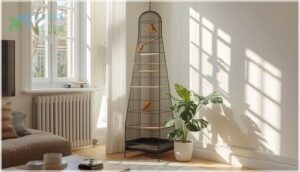
Compact Cage Designs optimized for small space living don’t sacrifice bird movement—vertical space (height over width) maximizes bird enclosures for apartment dwellers while preserving floor area. Cage depth of 18–24 inches (46–61 centimeters) allows natural hopping patterns without cramping wings.
Multi-level platforms and swinging perches help the best bird cages for parakeets make the most of vertical height without overwhelming tight quarters.
- Prioritize height-dominant dimensions for finches and canaries that fly vertically rather than horizontally
- Multi-level perch arrangements exploit vertical space efficiently in small bird cages
- Corner-placement models with triangular footprints recover unusable apartment square footage
- Narrow-profile bird cages (under 20 inches wide) fit between furniture without blocking pathways
- Stackable modular bird enclosures accommodate multiple birds without doubling your spatial commitment
Safe and Durable Cage Materials
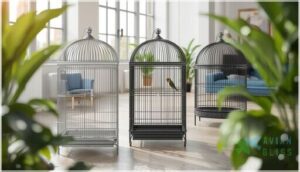
Stainless steel resists corrosion in humid environments, while powder-coated alternatives require chip-free surfaces to prevent ingestion hazards. Wrought iron delivers material strength for larger parrots, yet verify finishes exclude toxic metal coatings before purchase.
Homeowners combining shelter and water features should explore bird bath and house combinations using rust-resistant metals that match these durability standards.
| Material | Corrosion Resistance | Bird Safety Rating | Durability Lifespan |
|---|---|---|---|
| Stainless Steel | Excellent | Maximum | 15+ years |
| Powder-Coated Metal | Good | High (if unchipped) | 8–12 years |
| Wrought Iron | Moderate | Variable | 10–15 years |
| Lead/Zinc Coatings | Poor | Dangerous | Avoid entirely |
Essential Features for Apartment Living
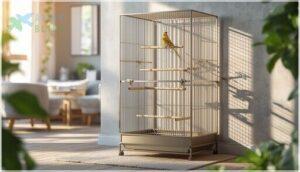
Multi-level designs with vertical height optimize Space Efficiency without expanding floor footprint—look for rectangular cages at least 24 to 36 inches tall that fit flush against walls.
Proper ventilation in multi-tier cages is essential to prevent respiratory issues like psittacosis in pet birds, especially in confined vertical spaces.
Secure latching mechanisms prevent escape incidents in apartments where hazards concentrate, while removable trays with surrounding floor pads contain debris for simplified maintenance.
Position cages away from heating vents and chemical fumes to protect Air Quality and Bird Safety in confined quarters.
Noise Reduction and Privacy Considerations

Acoustic Panels and vibration-dampening pads reduce transmitted cage noise by 20–30%, shielding apartment dwellers from clatter during feeding or play. Position your enclosure away from shared walls—preferably on area rugs—to lower sound transfer by 5–15 dB, and consider powder-coated finishes over bare metal to minimize squeaking. Nighttime covers paired with white-noise machines mask residual vocalizations without compromising Pet Bird Care.
- Soundproofing materials like dense liners and rubberized feet decrease floor-transmitted vibrations.
- Cage Placement in rooms with soft furnishings absorbs sound and protects neighbor privacy.
- Noise Masks and consistent sleep schedules prevent irregular vocalizations in Small Space Living Solutions.
Best Bird Species for Apartment Living

Not every bird thrives in apartment settings—some species adapt beautifully to compact quarters, while others demand space and sound tolerance you simply won’t have. Your success hinges on matching the right bird to your living situation, considering factors like noise levels, cage footprint, and daily care requirements.
Apartment bird success depends on matching species to your space, noise tolerance, and daily care capacity—not every bird adapts to compact living
Below, you’ll find four apartment-friendly species that balance personality with practicality, each with distinct space and maintenance needs you should evaluate before committing.
Budgerigars: Space and Care Needs
Budgies—those compact parakeets beloved by apartment dwellers—require cages at least 18 inches wide to accommodate their horizontal flight patterns, though larger enclosures (24⁄18⁄18 inches or 61⁄46⁄46 centimeters) better support their socialization needs and nesting habits.
Your budgie’s diet should include fortified pellets, fresh vegetables, and occasional millet treats, while daily out-of-cage time remains essential for small space living solutions and thorough pet bird care.
Watching for signs like lethargy, changes in droppings, or loss of appetite through early bird sickness diagnosis helps you catch health problems before they escalate.
Canaries: Quiet and Compact Options
Canaries prefer smaller, compact enclosures—usually 16×16×20 inches (41×41×51 centimeters)—making them ideal for tight quarters where bird cages must optimize vertical space without overwhelming your living area. These solitary singers thrive on visual appeal rather than interactive play, requiring minimal accessories compared to parakeets, lovebirds, or cockatiels.
Consider these essentials for your canary setup:
- Seed-based diet supplemented with leafy greens and occasional fruit
- Multiple perches positioned at varying heights to encourage movement
- Shallow water dishes for bathing and drinking
- Minimal cage accessories to preserve open flight paths
- Quiet temperament that respects apartment noise restrictions better than indoor aviaries
Finches: Sociable Apartment Companions
Finches thrive in paired groups—unlike solitary canaries—requiring vertically oriented cages measuring at least 24×18×18 inches (61×46×46 centimeters) with ample perches for social interaction and active flight patterns.
Their seed-based diet, supplemented with fresh greens, promotes vibrant plumage and energy levels essential for bird socialization within apartment bird keeping environments where space constraints demand thoughtful cage layout and careful bird cage selection.
Cockatiels and Parakeets: Suitability and Requirements
Cockatiels demand medium-sized cages measuring 24×24×36 inches (61×61×91 centimeters) minimum—larger than parakeets—with horizontal bars facilitating climbing behavior essential for cockatiel behavior and feather care through natural movement.
Both species benefit from cage enrichment, including varied perches, foraging toys, and daily out-of-cage interaction, making bird cage selection critical for apartment bird keeping success.
Pet bird housing must balance parakeet diet stations, bird socialization zones, and adequate flight space.
Top 5 Bird Cages for Apartments
You need a cage that fits your space without sacrificing your bird’s comfort—and that’s not always easy to find in a cramped apartment.
The options below balance compact footprints with solid construction, safe materials, and features that make daily care less of a hassle.
Each one’s built to handle the realities of apartment living while keeping your feathered friend healthy and engaged.
1. Vingli Large Bird Cage With Wheels
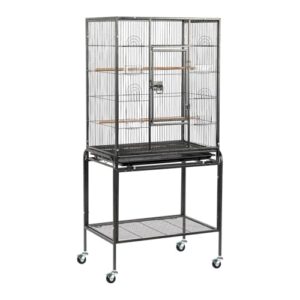
The Vingli Large Bird Cage With Wheels stands out as a flexible housing solution that combines wrought iron construction with mobility features, making it particularly well-suited for apartment dwellers. Measuring 25.4 x 16.5 x 53.9 inches overall, with cage dimensions of 24 x 16.3 x 28 inches, it offers ample space for birds.
Rotating wheels provide outstanding cage mobility while maintaining stability, allowing you to relocate your parakeets or cockatiels between sun-filled windows and quieter areas without disrupting their environment.
The 28.7-pound iron frame ensures pet safety and bird exercise through its ladder, wooden perch, and stainless steel feeders. These features create an interactive play area that aids physical and mental stimulation.
| Best For | Bird owners who need a spacious, mobile cage for small to medium birds like parakeets, cockatiels, or lovebirds and want the flexibility to move it around their home easily. |
|---|---|
| Material | Iron |
| Dimensions | 25.4 x 16.5 x 53.9 in |
| Cleaning System | Slide-out tray |
| Mobility | Rotating wheels |
| Target Birds | Small to medium birds |
| Bar Spacing | Not specified |
| Additional Features |
|
- Solid wrought iron construction with rotating wheels makes it easy to move between rooms while staying stable
- Interactive setup with ladder, wooden perch, and stainless steel feeders keeps birds active and entertained
- Slide-out trays and safety grille make daily cleaning quick and hassle-free
- Assembly instructions can be confusing and hard to follow
- Door may pop open unexpectedly and might need extra reinforcement for security
- Food tray doors don’t lock, which could be problematic for curious or clever birds
2. Prevue Parakeet Bird Cage
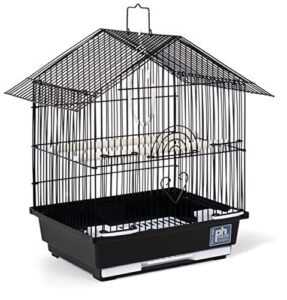
If you’re seeking compact housing that doesn’t sacrifice Bird Safety, the Prevue Pet Products Parakeet Manor delivers essential features for parakeets in tight quarters. Measuring 12″L x 9″W x 16″H with 3/8″ Bar Spacing, it’s designed for travel, quarantine, or temporary housing rather than permanent use.
Cage Assembly takes minutes, and the pull-out tray simplifies Cleaning Tips considerably. While Enrichment Options include two perches and cups, you’ll want a larger setup for long-term Pet Bird Care and Housing—this cage works best as your backup solution for vet visits or outdoor enrichment sessions.
| Best For | Bird owners who need a lightweight travel cage for vet appointments, outdoor time, or temporary quarantine of parakeets and canaries. |
|---|---|
| Material | Metal, Plastic |
| Dimensions | 12 x 9 x 16 in |
| Cleaning System | Pull-out tray |
| Mobility | Handle for carrying |
| Target Birds | Parakeets, canaries, small birds |
| Bar Spacing | 3/8 inch |
| Additional Features |
|
- Pull-out tray and simple assembly make cleaning and setup quick and hassle-free
- Compact 12″L x 9″W x 16″H design with carrying handle is perfect for transport and tight spaces
- Includes basic accessories like two perches and cups to get started right away
- Too small and flimsy for permanent housing or long-term use with any bird species
- Food and water doors can be difficult to open, making daily care frustrating
- Limited space means minimal room for enrichment toys or natural flight movement
3. BestPet Wrought Iron Bird Cage
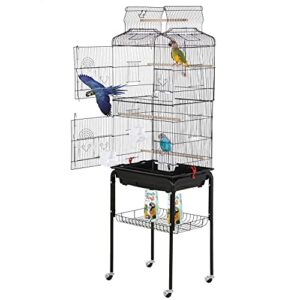
When you need Iron Durability without monopolizing floor space, the BestPet 64 inch Cage—measuring 16.9″L x 15.7″W x 64″H with 10mm bar spacing—houses 2-3 parakeets or cockatiels comfortably in vertical real estate.
Its Wrought Iron construction and powder-coated finish resist corrosion in humid apartment climates, while 360° swivel casters and detachable rolling stand simplify Cage Maintenance and repositioning during deep cleans.
Cage Assembly requires 30-60 minutes with standard tools, and the open-top design with lockable roof adds enrichment opportunities—though you’ll want to train your birds on Bird Safety protocols before granting rooftop privileges.
| Best For | Bird owners in apartments or smaller spaces who need a tall, narrow cage for 2-3 small to medium birds like parakeets or cockatiels and want easy mobility for cleaning. |
|---|---|
| Material | Wrought Iron |
| Dimensions | 16.9 x 15.7 x 64 in |
| Cleaning System | Slide-out tray |
| Mobility | 360° swivel casters |
| Target Birds | Canaries, lovebirds, cockatiels |
| Bar Spacing | 10 millimeters |
| Additional Features |
|
- Wrought iron build with powder coating holds up against rust in humid environments and lasts longer than basic steel cages
- Swivel casters and detachable stand let you roll the cage around for cleaning or rearranging without heavy lifting
- Open-top design with lockable roof gives your birds extra playtime space outside the main cage area
- 10mm bar spacing won’t work for larger parrots, and the compact footprint limits how many birds you can house
- Assembly takes 30-60 minutes and isn’t always straightforward based on customer feedback about instructions
- You’ll need to train birds carefully before using the open-top feature to prevent escape or injury risks
4. Yaheetech Large Parrot Bird Cage
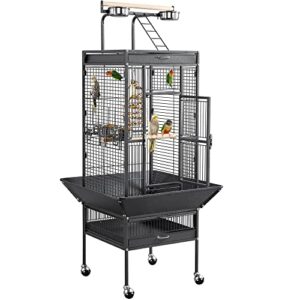
For medium to large parrots—conures, quakers, small cockatoos—this powder-coated steel fortress (40-50″L × 28-34″W × 72-80″H, 16-25mm bar spacing) balances Cage Durability with Bird Enrichment capacity. Multiple access doors, locking casters for repositioning, and pull-out trays simplify Cage Assembly and daily maintenance in tight quarters.
The rooftop play area encourages natural Parrot Behavior, while smooth welds and safe latching mechanisms uphold Pet Safety standards. Bird Cage Accessories like swings and foraging toys attach easily, supporting Indoor Avian Conservation principles without requiring outdoor space—Parrot Cages designed for apartment realities.
| Best For | Medium to large parrot owners in apartments who need a durable, easy-to-clean cage with good enrichment options and the flexibility to move it around without hassle. |
|---|---|
| Material | Wrought Iron |
| Dimensions | 26 x 26 x 61.5 in |
| Cleaning System | Slide-out tray |
| Mobility | 360° ball casters |
| Target Birds | Small to medium parrots |
| Bar Spacing | 15 millimeters |
| Additional Features |
|
- Powder-coated steel construction with smooth welds and safe latches protects your bird while standing up to years of daily use and regular cleaning
- Multiple access doors and pull-out trays make feeding and cleaning simple, even in tight spaces where you can’t walk around the entire cage
- Rooftop play area and plenty of attachment points let you add swings, toys, and perches so your parrot stays mentally stimulated
- Assembly instructions can be confusing and some users report side panels warping if you overtighten the screws during setup
- Limited interior space means you’ll need to be selective with toys and accessories, especially if you have a larger bird or multiple parrots
- Not built for extreme outdoor conditions, so you’ll need to keep it indoors or only use it outside during mild weather
5. Yaheetech Wrought Iron Bird Cage
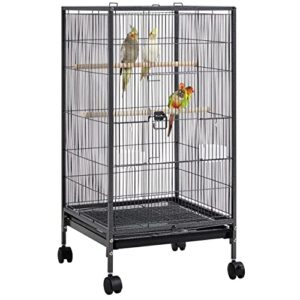
Compact living doesn’t demand sacrificing Cage Durability. This 18″L × 18″W × 40″H model (3/8″ bar spacing, $73.99) features solid Iron Construction with oxidant-resistant Metal Finishes, safeguarding budgies, canaries, finches through corrosion-proof powder coating.
Four 360-degree wheels enable smooth repositioning to improve sunlight exposure, while the removable water-resistant tray and metal grate simplify Pet bird care routines in tight quarters.
Wrought Details like rounded bar edges and secure latches uphold Bird Safety standards, making this steel cage a practical IndoorOutdoor Aviary alternative for small-species guardians.
| Best For | Bird owners with limited space who need a compact, durable cage for small birds like budgies, canaries, or finches and want easy cleaning plus mobility. |
|---|---|
| Material | Metal, Wood |
| Dimensions | 18 x 18 x 40 in |
| Cleaning System | Water-resistant tray |
| Mobility | Four 360° wheels |
| Target Birds | Budgies, canaries, cockatiels |
| Bar Spacing | 3/8 inch |
| Additional Features |
|
- Solid wrought iron construction with powder-coated, rust-resistant finish holds up well in humid environments
- Four rolling wheels make it simple to move the cage around for sunlight or cleaning without heavy lifting
- Removable tray and metal grate speed up daily maintenance, a real plus in small apartments
- Assembly can be tricky and time-consuming, especially if you’re putting it together alone
- Some users report misaligned bars or quality control issues that require adjustments
- Not ideal as a permanent flight cage for larger or more active birds—better suited as a temporary or nursery setup
Maintenance Tips for Apartment Bird Cages

Maintaining your bird’s cage in an apartment requires consistent routines that keep both your feathered companion healthy and your living space fresh. You’ll need to balance thorough cleaning with minimal disruption to your neighbors, while ensuring your bird receives adequate stimulation and proper hygiene care throughout the day.
The following maintenance strategies will help you create a sustainable care routine that works within the constraints of apartment living.
Cleaning Routines for Small Spaces
Daily Cleaning prevents odor buildup and maintains hygienic avian habitats in confined quarters. Wipe cage bars with a damp cloth to remove droppings, replace newspaper liners every 24 hours for odor control, and vacuum surrounding areas to manage dust.
Weekly cage sanitizing with mild soap ensures bird health and welfare, while monthly inspections of hardware prevent structural failures that compromise pet bird care standards in space-optimized environments.
Managing Bird Health and Hygiene
Vigilance protects your feathered companion from preventable illness—observe droppings for color shifts, monitor appetite fluctuations, and schedule annual veterinary examinations to maintain avian health and wellness.
Disease prevention requires species-appropriate nutrition management with fresh water daily, while respiratory care demands low-dust substrates and proper ventilation.
These pet care tips form the foundation of bird health and welfare, ensuring bird hygiene standards that support long-term avian enrichment and vitality in apartment environments.
Enrichment and Daily Stimulation
Cognitive vitality demands rotating perches, toys, and stimulation devices every 10–20 days to sustain mental stimulation and prevent behavioral stagnation in pet bird enclosures. Foraging activities—puzzle feeders concealing treats within bird aviaries or parrot habitats—promote avian enrichment through problem-solving sessions lasting 5–15 minutes.
Environmental enrichment, paired with bird socialization through brief handling routines, fosters bird health and wellness while reducing feather-plucking risk in apartment settings.
Nighttime Covering and Noise Control
Light-blocking cage covers made from breathable, opaque fabrics reduce ambient noise by 20–40 decibels while maintaining airflow—critical for nighttime calming in shared apartments. You’ll want covers that extend 2–3 inches beyond your bird enclosure options to minimize light leaks and support natural circadian rhythms.
Sound absorption improves dramatically when positioning bird cages away from shared bedroom walls, enhancing both pet care routines and avian housing welfare.
Frequently Asked Questions (FAQs)
Can bird cages damage apartment flooring or carpets?
Yes, bird cages can damage flooring through scratches, indentations, and moisture from droppings. Use protective mats under cage feet and clean spills immediately to prevent staining or water damage on hardwood, laminate, or carpet.
How do I bird-proof my apartment windows?
Glass films and window decals spaced five centimeters apart break reflections that birds misread as open sky—your first defense against collision.
Secure window screens prevent escapes, while bird netting cushions any impact during free flight.
What temperature range is safe for apartment birds?
Your apartment bird thrives between 65–80°F (18–27°C). Sudden drops trigger respiratory stress, while persistent heat stress signals poor humidity control or inadequate airflow, both critical factors in urban bird keeping and long-term avian thermoregulation.
Are there lease restrictions on keeping birds?
Before you sign anything, know this: residential leases frequently classify birds under general pet clauses—meaning “no pets” policies usually exclude your feathered companion unless caged animals receive explicit exemption in housing policies.
How do I handle bird molting in apartments?
During feather renewal, you’ll notice increased dust—run a HEPA filter near your Bird Cage, mist gently for Feather Care, and watch for abnormal Molting Signs requiring veterinary assessment.
Boost protein-rich Bird Nutrition to support your bird during this time.
Conclusion
The notion that apartments can’t accommodate birds unravels once you prioritize vertical engineering over floor sprawl—bird cages for apartments succeed when height, material durability, and debris containment align with your spatial realities.
Your choice ultimately determines whether your companion thrives or merely survives within urban constraints. Select cages that respect both avian behavioral needs and your lifestyle boundaries, transforming square footage limitations into intentional, well-designed habitats that honor the relationship you’re committing to cultivate.
- https://www.fearfreehappyhomes.com/setup-bird-cage/
- https://www.forthebirdsdvm.com/blogs/news/1586482-whats-that-cage-made-of
- https://petsafecandles.com/improving-indoor-air-quality-when-you-live-with-birds/
- https://news.maryland.gov/dnr/2018/05/01/habichat-bird-safe-windows/
- https://learn.eartheasy.com/articles/9-ways-to-help-birds-avoid-window-collisions/