This site is supported by our readers. We may earn a commission, at no cost to you, if you purchase through links.

Your first blurry photo of a cardinal through a window changes everything. Suddenly you’re scanning trees with intensity, noticing wing patterns you’d overlooked for years, craving sharper images of those fleeting moments. Bird photography breaks open a world that’s been hiding in plain sight—but the gear overwhelm hits fast.
Zoom ranges, autofocus systems, burst modes, and sensor specs create a confusing maze for beginners who just want to capture a decent shot of the woodpecker visiting their backyard. The right camera puts distance between you and frustration, letting you focus on the birds instead of fighting your equipment.
These ten cameras balance reach, speed, and beginner-friendly controls without demanding a professional’s budget or expertise.
Table Of Contents
- Key Takeaways
- Best Bird Cameras for Beginners in 2026
- 1. Minolta Pro Shot Digital Camera
- 2. Minolta Digital Camera With Optical Zoom
- 3. FLATIC Digital Camera with WiFi
- 4. Digital Camera With Optical Zoom
- 5. Monitech Digital Camera for Photography
- 6. 8K Digital Camera with WiFi and Touchscreen
- 7. IGXHAVIZ 8K Digital Camera
- 8. 4K Digital Camera for Photography
- 9. Yatao Digital Camera for Photography
- 10. VJIANGER 4K Digital Camera
- Essential Camera Features for Bird Photography
- Choosing The Right Camera Type
- Key Lens Specifications for Beginners
- Tips for Capturing Stunning Bird Photos
- Accessories Every Beginner Should Consider
- Best Bird Cameras for Beginners in026
- 1. Minolta Pro Shot Digital Camera
- 2. Minolta Digital Camera With Optical Zoom
- 3. FLATIC Digital Camera with WiFi
- 4. Digital Camera With Optical Zoom
- 5. Monitech Digital Camera for Photography
- 6. 8K Digital Camera with WiFi and Touchscreen
- 7. IGXHAVIZ 8K Digital Camera
- 8. 4K Digital Camera for Photography
- 9. Yatao Digital Camera for Photography
- 10. VJIANGER 4K Digital Camera
- Frequently Asked Questions (FAQs)
- Conclusion
Key Takeaways
- Bridge superzoom cameras with 40x–67x optical zoom offer beginners the simplest entry into bird photography by eliminating lens decisions, though most models under $200 sacrifice autofocus speed and low-light performance that mirrorless systems handle better.
- Effective bird photography requires at least 400mm equivalent focal length, 10+ fps burst shooting, and phase-detection autofocus with subject tracking—features that separate sharp flight shots from blurry misses regardless of your camera’s megapixel count.
- Digital zoom degrades image quality significantly compared to optical zoom, making cameras with 16x–18x digital magnification unsuitable for distant or fast-moving birds despite their appealing price points and high-resolution specs.
- Sensor size directly impacts your reach through crop factors—APS-C multiplies focal length by 1.5x and Micro Four Thirds by 2x—allowing a 300mm lens to deliver 450mm or 600mm equivalent range without the weight of longer glass.
Best Bird Cameras for Beginners in 2026
You need a camera that can keep up with birds in motion without breaking the bank. The right gear makes the difference between blurry shots and images that capture every feather detail.
Here are ten cameras that give you the reach, speed, and features to start your bird photography journey.
1. Minolta Pro Shot Digital Camera
The Minolta Pro Shot digital camera offers a 67x optical zoom that pulls distant birds into sharp focus, making it accessible for beginners stepping into bird photography. Optical image stabilization steadies your shots when tracking fast-moving subjects.
The 20MP CMOS sensor delivers detailed images, while 27 intelligent scene modes adjust settings automatically. Wi-Fi connectivity lets you transfer photos wirelessly and control the camera remotely.
However, some users report quality control issues and short battery life, so consider these limitations before committing.
| Best For | Beginner bird photographers who want serious zoom reach without diving into interchangeable lens systems. |
|---|---|
| Resolution | 20MP |
| Video Quality | 1080p |
| Optical Zoom | 67x |
| WiFi Connectivity | Yes |
| Screen Type | 3-inch articulating LCD |
| Image Stabilization | Optical |
| Additional Features |
|
- 67x optical zoom brings distant birds incredibly close, paired with optical stabilization to reduce shake
- 27 intelligent scene modes automatically optimize settings so you can focus on the shot instead of technical details
- Wi-Fi connectivity makes it easy to share photos instantly or control the camera from your phone
- Quality control complaints from users suggest inconsistent manufacturing standards
- Battery drains quickly according to multiple reports, which could cut birding sessions short
- Low-light performance struggles, limiting your shooting to bright outdoor conditions
2. Minolta Digital Camera With Optical Zoom
If you’re hunting for a more affordable entry point, this Minolta model with 40x optical zoom strikes a solid balance. The fixed lens reaches distant bird subjects without the bulk of interchangeable systems, and image stabilization helps you steady shots when tracking movement.
You get 16MP resolution and a 3.0″ LCD for composing in the field. Camera settings remain straightforward for beginners—white balance presets and exposure compensation let you adapt to changing light.
Battery life holds up through several hours of wildlife photography, though autofocus speed trails the Pro Shot model noticeably.
| Best For | Beginners and casual photographers who want an affordable camera with strong zoom capabilities for wildlife, travel, and everyday shooting without the complexity of interchangeable lenses. |
|---|---|
| Resolution | 20MP |
| Video Quality | 1080p |
| Optical Zoom | 40x |
| WiFi Connectivity | Yes |
| Screen Type | 3.0-inch LCD |
| Image Stabilization | Digital |
| Additional Features |
|
- 40x optical zoom reaches distant subjects like birds and wildlife without needing extra lenses
- Lightweight at 1.8 pounds and compact design makes it easy to carry on hikes or trips
- Straightforward controls and automatic features like face detection make it beginner-friendly
- Autofocus can be slow, making it harder to capture fast-moving subjects like sports or active wildlife
- Low-light performance is limited compared to cameras with larger sensors
- Some users report Wi-Fi connectivity issues and occasional freezing
3. FLATIC Digital Camera with WiFi
WiFi connectivity can simplify your workflow if you shoot birds near home and post images immediately, but the FLATIC 5K 64MP trades reach for convenience.
Shooting in rain or fog means you’ll need weatherproofing strategies to protect your gear while chasing the perfect shot, so check out these tips for photographing birds in different weather conditions.
Its 18x optical zoom falls short of the telephoto range serious bird photography demands—you’ll struggle to frame warblers and raptors at typical viewing distances.
The 1/3-inch sensor and digital image stabilization produce acceptable vlogging footage, yet low-light performance and autofocus lag disappoint in dawn conditions when songbirds are most active.
For sharper bird footage at sunrise, pair those features with optimized camera settings for bird watching and consider a weatherproof housing for early-morning dew.
Consider this camera only if social sharing outweighs image quality.
| Best For | Beginner vloggers and social media creators who prioritize wireless sharing and compact design over serious bird photography performance. |
|---|---|
| Resolution | 64MP |
| Video Quality | 5K |
| Optical Zoom | 18x |
| WiFi Connectivity | Yes |
| Screen Type | 180° flip screen |
| Image Stabilization | Digital |
| Additional Features |
|
- WiFi connectivity lets you transfer photos to your phone instantly without cables or card readers
- 180° flip screen makes it easy to frame yourself for vlogs or check composition at awkward angles
- Comes with two rechargeable batteries and a 64GB card so you can shoot longer without interruptions
- 18x optical zoom can’t match the 50–120x reach you need to photograph distant birds effectively
- 1/3-inch sensor struggles in low light and produces grainy images compared to larger sensors
- Autofocus lags when tracking moving subjects, making it tough to capture birds in flight or rapid motion
4. Digital Camera With Optical Zoom
The GWAEPU W3 mounts a 12x optical zoom onto a 72MP CMOS sensor, pushing your effective reach to roughly 288 mm equivalent—enough for backyard feeders but marginal for shy forest species. Optical image stabilization helps at full extension, yet reviews note the zoom turns grainy past 6x and the plasticky body won’t survive rough trail use.
You’ll appreciate the 180° flip screen for low-angle heron shots, but autofocus hunting and a harsh built-in flash limit your creative control in changing light.
A quality birdwatching camera with long zoom helps you compensate for these limitations by giving you the reach and flexibility to capture sharp images even when conditions aren’t ideal.
| Best For | Budget-conscious beginners who want optical zoom for travel snapshots, vlogging, and backyard wildlife without investing in a full camera system. |
|---|---|
| Resolution | 72MP |
| Video Quality | 4K |
| Optical Zoom | 12x |
| WiFi Connectivity | Yes |
| Screen Type | 180° flip screen |
| Image Stabilization | Optical |
| Additional Features |
|
- 12x optical zoom with image stabilization gives you real reach for wildlife and portraits without the blur you’d get on a phone
- 180° flip screen makes it easy to compose vlogs, selfies, and awkward-angle shots when you’re out shooting
- Multiple shooting modes and WiFi transfer keep things simple whether you’re filming time-lapses or just backing up vacation photos
- Image quality falls apart past 6x zoom—you’ll see grain and shake that make distant birds or landscapes look rough
- Plasticky build and finicky battery compartment won’t hold up to serious outdoor use or frequent handling
- Harsh flash and sluggish autofocus mean you’ll struggle in dim light or with fast-moving subjects
5. Monitech Digital Camera for Photography
You’re getting 64MP resolution and 4K–5K video on a 1/2-inch sensor, but that small chip struggles with fast autofocus—contrast-detect systems hunt when a sparrow darts across branches. JPEG-only output limits shadow recovery when a cardinal hides under tree cover, making this better suited for stationary backyard subjects than unpredictable flight.
The 16x digital zoom amplifies noise rather than optical glass, so image stabilization can’t rescue detail past moderate distances.
WiFi transfer is smooth for sharing quick shots, yet bird tracking fails without phase-detect sensors.
For distant subjects, consider pairing your camera with quality wildlife viewing optics to maximize reach without sacrificing image clarity.
| Best For | Beginners documenting backyard birds at feeders or perches who want affordable 4K video and easy smartphone sharing but don’t need professional-level tracking or manual control. |
|---|---|
| Resolution | 64MP |
| Video Quality | 5K |
| Optical Zoom | 16x |
| WiFi Connectivity | Yes |
| Screen Type | 3-inch flip screen |
| Image Stabilization | Digital |
| Additional Features |
|
- 64MP stills and 4K–5K video give you plenty of detail for casual bird photography when subjects stay put
- WiFi connectivity makes it simple to transfer images straight to your phone for quick sharing
- Lightweight body (around 300–500g) won’t wear you out during longer backyard birding sessions
- Contrast-detect autofocus hunts and misses fast-moving birds, making flight shots frustrating
- 16x digital zoom degrades image quality significantly compared to true optical zoom
- JPEG-only format leaves little room to fix exposure issues when birds move between sun and shade
6. 8K Digital Camera with WiFi and Touchscreen
An 88MP interpolated sensor sounds impressive, but the tiny 1/3-inch chip and 16x digital zoom can’t match optical glass when you’re tracking warblers through oak canopy. Sensor quality matters more than resolution numbers.
WiFi connectivity lets you fire the touchscreen interface remotely, yet contrast autofocus struggles with erratic bird movement—camera stabilization only masks the problem. Image quality suffers once you crop, and camera settings won’t fix physics.
At 15fps for 8K video, you’ll miss wing beats. This beginner camera works for backyard feeders, not nervous thrushes.
| Best For | Beginners who want an affordable all-in-one vlogging kit for social media content and backyard subjects, not serious bird photography. |
|---|---|
| Resolution | 88MP |
| Video Quality | 8K |
| Optical Zoom | 16x |
| WiFi Connectivity | Yes |
| Screen Type | HD touchscreen |
| Image Stabilization | Digital |
| Additional Features |
|
- Includes useful extras like external mic, remote, LED light, and spare battery right in the box
- Rotating touchscreen and WiFi connectivity make it easy to shoot selfie-style vlogs and transfer clips to your phone
- Simple automatic modes and webcam function help newcomers get started without technical knowledge
- 16x digital zoom and tiny sensor deliver poor image quality on distant or fast-moving birds compared to optical telephoto lenses
- Slow 15fps 8K video and weak autofocus can’t keep up with erratic bird movement or capture sharp wing details
- Lacks weather sealing, fast burst shooting, and low-light performance needed for real outdoor birding conditions
7. IGXHAVIZ 8K Digital Camera
The IGXHAVIZ 8K digital camera delivers 88MP stills and dual-lens flexibility for $130, yet image stabilization can’t overcome its 16x digital zoom limitation. You’ll find the touchscreen user-friendly for beginner camera operation, and WiFi transfer speeds uploads to social platforms. User reviews praise the 4.7-star rating and included 64GB card.
However, bird photography demands optical reach this model lacks—autofocus struggles with rapid movement, and video quality degrades past 1080p. Camera comparison shows bridge superzooms outperform it for distant subjects. Backyard feeders only.
| Best For | Beginners and casual content creators who want an affordable entry into high-resolution photography and vlogging without needing professional-grade equipment. |
|---|---|
| Resolution | 88MP |
| Video Quality | 8K |
| Optical Zoom | 16x |
| WiFi Connectivity | Yes |
| Screen Type | Touch screen |
| Image Stabilization | Optical |
| Additional Features |
|
- Shoots 8K video and 88MP photos at a budget-friendly $130 price point, making ultra-high-resolution content accessible to newcomers.
- WiFi connectivity enables quick wireless transfers to your phone or computer, perfect for posting content on the go.
- Comes with everything you need to start shooting—64GB card, two batteries, carrying case, and protective accessories included in the box.
- Digital zoom degrades image quality significantly, especially beyond 1080p video, making it poor for distant subjects like wildlife.
- Autofocus struggles with fast-moving subjects, limiting its usefulness for action shots or bird photography.
- Battery drains quickly during use, and some users report choppy video or fuzzy images that require manual adjustments.
8. 4K Digital Camera for Photography
This 4K digital camera offers 64MP resolution and autofocus targeting for $90. You’ll appreciate the 180° flip screen for low-angle shots and WiFi connectivity for quick image transfers to your phone. Camera settings include time-lapse and slow-motion modes for creative outdoor shooting.
However, bird photography demands more reach than its 16x digital zoom provides. Wildlife photography requires optical zoom—digital magnification degrades image quality beyond 4x. The CMOS sensor manages decent lighting well, but autofocus lags on fast-moving subjects. Photo editing can’t rescue soft details from digital zoom compression.
| Best For | Beginners and casual content creators who want an affordable camera for vlogging, travel photography, and social media without the complexity of professional gear. |
|---|---|
| Resolution | 64MP |
| Video Quality | 4K |
| Optical Zoom | 16x |
| WiFi Connectivity | Yes |
| Screen Type | 3-inch 180° flip screen |
| Image Stabilization | Digital |
| Additional Features |
|
- 64MP resolution and 4K video capture solid detail for social media and everyday photography
- 180° flip screen makes framing yourself easy for vlogs and selfies
- WiFi connectivity lets you transfer photos to your phone instantly for quick posting
- 16x digital zoom degrades image quality significantly—not suitable for wildlife or distant subjects
- Autofocus struggles with fast-moving subjects like birds or sports
- Limited manual controls and lower performance in low-light situations compared to professional cameras
9. Yatao Digital Camera for Photography
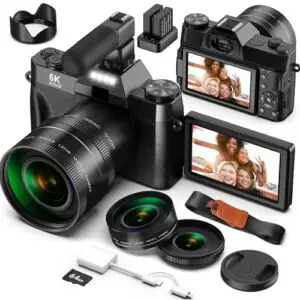
The Yatao digital camera delivers 64MP resolution with 18x optical zoom—enough reach for backyard bird photography without breaking the bank. Image stabilization keeps shots steady when you’re tracking movement, and the CMOS sensor manages morning light better than cheaper models.
You’ll find basic photography modes, including burst shooting for birds in flight. Camera durability suits outdoor shooting in mild conditions, though weather sealing remains limited.
For beginner photography, this photography equipment balances image quality against affordability, letting you learn bird tracking fundamentals before investing in pro-level gear.
| Best For | Beginner bird photographers who want decent zoom and resolution for backyard wildlife without spending a fortune on professional equipment. |
|---|---|
| Resolution | 64MP |
| Video Quality | 6K |
| Optical Zoom | 1x |
| WiFi Connectivity | Yes |
| Screen Type | 180° flip screen |
| Image Stabilization | Digital |
| Additional Features |
|
- 64MP sensor with 18x optical zoom gives you solid reach for capturing distant birds while maintaining sharp detail
- Image stabilization and CMOS sensor handle low-light morning shoots better than entry-level alternatives
- Affordable price point lets you learn bird photography basics before committing to expensive pro gear
- Limited weather sealing means you’ll need to be careful in wet or dusty conditions
- Manual controls are pretty basic, so advanced photographers will outgrow it quickly
- Some users report inconsistent image quality and battery drains fast when shooting in higher resolutions
10. VJIANGER 4K Digital Camera
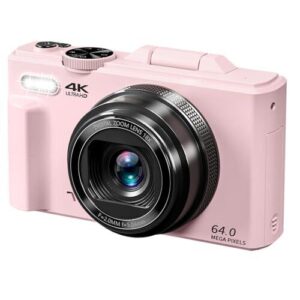
The VJIANGER 4K Digital Camera offers 64MP resolution and 18x digital zoom, catering to entry-level bird photography. You’ll capture 4K video at 30fps and utilize basic autofocus, though performance is slower compared to pricier options. Image stabilization relies on digital correction rather than optical systems. Camera settings prioritize auto modes for beginners, and WiFi connectivity simplifies file transfer.
In camera comparison tests, this model is ideal for backyard birding on a tight budget. However, serious bird photography requires better zoom and faster autofocus than digital cameras at this price point can deliver.
| Best For | Beginners and casual users looking for an affordable entry into 4K photography and vlogging, or anyone wanting a simple backup camera for travel and everyday moments. |
|---|---|
| Resolution | 64MP |
| Video Quality | 4K |
| Optical Zoom | 1x |
| WiFi Connectivity | Yes |
| Screen Type | Flip screen |
| Image Stabilization | Digital |
| Additional Features |
|
- 64MP resolution and 4K video at 30fps deliver solid image quality for the price point
- WiFi connectivity makes transferring photos and videos to your phone or computer quick and painless
- Compact, lightweight design with a flip screen is perfect for vlogging and self-portraits
- Digital zoom and stabilization fall short for serious bird photography or fast-moving subjects
- Autofocus can be sluggish and unreliable, especially in challenging lighting conditions
- Startup time is slower than expected, and some users find the camera overpriced for what it offers
Essential Camera Features for Bird Photography
Bird photography demands gear that can keep up with your subjects. The right camera features make the difference between a blurry miss and a keeper you’ll want to print.
Here’s what you need to look for when choosing your first bird photography camera.
Optical Zoom Range for Capturing Distant Birds
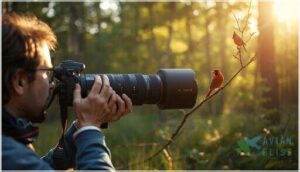
Optical zoom is your ticket to freedom when photographing wary birds that won’t let you get close. You’ll need at least 400 mm full-frame equivalent focal length to fill the frame with distant subjects without heavy cropping.
- Bridge cameras with 24–600 mm equivalent ranges balance reach and flexibility
- Ultra-telephoto models offering 2000–3000 mm equivalent capture extremely distant birds
- APS-C sensors apply a 1.5x crop factor, turning 300 mm lenses into 450 mm equivalent reach
- Image stabilization becomes critical at long focal lengths to counteract camera shake
Most beginners find 400–600 mm sufficient for backyard and moderate-distance birding. Understanding the bird photography basics is essential for capturing high-quality images.
Fast and Accurate Autofocus Systems
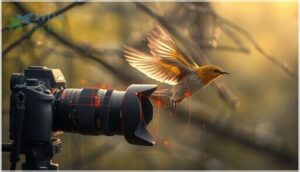
Long lenses mean nothing if your camera can’t lock onto a darting warbler. Modern autofocus systems rely on phase-detection and dual-pixel CMOS AF to track unpredictable birds through bursts. Fast autofocus speed, dense focus points, and subject detection modes keep your subject sharp when it zigzags through branches.
Modern autofocus systems with phase-detection and subject tracking make the difference between sharp birds and missed shots
Pair these tracking modes with burst shooting and image stabilization, and you’ll freeze motion that once seemed impossible to capture. This technology is similar to the methodological rigor used in scientific studies to guarantee accurate results.
High-Resolution Sensors for Detailed Shots
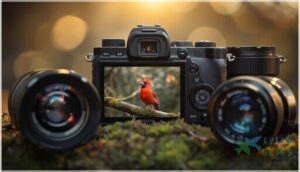
A 20-megapixel sensor or higher gives you freedom to crop aggressively without losing feather texture or eye detail. Higher pixel density captures finer nuances in plumage, while modern camera sensors balance resolution with low light performance.
APS-C and Micro Four Thirds bodies deliver sharp image quality that rivals FullFrame systems, especially when paired with quality glass and fast autofocus that locks detail frame after frame.
Burst Modes for Birds in Flight
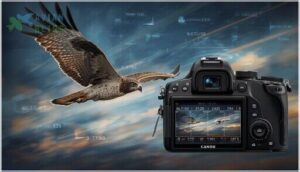
You can capture every detail in a single frame, but wings move fast—so you need a camera that fires off ten or more shots per second to freeze the moment mid-flight. Look for burst rates around 10–20 fps paired with fast shutter speeds above 1/2000.
Sophisticated autofocus speed and bird tracking modes lock onto erratic movement, while deep burst capacity ensures your buffer won’t choke when a hawk dives through your telephoto lenses.
Weather Sealing and Durability
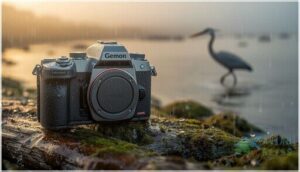
Camera housing built for fieldwork withstands rain and dust when you’re tracking warblers at dawn or herons in coastal spray. Most outdoor photography gear meets IP54 standards or higher for practical moisture protection.
- Seal materials: Gasket-based doors and rubberized grips block water ingress
- Durability tests: Drop resistance from bench height protects internal components
- Weather resistance: Anodized aluminum bodies resist corrosion in humid conditions
- Camera equipment maintenance: Inspect seals regularly; store with desiccants between shoots
Weather sealing lets you focus on the shot, not the forecast.
Choosing The Right Camera Type
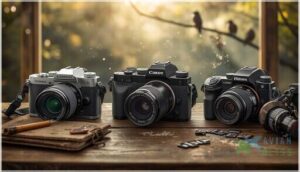
You don’t need to pick the most expensive camera to get started with bird photography. The right camera type depends on your budget, how much gear you want to carry, and what feels comfortable in your hands.
Let’s break down the main options so you can find what works best for your shooting style.
Bridge Superzoom Vs. Mirrorless Vs. DSLR
Choosing between bridge superzoom cameras, mirrorless systems, and DSLRs shapes your entire birding experience. Bridge cameras like the Sony RX10 IV deliver built-in reach up to 600mm equivalent in compact packages around $1,700, eliminating lens decisions.
Mirrorless bodies such as the Canon EOS R10 offer exceptional image quality and bird-detection autofocus but require separate telephoto lenses.
DSLRs provide rugged handling with extensive lens compatibility, though they’re heavier than mirrorless alternatives.
Sensor Size: APS-C, Micro Four Thirds, Full-Frame
Sensor comparison reveals how crop factors shape your reach and image quality. APS-C sensors multiply focal length by 1.5–1.6x, turning a 300mm lens into a 450mm equivalent reach—ideal for distant subjects.
Micro Four Thirds doubles magnification to a 600mm equivalent with lighter glass.
Full-frame systems demand longer lenses but excel in noise reduction and autofocus performance, though mirrorless APS-C bodies balance lens compatibility with practical field advantages.
Portability and Weight Considerations
Mirrorless bodies that weigh 340–600 g free your arms during extended handheld shooting, while bridge superzoom cameras around 691 g still beat the fatigue factor of heavier DSLRs. Your camera kit weight impacts every birding session—lighter setups let you roam longer without strain.
- Camera ergonomics: Entry-level mirrorless bodies reduce arm and shoulder fatigue during long handheld shooting sessions.
- Weight distribution: Camera backpacks with hip straps transfer load away from shoulders when carrying over 5 kg.
- Handheld shooting: Consumer telephoto lenses (400–650 g) keep total kit weight manageable for extended field use.
- Travel constraints: Airline cabin limits of 7–8 kg force strategic packing of camera lenses and accessories.
- Backpack systems: Sternum and hip straps improve comfort during walks to remote bird photography locations.
User Interface and Ease of Use
When you’re out in the field tracking fast-moving subjects, the last thing you need is to fight with your gear. Look for camera features that let you reach autofocus systems and burst controls in two taps—not six.
| Feature | Beginner-Friendly | Expert Setup |
|---|---|---|
| Menu Navigation | 2–3 levels deep | 4+ nested menus |
| Control Layout | Dedicated AF button | Multi-function dials |
| Help Resources | In-camera tutorials | External manuals only |
Clear interface customization and built-in user guides make mirrorless cameras easier to master during your first birding season. Physical dials beat touchscreen hunting when you’re tracking a heron in flight.
Key Lens Specifications for Beginners
Your lens matters just as much as your camera body when you’re photographing birds. The right focal length brings distant subjects close, while sharpness and aperture determine whether you’ll capture crisp feathers or blurry shapes.
Let’s break down what you need to know about telephoto reach, optical quality, system compatibility, and lenses that won’t empty your wallet.
Minimum Telephoto Focal Lengths for Birding
You need at least 400mm to frame most bird species without heavy cropping. A 300mm lens on APS-C sensors delivers roughly 450–480mm equivalent reach, while Micro Four Thirds systems double that effect. Recommendations vary by target:
- 200mm: Works for large, approachable birds like herons
- 300mm: Adequate with crop sensors or teleconverters
- 400mm: Practical minimum for small, distant subjects
- 600mm+: Ideal for filling frames with passerines
Importance of Lens Sharpness and Aperture
Lens quality is crucial in determining whether you capture intricate feather detail or end up with fuzzy blobs. A wider aperture, such as f/4 or f/5.6, can create pleasing background separation but may result in softened edges if the optical design is not up to par. Stopping down to f/8 generally improves overall sharpness, but this benefit diminishes as diffraction sets in at narrower apertures. While autofocus performance and telephoto lens comparisons are important, factors like lens coatings and chromatic aberration control play a significant role in distinguishing professional-level image clarity from mediocre results.
| Aperture Setting | Effect on Sharpness |
|---|---|
| f/4–f/5.6 (wide) | Shallow depth; potential edge softness |
| f/8 ideal | Peak sharpness across frame |
| f/11+ (narrow) | Diffraction reduces clarity |
| Lens coatings | Controls flare, boosts contrast |
| Chromatic correction | Eliminates color fringing on branches |
Compatibility With Camera Systems
Before you invest in telephoto glass, check whether your camera body accepts the lens mount you’re eyeing. Canon RF, Nikon Z, Sony E, and Micro Four Thirds each use proprietary systems, though camera adapters can bridge older lens mounts to newer mirrorless cameras.
Sensor compatibility dictates your effective focal length conversion—an APS-C sensor multiplies reach by approximately 1.5×, while optical stabilization and autofocus systems vary widely across manufacturers.
Always confirm lens selection matches your camera sensors and mount.
Budget-Friendly Lens Options
Once you’ve confirmed mount compatibility, affordable telephoto glass opens new creative territory. Third-party manufacturers deliver solid optical quality without flagship pricing:
- Sigma 150600mm Contemporary offers varied focal lengths and reliable autofocus
- Tamron 150600mm G2 balances budget optics with weather-resistant lens materials
- Used or refurbished camera lenses cut costs markedly
- Manual-focus fixed lenses sharpen your technique
- Camera adapters extend older glass to modern mirrorless bodies
Smart lens selection for bird photography prioritizes reach over luxury features.
Tips for Capturing Stunning Bird Photos

Having the right gear is only half the battle—knowing how to use it separates snapshots from keepers. The best bird photographers don’t just point and shoot; they understand their subjects, anticipate movement, and work with the light they’re given.
These four techniques will help you get sharp, compelling shots even when you’re just starting out.
Understanding Bird Behavior and Habitats
You can’t photograph what you can’t find. Understanding bird migration timing and habitat diversity transforms random walks into productive sessions.
Study feeding patterns—most songbirds forage at dawn and dusk—and identify nesting ecology to predict locations. Bird socialization matters too; mixed flocks increase your odds during wildlife photography outings.
| Behavior | Best Timing |
|---|---|
| Foraging activity | Dawn, late afternoon |
| Territorial displays | Breeding season peaks |
| Migration passage | Seasonal windows |
Master these patterns for better bird watching and nature photography results in any outdoor photography environment.
Mastering Autofocus and Burst Settings
Configure continuous AF (AF-C) and enable bird detection if your camera accommodates it—fast autofocus locks onto subjects before they vanish. Set burst mode to 10–20 fps and pair high buffer capacity with quick memory cards to sustain burst shooting without lag.
Use back-button focus to separate tracking from shutter release. Practice panning to eliminate motion blur while keeping your subject sharp and your background vibrant.
Working With Natural Lighting
You’ll capture your best shots when you work with the sun, not against it. Golden hour delivers soft lighting that reveals every feather detail without harsh shadows. Avoid midday glare—it flattens your subject and kills depth.
Seek shade photography or diffused light on overcast days for nature photography that shows true colors. Master backlight control by positioning birds at 45 degrees from your light source.
These wildlife photography techniques transform low-light performance into stunning images.
Practicing Composition and Framing
Position your bird along rule-of-thirds intersections to create visual balance in your frame. Leave space in front of its gaze—roughly twice as much as behind—to guide the viewer’s eye naturally.
These framing techniques and composition rules apply to both bird portraits and action shots. Try lower camera angles for eye-level perspectives that make wildlife photography feel intimate and immediate.
Accessories Every Beginner Should Consider
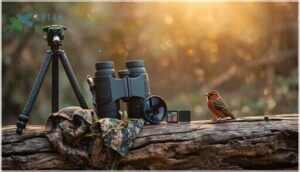
You’ve got your camera and lens sorted, but the right accessories can make or break your time in the field. The gear you bring along impacts everything from shot stability to how quickly you spot your subjects.
Here’s what you need to round out your bird photography kit.
Memory Card Size and Speed Recommendations
You’ll want at least 64 GB card capacity for RAW bursts, though 128 GB keeps you shooting longer without swapping. Write speed matters when birds take flight—look for U3 or V30 ratings (90 MB/s minimum) to handle burst mode and prevent buffer delays.
Use ExFAT file systems for cards over 32 GB, and always back up your data within 24 hours to protect those hard-won shots.
Tripods and Supports for Stability
A lightweight tabletop tripod or 60–80 cm adjustable model reduces shake when you’re framing perched birds with optical zoom and autofocus locked. Ball heads let you track unpredictable angles fast, while monopods add reach without the bulk.
Ground aids—bean bags, window mounts—stabilize heavier setups on uneven terrain.
Pair image stabilization with quick-release plates and burst mode to capture flight sequences without blur.
Binoculars for Spotting Birds
Before you frame distant subjects through a telephoto lens, 8×42 binoculars reveal sightings your camera can’t reach yet. Birders favor them for wide field views—around 7 to 8 degrees—and 15 mm eye relief accommodates eyeglasses.
Weather resistance shields optics in rain, while nitrogen-filled tubes prevent fog. Spend mornings spotting, then switch to your camera for closer wildlife photography once you’ve tracked behavior.
Protective Gear for Outdoor Use
Weather sealing protects your camera in drizzle, but rain covers and housings rated IP65+ stop downpours from flooding electronics. Lens shields block moisture on front elements, while padded holsters cushion impacts when you scramble over logs.
Gear durability matters—wildlife photography equipment takes abuse in mud and wind.
Low-light performance fades fast if condensation fogs your viewfinder, so pack rain ponchos and silica packets for every outdoor shoot.
Best Bird Cameras for Beginners in026
You don’t need to break the bank to start capturing birds in flight. The right camera balances zoom power, autofocus speed, and ease of use without overwhelming you with features you won’t touch for years.
Here are ten cameras that deliver solid performance for beginners ready to step into bird photography.
1. Minolta Pro Shot Digital Camera
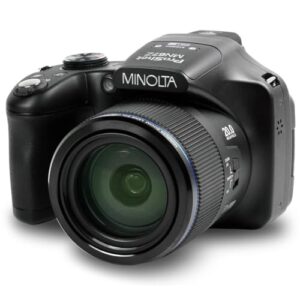
The Minolta Pro Shot digital camera offers a 67x optical zoom that pulls distant birds into sharp focus, making it accessible for beginners stepping into bird photography. Optical image stabilization steadies your shots when tracking fast-moving subjects.
The 20MP CMOS sensor delivers detailed images, while 27 intelligent scene modes adjust settings automatically. Wi-Fi connectivity lets you transfer photos wirelessly and control the camera remotely.
However, some users report quality control issues and short battery life, so consider these limitations before committing.
Best For: Beginner bird photographers who want serious zoom reach without diving into interchangeable lens systems.
Pros:
- 67x optical zoom brings distant birds incredibly close, paired with optical stabilization to reduce shake
- 27 intelligent scene modes automatically optimize settings so you can focus on the shot instead of technical details
- Wi-Fi connectivity makes it easy to share photos instantly or control the camera from your phone
Cons:
- Quality control complaints from users suggest inconsistent manufacturing standards
- Battery drains quickly according to multiple reports, which could cut birding sessions short
- Low-light performance struggles, limiting your shooting to bright outdoor conditions
2. Minolta Digital Camera With Optical Zoom
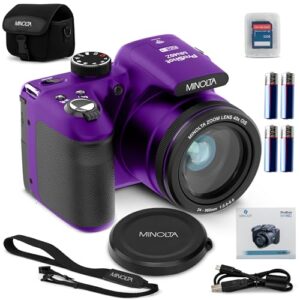
If you’re hunting for a more affordable entry point, this Minolta model with 40x optical zoom strikes a solid balance. The fixed lens reaches distant bird subjects without the bulk of interchangeable systems, and image stabilization helps you steady shots when tracking movement.
You get 16MP resolution and a 3.0″ LCD for composing in the field. Camera settings remain straightforward for beginners—white balance presets and exposure compensation let you adapt to changing light.
Battery life holds up through several hours of wildlife photography, though autofocus speed trails the Pro Shot model noticeably.
Best For: Beginners and casual photographers who want an affordable camera with strong zoom capabilities for wildlife, travel, and everyday shooting without the complexity of interchangeable lenses.
Pros:
- 40x optical zoom reaches distant subjects like birds and wildlife without needing extra lenses
- Lightweight at 1.8 pounds and compact design makes it easy to carry on hikes or trips
- Straightforward controls and automatic features like face detection make it beginner-friendly
Cons:
- Autofocus can be slow, making it harder to capture fast-moving subjects like sports or active wildlife
- Low-light performance is limited compared to cameras with larger sensors
- Some users report Wi-Fi connectivity issues and occasional freezing
3. FLATIC Digital Camera with WiFi
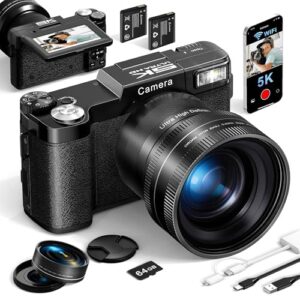
WiFi connectivity can simplify your workflow if you shoot birds near home and post images immediately, but the FLATIC 5K 64MP trades reach for convenience.
Its 18x optical zoom falls short of the telephoto range serious bird photography demands—you’ll struggle to frame warblers and raptors at typical viewing distances.
The 1/3-inch sensor and digital image stabilization produce acceptable vlogging footage, yet low-light performance and autofocus lag disappoint in dawn conditions when songbirds are most active.
Consider this camera only if social sharing outweighs image quality.
Best For: Beginner vloggers and social media creators who prioritize wireless sharing and compact design over serious bird photography performance.
Pros:
- WiFi connectivity lets you transfer photos to your phone instantly without cables or card readers
- 180° flip screen makes it easy to frame yourself for vlogs or check composition at awkward angles
- Comes with two rechargeable batteries and a 64GB card so you can shoot longer without interruptions
Cons:
- 18x optical zoom can’t match the 50–120x reach you need to photograph distant birds effectively
- 1/3-inch sensor struggles in low light and produces grainy images compared to larger sensors
- Autofocus lags when tracking moving subjects, making it tough to capture birds in flight or rapid motion
4. Digital Camera With Optical Zoom
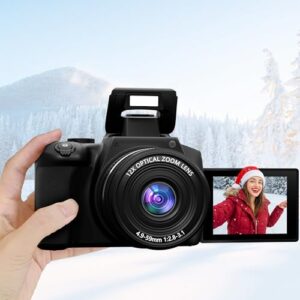
The GWAEPU W3 mounts a 12x optical zoom onto a 72MP CMOS sensor, pushing your effective reach to roughly 288 mm equivalent—enough for backyard feeders but marginal for shy forest species. Optical image stabilization helps at full extension, yet reviews note the zoom turns grainy past 6x and the plasticky body won’t survive rough trail use.
You’ll appreciate the 180° flip screen for low-angle heron shots, but autofocus hunting and a harsh built-in flash limit your creative control in changing light.
Best For: Budget-conscious beginners who want optical zoom for travel snapshots, vlogging, and backyard wildlife without investing in a full camera system.
Pros:
- 12x optical zoom with image stabilization gives you real reach for wildlife and portraits without the blur you’d get on a phone
- 180° flip screen makes it easy to compose vlogs, selfies, and awkward-angle shots when you’re out shooting
- Multiple shooting modes and WiFi transfer keep things simple whether you’re filming time-lapses or just backing up vacation photos
Cons:
- Image quality falls apart past 6x zoom—you’ll see grain and shake that make distant birds or landscapes look rough
- Plasticky build and finicky battery compartment won’t hold up to serious outdoor use or frequent handling
- Harsh flash and sluggish autofocus mean you’ll struggle in dim light or with fast-moving subjects
5. Monitech Digital Camera for Photography
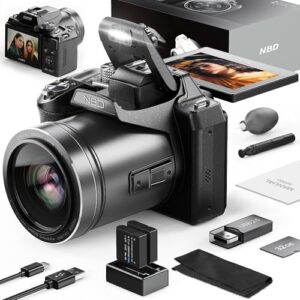
You’re getting 64MP resolution and 4K–5K video on a 1/2-inch sensor, but that small chip struggles with fast autofocus—contrast-detect systems hunt when a sparrow darts across branches. JPEG-only output limits shadow recovery when a cardinal hides under tree cover, making this better suited for stationary backyard subjects than unpredictable flight.
The 16x digital zoom amplifies noise rather than optical glass, so image stabilization can’t rescue detail past moderate distances.
WiFi transfer is smooth for sharing quick shots, yet bird tracking fails without phase-detect sensors.
Best For: Beginners documenting backyard birds at feeders or perches who want affordable 4K video and easy smartphone sharing but don’t need professional-level tracking or manual control.
Pros:
- 64MP stills and 4K–5K video give you plenty of detail for casual bird photography when subjects stay put
- WiFi connectivity makes it simple to transfer images straight to your phone for quick sharing
- Lightweight body (around 300–500g) won’t wear you out during longer backyard birding sessions
Cons:
- Contrast-detect autofocus hunts and misses fast-moving birds, making flight shots frustrating
- 16x digital zoom degrades image quality significantly compared to true optical zoom
- JPEG-only format leaves little room to fix exposure issues when birds move between sun and shade
6. 8K Digital Camera with WiFi and Touchscreen
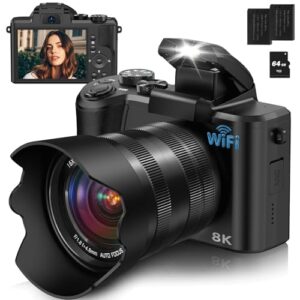
An 88MP interpolated sensor sounds impressive, but the tiny 1/3-inch chip and 16x digital zoom can’t match optical glass when you’re tracking warblers through oak canopy. Sensor quality matters more than resolution numbers.
WiFi connectivity lets you fire the touchscreen interface remotely, yet contrast autofocus struggles with erratic bird movement—camera stabilization only masks the problem. Image quality suffers once you crop, and camera settings won’t fix physics.
At 15fps for 8K video, you’ll miss wing beats. This beginner camera works for backyard feeders, not nervous thrushes.
Best For: Beginners who want an affordable all-in-one vlogging kit for social media content and backyard subjects, not serious bird photography.
Pros:
- Includes useful extras like external mic, remote, LED light, and spare battery right in the box
- Rotating touchscreen and WiFi connectivity make it easy to shoot selfie-style vlogs and transfer clips to your phone
- Simple automatic modes and webcam function help newcomers get started without technical knowledge
Cons:
- 16x digital zoom and tiny sensor deliver poor image quality on distant or fast-moving birds compared to optical telephoto lenses
- Slow 15fps 8K video and weak autofocus can’t keep up with erratic bird movement or capture sharp wing details
- Lacks weather sealing, fast burst shooting, and low-light performance needed for real outdoor birding conditions
7. IGXHAVIZ 8K Digital Camera
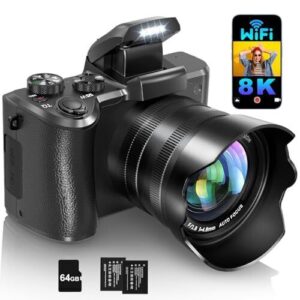
The IGXHAVIZ 8K digital camera delivers 88MP stills and dual-lens flexibility for $130, yet image stabilization can’t overcome its 16x digital zoom limitation. You’ll find the touchscreen user-friendly for beginner camera operation, and WiFi transfer speeds uploads to social platforms. User reviews praise the 4.7-star rating and included 64GB card.
However, bird photography demands optical reach this model lacks—autofocus struggles with rapid movement, and video quality degrades past 1080p. Camera comparison shows bridge superzooms outperform it for distant subjects. Backyard feeders only.
Best For: Beginners and casual content creators who want an affordable entry into high-resolution photography and vlogging without needing professional-grade equipment.
Pros:
- Shoots 8K video and 88MP photos at a budget-friendly $130 price point, making ultra-high-resolution content accessible to newcomers.
- WiFi connectivity enables quick wireless transfers to your phone or computer, perfect for posting content on the go.
- Comes with everything you need to start shooting—64GB card, two batteries, carrying case, and protective accessories included in the box.
Cons:
- Digital zoom degrades image quality significantly, especially beyond 1080p video, making it poor for distant subjects like wildlife.
- Autofocus struggles with fast-moving subjects, limiting its usefulness for action shots or bird photography.
- Battery drains quickly during use, and some users report choppy video or fuzzy images that require manual adjustments.
8. 4K Digital Camera for Photography
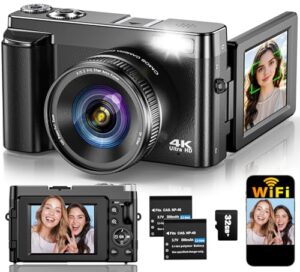
This 4K digital camera offers 64MP resolution and autofocus targeting for $90. You’ll appreciate the 180° flip screen for low-angle shots and WiFi connectivity for quick image transfers to your phone. Camera settings include time-lapse and slow-motion modes for creative outdoor shooting.
However, bird photography demands more reach than its 16x digital zoom provides. Wildlife photography requires optical zoom—digital magnification degrades image quality beyond 4x. The CMOS sensor manages decent lighting well, but autofocus lags on fast-moving subjects. Photo editing can’t rescue soft details from digital zoom compression.
Best For: Beginners and casual content creators who want an affordable camera for vlogging, travel photography, and social media without the complexity of professional gear.
Pros:
- 64MP resolution and 4K video capture solid detail for social media and everyday photography
- 180° flip screen makes framing yourself easy for vlogs and selfies
- WiFi connectivity lets you transfer photos to your phone instantly for quick posting
Cons:
- 16x digital zoom degrades image quality significantly—not suitable for wildlife or distant subjects
- Autofocus struggles with fast-moving subjects like birds or sports
- Limited manual controls and lower performance in low-light situations compared to professional cameras
9. Yatao Digital Camera for Photography
The Yatao digital camera delivers 64MP resolution with 18x optical zoom—enough reach for backyard bird photography without breaking the bank. Image stabilization keeps shots steady when you’re tracking movement, and the CMOS sensor manages morning light better than cheaper models.
You’ll find basic photography modes, including burst shooting for birds in flight. Camera durability suits outdoor shooting in mild conditions, though weather sealing remains limited.
For beginner photography, this photography equipment balances image quality against affordability, letting you learn bird tracking fundamentals before investing in pro-level gear.
Best For: Beginner bird photographers who want decent zoom and resolution for backyard wildlife without spending a fortune on professional equipment.
Pros:
- 64MP sensor with 18x optical zoom gives you solid reach for capturing distant birds while maintaining sharp detail
- Image stabilization and CMOS sensor handle low-light morning shoots better than entry-level alternatives
- Affordable price point lets you learn bird photography basics before committing to expensive pro gear
Cons:
- Limited weather sealing means you’ll need to be careful in wet or dusty conditions
- Manual controls are pretty basic, so advanced photographers will outgrow it quickly
- Some users report inconsistent image quality and battery drains fast when shooting in higher resolutions
10. VJIANGER 4K Digital Camera
The VJIANGER 4K Digital Camera offers 64MP resolution and 18x digital zoom, catering to entry-level bird photography. You’ll capture 4K video at 30fps and utilize basic autofocus, though performance is slower compared to pricier options. Image stabilization relies on digital correction rather than optical systems. Camera settings prioritize auto modes for beginners, and WiFi connectivity simplifies file transfer.
In camera comparison tests, this model is ideal for backyard birding on a tight budget. However, serious bird photography requires better zoom and faster autofocus than digital cameras at this price point can deliver.
Best For: Beginners and casual users looking for an affordable entry into 4K photography and vlogging, or anyone wanting a simple backup camera for travel and everyday moments.
Pros:
- 64MP resolution and 4K video at 30fps deliver solid image quality for the price point
- WiFi connectivity makes transferring photos and videos to your phone or computer quick and painless
- Compact, lightweight design with a flip screen is perfect for vlogging and self-portraits
Cons:
- Digital zoom and stabilization fall short for serious bird photography or fast-moving subjects
- Autofocus can be sluggish and unreliable, especially in challenging lighting conditions
- Startup time is slower than expected, and some users find the camera overpriced for what it offers
Frequently Asked Questions (FAQs)
How do I photograph birds in low light?
You’d think birds schedule themselves around golden hour, but they don’t.
Boost your ISO, open your aperture wide to f/6, and use fast autofocus with image stabilization for sharp low-light shots.
What camera settings work best for flying birds?
Set continuous autofocus and burst mode for tracking. Use shutter speeds around 1/2000 second to freeze wings. Choose apertures near f/6 for depth, and let auto ISO adjust with light conditions.
How close should I get to wild birds?
Maintain at least 1–2 meters from songbirds and 5–10 meters from shorebirds. Use optical zoom lenses (300 mm minimum) to capture birds without causing stress.
Respect wildlife ethics—if birds flush or vocalize, back off immediately.
Can I use my smartphone for bird photography?
You can use your smartphone for bird photography in good light, but digital camera zoom and autofocus often outperform mobile limitations.
Mobile accessories like telephoto attachments extend reach, while image editing apps improve smartphone bird photography tips results.
Whats the best time of day for birding?
Like telegraph operators once waited for signals, you’ll find the richest bird activity patterns at dawn. Morning light delivers sharp detail, while dusk offers brief feeding windows.
Seasonal variations shift these prime moments throughout the year.
Conclusion
The best bird cameras for beginners demand less from your wallet yet more from your commitment. Equipment solves technical problems—reach, sharpness, speed—but patience unlocks the real craft.
Your first cardinal shot won’t be perfect. Neither will your fiftieth. But each frame teaches you to read light differently, anticipate movement instinctively, and recognize the split-second when everything aligns.
The gear gets you close. Your willingness to fail repeatedly gets you the shot.
- https://www.pcmag.com/explainers/i-was-birding-before-it-was-cool-heres-the-gear-i-recommend
- https://www.youtube.com/watch?v=rnVFZWRk19k
- https://www.allaboutbirds.org/news/5-basics-of-good-bird-photography/
- https://www.rspb.org.uk/whats-happening/news/how-to-fund-wildlife-camera-kit
- https://www.birdforum.net/threads/should-i-by-a-bridge-superzoom-camera-instead-of-a-scope.417958/