This site is supported by our readers. We may earn a commission, at no cost to you, if you purchase through links.
A songbird returns to the same nesting site year after year, building her clutch in a space no bigger than your palm, yet most of us never witness what happens inside. Bird cameras for nest observation have cracked open this hidden world, letting you watch first feedings, sibling squabbles, and fledgling attempts without climbing trees or disturbing delicate families.
The technology has evolved far beyond grainy surveillance footage—today’s systems deliver sharp night vision, species identification through AI, and alerts that ping your phone the moment a parent arrives with breakfast.
Whether you’re tracking bluebirds in your backyard or documenting raptors for citizen science, choosing the right camera setup means balancing image quality, weatherproofing, and ethical placement that keeps birds safe while satisfying your curiosity.
Table Of Contents
Key Takeaways
- Modern nest cameras deliver 4K resolution, AI species identification, and night vision that captures nesting behavior around the clock without disturbing birds, turning backyard observation into legitimate wildlife documentation.
- Solar-powered models with 5–20W panels and batteries up to 10,000 mAh eliminate constant recharging, but performance depends heavily on sunlight availability and proper weatherproofing to survive rain, snow, and temperature extremes.
- Ethical installation matters more than specs—mount cameras before egg-laying begins, position them at 20–45 degree angles to avoid glare, and maintain at least 0.5 meters of clearance to prevent nest disturbance and predator detection.
- WiFi connectivity at 2.4 GHz with motion-triggered recording beats continuous streaming for battery life, while combining local microSD storage with cloud backup protects footage against weather damage and connection drops.
Best Bird Cameras for Nest Observation
You want a front-row seat to nature’s most intimate moments without disturbing the birds you’re watching. The right nest camera gives you crystal-clear footage, weatherproof reliability, and smart features that alert you when something’s happening.
Pairing your nest camera with a stable bird watching tripod ensures you capture shake-free footage even during windy conditions or extended observation sessions.
Here are six cameras that deliver professional-grade monitoring without the professional-grade hassle.
Whether you’re watching songbirds at the feeder or tracking raptors in flight, these beginner-friendly bird cameras make it easy to capture stunning footage without a steep learning curve.
1. Wiwacam Solar Birdhouse Camera
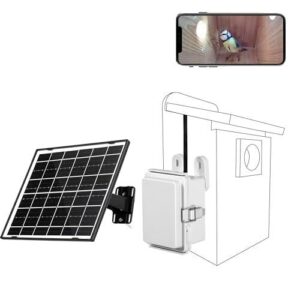
The Wiwacam Solar WiFi Birdhouse Camera delivers reliable nest monitoring without constant battery swaps. You’ll get 4K Ultra HD footage and night vision powered by a 10000mAh solar-charged battery, keeping watch through dawn and dusk. WiFi connectivity streams live video straight to your phone, while the waterproof design stands up to rain and sun.
If you’re comparing features across models, check out this guide to bird cameras for backyard bird watching to see how solar options stack up.
Camera placement inside the birdhouse captures intimate nest activity without disturbing residents. This setup aids wildlife conservation by letting you observe breeding behavior ethically, though battery performance depends on sunlight availability.
| Best For | Bird enthusiasts and wildlife observers who want to monitor nest activity without disturbing birds, especially those with outdoor birdhouses in sunny locations. |
|---|---|
| Video Resolution | 4K Ultra HD |
| Night Vision | Yes (IR) |
| Power Source | Solar + Battery |
| WiFi Connectivity | Yes |
| Material | Plastic |
| Weatherproof | Yes |
| Additional Features |
|
- Solar-powered 10000mAh battery eliminates the need for constant recharging and keeps the camera running through low-light periods
- 4K Ultra HD video with night vision captures clear footage of nest activity day and night, letting you observe birds without getting close
- WiFi live streaming to your phone plus microSD storage up to 256GB means you can watch in real-time or review recordings later
- Battery performance drops when sunlight is limited, so cloudy weather or shaded placement can affect runtime
- Some users report issues with image quality, color balance, and low-light performance that may not match the 4K spec in all conditions
- WiFi range and customer support have been pain points for some buyers, with warranty claims occasionally going unresolved
2. Visiogear Smart Bird Feeder Camera
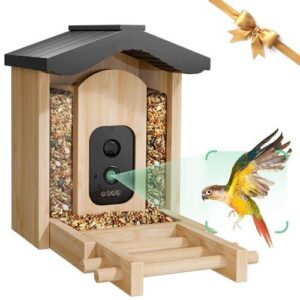
If you prefer watching birds at a feeder rather than inside a closed nest box, the Visiogear Smart Bird Feeder Camera shifts your monitoring strategy. Its 5MP HD sensor with a 130° wide-angle lens captures sharp daytime footage and clear night vision views of visiting species.
Two-way audio lets you listen to calls and vocalizations, deepening your understanding of bird behavior at feeding stations.
If you’re exploring bird cameras for birdhouse monitoring, look for models with two-way audio to capture both visuals and sounds in real time.
The 2.4GHz WiFi connectivity streams live to your phone, while solar efficiency keeps the camera charged through seasonal changes in sunlight availability.
| Best For | Bird enthusiasts who want to identify species visiting their feeder while enjoying real-time notifications and two-way audio interaction. |
|---|---|
| Video Resolution | 5MP HD |
| Night Vision | Yes |
| Power Source | Solar Panel |
| WiFi Connectivity | 2.4GHz |
| Material | Bamboo |
| Weatherproof | Yes |
| Additional Features |
|
- AI identifies over 11,000 bird species with clear 5MP HD footage and night vision capabilities
- Solar panel charging provides 3-6 months of battery life with minimal maintenance
- Two-way audio lets you listen to bird calls and communicate without disturbing your setup
- Only works with 2.4GHz WiFi, which limits router compatibility
- Roof can be knocked loose by larger birds, requiring frequent adjustments
- Smaller seed capacity due to camera housing takes up interior space
3. Smart Bird House Camera
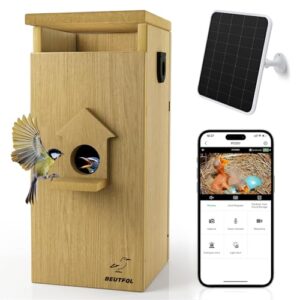
If sustainability matters to you, the Smart Bird House Camera built from renewable bamboo offers an eco-conscious option without sacrificing functionality. Its 2K HD resolution, night vision, and motion-triggered alerts deliver crisp views of nest activity, while the 6W solar panel maintains power throughout the season.
You can monitor bird behavior in real time through the WiFi birdhouse camera app, and two-way audio captures vocalizations. Camera placement is straightforward with wall or tree mounting, though assembly quality and bamboo durability may vary.
This smart birdhouse technology balances nest safety with renewable materials for an ethical monitoring approach.
| Best For | Bird enthusiasts who want eco-friendly monitoring with solar power and real-time alerts, especially if sustainability is a priority alongside watching nesting activity. |
|---|---|
| Video Resolution | 2K HD |
| Night Vision | Yes |
| Power Source | Solar (6W) |
| WiFi Connectivity | Yes |
| Material | Bamboo |
| Weatherproof | Yes (Waterproof) |
| Additional Features |
|
- Solar-powered operation means no battery changes or hardwired electricity needed for continuous monitoring
- 2K HD camera with night vision and motion alerts delivers clear footage day and night
- Made from renewable bamboo with waterproof coating, offering a greener alternative to plastic housings
- Build quality may be flimsy and bamboo durability could be a concern in harsh weather
- Assembly and installation require careful setup to ensure proper camera positioning and stability
- Some users report issues with power consistency and WiFi connectivity in outdoor environments
4. Intoo Lifes Birdhouse Camera
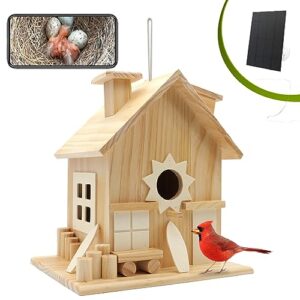
For decorative appeal paired with functional monitoring, the Intoo Lifes Birdhouse Camera offers 2K HD image quality and solar-powered operation in a wooden design you can hang outdoors. Its WiFi connectivity lets you track nesting activity through real-time viewing, while night vision extends your observations past dusk.
Its infrared capabilities mean you’ll get clear footage even after dark, similar to what you’d expect from dedicated bird watching camera traps designed for motion-triggered wildlife monitoring.
Camera placement is simple with wall or tree mounting, though setup can be finicky and weather exposure may compromise birdhouse design durability. Solar efficiency keeps it running, but you’ll want to secure mounting hardware and possibly weatherproof vulnerable joints for reliable birdhouse monitoring over multiple seasons.
| Best For | Nature enthusiasts who want a decorative outdoor birdhouse that doubles as a monitoring station for watching nesting birds in real-time. |
|---|---|
| Video Resolution | 2K HD |
| Night Vision | Not specified |
| Power Source | Solar Powered |
| WiFi Connectivity | Yes |
| Material | Wood |
| Weatherproof | Not specified |
| Additional Features |
|
- 2K HD video quality with night vision lets you observe birds clearly around the clock
- Solar-powered operation means no battery changes or constant recharging
- Real-time WiFi streaming brings nesting activity straight to your phone
- Setup can be frustrating and may need frequent resets to stay connected
- Wooden construction doesn’t hold up well in harsh weather and may need repairs
- Entry hole sizing might not work for all local bird species in your area
5. Whitehorse Bird House With Camera
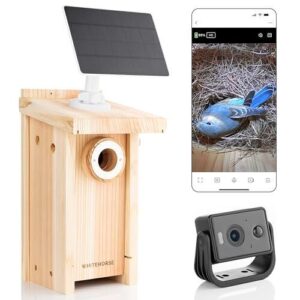
You’ll find the Whitehorse Bird House With Camera engineered specifically for cavity-nesting bird species, blending weatherproof housing with infrared night vision for round-the-clock monitoring. Its compact camera module captures nesting habits through motion detection, while WiFi connectivity streams footage directly to your phone. Solar-powered operation keeps it running without battery swaps, though you should verify current specs before purchase since production runs vary.
Camera placement demands a sturdy mount with clear sightlines, and proper installation protects both camera durability and the wildlife conservation goals driving your observations.
| Best For | Bird enthusiasts who want hands-off monitoring of cavity-nesting species without constantly checking physical nests. |
|---|---|
| Video Resolution | 4MP (2K HD) |
| Night Vision | Yes (Infrared) |
| Power Source | Solar Powered |
| WiFi Connectivity | 2.4GHz |
| Material | Cedar Wood |
| Weatherproof | Yes (Weatherproof) |
| Additional Features |
|
- Solar-powered design means you won’t need to climb up and swap batteries every few weeks
- Infrared night vision lets you catch nocturnal activity and early-morning feeding routines
- Weatherproof housing holds up in rain and temperature swings without babying it
- WiFi dependency means dead zones in your yard will leave you with no live stream
- Production specs vary between runs, so you might get different camera quality than expected
- Requires a solid mount and careful positioning to avoid disturbing the birds you’re trying to watch
6. Birdfy Smart Bird House Camera
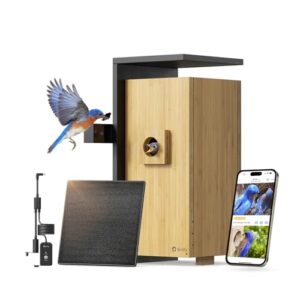
Dual 2MP cameras inside and outside this WiFi nesting box deliver 1080P footage of bird behavior and nesting patterns you’d otherwise miss. The Birdfy Smart Bird House with Camera employs smart AI detection that flags egg-laying and brooding moments, sending real-time alerts straight to your phone.
Its 5W solar panel and 9,000mAh battery power continuous nest monitoring systems, while IP66-rated weatherproofing manages rain and dust.
Camera comparison reveals customizable entrance sizes with metal predator guards—essential for wildlife conservation during vulnerable nesting periods.
| Best For | Bird enthusiasts and families who want a front-row seat to nesting activity without disturbing the birds, especially if you love sharing nature moments with a community. |
|---|---|
| Video Resolution | 2MP (1080P) |
| Night Vision | Not specified |
| Power Source | Solar (5W) + Battery |
| WiFi Connectivity | 2.4GHz/Bluetooth |
| Material | Bamboo |
| Weatherproof | Yes (IP66) |
| Additional Features |
|
- Dual cameras catch both interior nest activity and exterior approaches in 1080P, so you won’t miss egg-laying or feeding runs
- Solar panel and hefty battery keep it running without constant recharging, even during cloudy stretches
- AI alerts notify you the moment something interesting happens, saving you from hours of scanning footage
- Setup instructions confuse some users, particularly if you’re wrestling with 2.4GHz WiFi networks or mesh systems like Eero
- Heavy build demands a solid mounting spot—flimsy poles or weak branches won’t cut it
- Exporting time-lapse compilations takes more steps than you’d expect for quick sharing
Key Features to Look for in Nest Cameras
Not all nest cameras are built the same, and the right features can mean the difference between grainy footage you squint at and crystal-clear views that make you feel like you’re right there in the nest. You want a camera that works around the clock, withstands whatever weather comes its way, and sends you updates the moment something exciting happens.
Here’s what separates a solid nest camera from one that’ll leave you frustrated.
Infrared and Night Vision Capabilities
Night vision transforms your nest camera into a 24/7 monitoring tool. Most cameras use infrared illumination with 850 nm or 940 nm IR LED types, providing clear black-and-white footage up to 15 meters without disturbing birds.
Low light sensors with back-illuminated CMOS technology capture sharp detail even when ambient light drops below 5 lux, letting you witness nocturnal nest activity you’d otherwise miss completely.
Motion Detection and AI Alerts
Motion detection turns your nest camera into a vigilant field assistant. Modern PIR and optical motion sensors track bird activity with 80–95% detection accuracy, sending smart notifications to your phone within seconds.
You can adjust sensitivity on a 1–5 scale, configure detection zones around nest entrances, and filter alerts by confidence score.
AI species recognition adds another layer, classifying birds versus squirrels or wind-blown branches with impressive precision.
Weatherproof and Durable Housing
Your nest camera won’t last a single season if it can’t handle rain, snow, and summer heat. Look for IP65 or IP66 ratings—proven weatherproof designs that block dust and resist heavy rain.
Quality housing materials like UV-resistant polycarbonate or treated bamboo withstand years outdoors. Silicone sealants around lens ports prevent moisture intrusion, while solar-powered models need extra weather resistance on panel connections for reliable operation.
WiFi and Mobile App Connectivity
A stable 2.4 GHz connection is the backbone of reliable WiFi Camera Connectivity—look for WiFi Range extending at least 30 feet for typical backyard setups.
Your Wireless Connectivity to Smart Home Devices depends on WPA2 or WPA3 encryption for App Security, while companion apps deliver Mobile Alerts within seconds when motion triggers.
Most WiFi Birdhouse Camera models support Cloud Storage alongside local microSD backup, ensuring Network Stability even during brief outages.
Solar Power and Battery Options
Most Solar Powered Cameras rely on 5W to 20W Solar Panels paired with 2000–10,000 mAh battery banks, giving you days of operation even through cloudy stretches. Power Management circuits prevent overcharging while maximizing Energy Efficiency, and in winter’s short daylight, larger Battery Life reserves keep your Solar Energy flowing.
That hands-off Charging Systems approach means uninterrupted nest monitoring without climbing trees to swap batteries.
Factors to Consider Before Buying
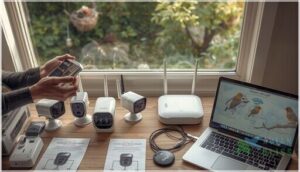
Before you commit to a bird camera, you’ll want to think beyond the spec sheet and consider how it fits your actual setup. The wrong power source or shaky WiFi can turn your dream monitoring project into a headache, and nest safety isn’t something you can compromise on.
Let’s walk through the practical factors that’ll help you choose a camera that works for both you and the birds.
Camera Placement and Field of View
Getting the right angle makes all the difference between blurry wing-flaps and crystal-clear nesting behavior. Position your bird nest camera 1 to 2 meters above the nest box, using an oblique angle of 20–45 degrees to cut glare and boost nest visibility.
Wide-angle lens selection covers both entrance and interior, while maintaining 0.5 meters of clearance prevents view obstruction and keeps your outdoor camera installation bird-safe.
Power Source Compatibility
Once you’ve nailed the view, match your power source to the nest’s sunlight reality. Solar panels shine in open spots with 4+ hours of direct sun, while battery life becomes king in shaded corners.
Here’s what to weigh:
| Power Type | Best For | Typical Runtime |
|---|---|---|
| Solar Powered | Full-sun sites | Continuous with 5–18W panel |
| Battery (rechargeable) | Partial shade | 2–6 weeks per charge (2000–6000 mAh) |
| Dual Mode | Variable weather | Smooth solar-to-battery handoff |
Wireless cameras demand energy-aware recording—motion-triggered beats continuous streaming for longevity. Check your app for battery health indicators, and pick weatherproof charging systems that survive morning dew and afternoon storms. Cold snaps can sap 20% capacity, so size up if you’re monitoring through winter.
Solar-powered devices with monocrystalline panels grab every photon, even under clouds, keeping your nest watch uninterrupted.
Connectivity and Streaming Reliability
Power won’t matter if your wireless WiFi birdhouse camera can’t hold a connection. WiFi stability under –65 dBm signal strength keeps 1080p streaming quality smooth, while network latency above 500 ms turns real-time alerts into delayed snapshots.
Motion detection and solar-powered units need reliable reconnect features—a weatherproof housing protects hardware, but mesh access points and dual-band routers prevent the dropouts that ruin nesting milestones.
Bird and Nest Safety Considerations
Your camera shouldn’t become the reason a nest fails—placement, timing, and restraint matter more than the specs on the box. Understanding and following responsible photography practices is vital to minimize disturbance and stress on the birds.
Mount cameras before egg-laying begins to reduce nest disturbance, and position them where nest predators won’t follow camera angles to vulnerable broods.
Birdhouse monitoring technology aids wildlife conservation when bird stress stays minimal and nesting activity unfolds naturally.
Storage Options: MicroSD Vs. Cloud
Between microSD cards and cloud subscriptions, each storage path shapes how you’ll capture and protect nest footage. Local backup via microSD offers independence—your birdhouse cameras record continuously even when WiFi drops, and a 128 GB card holds weeks of motion detection clips without recurring cloud costs. Yet cloud services provide remote access and off-site protection if weather or theft damages your solar-powered, weatherproof setup.
Consider three priorities:
- Storage capacity needs for night vision recordings
- Data security against physical loss or breaches
- Budget tolerance for ongoing subscription fees versus one-time hardware investment
For peak performance, confirm you understand the Wi-Fi bird box setup and configuration.
Installation and Maintenance Tips
Getting your bird camera up and running isn’t rocket science, but a little care in placement and upkeep makes all the difference between crystal-clear nest footage and missed moments. You’ll want to mount it where birds feel safe and you get the best view, then keep everything clean and powered through the seasons.
Here’s what you need to know to set up your camera right and keep it working like a champ.
Optimal Camera Mounting Techniques
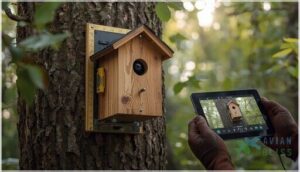
Mounting your birdhouse camera requires precision that’ll pay off in stunning footage. Position the lens centrally above the nest cup—measure equal distances from box edges for ideal field of view adjustment.
Install between 2 and 4 meters high to deter predators while keeping maintenance accessible.
Secure mounts firmly to prevent vibration that compromises motion detection and night vision clarity in your weatherproof setup.
Ensuring Clear and Safe Nest Views
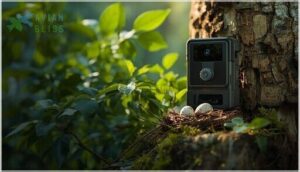
Angle matters more than you’d think—position your birdhouse cameras slightly above and to the side of the nest to prevent light reflection that ruins image clarity and night vision. This camera placement reduces collision risk while maintaining clear views of nesting activity.
Conceal the weatherproof housing with surrounding vegetation for predator avoidance, since exposed equipment can signal nest locations to ravens and other threats, compromising nest safety without triggering motion detection alerts.
Maintaining Weatherproofing and Cleanliness
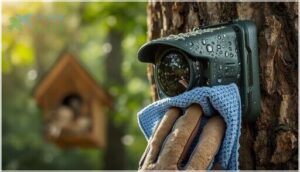
Dust, moisture, and bird droppings can turn your high-tech monitoring setup into a blurry mess faster than a spring storm rolls in. Check waterproof sealants monthly around lens openings—silicone breaks down under UV exposure, compromising weather resistance in outdoor cameras.
Gently wipe the lens with a microfiber cloth during birdhouse maintenance, avoiding harsh chemicals that damage weatherproof materials. This keeps your wildlife monitoring systems capturing crisp footage through every season.
Solar Panel and Battery Maintenance
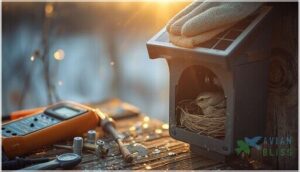
Think of solar powered birdhouse cameras as living systems—they thrive or falter based on care. For peak performance and charge optimization, make these habits routine:
- Wipe panels gently to boost solar orientation and output.
- Inspect mounting for weather resistance after storms.
- Monitor battery health for steady power.
- Adjust settings for smarter power management.
- Clear snow or debris during birdhouse maintenance—nature’s not always kind.
Troubleshooting Common Issues
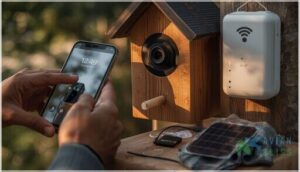
Even vigilant observers hit snags. Connection issues plague 2.4 GHz-only birdhouse cameras when routers broadcast dual-band signals—check your network settings first. Signal strength falters outdoors, so position a Wi-Fi extender midway to your nest box. Camera malfunctions often stem from corrupted firmware updates or full MicroSD cards; reformatting storage usually restores recording. Power outages drain batteries fast, while dirty solar panels choke charging. For night vision failures or motion detection gaps, verify lens clarity and adjust sensitivity. Birdhouse camera reviews confirm these fixes work across models, keeping your weatherproof sentinel operational through nesting season.
| Problem | Likely Cause | Quick Fix |
|---|---|---|
| No WiFi connection | 5 GHz network selected | Switch to 2.4 GHz band |
| Missed bird alerts | Low motion sensitivity | Increase detection threshold |
| Recording stopped | SD card full or corrupt | Format card in camera |
Enhancing Your Bird Nest Monitoring Experience
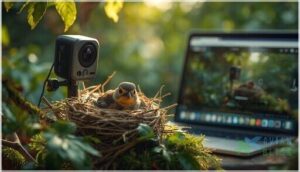
You’ve got your camera mounted and your live stream running—now it’s time to pull more from the setup than just passive viewing. The right tools and approach can turn casual observation into genuine wildlife discovery, from instant species ID to footage worth sharing with other birders.
Let’s look at how to get the most from your nest monitoring system while respecting the birds you’re watching.
Using AI for Species Identification
Modern bird house cameras now integrate AI models that use computer vision and machine learning to recognize species visiting your nest box. Some systems, like Birdfy’s smart bird house with camera, identify over 11,000 species automatically through onboard species classification—turning casual observation into real wildlife conservation technology.
You’ll get accurate bird recognition without manually sorting through hundreds of photos, letting you focus on bird behavior analysis instead.
Real-Time Nesting Activity Alerts
AI Detection now means your birdhouse’s alert systems can ping your phone the moment a nest visitor arrives—whether it’s dawn, dusk, or the dead of night.
RealTime Nesting Observation uses motion detection and night vision, filtering out false alerts, so you get fast, meaningful notifications. That’s nest monitoring with notification speed you can trust, all without missing a beat.
Recording and Sharing Nest Footage
Once your Motion Detection alerts arrive, you’ll want to capture the action. Camera Settings matter—aim for 1080p minimum, ideally 4K footage at 30fps for smooth, detailed clips. Night Vision ensures dawn and dusk visits don’t go unrecorded.
Use local Data Storage on microSD cards to simplify Footage Editing, then compress files before Nest Streaming online, keeping your Wireless Birdhouse Cameras’ best moments shareable without overwhelming bandwidth or Video Compression quality loss.
Ethical Guidelines for Nest Observation
Bird Welfare demands more than just great footage—it requires restraint. Camera Ethics starts with Nest Safety: install outside breeding season, minimize visits, and never handle eggs or chicks without permits.
Bird welfare isn’t about capturing perfect footage—it’s about knowing when to turn the camera off
Wildlife Protection means limiting Predator Protection risks by varying your approach routes and keeping exact locations private.
Conservation Principles remind us that Nature Conservation and responsible Wildlife Monitoring always trump our desire for the perfect Nesting Activity shot during Bird Watching.
Frequently Asked Questions (FAQs)
Can bird cameras disturb nesting or breeding behavior?
Camera Impact on nesting activity isn’t always straightforward. While Nest Disturbance and Breeding Effects can occur, especially with frequent visits, careful Nest Monitoring—using infrared and minimizing Wildlife Stress—usually avoids major shifts in Bird Behavior or Nesting Behavior.
What video resolution is best for identification?
For reliable identification, you’ll want at least 1080p HD camera resolution, though 2K or 4K provides sharper detail when distinguishing subtle plumage patterns.
This is especially important with birdhouse cameras featuring strong sensor quality and frame rate consistency.
How far can WiFi signals reach outdoors?
Under ideal line-of-sight conditions, standard 4 GHz WiFi signals generally reach 150–300 feet outdoors, though trees, buildings, and weather can slash that range by half, compromising network stability for wireless connectivity needs.
Do cameras work during heavy rain or snow?
Most outdoor cameras with IP65 ratings or higher handle rainy conditions well, protecting internal electronics.
Snow performance depends on weatherproof housing and heated lenses, which prevent fogging and maintain infrared night vision functionality.
Whats the typical lifespan of these cameras?
Though they’re built to endure the elements, outdoor cameras generally last 5 to 10 years.
Solar-powered birdhouse cameras often reach 7–15 years with proper maintenance, weatherproof housing, and battery replacements extending their durability considerably.
Conclusion
A researcher in Montana once captured the exact moment a returning swallow recognized last year’s nest—proof that these tiny architects hold memories we’re only beginning to decode.
With the right bird cameras for nest observation, you’re not just watching; you’re documenting behaviors scientists still debate.
Mount your setup thoughtfully, respect the rhythm of nesting cycles, and you’ll gather footage that transforms backyard curiosity into meaningful understanding of the wild lives unfolding inches from your window.
- https://x.com/godofprompt/status/1990526288063324577
- https://www.sciencedirect.com/science/article/pii/S0749208123000268
- https://pmc.ncbi.nlm.nih.gov/articles/instance/9553038/bin/pone.0275964.s005.docx
- https://github.com/vinhphunguyen/how-to-write-a-paper/blob/master/how-to-write-paper.out
- https://green-backyard.com/blogs/how-to-install-a-wifi-bird-box-camera-when-theres-no-wi-fi/