This site is supported by our readers. We may earn a commission, at no cost to you, if you purchase through links.

A century ago, passenger pigeons darkened North American skies in flocks numbering billions—yet within decades, relentless hunting and habitat destruction drove them to complete extinction, with the last individual dying in captivity in 1914. This stark historical lesson underscores the vulnerability of even seemingly abundant bird populations when compounded threats overwhelm their adaptive capacity.
Today, the IUCN Red List reveals that approximately 13% of bird species face direct extinction risk, with habitat loss, invasive predators, and climate-driven range shifts creating an increasingly perilous landscape for avian biodiversity. Understanding bird conservation status and threats requires examining the quantitative criteria scientists use to assess extinction risk, the geographic and ecological patterns driving population declines, and the targeted interventions that have successfully reversed species trajectories toward recovery.
Table Of Contents
- Key Takeaways
- Understanding Bird Conservation Status Worldwide
- Major Threats Driving Bird Species Decline
- Habitat Loss and Environmental Degradation
- Human-Caused Mortality and Direct Threats
- Conservation Actions and Protection Strategies
- Frequently Asked Questions (FAQs)
- What is the #1 bird threat?
- What is the impact factor of the bird conservation?
- What are the top 3 killers of birds?
- How do birds impact global ecosystems and biodiversity?
- What are successful bird reintroduction programs worldwide?
- Which bird species show resilience to environmental changes?
- How does noise pollution affect bird behavior?
- What role do indigenous practices play in bird conservation?
- How do bird diseases spread between wild populations?
- What role do birds play in ecosystem health?
- Conclusion
Key Takeaways
- You’re witnessing approximately 13% of all bird species facing direct extinction risk on the IUCN Red List, with agricultural expansion affecting 73% of globally threatened birds—making habitat loss from croplands, deforestation, and wetland drainage the single most pervasive driver of population declines worldwide.
- Invasive mammal predators have caused roughly 90% of bird extinctions since 1500 on island ecosystems, yet targeted eradication programs demonstrate measurable population recoveries when you eliminate rats, cats, and pigs from vulnerable breeding colonies.
- Human-caused mortality from building collisions kills millions of birds annually during migration, but implementing bird-friendly design elements like fritted glass and UV films reduces fatalities by 20-70%, proving that infrastructure modifications can coexist with conservation goals.
- Species recovery programs have achieved documented successes—California Condors increased from 22 individuals in 1987 to over 560 by 2025, and Whooping Cranes rebounded from 16 birds to approximately 536—demonstrating that coordinated, science-based interventions combining captive breeding, threat mitigation, and habitat restoration can reverse even near-extinction scenarios.
Understanding Bird Conservation Status Worldwide
You can’t protect what you don’t measure, and the IUCN Red List provides the global standard for evaluating how close bird species are to disappearing from our planet. Understanding these conservation categories, current threat statistics, and population trends helps you grasp the scope of the crisis facing avian biodiversity.
Let’s examine the classification system, the numbers behind today’s threatened species, and the broader patterns of decline affecting bird populations worldwide.
IUCN Red List Categories and Assessment Criteria
Think of the IUCN Red List as a universal report card for every bird species on the planet. You’ll find seven threat categories that reveal each bird’s conservation status, from Least Concern through Near Threatened, Vulnerable, Endangered, Critically Endangered, Extinct in the Wild, to Extinct.
The assessment process evaluates extinction risk through five quantitative criteria:
- Population decline rates over ten years or three generations
- Geographic range size combined with fragmentation evidence
- Total population size thresholds with observed declines
- Extremely restricted distribution affecting fewer than fifty mature individuals
- Quantitative extinction probability analyses using population viability models
These Red List criteria demand transparent, repeatable documentation from peer-reviewed studies, monitoring programs, and expert observations, ensuring that threat categories reflect current data on population trends, habitat quality, and pressures affecting threatened species worldwide. Researchers can utilize advanced search tools to find relevant data and definitions that support conservation efforts.
Current Threat Levels and Endangered Species Statistics
You’re now looking at roughly 40 percent of all assessed bird species falling into threatened or near threatened categories on the IUCN Red List, with approximately 13 percent facing direct extinction risk. Over 230 species carry Endangered status globally, while more than 70 earn the Critically Endangered designation—your most urgent conservation targets.
Conservation programs now focus on protecting critical breeding grounds and migration routes, with global bird habitat research guiding these targeted efforts.
Australasia and Africa lead regional threat concentrations, where habitat loss, invasive species, and overexploitation drive these alarming population trends among threatened species worldwide.
Population Decline Patterns Across Bird Species
Beyond the stark extinction risk categories, you’ll find that population declines among bird species follow complex, non-uniform trajectories shaped by taxonomy, geography, and ecological specialization. Migratory shorebirds experience compound threats across multiple flyway stopover sites, while passerines typically undergo gradual attrition rather than catastrophic drops.
Species with restricted ranges or specialized bird habitats face disproportionate declines, disrupting regional ecological balance and accelerating localized extinction risk through small, accumulating annual losses. Understanding methodological rigor is vital for evaluating the impact of these declines.
Major Threats Driving Bird Species Decline

You now understand the conservation status of bird species worldwide, but identifying the specific threats driving their decline reveals the complexity of the challenge ahead. Agricultural expansion alone affects 73 percent of globally threatened bird species, while logging, invasive species, hunting, and climate change each contribute substantially to population losses across multiple taxonomic groups.
The following sections examine five primary threat categories that conservation biologists have identified as the most significant drivers of avian decline, providing you with the evidence-based foundation necessary to understand current conservation priorities.
Agricultural Expansion and Intensive Farming Impacts
Agricultural expansion remains the foremost driver of habitat destruction globally, with 14 to 35 percent of Earth’s land converted to farming practices that directly cause biodiversity loss.
Coastal wetlands and marshes, home to diverse types of birds found near water, face particular pressure as agricultural land claims vital feeding and nesting grounds.
Cropland expansion generates ecological threats through continuous forest edge effects, reducing insectivorous bird density by up to 20 percent in tropical regions.
Habitat fragmentation compounds the risks migratory birds already face from collisions and light pollution, especially during peak migration windows when millions traverse altered landscapes.
Intensive crop management and pesticide application—particularly neonicotinoids—compromise survival and fecundity in seed-eating species, simultaneously degrading soil quality and diminishing critical ecosystem services.
Logging and Deforestation Effects on Forest Birds
Forest fragmentation from logging and deforestation reduces resident woodland bird richness by up to 40 percent within a decade, amplifying nest predation rates two- to threefold in disturbed forests. Habitat destruction creates edge effects, raising microclimate variability and predator abundance at boundaries, which directly threatens forest-dependent species.
Although second-growth forests can recover certain functional groups within 20–40 years, species composition usually remains skewed toward generalists, demonstrating persistent impacts on bird conservation and environmental conservation priorities.
Invasive Alien Species and Predation Pressure
You’ll find that invasive alien species have driven over 60 bird declines across major regions, with feral cats and rats causing more than 40 percent of island extinctions.
These biological invasions suppress breeding success through predation pressure, yet targeted invasive species control—such as predator eradication campaigns—has produced measurable recoveries, demonstrating that proactive alien predation management directly reduces threats to bird species.
Hunting, Trapping, and Illegal Wildlife Trade
You should recognize that wildlife crime targeting birds—including poaching effects through illegal trapping for pet markets and traditional medicine—threatens 41 percent of globally threatened species, with enforcement strategies often failing to deter trade because penalties remain minimal and cross-border coordination is weak.
Conservation law improvements, stronger trade regulation under frameworks like CITES, and community-based environmental impact assessment can reduce these human-caused mortality factors and protect vulnerable bird populations.
Climate Change and Habitat Suitability Shifts
Climate change impacts 37 percent of globally threatened bird species by altering habitat suitability across their ranges, forcing poleward and upslope climate shifts. These shifts contract suitable areas for tropical specialists while expanding zones for some temperate taxa.
You’ll observe phenological mismatches between breeding periods and peak food availability, reduced moisture regimes in arid regions, and Arctic range contractions that heighten extinction risk for habitat-restricted populations. Collectively, these changes undermine ecosystem health and accelerate biodiversity loss.
Habitat Loss and Environmental Degradation
Habitat loss remains the single most pervasive driver of bird population declines globally, with agricultural expansion, deforestation, and urban development systematically eliminating the nesting sites, foraging grounds, and migratory stopover habitats that diverse avian species require for survival.
Habitat loss from agriculture, deforestation, and urbanization is the leading driver of global bird population decline
Beyond direct habitat destruction, environmental degradation—including climate-induced phenological shifts and range contractions in temperature-sensitive ecosystems—creates conditions that reduce reproductive success and force vulnerable populations into increasingly fragmented landscapes.
The following sections examine five critical pathways through which habitat loss and environmental change are pushing bird species toward extinction across terrestrial, freshwater, and high-elevation ecosystems worldwide.
Forest Conversion to Croplands and Pasture

When croplands and pasture replace forests, you’re witnessing Agricultural Expansion that triggers profound Habitat Loss and Forest Fragmentation, compromising ecosystem health for bird communities. Biodiversity Decline accelerates as tropical deforestation rates climb, with species richness plummeting near agricultural edges where Ecosystem Disruption favors generalists over specialists.
Your support for habitat preservation and wildlife conservation, coupled with biodiversity protection through ecological corridors, can meaningfully counteract these fragmenting forces.
Wetland Drainage and Freshwater Habitat Destruction
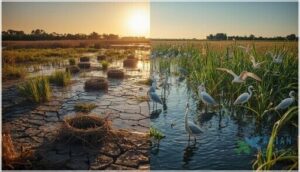
When wetlands vanish, you’re watching waterbird populations plummet. Drainage reduces foraging and roosting habitat by 20–60% in many landscapes, disrupting ecosystem services that sustain migratory shorebirds and resident species alike.
Freshwater conservation through habitat preservation and restoration can recover partial wetland ecology within 5–10 years, demonstrating that ecological conservation and biodiversity protection efforts yield measurable gains for wildlife conservation and waterbird decline reversal.
Urbanization and Infrastructure Development

As cities expand, urban planning dictates whether green spaces remain or disappear, fragmenting habitat and reducing core refugia for forest specialists by up to 70 percent in heavily developed zones.
Infrastructure growth introduces collision risks—glass collisions alone kill millions annually—alongside light and noise pollution that disrupts migratory timing, making urban ecology central to addressing human-caused mortality factors and advancing wildlife preservation.
Phenology Mismatches and Breeding Disruption

Rising temperatures shift the timing of insect emergence and plant flowering, creating mismatches between peak food availability and breeding periods that reduce nestling growth and survival across temperate songbirds by up to 30 percent.
Phenology research reveals that long-distance migrants suffer greater reproductive failure than residents, unable to adjust arrival timing to climate shifts, underscoring how environmental degradation compounds habitat loss and disrupts migration patterns critical to avian conservation.
Arctic and High-Altitude Range Contractions

Beyond breeding disruptions, climate change drives Arctic and high-altitude species toward vanishing habitats. Warming temperatures force upslope and latitudinal range contractions, while sea ice loss and glacier retreat eliminate critical nesting sites.
Alpine ecosystems shrink upward, trapping cold-adapted birds in contracting cryospheres. Habitat loss erodes populations, with some taxa losing over 10 percent of their historical range within decades. This underscores urgent priorities for species preservation amid accelerating environmental degradation.
Human-Caused Mortality and Direct Threats

Beyond habitat destruction, birds face a suite of direct, human-caused threats that kill millions of individuals annually and accelerate population declines across species. These mortality sources range from physical infrastructure collisions and commercial fishing operations to chemical exposure and artificial lighting that disrupts natural behaviors.
Understanding these immediate threats provides essential context for implementing targeted conservation interventions that can reduce avoidable bird deaths worldwide.
Building and Wind Turbine Collisions
Every year, you’re looking at collision risks that claim tens of thousands to millions of birds when they strike buildings, windows, and wind turbines during migration. Urban planning now embraces bird-friendly designs—fritted glass, UV films, and curtailment strategies—that cut mortality rates by 20–70%. These migratory bird conservation efforts tackle human-caused mortality factors head-on, proving that thoughtful wind turbine energy development and reducing glass collisions can coexist with conservation.
Here are key aspects of these efforts:
- Seasonal peaks: Spring and fall migrations drive collision spikes along urban corridors and wind farms.
- Smart mitigation: Blade feathering and window treatments deliver measurable reductions in fatalities.
- High-risk zones: Dense glass façades and coastal flyways concentrate avian deaths.
- Policy momentum: Impact assessments and design guidelines are reshaping infrastructure to protect birds.
Fisheries Bycatch and Seabird Mortality
When you think about threats to bird populations, fisheries bycatch stands out as a silent killer, drowning hundreds of thousands of seabirds—albatrosses, petrels—each year in longline and trawl nets.
Seabird conservation depends on bycatch reduction through mitigation strategies like bird-scaring lines and weighted gear, which cut human-caused mortality factors by reshaping fishing gear practices and protecting migratory birds across vulnerable ocean zones.
Island Extinctions and Invasive Mammal Predators
Since 1500, roughly 90 percent of all bird extinctions have occurred on island ecosystems, where invasive mammals—rats, cats, and pigs—trigger predation on vulnerable seabird colonies and Hawaiian species, driving extinction risk to critical levels.
Predator control programs demonstrate measurable recovery when you eliminate these invasive mammal threats, reversing seabird decline through targeted bird conservation interventions across isolated island systems.
Light Pollution and Migratory Disorientation
Artificial illumination disorients nocturnally migrating birds, causing collision-related mortality near urban lighting structures during peak migration seasons. Millions of migratory birds navigate using celestial cues, which light pollution disrupts.
You’ll support bird conservation efforts and environmental sustainability through these wildlife conservation strategies:
- Shield outdoor lights downward to reduce skyward artificial illumination during nocturnal migration periods
- Install motion-activated lighting instead of continuous illumination in migration corridors
- Reduce short-wavelength blue light emissions that disorient birds more severely than amber alternatives
- Advocate for Lights Out programs during spring and fall migration under Migratory Bird Treaty Act protections
- Support light mitigation ordinances restricting work-hour lighting when bird disorientation risk peaks in urban areas
Pesticide Exposure and Plastic Pollution
Pesticides and plastics form a toxic double threat to bird populations, with organochlorine residues thinning eggshells by up to 40% in raptors and microplastics detected in 60% of seabird species globally. Bird conservation efforts depend on your choices—from lawn care to shopping habits—because avian toxicology research confirms sublethal exposures impair immunity and reproduction across species.
You’ll advance wildlife preservation efforts through environmental sustainability practices that reduce these pollution effects:
| Threat Type | Action You Can Take |
|---|---|
| Toxic chemicals | Choose organic produce; support pesticide-free habitat zones |
| Plastic ingestion | Reduce single-use plastics; participate in coastal cleanup programs |
| Combined eco toxicity | Advocate for stronger regulation of pesticides toxins and plastics nationwide |
Conservation Actions and Protection Strategies

While the threats facing bird populations remain substantial, you can find hope in the growing body of conservation strategies that have demonstrated measurable success in stabilizing and recovering imperiled species. From landscape-level protected area networks to localized invasive species eradication campaigns, these interventions employ science-based approaches customized to specific ecological challenges and regional conservation contexts.
The following sections examine five critical categories of conservation action that are currently shaping global bird protection efforts and yielding documented population improvements.
Successful Species Recovery Programs and Case Studies
Recovery planning transforms near-extinction scenarios into wildlife restoration triumphs through strategic reintroduction methods and species relocation. Conservation biology demonstrates measurable success when targeted conservation efforts address specific threats facing threatened species:
- California Condor populations increased from 22 individuals in 1987 to over 560 by 2025 through captive breeding and lead poisoning mitigation
- Whooping Cranes rebounded from 16 birds in 1941 to approximately 536 during 2022-2023, achieving 4% annual growth
- Mauritius Kestrel recovery expanded from 4-6 individuals in 1974 to 350-800 through fostering programs
- Kakapo populations grew from 51 birds in the early 1990s to 237 individuals via supplementary feeding and predator control
- Bald Eagle numbers surged to 316,700 individuals following DDT prohibition and habitat conservation
These bird conservation achievements demonstrate how coordinated species recovery programs deliver wildlife preservation outcomes when you combine scientific expertise with sustained commitment.
Protected Areas and Habitat Restoration Initiatives
You’ll find that protected area networks covering approximately 15% of terrestrial and 7% of marine environments establish critical sanctuaries for biodiversity management and habitat preservation.
Conservation planning integrates ecosystem restoration through reforestation, wetland rehabilitation, and wildlife corridors connecting fragmented landscapes, facilitating sustainable resource management.
These ecological conservation initiatives employ adaptive ecosystem management strategies, incorporating monitoring protocols and community-led co-management to reverse habitat loss while supporting metapopulation dynamics and migratory patterns essential for long-term ecological restoration outcomes.
Invasive Species Control and Eradication Efforts
You can protect vulnerable bird populations through targeted invasive species control programs that employ predator control methods, including humane traps and ecologically safe baits, to remove cats, rats, and other invasive mammals threatening endemic seabirds on islands.
Eradication methods prioritize species preservation while minimizing pesticides toxins exposure to non-target fauna, complemented by biosecurity measures preventing reinvasion, habitat restoration with native vegetation regeneration, and long-term monitoring ensuring ecological restoration success across breeding sites.
Flyway Conservation for Migratory Shorebirds
You can safeguard migratory shorebirds by supporting flyway conservation networks that coordinate habitat restoration across international stopover sites, protecting critical wetlands where exhausted travelers refuel during transcontinental journeys. Migratory patterns depend on connected habitat corridors, requiring flyway management strategies that address habitat loss through the Migratory Bird Program and conservation networks guided by IUCN Red List assessments prioritizing bird population conservation.
- Protect seasonal refueling stations along migration routes
- Restore degraded wetlands and coastal mudflats
- Support international cooperation across flyway countries
Citizen Science and Community Engagement Programs
You can boost bird conservation by joining citizen science programs that link your field observations with formal biodiversity databases. Volunteer training reduces species misidentification, and data validation protocols guarantee your submissions inform State of the Birds assessments used by BirdLife International.
Community engagement through birding apps and conservation outreach creates longitudinal datasets that enable trend analyses, turning your passion into rigorous bird science.
Frequently Asked Questions (FAQs)
What is the #1 bird threat?
Habitat destruction stands as the primary threat to avian populations worldwide, with agricultural expansion, deforestation, and wetland drainage eliminating critical breeding and foraging grounds, thereby driving 41 percent of bird species toward extinction risk.
What is the impact factor of the bird conservation?
Like a compass needle tracking true north, conservation metrics guide bird protection efforts through IUCN Red List categories, population trend analyses, protected area effectiveness, and species monitoring data—quantifying threat reduction and recovery outcomes across threatened species management programs.
What are the top 3 killers of birds?
You’ll find that free-ranging cats kill 3 to 4 billion birds yearly in the United States alone, followed by building collisions claiming 365 to 988 million, then vehicle impacts causing 89 to 340 million deaths annually.
How do birds impact global ecosystems and biodiversity?
You rely on birds as ecosystem engineers—they control pests, disperse seeds, pollinate plants, and cycle nutrients across continents through migration, making avian ecology essential for ecosystem health and biodiversity conservation worldwide.
What are successful bird reintroduction programs worldwide?
You can witness impressive avian recovery through programs like California condor reintroduction, which established self-sustaining wild populations, and Mauritius parakeet restoration, where coordinated release programs and habitat protection achieved population growth from near-extinction levels.
Which bird species show resilience to environmental changes?
Adapt or perish” rings true for species like the red knot, house sparrow, American kestrel, great tit, and white-throated sparrow—birds demonstrating adaptive migration, climate tolerance, and ecological flexibility despite habitat alterations and urbanization pressures.
How does noise pollution affect bird behavior?
Noise impacts bird communication by masking songs, delaying territorial responses, and forcing acoustic adaptation through frequency shifts.
Urban ecology reveals reduced foraging efficiency, elevated stress hormones, and compromised reproductive success, underscoring sonic pollution’s threat to wildlife protection.
What role do indigenous practices play in bird conservation?
You can strengthen wildlife preservation through indigenous stewardship. Traditional knowledge guides habitat restoration, cultural conservation creates protected refugia, and community engagement builds ecological resilience.
Traditional ecological knowledge informs sustainable development that fosters nature preservation and environmental sustainability across landscapes.
How do bird diseases spread between wild populations?
You might wonder how quickly illness spreads when birds gather. Direct contact and fecal-oral routes drive avian disease transmission, amplified by environmental contamination in water bodies and shared foraging sites where virus shedding patterns persist for weeks.
What role do birds play in ecosystem health?
You rely on birds for pest control, pollination services, seed dispersal, and nutrient cycling—ecosystem indicators that reveal biodiversity and ecosystem health.
These services support ecological conservation, wildlife preservation, and environmental sustainability across habitats.
Conclusion
Consider whether conservation efforts can truly outpace the accelerating threats detailed throughout this guide. The evidence suggests cautious optimism: targeted interventions have demonstrably reversed declines for dozens of species, yet bird conservation status and threats remain dynamically interconnected across scales you can influence.
Your engagement—whether supporting habitat restoration, reducing collision risks, or contributing observational data—directly strengthens the collective capacity to prevent extinctions that once seemed as inevitable as the passenger pigeon’s disappearance.
- https://wildlife.org/half-of-worlds-bird-species-in-decline-iucn/
- https://iucn.org/press-release/202510/arctic-seals-threatened-climate-change-birds-decline-globally-iucn-red-list
- https://www.birdlife.org/projects/rapa-iti-other-priority-islands-tackling-invasives/
- https://www.ioes.ucla.edu/article/americas-birds-are-disappearing-heres-why/
- https://www.waddensea-worldheritage.org/news/new-report-shows-current-trends-migratory-waterbird-populations-east-atlantic-flyway