This site is supported by our readers. We may earn a commission, at no cost to you, if you purchase through links.
 Bird feathers and plumage represent nature’s most sophisticated design system, combining beauty with function in ways that’ll amaze you.
You’re looking at structures made of keratin—the same protein in your fingernails—arranged in precise patterns called feather tracts. These aren’t randomly placed; they follow organized rows that serve specific purposes like flight, insulation, and communication.
Each feather type has adapted for different jobs: contour feathers create streamlined shapes, down feathers trap warm air, and flight feathers generate lift. Colors come from pigments or microscopic structures that reflect light, creating everything from cardinal red to peacock iridescence.
Most birds molt twice yearly, swapping between breeding and basic plumages. What’s fascinating is how these seemingly simple structures solve complex engineering challenges that human technology still struggles to replicate.
Table Of Contents
Key Takeaways
- You’ll discover feathers are sophisticated engineering marvels – Each feather type serves specific functions, such as flight, insulation, waterproofing, and display, with structures that outperform human-made materials in efficiency and durability.
- You can identify birds through their unique plumage patterns – Feather colors come from pigments and microscopic light-reflecting structures, creating everything from cardinal red to peacock iridescence, with patterns like mottled, scaled, barred, and spotted serving as natural camouflage.
- You’re witnessing nature’s communication system in action – Birds use their plumage as visual billboards to signal availability, dominance, territory ownership, and genetic fitness, with males typically showcasing vibrant colors while females master camouflage for survival.
- You’re observing millions of years of evolutionary adaptation – Environmental factors, such as climate, latitude, and habitat, continuously shape feather evolution, with birds developing specialized adaptations like seasonal molting, thermal regulation, and disruptive camouflage patterns that reduce predator attacks by nearly 19%.
Bird Feather Structure
When you examine a bird’s feather structure, you’ll discover a complex arrangement designed for multiple functions including flight, insulation, and display.
The organization of plumage follows distinct patterns that serve specific adaptive purposes, from the downy neossoptile feathers of newborn chicks to the specialized teleoptile feathers that enable aerial navigation.
Plumage Classification Patterns
When you observe bird plumage patterns, you’ll encounter four main classifications that reveal nature’s camouflage secrets.
Mottled patterns feature irregular pigmentation across feathers, while scaled feathers display pigment following feather edges.
Barred plumage shows alternating dark and light bands perpendicular to the feather shaft.
Spotted colors include distinct spots per feather.
These disruptive camouflage strategies break up a bird’s outline, helping them blend seamlessly with their environment.
Understanding feather color patterns involves recognizing feather identification techniques that aid in species classification.
Feather Functions and Adaptations
Feathers reveal your bird’s incredible abilities through specialized adaptations.
Nature’s engineering creates feathers that outperform synthetic materials in flight, insulation, and waterproofing.
Flight Mechanics depend on wing feathers generating Aerodynamic Lift and tail feathers providing steering control.
Plumage Streamlining reduces air resistance, while Feather Insulation traps warm air using downy layers.
Bird Camouflage protects through strategic coloration matching surroundings.
Waterproofing keeps birds dry via waxy coatings on contour feathers, essential for aquatic species survival.
The unique characteristics of bird feathers are influenced by their feather care products.
Molting and Regrowth Processes
Understanding how birds replace their worn plumage reveals nature’s remarkable renewal system.
Molting cycles follow predictable patterns, with most songbirds shedding flight feathers symmetrically between April and August. You’ll notice birds becoming temporarily flightless during this vulnerable period while new plumage develops.
Bird molting processes include three distinct phases:
- Prejuvenile molt – Young birds shed their first downy neossoptile plumage
- Preformative molt – Subadults move toward definitive adult coloration
- Prebasic molt – Adults undergo annual plumage replacement for maintenance
Feather regrowth timing varies dramatically by species. While songbirds achieve adult plumage within one year, eagles require four to five years of molt patterns before reaching maturity. Environmental stress can suspend molting entirely, disrupting normal plumage renewal cycles.
Plumage Coloration Types
You’ll encounter a fascinating array of plumage colors and patterns as you observe birds in their natural habitats.
These variations result from complex interactions between genetic factors, environmental influences, and the specific pigments that produce each bird’s distinctive appearance.
Abnormal Colors and Patterns
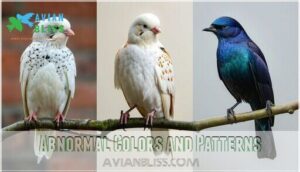
Several color abnormalities affect bird plumage naturally.
Albinism creates completely white feathers lacking melanin pigment, while leucism produces patchy white areas with some normal coloration remaining.
Melanism causes unusually dark, pigment-rich plumage.
These feather anomalies occur through genetic mutations affecting pigment production.
Dilute plumage appears faded yet retains normal patterns.
Melanistic birds display excess dark pigmentation throughout their feathers, showcasing melanistic characteristics.
Genetic Mutations and Environmental Influences
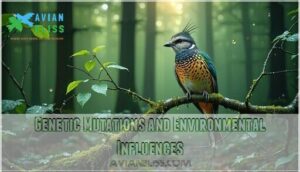
You’ll notice that genetic mutations create permanent color changes in your feathered subjects.
Unlike temporary environmental effects, these genetic aberrations alter melanin production pathways, creating lasting feather color variations.
Pollution exposure compounds these changes, often darkening plumage through heavy metal binding.
Research on bird colour effects has shown that environmental factors can substantially impact feather coloration.
- Melanin Effects: Excess production creates darker birds, while deficiency produces lighter variants
- Genetic Aberrations: Chromosome insertions disrupt normal pigment synthesis in specific body regions
- Feather Bleaching: UV radiation degrades proteins and carotenoids, causing structural color changes
Pigments and Color Production

When you examine bird plumage closely, you’ll discover that melanins create the foundation for most feather colors.
These pigments produce blacks, browns, and buffs through eumelanin and phaeomelanin variations. Carotenoids from diet generate brilliant yellows, oranges, and reds, while specialized pigments like psittacofulvins in parrots create unique hues.
Melanin production strengthens feathers against wear. The variety of colors and patterns in bird feathers can be attributed to the complex interplay of bird color pigments that create their distinctive appearances through the combination of different pigments and diet.
Bird Communication Methods
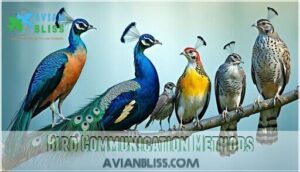
You’ll discover that birds use their plumage as a sophisticated communication system, sending visual messages about availability, dominance, and territory ownership.
Their feather colors and patterns function like living billboards, conveying essential information to potential mates, rivals, and even predators without making a sound, which is a key aspect of their communication system.
Plumage in Courtship and Mating
Bird courtship displays transform ordinary feathers into dazzling advertisements.
Males showcase breeding colors and elaborate plumage patterns to signal genetic fitness during mating rituals.
Peacocks spread iridescent tail feathers, while cardinals flash crimson crests.
These visual courtship displays help females assess potential mates through plumage signals that indicate health, age, and reproductive quality during sexual selection processes.
Sexual Dimorphism and Plumage
You’ll notice dramatic differences when comparing male and female birds of the same species.
**Male birds showcase their finest colors while females master the art of blending in.
Male plumage typically showcases vibrant colors and bold patterns designed to catch attention, while female camouflage prioritizes survival over spectacle.
This sexual dichromatism serves mate selection perfectly—colorful plumage signals genetic fitness and health.
Females evaluate these color signals when choosing partners, ensuring strong offspring survival rates.
The process of sexual selection mechanisms drives the evolution of these distinct plumage characteristics in many bird species.
Territorial Defense and Warning Signals
You’ll spot warning calls echoing through territories as birds defend their boundaries.
These territorial marks include aggressive displays, threatening postures, and distinctive alarm signals.
Male birds often use bright plumage combined with specific threat displays to warn intruders.
Their feather patterns become more pronounced during confrontations, creating visual boundary defense mechanisms that communicate ownership and readiness to fight.
The combination of these visual and auditory cues serves to establish a clear boundary defense, reinforcing the bird’s claim to its territory.
Plumage Evolution Factors
You’ll discover that plumage evolution isn’t random but follows predictable patterns shaped by environmental pressures and genetic constraints.
Climate, latitude, and habitat type work together like invisible sculptors, molding feather colors and patterns across bird populations over thousands of generations, influenced by environmental pressures.
Environmental Influences on Plumage

You’re about to discover how environmental factors shape bird plumage like master sculptors working clay.
Climate Change and Air Pollution don’t just affect weather patterns—they’re actively rewriting feather structure and molting patterns across species worldwide.
Environmental forces influencing bird plumage include:
- Climate Change – Rising temperatures and reduced rainfall cause measurable declines in plumage brightness and intensity
- Air Pollution – Heavy metals and urban pollutants alter feather coloration through contamination exposure
- Sun Exposure – Ultraviolet radiation bleaches feathers, creating paler appearances over time
- Diet Effects – Nutritional availability directly impacts pigment production and color vibrancy
- Habitat Influence – Vegetation cover and microhabitat selection drive camouflage adaptations
Research reveals darker plumage correlates with higher rainfall regions, while urban environments homogenize color diversity.
Environmental protection becomes essential as pollution sources demonstrably pale yellow plumage in factory-adjacent populations, showing nature’s immediate response to human impact.
Genetic Factors and Species Variation
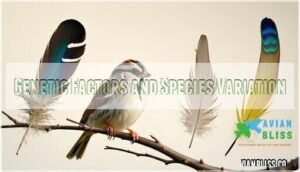
How does genetic variation shape the stunning diversity you’ll observe in bird plumage across species?
Supergenes containing over 1,000 genes control dramatic differences in white-throated sparrows, creating distinct color morphs within single species.
Major effect genes like MC1R determine melanic plumage, while BCO2 controls yellow versus white feathers.
These hereditary traits enable rapid color evolution through single-gene changes affecting melanins and carotenoid pigments throughout avian lineages.
Latitude and Climate Effects on Coloration
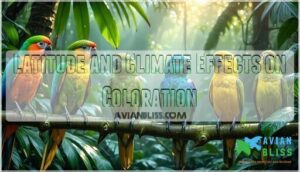
Geographic patterns paint a fascinating picture of how latitude influences bird color variations across our planet.
You’ll find tropical species displaying more vibrant hues than their temperate cousins, while climate effects drive remarkable adaptations.
- Tropical birds showcase higher colorfulness – Both males and females exhibit more saturated carotenoids and melanins near the equator
- Gloger’s rule governs darkness patterns – Darker feather coloration appears in wetter, more humid tropical environments
- Migratory species stay lighter – Long-distance travelers sport paler plumage to prevent overheating during flight
- Temperature drives thermoregulation – Hot climates select for lighter colors that efficiently dissipate heat energy
- Climate change shifts distributions – Warming temperatures cause color morphs to migrate northward approximately 1.5 km yearly
Adaptive Plumage Strategies

You’ll encounter birds using sophisticated plumage strategies that blur their outlines and protect them from harsh environments.
These adaptive features combine camouflage patterns with specialized feather structures to help birds survive, thrive, and navigate their ecological challenges.
Camouflage and Disruptive Patterns
Within nature’s endless game of hide-and-seek, birds master camouflage strategies through disruptive patterns that break up their outline.
These feather mimicry techniques use background matching and countershading to achieve concealment. Disruptive patterns create false edges, confusing predators’ visual systems.
Studies show these plumage patterns reduce attack rates by nearly 19%, proving outline disruption works effectively across diverse habitats.
Birds also utilize effective camouflage methods to enhance their survival chances in various environments.
Waterproofing and Insulation Functions
You’ll find that birds have mastered two critical survival skills through their plumage.
Waterproofing relies on interlocking barbules creating water repellent barriers, while preen gland oils boost hydrophobic properties by 80%.
Meanwhile, insulation layers from down feathers trap air, reducing heat loss by 90%.
This thermal regulation system rivals high-performance synthetic materials, with some Arctic species increasing feather density 25% seasonally for enhanced protection.
The unique properties of waterproof feather structures contribute to their remarkable adaptability in various environments, showcasing their highly efficient survival skills.
Frequently Asked Questions (FAQs)
Is it legal to keep feathers you find?
You can’t legally keep most found feathers in the US. The Migratory Bird Treaty Act prohibits possessing native bird feathers without permits. Only non-native species like House Sparrows are exempt.
How often do birds preen their feathers?
Like clockwork maintaining perfect order, you’ll witness birds preening their feathers multiple times daily.
They systematically clean, oil, and arrange each feather using their beaks, spending roughly 10-15% of their waking hours on this essential maintenance routine.
Can birds fly with damaged wing feathers?
You can fly with damaged wing feathers, but it depends on which ones are affected.
Primary flight feathers are critical—losing several makes flight impossible until they regrow during molting cycles.
Do baby birds have different feather types?
Newborn chicks possess downy neossoptile feathers that differ completely from adult teleoptile feathers.
You’ll notice these fluffy, insulating down feathers lack the structured barbules needed for flight, keeping babies warm while they develop proper contour feathers through molting.
How long does feather regrowth take?
Feather regrowth typically takes 4-8 weeks, depending on feather size and bird species.
You’ll notice flight feathers grow slower than smaller contour feathers, while down regenerates fastest during this natural replacement process.
What happens to shed feathers naturally?
Do shed feathers simply vanish into thin air? Naturally shed feathers decompose through bacterial action, becoming nutrients that enrich soil ecosystems while supporting new plant growth.
Conclusion
Throughout nature’s grand theater, bird feathers and plumage stand as masterpieces that blend artistry with engineering precision.
You’ve discovered how these remarkable structures serve multiple functions—from flight mechanics to thermal regulation, from camouflage to courtship displays.
Each feather type represents millions of years of evolutionary refinement, creating solutions that outperform human technology.
Understanding bird feathers and plumage reveals nature’s incredible ability to solve complex challenges through elegant design, reminding us that beauty and function aren’t opposing forces but complementary aspects of survival.