This site is supported by our readers. We may earn a commission, at no cost to you, if you purchase through links.
The cardinal lands exactly three feet from your lens, plumage blazing against morning light, but your footage shows nothing except a blurred red streak disappearing into branches. Most wildlife photographers discover this frustration early—birds won’t cooperate with your schedule, your positioning, or your carefully planned compositions.
Bird feeders for wildlife photography solve this ancient problem by transforming random chance into predictable opportunity, creating stages where species return reliably while you control lighting, angles, and backdrop.
Modern feeder cameras take this further, combining HD recording with AI identification to capture moments you’d otherwise miss entirely, from predawn feeding rituals to aggressive territorial displays. The difference between hoping for decent shots and consistently capturing gallery-worthy images often comes down to equipment that works with avian behavior rather than against it.
Table Of Contents
Key Takeaways
- Camera-equipped bird feeders transform wildlife photography from unpredictable waiting into controlled opportunity by combining AI species identification, motion-triggered recording, and strategic placement that documents natural behavior without disturbing your subjects.
- Successful feeder photography depends on positioning your setup 10–15 feet from shooting locations with careful attention to seasonal lighting shifts, clean backgrounds, and telephoto lenses between 300mm and 600mm that isolate subjects while maintaining frame-filling detail.
- Modern smart feeders deliver 2K-4K resolution with solar charging and weatherproof housings rated IP65 or higher, though you’ll need to balance features like AI identification subscriptions, storage capacity, and anti-squirrel protection against your specific backyard conditions.
- Ethical bird photography requires respecting wildlife behavior through minimal disturbance, consistent feeder maintenance to prevent disease transmission, and anticipating movement patterns 0.15–0.40 seconds before birds strike the feeder to capture authentic action frames.
Best Bird Feeders for Wildlife Photography
The right bird feeder can turn your backyard into a stage for wildlife moments you’d otherwise miss, capturing sharp images while you’re miles away or fast asleep. Camera-equipped feeders now combine AI identification, weatherproof durability, and wireless connectivity, giving you front-row access to species behavior without disturbing their natural rhythms.
Here are five feeders that deliver professional-quality footage and make bird photography feel less like a waiting game and more like controlled artistry.
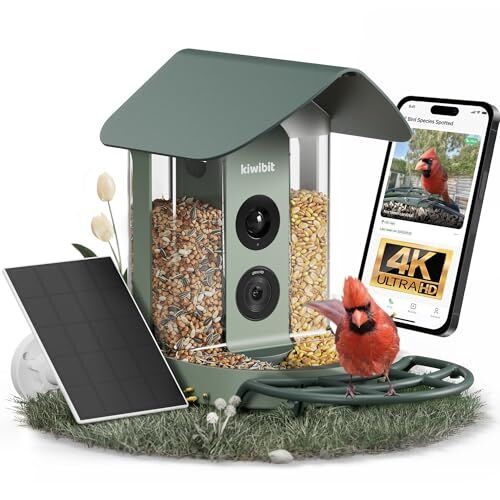
1. BROAIMX Bird Feeder Camera
The BROAIMX Bird Feeder Camera delivers 1080p image quality through a weather-resistant housing, transforming feeder placement into a strategic wildlife photography decision. It combines motion-triggered recording with infrared night vision to document bird behavior around the clock.
You’ll appreciate the wireless connectivity and local microSD storage options, which let you review footage from dawn visitors without disturbing their natural routines. The battery-powered design frees you to position this camera feeder wherever lighting and backgrounds align for compelling compositions.
| Best For | Bird enthusiasts and wildlife photographers who want to capture detailed footage of backyard visitors without constant manual monitoring. |
|---|---|
| Camera Resolution | 2K HD |
| AI Bird Recognition | 11,000+ species |
| Power Source | Solar + 5200mAh battery |
| WiFi Connectivity | 2.4GHz |
| Night Vision | Full-color |
| Weight | 3.74 lbs |
| Additional Features |
|
- 2K HD camera with AI recognition for 11,000 bird species makes identification effortless
- Solar-powered with 5200mAh battery means minimal maintenance and eco-friendly operation
- Two-way audio and real-time app alerts keep you connected to feeder activity from anywhere
- Seed hopper capacity requires more frequent refilling than larger traditional feeders
- WiFi range limited to 50 feet may restrict placement options in larger yards
- Solar charging dependency can reduce performance during extended cloudy periods or winter months
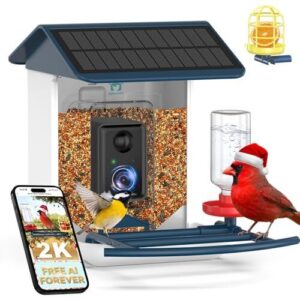
2. Beako Smart Bird Feeder Camera
The Beako Smart Bird Feeder Camera steps up image quality with HD recording and motion-triggered capture, giving you sharper footage of bird behavior while preserving battery life through scheduled power modes.
Its companion app lets you adjust camera settings remotely, fine-tuning exposure and color balance without approaching the feeder, which respects wildlife ethics by minimizing disturbance.
Local microSD storage pairs with optional cloud backup to archive your best shots, and the IP-rated housing manages rain and dawn condensation, simplifying feeder maintenance across changing seasons.
| Best For | Birdwatchers who want sharp HD footage and flexible storage options without constantly disturbing their backyard visitors. |
|---|---|
| Camera Resolution | 4K Ultra HD |
| AI Bird Recognition | 10,000+ species |
| Power Source | Solar + 5200mAh battery |
| WiFi Connectivity | 2.4GHz |
| Night Vision | Yes |
| Weight | 3.3 lbs |
| Additional Features |
|
- Motion-triggered recording saves battery and storage space by only capturing when birds are actually present
- Remote camera adjustments let you tweak settings without walking up to the feeder and scaring birds away
- Local microSD plus optional cloud backup gives you control over how and where you store your footage
- HD quality falls short of 4K, so fine details like feather patterns may not be as crisp in your recordings
- Battery life depends heavily on how often motion triggers the camera, which can vary wildly by location
- Requires stable Wi-Fi coverage at the mounting spot, limiting placement options in larger yards
3. Bird Feeder With Camera
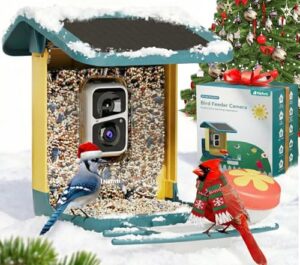
When you’re comparing Bird Feeder Camera Reviews, the generic Bird Feeder With Camera category covers pole-mount and tree-branch models that balance wildlife monitoring with practical camera placement. These Camera Feeders usually support 1080p streaming, weather-resistant housings rated IP65 or higher, and adjustable angles that help you frame bird behavior without constant feeder maintenance.
Smart Bird Feeders in this tier often pair solar charging with microSD storage, letting you adjust camera settings in the field and capture natural feeding moments while respecting the rhythms of your backyard subjects.
| Best For | Backyard wildlife enthusiasts who want hands-off monitoring with solid video quality and don’t mind adjusting placement for optimal lighting and camera angles. |
|---|---|
| Camera Resolution | 2K HD |
| AI Bird Recognition | 10,000+ species |
| Power Source | Solar + 5200mAh battery |
| WiFi Connectivity | 2.4GHz & 5GHz |
| Night Vision | Infrared |
| Weight | 4.84 lbs |
| Additional Features |
|
- Solar charging with battery backup means you won’t be swapping batteries every few weeks, especially if you mount it in a sunny spot.
- 1080p streaming and IP65 weather resistance let you capture clear footage in rain or shine without worrying about camera damage.
- Adjustable camera angles and pole or tree-branch mounting give you flexibility to frame shots that show natural feeding behavior.
- You’ll need to experiment with placement since lighting and field of view depend heavily on where you install the feeder and time of day.
- Microsd storage fills up quickly if you record a lot, so you’ll be managing files or upgrading cards regularly.
- Anti-squirrel features aren’t universal across all models, so lens protection and feed access may vary by brand.
4. Smart Bird Feeder Camera
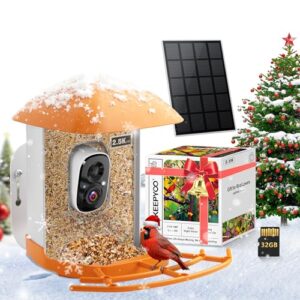
If you want richer control over camera settings and bird behavior documentation, Smart Bird Feeder models step up with AI species identification that sends real-time alerts when new visitors arrive. These camera feeders usually record 2K or higher resolution, letting you adjust frame rates and exposure on the fly—critical when morning light shifts rapidly.
Most support 2.4Ghz Wi-Fi for live streaming, microSD backup, and cloud storage subscriptions, so you can enhance your wildlife photography techniques without disturbing the natural feeding rhythm your backyard subjects prefer.
| Best For | Birdwatchers and nature enthusiasts who want AI-powered species identification and crystal-clear video footage of their backyard visitors without disturbing natural feeding behavior. |
|---|---|
| Camera Resolution | 2.5K HD |
| AI Bird Recognition | Yes |
| Power Source | Solar + rechargeable batteries |
| WiFi Connectivity | 2.4GHz |
| Night Vision | Yes |
| Weight | 2.8 lbs |
| Additional Features |
|
- AI bird recognition sends instant alerts when new species visit, plus 2.5K HD video captures sharp details even in shifting morning light
- Solar-powered design with rechargeable batteries means less maintenance and uninterrupted recording during peak activity times
- Supports multiple users for live streaming over 2.4Ghz WiFi, with both cloud and SD card storage options up to 128GB
- AI bird identification requires a paid subscription after the initial 30-day trial period
- Seed chamber latch can be tricky to open, and the feeder may attract squirrels or mice climbing the mounting pole
- Cloud storage needs a separate subscription, and some users report occasional issues with video downloads failing
5. PeckCam Bird Feeder Camera
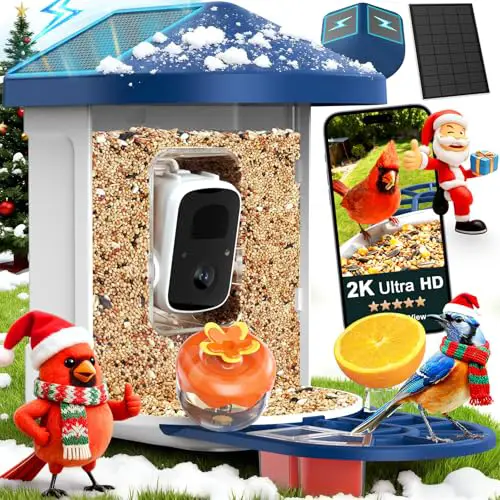
PeckCam Bird Feeder Camera delivers weather-resistant durability through ABS and polycarbonate housing that shields electronics from Virginia rain while its 2K resolution captures sharp bird photography even in low forest light.
The three solar panels keep batteries charged during field sessions, and motion detection triggers recording automatically when cardinals or finches approach, letting you study bird behavior without manual camera settings adjustments.
At 4.72 pounds, this camera feeder mounts securely to minimize shake, and routine feeder maintenance requires only microfiber lens cleaning to preserve image quality for ongoing wildlife conservation documentation.
| Best For | Backyard birders and wildlife enthusiasts who want automated bird identification and high-quality video capture without managing separate cameras or missing rare species visits. |
|---|---|
| Camera Resolution | 2K HD |
| AI Bird Recognition | 10,000+ species |
| Power Source | 3 solar panels + battery |
| WiFi Connectivity | 2.4GHz |
| Night Vision | Full-color |
| Weight | 4.72 lbs |
| Additional Features |
|
- Three solar panels with battery backup provide continuous power for extended outdoor use without frequent recharging interruptions
- 2K HD resolution with full-color night vision captures sharp bird footage in varying light conditions, from bright daylight to dawn and dusk
- AI recognition identifies over 10,000 bird species instantly with motion-triggered alerts, so you never miss uncommon visitors
- Plastic-wrapped cables are vulnerable to damage from squirrels and climbing mice, potentially requiring extra protective measures
- Setup instructions may be insufficient for some users, making initial installation and configuration more challenging
- Full AI features and expert tips require a subscription, adding ongoing costs beyond the initial purchase price
Key Features to Look For
Not all bird feeder cameras are created equal, and choosing the right one can mean the difference between blurry snapshots and portfolio-worthy images. The features that matter most aren’t always the ones manufacturers shout about in their marketing, so you’ll want to know what actually has an impact in the field.
Here’s what to prioritize when you’re ready to invest in a feeder that’ll help you capture those intimate, frame-worthy moments.
Battery Life and Power Options
Nothing kills a wildlife photography session faster than a dead battery. Look for feeders that deliver 1,000–3,000 shots per standard AA set, though lithium cells stretch that by two to three times in cold weather.
Solar charging and external powering options keep your camera equipment for wildlife photography running through marathon observation sessions, while low power modes preserve juice between bird visits without sacrificing the weatherproof reliability you need for outdoor camera installation.
Ensuring the methodological rigor of equipment testing is vital for peak performance.
Smart Bird Identification Capabilities
Machine learning has turned feeders into field guides that recognize 1,000+ bird species with 70–90% accuracy, tracking visits so you know when your target arrives.
Real-time alerts let you grab your lens the moment a scarlet tanager lands, while multi-modal image analysis—reading color, shape, and bird behavior—sharpens identification even under tricky light, transforming casual backyard sessions into strategic wildlife photography expeditions.
Durability and Weather Resistance
Your feeder lives outside 24/7, so look for IP65-rated housings that laugh off rain and dust, plus powder-coated aluminum or UV-stabilized plastics that resist corrosion and fading.
Weatherproof materials with sealed compartments keep moisture away from electronics, while temperature tolerance from -20°C to 50°C ensures your setup captures shots year-round, no matter what nature throws at it.
Easy Cleaning and Maintenance
A feeder that fights you during cleaning won’t last long in your rotation, so prioritize removable trays, snap-apart seed chambers, and wide openings that let you scrub every corner where mold hides.
Weekly maintenance schedules keep feeding stations healthy, while polycarbonate bodies and centralized drainage systems shed water fast, preventing the bacterial buildup that turns prime shooting locations into health hazards for your subjects.
Feeder Placement Tips for Perfect Shots
Where you position your feeder makes the difference between snapshots you’ll delete and images that stop people mid-scroll. The sweet spot isn’t just about getting close enough for sharp shots—it’s about understanding how distance, background, and light work together to create photographs that feel alive.
Here’s how to set up your feeding station so every frame captures the wild freedom you’re after.
Ideal Distance From Shooting Location
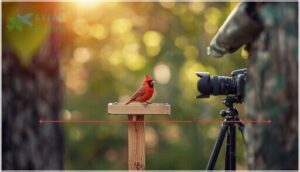
Getting the distance right between your feeder and camera setup makes the difference between skittish subjects and relaxed, natural behavior. Bird perception of human presence kicks in around 10–15 feet, so position your feeder at least that far from your shooting location to maintain authentic foraging activity while still capturing sharp, frame-filling detail.
- Use hides or natural cover to extend effective distance by 4–6 meters without sacrificing image quality
- Adjust camera placement by 1–2 meters seasonally to fine-tune lighting angles and minimize harsh shadows
- Remote setups allow 5–20 meter distances, preserving wildlife behavior while maintaining photographic control
- Consider shooting angles that incorporate clean backgrounds 10–30 feet beyond the feeder for professional bokeh
Minimizing Disturbance to Birds
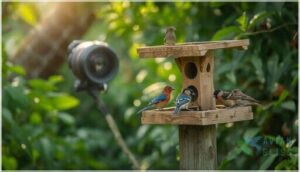
Once you’ve nailed your shooting distance, respecting your subjects’ comfort becomes the heart of ethical bird photography. Bird-friendly designs with multiple feeding stations reduce crowding, while noise reduction through quiet mechanisms keeps approach behavior natural. Position feeders away from high-traffic zones, limit monitoring visits to essential times, and employ camera concealment to capture authentic wildlife moments without triggering flight responses.
| Disturbance Factor | Wildlife Ethics Solution |
|---|---|
| Visual stress from movement | Use motion-free feeder mechanisms and remote camera concealment |
| Crowding at single perch | Install multiple feeding stations to distribute bird behavior naturally |
| Repetitive human visits | Limit monitoring to essential times, automate capture when possible |
| Sensitive breeding periods | Adjust feeder placement seasonally following bird photography techniques |
Seasonal Adjustments for Best Lighting
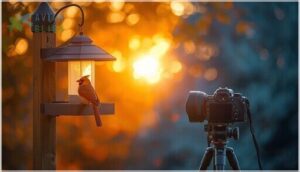
Beyond respecting your subjects’ space, mastering seasonal lighting transforms ordinary shots into gallery-worthy captures. Golden hours shift with daylight saving and latitude, so adjust your feeder’s angle quarterly to track warmer morning light in spring and oblique afternoon rays in summer.
Winter’s soft, extended twilight demands higher ISO exposure settings, while autumn fog calls for careful light metering to preserve natural color temperature in your bird photography techniques.
Essential Photography Techniques
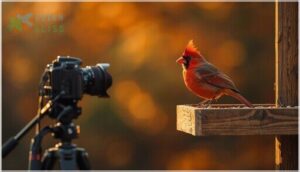
You’ve got your feeder positioned perfectly, now it’s time to capture images that actually tell a story. The right photography techniques transform ordinary backyard visitors into frame-worthy subjects, whether you’re shooting manually or relying on automated feeder cameras.
Let’s break down the essential approaches that’ll enhance your bird photography from snapshots to stunning wildlife portraits.
Optimal Camera Angles and Perspectives
Your angle transforms ordinary bird portraits into striking wildlife photography. Position yourself at eye level with perched subjects to capture intimate expressions and feather texture, while slightly lower angles emphasize flight shots against clean sky backgrounds. Camera feeders let you pre-test angles before birds arrive, ensuring you’re ready for action frames.
- Shoot level with the bird’s eyes to create engaging bird portraits that draw viewers into the moment
- Lower your position 15-20 degrees to isolate flight shots and wing mechanics against uncluttered skies
- Align slightly above nest height for nesting scenes that document behavior without causing disturbance
- Frame subjects using natural foreground branches to add depth in wildlife landscapes while maintaining focus
- Test photography composition techniques with stationary feeders, then apply those angles to varied behavior and action frames.
Lens Selection for Bird Photography
Your lens choice makes or breaks bird photography. Telephoto lenses between 300mm and 600mm bring distant subjects close while blurring distracting backgrounds, and prime optics deliver sharper detail than zooms at matching focal lengths.
Image stabilization becomes your secret weapon when handholding these beasts, while lens calibration ensures every feather stays razor-sharp across the frame—critical photography equipment decisions that separate striking wildlife photography from forgettable snapshots.
Focusing on Bird Behavior and Movement
You’ll capture magic when you anticipate feeding habits and flight patterns before they unfold.
Watch how birds telegraph their next move through tail fanning or brief wing shakes—those micro-signals occur 0.15–0.40 seconds before they strike the feeder, giving you split-second framing opportunities that transform ordinary bird watching into visceral wildlife photography tips that celebrate authentic social interactions and nesting behavior rhythms.
Birds telegraph their next move through tail fanning and wing shakes 0.15–0.40 seconds before striking the feeder, giving you split-second framing opportunities
Safety and Ethics in Outdoor Photography
Respect becomes your lens when you photograph wild subjects—your environmental impact and photographer responsibility matter as much as shutter speed.
Keep feeder sites clean to protect animal welfare, maintain distances that honor wildlife conservation efforts, and pack out every wrapper to support nature conservation.
These ethical practices help your outdoor photography safety habits boost wildlife conservation rather than compromise the species you’re celebrating through your outdoor photography tips.
Frequently Asked Questions (FAQs)
How often should I refill my bird feeder?
Your refill schedule depends on feeder capacity, bird activity, and season—daily in winter when energy demands peak, weekly in summer when natural food abounds, with regular cleaning preventing spoilage and disease transmission.
To maintain a consistent food source, consider checking the refill frequency guide for best results.
What food attracts the most photogenic bird species?
Think of your feeder as a casting call—the right menu draws the stars. Black oil sunflower seeds attract cardinals and chickadees, while suet brings woodpeckers’ dramatic poses to your backyard bird photography sessions.
Can I use flash photography with bird feeders?
Flash can startle birds and disrupt their natural behavior at feeders, making it ethically questionable for wildlife photography.
Instead, rely on higher ISO settings, wider apertures, and natural light to capture authentic moments.
How do I prevent squirrels from raiding feeders?
Outsmarting these acrobatic bandits means choosing weight-activated feeders with baffle designs and feeder guards.
Squirrel deterrents like smooth pole mounting and strategic feeder placement create squirrel-resistant bird feeding stations that protect your seeds while keeping birds accessible.
What time of day produces the best lighting?
Golden hour delivers the magic—shoot during morning light within an hour of daybreak moments or late afternoon before sunset shots.
Twilight photography captures warm tones that make bird photography and wildlife photography sing with dimensional depth.
Conclusion
Feathered subjects won’t wait for perfect conditions—you bring perfect conditions to them. Strategic bird feeders for wildlife photography eliminate the guesswork that leaves most shooters empty-handed, replacing hope with repeatable results through controlled staging and reliable return visits.
Combine smart placement with feeder cameras that capture behavior round-the-clock, and you’re not just photographing birds anymore—you’re documenting their unguarded moments, the territorial disputes and dawn rituals that define truly compelling wildlife imagery.