This site is supported by our readers. We may earn a commission, at no cost to you, if you purchase through links.
You’ve spotted movement in the canopy, raised your 400mm lens, and captured what you think might be a Tennessee Warbler—until you review the shot and notice the eye-ring doesn’t quite match. This moment of uncertainty, multiplied across dozens of field outings, reveals why bird field guides for photographers serve a dual purpose: they sharpen your identification skills before the shutter clicks and validate your captures after you’ve packed up your gear.
The difference between a regional sparrow and a rare vagrant can hinge on subtle plumage details that only become apparent when you cross-reference behavior, habitat, and those critical field marks like wing bar angles or undertail covert patterns.
The guides that excel for photographers don’t just catalog species—they decode the visual language of posture, lighting conditions, and seasonal variation that transforms a lucky snapshot into a documented observation backed by fieldcraft and technical precision.
Table Of Contents
Key Takeaways
- The best bird field guides for photographers combine high-quality photos or illustrations with detailed field marks, behavioral cues, and habitat information that help you identify species quickly before the shot and verify captures afterward.
- Regional guides excel when they cover at least 120 local species with seasonal distribution maps, elevation ranges, and accessible hotspot locations that let you plan productive shoots based on migration patterns and daily activity windows.
- Photo-based guides show real-world plumage variation but add visual clutter, while illustration-based guides strip away backgrounds to emphasize diagnostic marks, making each format better suited to different field conditions and identification challenges.
- Integrating field guides into your workflow means using habitat descriptions and behavioral notes to anticipate bird movements before you shoot, then annotating your guide with custom GPS coordinates, lighting angles, and species-specific camera settings that turn generic references into personalized shooting tools.
Essential Features in Bird Field Guides
When you’re standing in the field with your camera, the right field guide can mean the difference between nailing the shot and missing it entirely. Not all guides are built with photographers in mind, and the features that matter most to us differ from what casual birders need.
A solid birdwatching field guide comparison helps you zero in on which features—like range maps, image quality, or portability—actually support your photography workflow.
Here are the essential elements you should look for in a field guide that will actually support your photography work.
Visual Identification Aids for Photographers
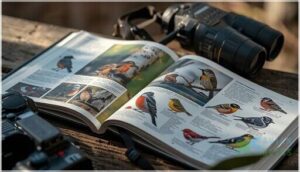
The strongest photographic guides combine full-color photographs with detailed illustrations to highlight plumage patterns, silhouette cues, and behavioral depictions that make bird identification faster in the field.
You’ll find that field guides using high-contrast markers help you distinguish species during quick passes, while habitat context annotations and multi-angle wing bar profiles give you reliable visual references when birds are moving or backlit.
Techniques similar to those used in can improve accuracy when distinguishing hard-to-identify species in bird photography.
Coverage of Regional Bird Species

Regional guides excel in bird photography when they document at least 120 local species with full-color photographs showing seasonal distribution and habitat specificity. You’ll want editions that cover:
- Local endemics unique to your biogeographic area
- Migratory passages with peak arrival months
- Elevation ranges across mountain-to-lowland gradients
- High-resolution range maps marking accessible hotspots
This regional species breadth helps you target productive locations and anticipate which photographic guides to pack for specific shooting conditions.
Behavioral and Habitat Information

Look for field guides that decode Vocalization Cues and Daily Rhythms, since alarm calls within 50 to 100 meters signal incoming action while dawn territory defense reveals active poses.
Roosting Preferences and habitat information—such as preferred perch heights of 5 to 15 meters or shrub density details—let you scout productive zones and anticipate bird behavior before you lift your camera, sharpening your behavioral observation and photographic technique.
Portability and Durability for Field Use

Understanding habitat and behavior means nothing if your field guides disintegrate after a few wet outings, so prioritize durable materials like ripstop nylon covers and laminated pages that handle moisture, mud, and repeated handling.
Compact designs—often A5 or pocket size—slip into camera bags without adding weight, while water resistance and reinforced bindings guarantee your bird identification resources survive field-tested conditions, letting you focus on capturing decisive moments rather than protecting fragile books.
Top Bird Field Guides for Photographers
After years of shooting birds in the field, I’ve learned that the right guide can make the difference between a missed shot and a portfolio-worthy image.
The following six field guides stand out for their practical value to photographers, whether you’re tracking warblers through dense foliage or waiting for raptors at your favorite overlook.
Each offers something unique, from specialized identification systems to photography-specific behavioral insights that help you anticipate the perfect moment.
1. Peterson Field Guide To Birds

The Peterson Field Guide to Birds remains one of the most influential field guides for photographers working east of the Rockies, thanks to its distinctive pointer system that highlights the exact features you need to identify birds quickly in the field.
This compact guide, measuring 5.25 x 8 inches across 445 pages, uses detailed illustrations paired with brief captions that call out key field marks like wing patterns and tail characteristics, making it easy to confirm a species before it flies off while you’re adjusting your camera settings.
| Best For | Birders and wildlife photographers in eastern and central North America who want a portable field guide with a proven identification system that highlights key features for quick species recognition. |
|---|---|
| Format | Paperback guide |
| Page Count | 445 pages |
| Language | English |
| Publication Year | 2010 |
| Color Images | Yes |
| Target Audience | All birders |
| Additional Features |
|
- Unique pointer system draws attention to distinguishing features, making it easier to identify birds quickly before they move
- Includes both color and black-and-white illustrations plus photographs, giving multiple visual references for each species
- Compact size (5.25 x 8 inches) makes it more field-friendly than larger guides while still covering 445 pages of content
- Range maps are grouped in the back of the book instead of appearing with each species, requiring you to flip back and forth
- Slightly heavier and bulkier than some competing field guides, which can be tiring during long field trips
- Doesn’t include audio recordings of bird calls, which many modern birders and photographers find helpful for identification
2. Stokes Eastern Region Bird Field Guide

The Stokes Eastern Region Field Guide delivers 545 species across 512 pages, with over 2,000 color photographs that show adult, juvenile, breeding, and non-breeding plumages side by side, giving you the visual reference you need to identify birds in different seasons and life stages.
You’ll find detailed range maps that clearly mark seasonal distribution, migration routes, and year-round presence, while behavioral notes on perching habits and foraging strategies help you anticipate photo opportunities and position yourself effectively in edge habitats and riparian zones.
| Best For | Birders in eastern North America who want a portable field guide with clear photos showing seasonal plumages and behavior details to help with quick identifications on the trail. |
|---|---|
| Format | Paperback guide |
| Page Count | 512 pages |
| Language | English |
| Publication Year | 2013 |
| Color Images | Yes |
| Target Audience | All birders |
| Additional Features |
|
- Over 2,000 color photos showing birds in different life stages and seasons, making identification easier when plumage varies
- Detailed range maps and behavioral notes help you predict where and how birds will appear, useful for planning photo setups
- Compact size at 1.7 pounds means you can carry it in the field without weighing down your pack
- Maps can be small and hard to read, which might slow you down when checking ranges quickly
- Doesn’t dive deep into nesting or feeding behaviors, so you may need another guide for that level of detail
- Limited to eastern species only, so it won’t help if you travel west or want a continent-wide reference
3. North American Warbler Identification Guide

When warblers flit through spring canopy light, you’ll appreciate the 1,000+ photographs and detailed sonograms in this Princeton University Press guide. It covers all 56 North American species with multiple viewing angles that show eye rings, wing bars, and crown patches essential for rapid identification.
You’ll navigate 560 pages of plumage variability across seasons, geographic range maps that track migration windows, and habitat notes on foraging strata. However, the 2.06-pound weight makes it better suited for pre-shoot research than fieldwork in dense undergrowth.
| Best For | Serious birdwatchers and ornithology students who want comprehensive coverage of warbler identification, including detailed plumage variations and song analysis, and don’t mind a heavy reference book. |
|---|---|
| Format | Hardcover guide |
| Page Count | 560 pages |
| Language | English |
| Publication Year | 2013 |
| Color Images | Yes |
| Target Audience | Warbler enthusiasts |
| Additional Features |
|
- Over 1,000 color photos showing multiple angles make it easier to identify warblers no matter how they’re positioned
- Innovative sonogram system helps you learn to distinguish between similar-sounding species
- Covers all 56 North American warbler species with extensive details on plumage, calls, and behavior
- Weighs over 2 pounds and measures 7×9 inches, making it impractical to carry on long hikes or field trips
- Sonograms can be tough to interpret if you’re not already familiar with reading sound visualizations
- The specialized, in-depth content may overwhelm beginners who just want basic identification help
4. Bird Photography Field Guide Book
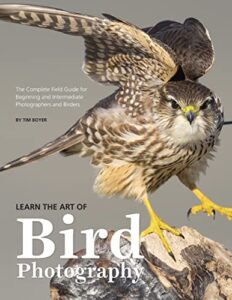
If you’re just starting to build your bird photography skills, this CreateSpace guide delivers practical instruction across 154 pages of camera settings, composition fundamentals, and ethical fieldwork practices.
You’ll work through hands-on practice sessions that translate exposure theory into real shooting scenarios, plus a curated list of North American hot spots to plan your next outing.
At 1.14 pounds with 8.5 x 11-inch dimensions, it’s designed for home study rather than field carry, though some readers noted editing inconsistencies that occasionally disrupt the instructional flow.
| Best For | Beginning and intermediate photographers who want to improve their bird photography through structured lessons on camera settings, composition, and field techniques. |
|---|---|
| Format | Instructional book |
| Page Count | 154 pages |
| Language | English |
| Publication Year | 2018 |
| Color Images | Yes |
| Target Audience | Beginner/intermediate photographers |
| Additional Features |
|
- Covers the full workflow from camera setup to composition and ethical field practices
- Includes hands-on practice sessions that help you apply concepts in real shooting situations
- Provides a list of bird photography hot spots across North America for trip planning
- Contains editing issues with grammatical errors and unclear phrasing that can interrupt learning
- The image processing section feels rushed and doesn’t match the depth of earlier chapters
- Written with Canon equipment in mind, so users of other camera brands need to translate the instructions
5. Bird Photography Field Guide
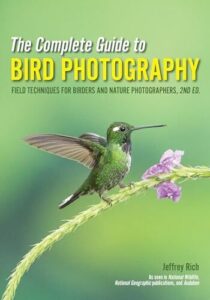
At 128 pages packed with over 180 full-color images, this Amherst Media guide balances equipment selection advice with postproduction techniques you’ll actually use in Adobe Lightroom, from noise reduction to black-and-white conversions.
You’ll find detailed coverage of camera settings, compositional choices that apply the rule of thirds without feeling formulaic, and practical tips for attracting birds to controlled shooting environments.
Published in September 2018 with dimensions of 7 x 0.5 x 10 inches, it caters to beginners and professional photographers new to avian subjects equally well.
| Best For | Beginners and professional photographers who are new to bird photography and want to learn both field techniques and post-processing skills. |
|---|---|
| Format | Instructional book |
| Page Count | 128 pages |
| Language | English |
| Publication Year | 2018 |
| Color Images | Yes |
| Target Audience | Beginner/professional photographers |
| Additional Features |
|
- Over 180 full-color images provide visual examples of techniques and bird photography in action
- Covers the complete workflow from equipment selection and camera settings to Adobe Lightroom post-production
- Includes practical advice on attracting birds and finding subjects ethically in the field
- Published in 2018, so some equipment recommendations and software techniques may be outdated
- Focuses primarily on field photography, which limits its usefulness for studio or controlled environment work
- May lack the depth advanced bird photographers need for specialized techniques
6. Bird Photography Field Guide for Digital SLR
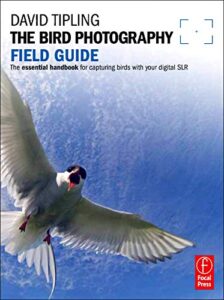
If you shoot with a digital SLR and want guidance suited to your gear’s technical strengths, this Focal Press title at 192 pages covers telephoto lenses from 300 to 600 mm, image stabilization for steadier handheld shooting, and DX format crop factors that effectively extend your reach for distant subjects.
You’ll learn servo autofocus techniques for tracking birds in flight, high ISO performance up to 12,800 for faster shutter speeds in dim conditions, and RAW workflow strategies that preserve feather detail through extensive post-processing without quality loss.
| Best For | Digital SLR photographers at any skill level who want practical, field-ready advice on telephoto lenses, autofocus tracking, and RAW editing tailored specifically to bird photography. |
|---|---|
| Format | Instructional book |
| Page Count | Not specified |
| Language | English |
| Publication Year | Not specified |
| Color Images | Yes |
| Target Audience | All photographers |
| Additional Features |
|
- Covers the full workflow from camera settings and field techniques to post-processing and photo enhancement
- Compact size makes it easy to carry in your camera bag for quick reference while shooting
- Addresses technical aspects like servo autofocus, high ISO performance, and crop factor advantages that matter for bird photography
- Small font size can strain your eyes, especially when trying to read it outdoors
- Lacks in-depth coverage of manual settings and photography modes that some shooters need
- The compact format that makes it portable also makes it harder to use as a detailed reference guide in the field
Choosing The Right Guide for Bird Photography

Picking a field guide isn’t about finding the “best” one—it’s about matching the format and content to how you actually work in the field with your camera.
Different shooting styles, from wildlife portraiture to flight photography, require different kinds of information at different levels of detail.
The right guide becomes a working tool that fits your gear setup, your target species, and the behavioral insights you need to anticipate the shots you’re after.
Matching Guide Format to Camera Gear
Your camera system dictates which field guides deliver the most value in the field, since sensor matching and equipment synchronization guarantee the visual references align with your viewfinder experience.
When you’re using a full-frame DSLR with telephoto lenses, guides featuring scale-labeled field marks help you quickly identify birds through your camera settings, making field techniques for bird photography more efficient and your photographic equipment work harder for you.
Specialized Guides for Challenging Species
When warblers, sparrows, or shorebirds consistently evade your lens, specialized birding guides become indispensable bird identification resources that decode subtle field markers and conservation status variations within these challenging groups.
- Dorsal and ventral view plates with scale bars establish size reference for quick species identification
- Regional checklists map target species to known migratory corridors photographers frequent
- Courtship display sequences with typical vocalizations reveal prime photographable behaviors
- Seasonal plumage changes documented through photography tips expand your identifiability windows
- High-contrast plumage pairs distinguish lookalikes under varying light conditions you’ll encounter
Comparing Photo-based Vs. Illustration Guides
You’ll face a fundamental tradeoff between realism vs. clarity when choosing field guides for bird photography: photographs capture exact plumage detail and cognitive load from backgrounds, while illustrations strip away clutter to emphasize diagnostic marks and range detail.
Field guide photos show real plumage but add visual clutter, while illustrations clarify diagnostic marks by stripping away distracting backgrounds
Photo-based volumes excel at showing real-world variation but sacrifice field durability and portability, whereas illustration guides offer lightweight, weather-resistant identification that simplifies complex comparisons without overwhelming your visual processing during quick field checks.
To understand how these differences impact scientific communication, see this explanation of illustration versus photography in science.
Evaluating Depth of Behavioral Content
Beyond static identification, the best field guides provide behavioral analysis that elevates your photography strategies—look for content depth covering foraging postures, territorial displays, and species interactions with timing notes you can apply during field observations.
Guides that map behavioral context to microhabitats and seasonal windows transform bird identification into actionable intel, letting you anticipate photographic moments rather than simply reacting to avian behavior study opportunities as they unfold.
Integrating Field Guides Into Photography Workflow

Your field guide shouldn’t sit in the truck while you’re out shooting—it’s a working tool that shapes how you plan, execute, and learn from every photography session.
The most effective photographers build their guides into each stage of their workflow, from pre-shoot research to post-processing identification checks.
Here’s how to make your field guide an active partner in capturing better bird images.
Planning Shoots Based on Guide Information
Your field guides aren’t just for bird identification—they’re essential Location Scouting tools that shape every shoot. Study habitat descriptions and seasonal patterns to predict where target species perch, feed, and display, then cross-reference daily activity windows with golden hour light for ideal Shoot Scheduling.
Behavioral notes help you anticipate flight paths and set Camera Settings ahead of time, transforming reactive field observation into deliberate, behavior-driven composition planning.
Using Guides for Real-time Identification
When a distant silhouette catches your viewfinder, flip to the guide’s plates and run through rapid Species Differentiation by comparing size, posture, and tail shape for Bird Silhouette Analysis.
Field Mark Recognition drives Real Time Verification—cross-check color patches or bill angle while the subject perches, using the quick reference tabs to resolve Identification Strategies that separate confusingly similar species during fleeting photo opportunities.
Leveraging Audio Resources for Behavioral Cues
Often, bird vocalizations telegraph what’s about to happen—rapid chatters signal takeoffs, letting you pre-focus before the action peaks, while Audio Cue Mapping links species-specific calls to perch behavior within minutes of detection. Audio Guided Scouting and Behavioral Acoustics sharpen your timing:
- Territorial trills warn you a display is brewing, prompting you to shift position and dial in exposure settings
- Sound Pattern Analysis reveals mixed-age flocks through voice differences, influencing your lens choice and shooting stance
- Audio collections from Macaulay Library help you recognize regional dialects and forecast bird behavior even when plumage offers few clues
Annotating Field Guides for Personal Reference
Custom Notes transform a generic reference into a tool as unique as your lens kit. Guide Customization begins with Field Mark Symbols beside each species—red dots for common sightings, blue for rarities—while Annotation Techniques stack behavioral cues, preferred light angles, and GPS coordinates in margins, turning static field guides into living reference books that accelerate bird identification during scouting and post-shoot verification.
| Annotation Type | Implementation Method |
|---|---|
| Field Mark Symbols | Color-coded status dots beside species names |
| Behavioral Notes | Margin entries linking calls to camera settings |
| Location Data | GPS coordinates logged for seasonal patterns |
| Reference Organization | Back-of-book index cross-referencing similar species |
Enhancing Bird Photography With Guide Insights

The real power of field guides shows up when you apply what you’ve learned to your photography sessions, turning identification knowledge into technical advantages behind the lens. Understanding behavior patterns, habitat preferences, and seasonal movements lets you position yourself in the right place at the right time with camera settings already dialed in.
Here’s how you can transform guide insights into stronger images and more successful field outings.
Anticipating Bird Behavior for Better Shots
Reading field guides before dawn sharpens your predictive photography instincts, because understanding bird communication—wing claps, tail raises, territorial calls—lets you anticipate flight patterns seconds before they unfold.
When you recognize foraging routes and habitat timing cues through field observation, you position your lens where action will happen, not where it just occurred, transforming wildlife anticipation into consistently sharp, behavior-rich images that showcase wildlife photography skills.
Utilizing Habitat and Seasonal Data
Field guide habitat mapping reveals where seasonal variations drive bird migration through specific plant communities, water sources, and elevation zones, letting you predict foraging hotspots by cross-referencing bloom calendars with weather forecasts.
When you track ecosystem dynamics—insect emergence, fruiting phenology, climate patterns—you’ll position your camera at riparian edges or meadow transitions where habitat-specific birding opportunities peak, overcoming bird identification challenges through informed timing rather than chance encounters.
Improving Composition Using Field Marks
Once you know which wing bars, eye rings, and plumage patterns define a species, you can align those field marks along leading lines in your frame—a perching branch or reed directing the viewer’s eye toward the bird’s diagnostic features.
While establishing visual balance through color contrast, depth layering, and framing techniques, these methods transform identification cues into deliberate compositional choices.
Documenting Rare or Elusive Species
When rare species appear in your viewfinder, field mark notes and time-stamped photos form the backbone of sighting verification—camera metadata, GPS coordinates, and behavioral sketches all strengthen data submission to regional committees.
Ethical documentation means using zoom lenses rather than flushing stressed vagrants, while technology aids like portable audio recorders capture diagnostic calls that photos alone can’t confirm.
Frequently Asked Questions (FAQs)
How do audio guides complement visual field guides?
Audio collections transform species differentiation by pairing vocalizations with field mark enhancement. When visual confirmation is uncertain, bird call analysis through recordings reinforces bird identification, enabling you to cross-reference audio resources for birding with visual cues instantly.
Which guides work best for international bird photography?
Like a passport stamped for every continent, your international bird photography toolkit demands guides with global birding tips: choose Collins Bird Guide for Europe, Helm Field Guides for regional species research, and Birds of the World Online for exhaustive travel planning.
Are digital field guide apps better than books?
Neither format dominates every scenario, so your field guide selection criteria should weigh app features like offline access and guide updates against print’s reliability, creating a hybrid approach that matches your shooting conditions and user experience preferences.
How often should you update your field guides?
Don’t let your guides become field relics—update frequency hinges on taxonomy changes and edition cycles, usually every one to five years.
Though digital supplements maintain guide relevance between exhaustive species guides’ updated editions for accurate bird identification.
Can field guides help identify birds by song?
Field guides often include vocalization tips and song patterns for species identification, featuring sonograms and audio matching tools to help you confirm bird songs against written descriptions and recordings for accurate avian identification.
Conclusion
Like a telephoto lens that collapses distance between you and your subject, bird field guides for photographers compress the gap between recognition and certainty in the field. The right guide transforms those fleeting encounters with warblers, sparrows, and raptors into documented moments backed by precise identification, giving you the confidence to shoot decisively when behavior, lighting, and composition align.
Your next standout image starts with knowing exactly what you’re photographing before you press the shutter.