This site is supported by our readers. We may earn a commission, at no cost to you, if you purchase through links.
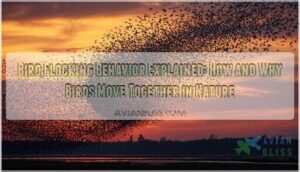 When thousands of starlings sweep across the evening sky, twisting and turning as one fluid organism, they’re not following a leader or rehearsing choreographed moves—they’re each responding to the movements of their seven nearest neighbors. This simple rule, replicated across the entire flock, creates those breathtaking aerial displays called murmurations that seem to defy physics.
Bird flocking behavior explained comes down to elegant mathematical patterns emerging from basic interactions: maintain spacing, match velocity, stay cohesive. But these aren’t just pretty spectacles—flocking is survival mathematics in action. A sparrow in a group of 50 cuts its predation risk by half compared to a lone bird, while geese flying in V-formation save up to 30% of their energy on long migrations.
Understanding how and why birds move together reveals one of nature’s most fluid group survival strategies, refined over millions of years into the smooth coordination you see overhead.
Table Of Contents
- Key Takeaways
- What is Bird Flocking Behavior?
- How Flocks Form and Stay Organized
- Survival Benefits of Flocking
- Types and Patterns of Bird Flocks
- Environmental and Biological Influences on Flocking
- Frequently Asked Questions (FAQs)
- What is flocking behavior?
- What is a bird flock?
- How do birds lead a flock?
- Why do birds live in a flock?
- How does flocking benefit birds?
- What does it mean when a bird sees a large flock?
- How do birds avoid collisions in dense flocks?
- Can flocking behavior be observed in captive birds?
- Do juvenile birds learn flocking from adult birds?
- How does flock size affect individual decision-making?
- Conclusion
Key Takeaways
- Bird flocking emerges from each bird following simple rules—maintaining spacing, matching velocity, and staying cohesive with just seven nearest neighbors—which creates complex aerial displays without any central leader or choreography.
- Flocking delivers measurable survival advantages, including a 50% reduction in predation risk for grouped birds compared to solitary individuals and up to 30% energy savings for geese flying in V-formation during migration.
- Environmental factors like temperature drops, habitat fragmentation, and predation pressure directly shape flock behavior, with flock sizes doubling in complex habitats and increasing 40% in high-risk areas while cold weather boosts flocking rates by 1.8 times.
- Leadership in flocks rotates continuously based on individual traits like speed and boldness rather than fixed hierarchy, allowing position switching that reduces energy costs and ensures every member contributes to navigation and survival decisions.
What is Bird Flocking Behavior?
Bird flocking behavior is more than just birds flying together—it’s a complex, coordinated way of moving, feeding, and surviving as a group. You’ll notice some patterns and traits that make this phenomenon unique across different species and habitats.
Let’s look at what defines flocking, how it’s been observed over time, and which birds are most likely to join in.
Definition and Key Characteristics
Flocking behavior is the collective movement you see when birds coordinate their locations and timing, creating a living tapestry in the sky. This group interaction relies on simple interaction rules—each bird aligns with neighbors, keeps a set distance, and reacts quickly.
The emergent order and social structure allow flocks to move as one, revealing intricate behavioral patterns in nature. Studies show that birds maintain a minimum distance from each other.
Historical Observations and Famous Examples
You’re not alone in your fascination—people have watched bird flocks for centuries. Think of Darwin’s Observations on pigeons, Audubon’s Flock spanning 500 km, or Roman Omens interpreting flock movements. The Selfish Herd concept explains safety in numbers, while Catesby’s Pigeons shaped taxonomy. These events show how bird flocks, from starlings’ murmurations to geese’s V-shaped formations, captivate us. Starlings create beautiful formations, and scientists study how they achieve this murmuration phenomenon.
- Darwin’s Observations on pigeons
- Audubon’s Flock of passenger pigeons
- Roman Omens from bird flock movements
- The Selfish Herd theory
- Catesby’s Pigeons and taxonomy
Common Species That Flock
From those mesmerizing starling murmurations to vast blackbird flocks sweeping across fields, bird flocks take many forms. You’ll spot sparrow abundance in city parks, swallow migrations tracing the sky, and geese in V-shaped flight.
Mixed-species flocks, often led by finches or chickadees, highlight how bird species cooperate—each group weaving survival and belonging into the landscape.
How Flocks Form and Stay Organized
Understanding how bird flocks form and stay organized reveals some fascinating teamwork at play. There are a few key ways birds manage to move together so seamlessly.
Let’s look at what keeps these groups in sync.
Local Interactions and Swarm Intelligence
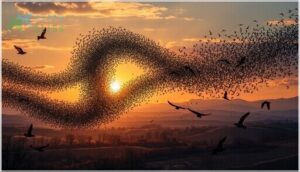
Think about a flock as a living tapestry, where each bird abides by simple topological rules, responding to just a handful of neighbors. This web of social interaction, powered by rapid information propagation and cohesion forces, produces emergent behavior.
A flock is a living tapestry where simple rules between neighbors create emergent behavior through rapid social interaction
Swarm intelligence lets collective decisions arise almost instantly—birds weave these intricate patterns without ever pausing for formal instruction.
Leadership Roles and Position Switching
Ever wonder why no single bird leads forever? Leadership roles in flocks shift constantly, with a subtle leadership hierarchy that relies on speed, boldness, and navigational skill.
Frequent position switching isn’t just a quirk—it lowers energy expenditure for followers and keeps leadership dynamics fluid. This shifting pattern helps every member contribute, boosting survival implications for the whole group.
Visual and Acoustic Communication
From high above or just overhead, you’ll notice how tightly birds move together—thanks to a mix of vision and vocalizations. Avian communication within flocks relies on:
- Visual field scanning for instant collision avoidance
- Vocal signals, like stack calls, to coordinate shifting locations
- Smart modality trade-offs, where birds increase vocalizations in low light, adapting communication as needed
Survival Benefits of Flocking
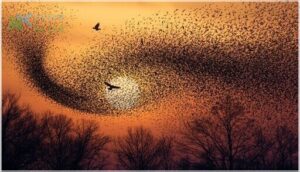
When birds flock together, they don’t just create a beautiful sight in the sky—they also stack the odds in their favor for survival. The whole group benefits from sharing protection, finding food, and saving energy.
Let’s look at how these teamwork advantages play out.
Predator Avoidance Strategies
Imagine a hawk circling overhead—your best defense is sticking with the crowd. Birds use vigilance mechanisms and rapid alarm propagation to spot predators early.
Flock members trigger an orderly chaos, confusing predators through sudden turns, and reducing each individual’s predation risk. This “risk dilution” and flexible responses make flocking one of nature’s most reliable predator avoidance strategies.
Enhanced Foraging Efficiency
When you join a foraging flock, your food detection rates skyrocket, and resource discovery becomes almost simple. Birds weave through the landscape in efficient search patterns, reducing competition while extending foraging time.
Safety in numbers enhances foraging efficiency, since vigilant neighbors allow you to spend less time watching for threats and more time actually finding food. That’s flocking behavior at its best.
Energy Conservation in Flight
You mightn’t notice it from the ground, but V-formation flying is a masterclass in aerodynamics. Birds in formation flight skillfully ride the upwash of their neighbors, saving up to 30% of their energy.
This energy conservation boosts metabolic savings, but species variability and environmental impact mean not every flock reaps equal rewards—migratory birds fine-tune their strategies on the fly.
Types and Patterns of Bird Flocks
Birds gather in flocks for reasons that go far beyond simple safety in numbers. How these groups come together and move often depends on their needs, their species, and the environment around them.
Let’s look at the main ways flocks form and the patterns you’ll see out in the wild.
Foraging, Roosting, and Migratory Flocks
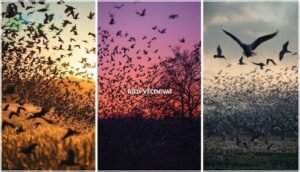
Ever noticed how some bird flocks glide low over fields, while others swarm trees at dusk or cut sharp shapes across the sky?
Foraging flocks boost foraging success rates by up to 30%, roosting flock sizes can number in the thousands, and migration group behavior shifts with resource density—driven by the social interaction benefits unique to flocking behavior.
Mixed-Species Vs. Single-Species Flocks

When you watch birds gather, the flock composition reveals much about avian social behavior. Singlespecies foraging flocks keep things simple, sticking with their own and relying on shared routines.
Mixedspecies flocks, on the other hand, combine diverse roles and strategies—sentinels, followers, beaters—sharing information about predator risk and food. Seasonal impact shifts who joins, reshaping flock composition as resources change.
Flocking Formations (V-shape, Murmurations, Clusters)

Just as flock composition can be shaped by diversity, flocking formations like the V-shape or striking murmurations offer their own unique survival advantages. You’ll see bird flocks adopting these patterns for:
- V-Formation Benefits: significant energy savings, leadership switching
- Murmuration Dynamics: swirling, dense clouds of starlings
- Cluster Patterns: tight, efficient group cohesion
- Notable energy trends: every formation helps conserve resources
Environmental and Biological Influences on Flocking
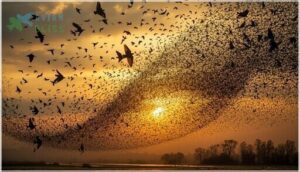
When you watch a flock of birds weaving through the sky, it’s not just luck or instinct at play. The way birds group up and move is shaped by both the world around them and what’s going on inside each bird.
Let’s look at the main factors that influence these striking gatherings.
Habitat Structure and Weather Conditions
Environmental conditions shape flocking behavior in powerful ways. Habitat fragmentation can double flock sizes when structural complexity increases by just 20%, while disturbed areas push birds into tighter formations.
Weather impacts are equally dramatic—temperatures dropping by 1°C greatly boost flock membership, and cold seasons see flocking rates jump 1.8 times higher.
Vegetation cover and landscape configuration further determine which species join and how flocks move across territories.
Resource Availability and Seasonal Changes
Resource availability drives profound shifts in flock size and composition throughout the year. During breeding seasons, mixed-species flocks decline by 25-40% as parental care takes priority over group foraging.
Migration timing increasingly mismatches with resource peaks due to environmental change, affecting up to 20% of survival variability.
Resource uncertainty also alters reproductive strategies, with capital breeders producing 30% larger clutches when early-season foraging succeeds.
Impact of Predation Pressure
Predation shapes flocking behavior more dramatically than you might expect. In high-risk habitats, flock size increases by up to 40%, while predator detection improves by 57% in larger groups—a compelling demonstration of safety in numbers.
- Vigilance rates drop 35% in flocks over 50 birds, freeing time for feeding
- Confusion effect cuts attack success from 31% to under 14% as density rises
- Evolutionary responses tighten cohesion by 40% in predator-dense regions
Frequently Asked Questions (FAQs)
What is flocking behavior?
Birds behaving brilliantly in groups demonstrate flocking behavior—collective movement driven by swarm intelligence. Each individual follows simple local rules, creating complex patterns that improve survival functions through coordinated avian behavior and active group interactions.
What is a bird flock?
A bird flock is a cohesive group moving, feeding, or roosting together through coordinated behavior. Flock size varies dramatically—from small family groups under twenty to massive congregations exceeding 100,000 individuals during migration.
How do birds lead a flock?
Leadership within flocks isn’t fixed to one bird. Shared roles shift dynamically based on trait influence—boldness, speed, resilience—and environmental factors.
Situational leadership allows position changes as fatigue sets in or conditions demand.
Why do birds live in a flock?
Flocking offers safety in numbers through predator dilution, foraging efficiency gains via social thermoregulation, and energy conservation during flight.
These predator avoidance strategies, combined with mate finding opportunities, deliver measurable social benefits you’ll observe across species.
How does flocking benefit birds?
You gain protection through predator evasion strategies, enhanced foraging efficiency with up to 30% energy savings in flight formations, and improved navigation accuracy.
Safety in numbers delivers measurable survival advantages through social learning and collective decision-making.
What does it mean when a bird sees a large flock?
When you spot a large gathering, it triggers an immediate assessment of opportunity and risk. Flock size perception activates predator detection mechanisms, signaling safety in numbers.
This collective behavior also reveals food sources through collective intelligence and avian communication patterns.
How do birds avoid collisions in dense flocks?
Birds rely on visual perception and reaction times of 20-40 milliseconds to sense neighbors within about one meter.
This allows for aerodynamic maneuvers, rapid information transfer, and adaptability strategies that prevent collisions through collective behavior.
Can flocking behavior be observed in captive birds?
Yes, you can observe flocking behavior in captive parrots, flamingos, and weaverbirds. Enclosure size and artificial flocking stimuli influence the fidelity of flocking in captivity.
Captive social bonds provide stress reduction benefits through group dynamics and avian social behavior.
Do juvenile birds learn flocking from adult birds?
Young birds acquire flocking behavior through social learning, observing adult flock members to develop coordination skills. This adaptive behavior combines innate instincts with juvenile guidance, allowing individual birds to master complex flock dynamics and collective animal behavior essential for survival strategies in birds.
How does flock size affect individual decision-making?
When a sparrow joins a hundred others, its personal scanning drops by half—relying instead on group vigilance. Flock size dynamics reshape individual decision-making: larger groups boost predator detection and improve collective navigation through social learning, yet increase foraging competition.
This fundamentally alters how individual birds balance survival priorities and energy conservation within collective animal behavior.
Conclusion
Think of flocking as nature’s original cloud computing—distributed intelligence with no central server. When you watch bird flocking behavior explained in real time overhead, you’re witnessing millions of years of evolutionary refinement compressed into split-second decisions.
Each bird processes information from its neighbors, adjusting course hundreds of times per minute. That’s the elegant reality: survival doesn’t require complexity, just countless simple interactions creating something far greater than the sum of its parts.