This site is supported by our readers. We may earn a commission, at no cost to you, if you purchase through links.
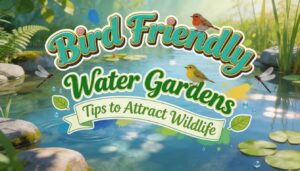
A single bird splashing in shallow water can draw a dozen more within minutes—birds communicate the presence of water through calls and behavior, turning one visitor into a flock.
Most gardeners think about feeders first, but water pulls in species that seeds never will: warblers, thrushes, orioles, and cedar waxwings that pass right through seed-only yards without stopping.
The difference between garden birds tolerate and one they genuinely inhabit often comes down to how thoughtfully the water is placed, planted around, and maintained.
Bird friendly water gardens work because they speak directly to what birds need—not just a drink, but cover, safety, and a reason to stay.
Table Of Contents
- Key Takeaways
- Designing Bird Friendly Water Gardens
- Best Types of Water Features for Birds
- Selecting Bird-Friendly Plants and Landscaping
- Enhancing Water Features for Wildlife
- Seasonal Care and Maintenance Tips
- Eco-Friendly and Sustainable Garden Practices
- Top Bird-Friendly Water Garden Products
- Frequently Asked Questions (FAQs)
- Why should you put rocks in your birdbath?
- Where is the best place to put water for birds?
- How do water gardens attract rare bird species?
- What sounds attract birds to water features most?
- Can water gardens help birds during migration periods?
- How deep should water be for different birds?
- Do water gardens attract unwanted wildlife or pests?
- Can birds find water features in dense fog?
- Do water gardens increase neighborhood property values?
- Can water features attract unwanted large animals?
- Conclusion
Key Takeaways
- Moving water—a gentle trickle or soft drip—draws in far more bird species than still water ever does, including warblers, orioles, and thrushes that simply pass through seed-only yards without stopping.
- Where you place your water feature matters as much as which one you choose: open sightlines, partial shade, and shrubs set back 6–10 feet give birds the safety and confidence to actually stay and splash.
- Varying water depth from 1 to 3 inches, adding rough‑textured rocks, and sloping the edges naturally welcome every bird from tiny sparrows to larger jays, making your feature work for the whole neighborhood.
- Keeping the water clean, circulating, and topped up through every season—including winter with a heated bath—is what transforms a pretty garden feature into a genuine wildlife habitat, birds return year‑round.
Designing Bird Friendly Water Gardens
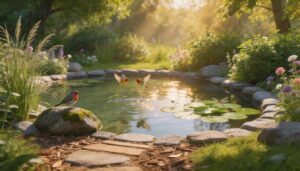
Designing a bird-friendly water garden starts with a few thoughtful decisions that make all the difference. Where you place your feature, how much sun it gets, and how it fits into your existing garden all shape whether birds actually show up and stay.
Even small choices like bath height matter—birds often have strong preferences, so it’s worth understanding whether birds prefer ground-level or elevated baths before you commit to a placement.
Here’s what to think about as you plan it out.
Choosing The Ideal Location
Where you place your water feature matters just as much as which one you choose. Birds need open sightlines to spot approaching threats — a cat crouched in nearby shrubs, a hawk circling overhead. That’s why positioning your bath or fountain in a reasonably open area, with nearby cover set back about six to ten feet, gives visiting birds the confidence to stay and splash.
Keep window distance in mind, too. The "3 or 30" rule is worth remembering: place your feature either within three feet of glass or beyond thirty, reducing collision risk dramatically. Make sure a 6 ft window clearance to reduce collision risk.
Stable ground keeps the bowl level and makes your routine easier — easy access to a hose or rain barrel turns refilling from a chore into a habit.
- Open sightlines let birds watch for danger while bathing
- Nearby cover offers quick escape without hiding predators
- Proper window distance prevents harmful bird collisions
- Stable ground keeps the feature safe and easy to maintain
- Easy access encourages consistent refilling for habitat enrichment
Assessing Sunlight and Shade Needs
Morning Sun Balance is everything regarding keeping birds comfortable and water fresh. Aim for four to six hours of direct sun, ideally in the morning, then let afternoon shade take over.
That shift in Seasonal Light Shifts means water stays cooler when heat peaks, slowing evaporation and reducing algae without losing the warmth early risers love.
Dappled Light Benefits from nearby trees offer flexible, natural protection — far better than a fixed shadow.
Sun Angle Mapping through the seasons helps you catch when summer intensifies exposure unexpectedly.
Integrating Water Features With Garden Layout
Once your light balance is sorted, think about how water features anchor the overall layout. Good zoning water zones and pathway flow design keep things both beautiful and functional — guiding visitors naturally through the space while giving birds clear, safe sightlines.
- Position reflective ponds near berry shrubs, drawing fruit-loving birds from 10–15 feet away
- Cluster fountains with nectar flowers to create hummingbird hotspots as visual focal points
- Match material harmony to existing hardscape for cohesive, eco-friendly water solutions
Seasonal placement strategy ensures your integrating aesthetic water features into landscape design stays intentional year-round, enhancing garden biodiversity through water features without overwhelming what’s already there.
Best Types of Water Features for Birds
Not all water features work the same way for birds, and picking the right one can make a real difference in who shows up to your garden. From simple birdbaths to gently trickling fountains, each option has its own way of drawing in different species.
Here are the best types to explore.
Bird Baths—Ground and Elevated Styles
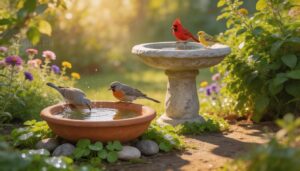
Choosing between a ground bath and a Classic Birdbath on a Pedestal is really about knowing your visitors. Ground-level designs mimic natural puddles, drawing robins, doves, thrushes, and sparrows that feel at home close to the earth.
Elevated pedestal styles, raised around 2.5 to 3 feet, give finches, cardinals, and chickadees a wider view—a real height‑benefit advantage when predators are nearby. Both options reward thoughtful designing of bird‑friendly water features for outdoor spaces:
- Surface Texture: Rough, coarse bottoms prevent slipping
- Material Selection: Ceramic, stone, or concrete resist weathering
- Escape Routes: Place near low shrubs for quick cover
- Thermal Regulation: Partial shade keeps water cooler longer
- Hanging Birdbath: Ideal for compact spaces, attracting hover-feeders
Offering both styles doubles your welcome.
Solar-Powered Fountains and Pumps
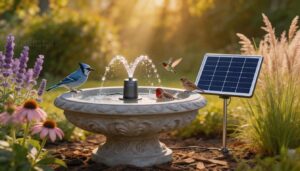
Running a solar-powered fountain couldn’t be simpler — no wiring, no electrician, just sunlight doing the work. Smart panel placement strategies guarantee your pump catches peak sun, while battery backup integration keeps water moving through cloudy stretches.
Nozzles with adjustable flow optimization let you dial down splash for smaller birds.
UV-resistant materials hold up season after season, making these genuinely eco-friendly water solutions.
Reflective Ponds and Natural Streams
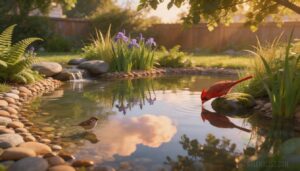
still water holds a kind of magic for birds — and a well-designed reflective garden pond gives them exactly what they’re drawn to. A calm mirror surface catches light at just the right angle, making the water visible from above. Keep the edge wall height low on one side so birds can approach comfortably, and use pebble bottom texture near the margins for safe footing.
- Design shallow margins of 2–3 inches for easy wading
- Follow a gentle flow pattern design to keep water fresh
- Add a trickling stream element to deter mosquitoes naturally
- Plant native vegetation along edges for bird habitat and cover
These eco-friendly water solutions genuinely support creating habitats for wildlife in residential gardens.
Installing a solar-powered bird bath fountain kit makes it easy to attract birds and other wildlife without running a single cable.
Waterfalls and Trickling Features
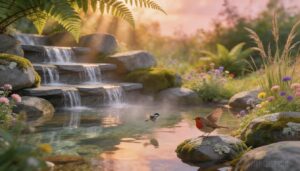
A trickling stream or cascading rock waterfall does something still water simply can’t — it calls to birds through sound. That gentle water flow carries across the garden, drawing visitors in. A tiered cascading fountain with rock cascade design creates microhabitat through varied perch levels and splash zones.
| Feature | Bird Benefit | Design Tip |
|---|---|---|
| BirdFriendly Waterfall | Soundscape attraction | Keep height 12–24 inches |
| Trickling Stream | Deters mosquitoes naturally | Use seasonal flow adjustment |
| EcoFriendly Water Solutions | Sustainable garden impact | Recirculating pump saves water |
Selecting Bird-Friendly Plants and Landscaping
The right plants can turn a simple water feature into a true wildlife haven, drawing in birds that might otherwise pass your garden by. What you grow around the water matters just as much as the water itself.
Here’s what to think about when choosing plants and landscaping that birds will love.
Native Aquatic and Marginal Plants
Native aquatic and marginal plants are the quiet backbone of any thriving bird habitat. They’re not just pretty additions—they’re doing real work at the water’s edge. Dense root systems provide shoreline stabilization, holding soil in place while filtering nutrients before runoff can fuel algae blooms. Submerged varieties contribute oxygenation benefits that support the insects and invertebrates birds depend on throughout nesting season.
Native aquatic plants don’t just beautify water’s edge — they stabilize shorelines, filter runoff, and fuel the insect life birds depend on
Organizing your planting by seasonal plant zones—submerged, emergent, and marginal—layers your aquatic habitat in a way that benefits a wide range of wildlife:
- Emergent plants like cattails anchor shorelines and shelter nesting birds
- Submerged plants release oxygen, supporting aquatic food webs
- Marginal plants trap fine sediment and improve nutrient filtering
- Native plants boost garden biodiversity and macroinvertebrate populations
- Dense plantings near water give frogs, toads, and birds safe cover
Wildlife attraction follows naturally when the habitat feels complete.
Layered Planting for Diverse Habitats
Picture your water garden as a living apartment complex — every floor doing something different, and every bird knowing exactly which one suits them best.
Canopy layering from tall trees gives higher-branch species their perches, while shrub density below creates nesting cover and groundcover diversity fills in the gaps close to soil level.
This vertical connectivity is what turns a simple planting into genuine microhabitat creation.
Seasonal plant rotation keeps the habitat productive year‑round, supporting native vegetation that drives real garden biodiversity and reliable wildlife attraction across every bird species visiting your space.
Berry Bushes and Nectar Flowers
Think of berry bushes and nectar flowers as your water feature’s best companions — they complete the picture birds are actually looking for.
- Winter Berry Food: Winterberry holly and beautyberry hold fruit well into cold months, giving birds reliable calories when little else is available.
- Spring Nectar Sources: Cardinal flower and trumpet honeysuckle offer tubular blooms perfectly shaped for hummingbirds returning north.
- Seasonal Fruit Timing: Serviceberry ripens in early summer, elderberry follows midseason — together, they create uninterrupted native berry benefits across the year.
- Pollinator Plant Pairings: Native plants support insects too, doubling as pollinator support that feeds nestlings during breeding season.
Attracting birds with garden water features works best when native plants for birds frame the space naturally.
Creating Shelter and Nesting Areas
Berries draw birds in, but shelter keeps them. Dense shrubs like holly and hawthorn — especially thorny hedges — give nesting birds a natural fortress against predators.
Layer that with ground cover layers of low grasses and climbing plants, and you’ve built real depth.
Nest box placement near shrubs adds safe cavities where natural cavity preservation isn’t possible, turning your bird-friendly mist fountain or natural rock fountain into a true nesting habitat.
Enhancing Water Features for Wildlife
A well-designed water feature does more than look beautiful — it becomes a genuine lifeline for the birds and wildlife in your garden.
A thoughtful touches can make all the difference between a feature that gets occasional visits and one that draws a steady stream of feathered guests.
Here’s what to focus on when enhancing your water garden for wildlife.
Maintaining Clean and Safe Water
Keeping your water feature clean isn’t just good housekeeping — it’s genuinely caring for the birds that depend on it. Refresh water every one to two days in summer, and scrub surfaces weekly using non‑toxic cleaning agents such as diluted white vinegar. Circulation and oxygenation from a simple solar pump support natural algae inhibition methods while discouraging mosquito larvae.
Water Feature Maintenance Tips for Homeowners:
- Replace water every 1–2 days during warm months
- Scrub with a 9:1 water-to-vinegar solution weekly
- Use solar-powered circulation for eco-friendly water solutions
- Skim debris daily to support water sanitation for birds
Providing Varying Water Depths
Not every bird wades in the same way. Sparrows prefer barely an inch of shallow water, while robins and jays want a little more room. Sloped Edge Design solves this naturally — one gradual incline creates Depth Zone Mapping that welcomes everyone. Add Rock Islands for gripping, Pond Shelf Creation for nervous beginners, and Adjustable Water Levels for seasonal flexibility.
| Depth Zone | Best For |
|---|---|
| 0–1 inch | Sparrows, wrens, finches |
| 1–2 inches | Robins, starlings |
| 2–3 inches | Jays, doves |
| Rocks/islands | Landing, perching |
| Shelf edges | Gradual bird entry |
Bird-friendly water features work best when every visitor finds their spot.
Preventing Predators and Hazards
Once you’ve mapped out the right depths, protecting your visitors becomes the next priority. Elevating baths to 4–5 feet provides Cat Deterrent Height — most cats simply can’t reach. Predator Resistant Placement means keeping clear, open sightlines, while Escape Route Planning puts shrubs 5–10 feet away — close enough for retreat, far enough to prevent ambushes.
- Position baths away from untreated windows to prevent dangerous collisions through Window Collision Mitigation
- Choose nontoxic, safe materials — skip daffodils and foxgloves near water
- Use Visual Barrier Design and open spacing to prevent stagnation and keep birds safe
Adding Rocks, Logs, and Perches
Adding a few well-placed rocks and logs transforms your birdbath from a simple water dish into a genuine Stone Bird Spa that birds keep coming back to. Rock Perch Placement near the water’s edge gives birds a stable spot to assess their surroundings before stepping in — and rough Natural Texture Benefits mean fewer slips on wet surfaces.
Here’s how to build it well:
- Use Varied Rock Sizes to accommodate everything from tiny wrens to larger jays.
- Practice Driftwood Water Integration by resting branches partly in the water.
- Apply Microhabitat Development Using Pebbles and Rocks to create safe shallow zones.
- Add Log Edge Stability along pond margins for cautious visitors.
- Consider a Rustic Log Water Trough for a naturalistic, welcoming focal point.
These Bird-Friendly Water Features invite biodiversity without complicated installation.
Seasonal Care and Maintenance Tips
Even the most welcoming water garden needs a little attention as the seasons shift. Birds rely on you year-round, so keeping things clean, safe, and functional through summer heat and winter cold makes all the difference.
Here’s what to focus on through each season.
Winterizing Water Features and Baths
Winter is unforgiving to neglected water features.
Before the first hard freeze arrives, drain and dry your basin completely — ice expansion cracks concrete and ceramic faster than you’d expect. Store pumps indoors in a dry garage or shed, then insulate basins with burlap or straw wrap.
Heated bird baths with thermostat controls keep water open for drinking birds all season.
Smart winter placement in a sunny, sheltered spot naturally slows ice formation without extra effort.
Preventing Algae and Mosquitoes
Warm weather turns still water into a mosquito nursery and an algae farm faster than you’d think. The good news? Continuous water flow from a fountain or bubbler disrupts breeding cycles naturally, making your feature one of the best water features that prevent mosquito breeding. Smooth surface materials also make weekly scrubbing far less of a chore.
- Replace water every 2–3 days for regular water replacement that breaks the mosquito life cycle
- Use Bti larval control tablets — a EPA-registered bacterial treatment for standing water
- Scrub basins with a stiff brush weekly, targeting algae-resistant coatings and textured corners
- Keep leaves and debris out to cut the organic buildup algae feeds on
- Choose low-maintenance water installations for home gardens with recirculating pumps to slow algae growth
Shading and Cooling Water in Summer
Hot summer sun turns a shallow water feature into a lukewarm puddle, birds won’t touch.
Strategic shade cloth placement over your bath — paired with light basins that reflect rather than absorb heat — keeps water invitingly cool.
Drop in an ice block cooling chunk each morning, add misting sprinklers nearby, and position reflective tile surfaces to deflect afternoon rays.
Bird-friendly, eco-friendly landscaping and solar energy usage keep everything refreshingly balanced.
Leaf and Debris Management
Fallen leaves are quieter troublemakers than you’d think — clogging drains, clouding water, and smothering the habitat balance your birds depend on. Solid drain protection strategies and simple leaf collection tools, like nets or rakes, keep things manageable before wet leaves compact into a real mess.
Compost mulch integration turns that debris into garden gold.
Seasonal cleanup timing matters: clear often, clear early, and your water quality stays healthy all autumn long.
Eco-Friendly and Sustainable Garden Practices
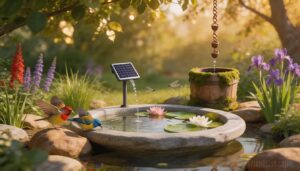
Making your water garden eco-friendly doesn’t have to be complicated — small, thoughtful choices can make a real difference for the birds and the broader garden ecosystem. From the way you power your water features to how you manage rainwater, there are practical ways to lighten your footprint while creating a richer habitat.
Here are some sustainable practices worth building into your garden routine.
Solar-Powered Water Feature Benefits
A solar-powered fountain is quietly one of the smartest choices you can make for a bird-friendly water garden. With zero electricity cost and cord‑free placement, you can tuck it wherever sunlight falls naturally — no wiring, no fuss.
Here’s why it works so well:
- Battery backup resilience keeps water circulating even on cloudy afternoons.
- Adjustable flow patterns let you match the gentle trickle birds actually prefer.
- Reduced carbon footprint makes every ripple an eco‑friendly water solution for your sustainable garden.
Reducing Chemical Use and Pesticides
Just as your solar fountain keeps energy clean, keeping chemicals out of your garden keeps birds safe. Integrated Pest Management offers a smarter path — using Biological Controls, Nonchemical Weed Control, and Precision Spraying only when truly needed.
Crop Rotation and eco-friendly landscaping naturally reduce pest pressure without harming wildlife. A pesticide-free environment promotes healthier water quality in your bird-friendly water features, too, since runoff carries toxins directly into baths and ponds.
| Chemical Threat | Sustainable Gardening Alternative |
|---|---|
| Synthetic herbicides | Native buffer plantings |
| Slug pellets | Manual removal or barriers |
| Broad-spectrum insecticides | Beneficial insects and neem oil |
| Pond algaecides | Aeration and aquatic plants |
Rainwater Harvesting and Water Conservation
Collecting rain from your roof is one of the most rewarding eco-friendly water solutions you can build into a bird-friendly garden. A simple roof catchment design with first-flush diverters keeps debris out of your cistern, while drip irrigation integration delivers that stored water right where plants need it.
Add mulch moisture retention around your beds, and you’re stretching every drop beautifully.
Top Bird-Friendly Water Garden Products
Once you’ve figured out what your garden needs, the next step is finding the right product to bring it to life.
There are some genuinely well-designed options out there that work beautifully for birds and fit a range of budgets and garden styles. Here are five worth considering.
1. Detachable Brown Bird Bath Feeder
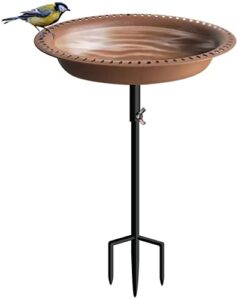
The Detachable Brown Bird Bath Feeder earns its place in a wildlife-friendly garden by keeping things simple — and that simplicity is where it really shines.
Weighing under three pounds and built from high-density polypropylene, it’s light enough to reposition whenever you need to.
The deep brown finish settles naturally into garden beds, bark mulch, and planting borders without startling visiting birds.
What makes daily care genuinely easy is the detachable oval dish — just unscrew it, rinse, and you’re done.
It also doubles as a seed feeder, so chaffinches, butterflies, and bees can drink or snack from the same spot.
All that for around $19.
| Best For | Gardeners who want a fuss-free way to support local wildlife without spending much or committing to a permanent setup. |
|---|---|
| Material | High-density polypropylene |
| Weight | Under 3 lbs |
| Wildlife Support | Birds, butterflies, bees |
| Maintenance | Detach and rinse dish |
| Power Source | None required |
| Color | Brown |
| Additional Features |
|
- The detachable dish makes cleaning genuinely quick — unscrew, rinse, done.
- Doubles as a seed feeder, so birds, butterflies, and bees all get something out of it.
- At under $20 and less than three pounds, it’s easy to move around and easy to justify buying.
- Only two support prongs on the stand, so it can tilt on uneven or soft ground.
- No built-in drain means you have to fully remove the dish every time you clean it.
- The plastic build feels a step down from ceramic or glazed alternatives, which some people will notice.
2. Resin Rock Bird Bath Fountain Pump
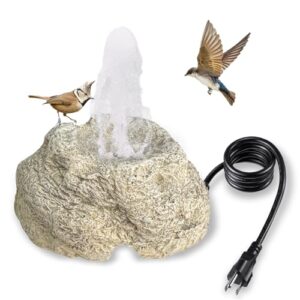
When a simple bird bath just isn’t pulling in the visitors you’d hoped for, moving water makes all the difference — and that’s exactly what the Resin Rock Bird Bath Fountain Pump delivers.
Its 7.5-watt recirculating pump keeps water flowing continuously, which discourages mosquito breeding and draws in far more birds than still water ever could. The beige resin shell mimics natural stone convincingly, so it sits quietly inside an existing bath without looking out of place. Built-in safety cut-offs protect the pump if water runs too low or temperatures spike.
Weekly cleaning keeps things running smoothly. At roughly 6 inches across, it suits smaller baths best, but for a compact garden setup, it’s a genuinely dependable choice.
| Best For | Bird enthusiasts with small to medium-sized baths who want to attract more backyard wildlife without a complicated setup. |
|---|---|
| Material | Resin |
| Weight | Not specified |
| Wildlife Support | Birds |
| Maintenance | Weekly cleaning |
| Power Source | Electric pump |
| Color | Beige |
| Additional Features |
|
- Keeps water moving continuously, which cuts down on mosquito breeding and brings in way more birds
- Built-in safety shut-offs protect the pump from overheating or running dry
- Blends naturally into existing baths with its realistic stone-look resin finish
- Flow can be too strong for shallow baths, sending water splashing over the rim
- At just 6 inches across, it won’t work well with larger bird bath installations
- Limited flow-control options mean you may need extra adapters to dial it in just right
3. Dunkive Solar Bird Bath Fountain
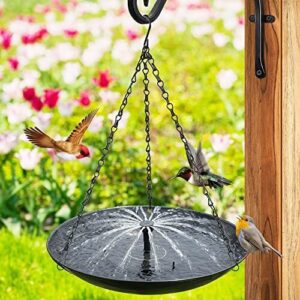
If you love the idea of a garden fountain that practically runs itself, the Dunkive Solar Bird Bath Fountain is worth a close look.
Once sunlight hits the solar panel, the pump activates within seconds, sending water through four interchangeable spray patterns — giving you flexibility to dial in just the right flow for bathing birds or decorative effect.
The aluminum alloy bowl is sturdy, and the five-prong stake base keeps everything anchored firmly in garden beds.
Position it where it catches consistent direct sunlight, and rinse the pump twice weekly to prevent clogs.
A quick refill every day or two in summer heat keeps the water fresh and inviting.
| Best For | Gardeners and wildlife lovers who want a low-maintenance, solar-powered water feature to attract birds, butterflies, and bees without running electrical lines. |
|---|---|
| Material | Aluminum alloy |
| Weight | Not specified |
| Wildlife Support | Birds, butterflies, bees |
| Maintenance | Rinse pump twice weekly |
| Power Source | Solar |
| Color | Black |
| Additional Features |
|
- Runs on solar power with no wiring needed — just set it in the sun and it gets to work
- All-metal aluminum build feels solid and looks sharp with the black finish
- Flexible setup options: hang it, place it on a pot, or stake it wherever works best
- Stops working the moment clouds roll in or it falls into shade, so placement is everything
- The black bowl heats up fast in summer, warming the water and speeding up evaporation
- Pump reliability has been hit-or-miss for some users, with failures reported within just a few weeks
4. VOROSY Solar Fountain Bird Bath Pump
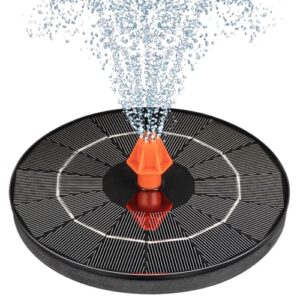
The VOROSY Solar Fountain Bird Bath Pump is a compact, no-fuss addition to any bird-friendly garden. Weighing less than a pound and measuring just over six inches across, it slips neatly into most bird baths without crowding the basin.
Eight interchangeable nozzles let you switch spray patterns depending on who’s visiting — a gentle mist for smaller birds like chickadees, a taller jet for robins cooling off in summer heat.
Direct sunlight gets it running almost immediately, with no cords or batteries involved. Keep the filter cotton clean monthly and wipe the solar panel regularly to maintain steady flow.
At under seventeen dollars, it’s an accessible way to bring moving water — and more wildlife — into your garden.
| Best For | Casual gardeners and bird lovers who want to add a little life to their bird bath or garden pond without spending much or dealing with wires. |
|---|---|
| Material | Plastic |
| Weight | Under 1 lb |
| Wildlife Support | Birds, wildlife |
| Maintenance | Monthly filter cleaning |
| Power Source | Solar |
| Color | Not specified |
| Additional Features |
|
- Runs on sunlight alone — no cords, no batteries, no electricity bill
- Eight nozzle options make it easy to dial in the right spray for your setup
- Tiny and light enough to move around wherever the sun hits best
- No battery backup means it stops the moment clouds roll in
- Can clog or slow down without regular cleaning of the panel and filter
- Plastic build may not hold up well after a full season of direct sun exposure
5. Wildlife World Shenstone Sustainable Bird Bath
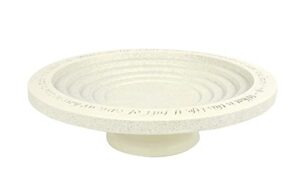
The Wildlife World Shenstone Bird Bath brings something genuinely thoughtful to the garden — it’s made from Polyboo, a composite of recycled plastics, clay, and bamboo that looks convincingly like aged stone without the weight or fragility.
That ripple-step design isn’t just decorative, either. Each smaller birds, bees, and butterflies a safe foothold near the water’s edge, so nobody’s struggling to reach a drink.
It’s frost-proof, lightweight enough to reposition between seasons, and hand-finished with lines from W. H. Davies’ poem embossed around the rim — a quiet nod to nature’s slower pace.
For a garden that nurtures wildlife year-round, it earns its place beautifully.
| Best For | Gardeners who want a low-maintenance, eco-friendly water source that attracts birds, bees, and butterflies through all four seasons. |
|---|---|
| Material | Polyboo composite |
| Weight | 5.29 lbs |
| Wildlife Support | Birds, bees, butterflies, mammals |
| Maintenance | Periodic water refill and cleaning |
| Power Source | None required |
| Color | Gray |
| Additional Features |
|
- Made from recycled Polyboo composite — looks like real stone but weighs just over 2 kg, so it’s easy to move around
- Ripple-step design gives wildlife of all sizes a safe spot to drink or bathe, from butterflies right up to squirrels
- Frost-proof build means you can leave it outside year-round without worrying about cracks
- The finish can start to peel or bubble after about a year, especially if your garden gets a lot of sun or rain
- At only 2.24 kg, a strong gust can knock it over — you may need to weigh it down or pick a sheltered spot
- No warranty to speak of beyond a short return window, so you’re on your own if issues crop up later
Frequently Asked Questions (FAQs)
Why should you put rocks in your birdbath?
Rocks give birds a safe grip, control water depth, and help keep the bath cleaner longer.
They also make it easier for bees, butterflies, and even small frogs to drink safely.
Where is the best place to put water for birds?
Place water in partial shade, about 10 to 15 feet from shrubs, and away from dense cover where cats can hide. Morning sun with afternoon shade keeps it cool and fresh longest.
How do water gardens attract rare bird species?
well-placed water garden becomes a quiet beacon for rare birds passing through — drawing them in with the sound of moving water, shallow edges, and the kind of shelter that makes a tired migrant feel safe enough to stay.
What sounds attract birds to water features most?
Birds don’t read signs — but they do hear water.
gentle trickle or soft drip acts like a dinner bell, drawing birds in far more reliably than still, silent water ever could.
Can water gardens help birds during migration periods?
Absolutely — think of water garden as a welcome rest stop on a very long highway.
Migrating birds lose significant water during flight and desperately need reliable sources to rehydrate and recover between stopovers.
How deep should water be for different birds?
Depth matters more than most gardeners realize. Small songbirds like finches and sparrows feel safest in just 1 to 5 inches, while larger visitors like cardinals prefer closer to 2 inches.
Do water gardens attract unwanted wildlife or pests?
Yes, water gardens do attract unwanted visitors. Mosquitoes breed in stagnant water, raccoons raid ponds for fish, and herons pick off goldfish.
Smart design and regular upkeep keep the balance in your favor.
Can birds find water features in dense fog?
Surprisingly, yes. Birds use sound, memory, and even ultraviolet light reflections to locate water in low visibility.
Familiar garden visitors, like robins, can pinpoint a known water feature from up to 100 meters away.
Do water gardens increase neighborhood property values?
Water gardens can boost curb appeal and help your home stand out, but the value bump isn’t guaranteed.
Design quality, upkeep, and what neighboring homes look like all shape the outcome.
Can water features attract unwanted large animals?
Occasionally, yes. Raccoons, deer, and even bears in rural areas may visit open water features, especially ground-level ones. Elevated baths and smaller fountains help keep those visits less frequent.
Conclusion
The ripple effect of creating a bird friendly water garden can be impactful, turning your outdoor space into a haven for wildlife.
By thoughtfully designing and maintaining your water feature, you’ll be casting a wider net, attracting a diverse array of bird species.
As you watch your garden come alive with the sights and sounds of nature, you’ll realize that the true beauty lies not just in the water, but in the connections you make with the natural world every day.
- https://auduboncnc.org/bird-baths/
- https://www.wildandalucia.com/helping-wildlife/build-wildlife-pond/
- https://www.sacramentoaudubon.org/kids-corner/birdbath-tips-help-wild-birds-by-creating-a-clean-water-source-in-your-yard
- https://www.thebirdhousechick.com/blogs/resources/bird-bath-cleaning
- https://extension.psu.edu/water-for-wildlife-bird-baths-and-backyard-ponds/