This site is supported by our readers. We may earn a commission, at no cost to you, if you purchase through links.
 You’ll transform your backyard into a bird photographer’s paradise by creating natural habitats that attract diverse species.
Start with native plants and a reliable water source—birds can’t resist a good drink and bath. Position feeders strategically where morning light hits best, then add nearby perches for those perfect pre-meal portraits.
The magic happens when you combine habitat creation with smart photography techniques like backlighting to showcase feather details and using natural elements for framing. Understanding bird behavior patterns will help you anticipate those fleeting moments when everything aligns perfectly.
These bird habitat photography ideas work best when you master the delicate balance between creating an inviting environment and capturing it beautifully.
Table Of Contents
- Key Takeaways
- Bird Habitat Creation
- Photography Techniques
- Camera Settings
- Bird Behavior Observation
- Equipment Selection
- Ethical Photography Practices
- Seasonal Photography Opportunities
- Advanced Photography Techniques
- Frequently Asked Questions (FAQs)
- Is backyard bird photography a good idea?
- What is bird photography?
- Do you know the basics of bird photography?
- How can I improve my backyard bird photography?
- What makes a good bird photo?
- Why is bird photography important?
- What makes a good bird photograph?
- What is the rule of thirds in bird photography?
- Can you make money with bird photography?
- What is the best format for bird photography?
- Conclusion
Key Takeaways
- Create a habitat foundation with native plants and water features – You’ll attract diverse bird species year-round by establishing indigenous trees, shrubs, and reliable water sources that birds recognize as natural homes.
- Master backlighting and natural framing techniques – You’ll capture stunning feather details by positioning yourself so sunlight filters through plumage while using branches, leaves, and rocks to create compelling compositions.
- Use telephoto lenses with proper camera settings – You’ll maintain respectful distances while achieving sharp results with 400-600mm lenses, fast shutter speeds (1/1000s+), and ISO 800-1600 for optimal exposure.
- Study bird behavior patterns for predictable shots – You’ll anticipate perfect moments by observing feeding schedules, migration timing, and territorial displays that transform random encounters into intentional captures.
Bird Habitat Creation
You’ll create bird photography opportunities that last year-round by designing spaces that naturally attract diverse species to your backyard.
The key lies in combining native plants, reliable water sources, and strategic food-producing trees that transform your property into a thriving ecosystem where birds feel safe enough to display their natural behaviors.
Natural Landscaping With Native Plants
Transform your backyard into a bird haven by choosing native plantings that naturally attract local species.
Native plants create authentic ecosystems, supporting biodiversity while requiring less maintenance than exotic varieties.
Transform your yard into a wildlife sanctuary where birds naturally thrive and photography magic happens.
Your garden design becomes a living habitat conservation project when you select indigenous trees, shrubs, and flowers that birds recognize as home.
This bird-friendly approach establishes sustainable habitats.
Water Features for Bird Attraction
Water’s magnetic pull on birds creates endless photography opportunities in your backyard sanctuary.
Strategic water features transform ordinary spaces into bustling avian hubs where intimate moments unfold naturally.
- Pond Design: Create shallow edges (1-2 inches deep) with gradual slopes, allowing various species to drink and bathe comfortably while providing clear photography angles.
- Birdbath Placement: Position at varying heights near natural cover, ensuring clean water quality and easy refilling access for consistent bird attraction.
- Fountain Features: Install gentle water movement to prevent stagnation and create audible appeal, drawing birds from greater distances to your bird friendly habitat.
Effective bird bath maintenance involves understanding proper bird bath systems to support local wildlife.
Planting Native Trees and Flowers
Selecting bird attractants from local nurseries creates a thriving backyard ecosystem that’ll make your camera sing with possibilities.
Native plantings like mulberries and sunflowers provide natural food sources while enhancing your garden design with floral diversity.
| Tree Species | Bird Attractants | Bloom Season | Photography Benefits |
|---|---|---|---|
| Serviceberry | Small berries, insects | Spring | White blossoms, feeding scenes |
| Dogwood | Red berries, nectar | Spring/Fall | Vibrant colors, perching spots |
| Crabapple | Fruit, winter persistence | Spring | Pink blooms, winter compositions |
| Mulberry | Sweet berries | Summer | Dense foliage, natural framing |
Native plants establish birdfriendly habitat that supports natural landscaping goals while creating diverse photographic opportunities.
Your bird habitat becomes a conservation success story where habitat conservation meets stunning imagery.
Photography Techniques
You’ll discover that mastering specific photography techniques can transform ordinary backyard bird shots into stunning visual narratives.
These compositional strategies help you capture the natural beauty of birds within their carefully created habitats, which is key to creating a stunning visual effect.
Backlighting for Feather Details
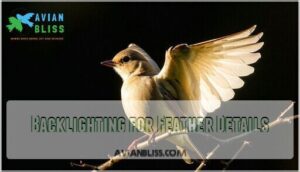
Golden hour backlighting transforms ordinary bird photography into stunning feather texture displays.
Position yourself so sunlight filters through plumage, creating natural light diffusion that reveals intricate details.
Let sunlight paint your feathers with golden fire, revealing nature’s hidden textures.
Essential backlighting techniques:
- Spot meter on shadowed feathers – prevents silhouettes
- Use +0.3 to +1.7 EV compensation – balances exposure
- Shoot during golden hour – ideal soft focus conditions
- Choose darker backgrounds – enhances rim lighting effects
- Avoid polarizing filters – preserves feather glow
This bird photography lighting technique excels in bird habitat images, emphasizing translucent wing tips and creating dramatic bird silhouettes.
Your photography composition gains depth when backlighting reveals microscopic feather structures through transmitted light.
Reflections in Water for Symmetry

Capturing water reflections transforms ordinary bird photography into stunning symmetry shots.
Position yourself at pond photography locations where still water creates perfect mirror images of your feathered subjects.
Even gentle ripples effects can enhance composition by adding texture while maintaining recognizable bird habitat images.
Choose calm morning hours when wind won’t disturb water features.
Use polarizing filters to control reflections prevention when needed, ensuring your photography backgrounds complement rather than compete with your main subject, creating a perfect mirror image.
Framing With Natural Elements
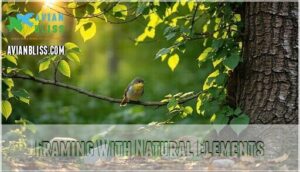
Natural elements become powerful allies in bird photography composition, transforming ordinary shots into compelling visual stories.
Branch framing creates intimate windows around your subjects, while leaf composition adds organic borders that guide the viewer’s eye.
Rock formations provide sturdy foregrounds, and tree silhouettes offer dramatic nature backdrops, enhancing creative framing in natural habitats.
These environmental photography techniques elevate bird photography backgrounds beyond simple portraits, and mastering bird photography techniques is essential to capture stunning shots that tell a story, making use of natural habitats and dramatic nature.
Camera Settings
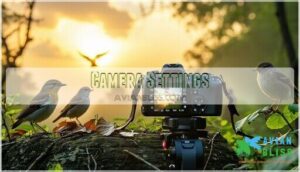
Your camera settings determine whether you’ll capture a sharp robin mid-flight or a blurry disappointment that makes you question your life choices.
Understanding the relationship between shutter speed, aperture, and ISO transforms your bird photography from random snapshots into deliberate, professional-quality images, with professional-quality results that reflect your skill and dedication.
Shutter Speed and Aperture Settings
When using Aperture Priority mode, you’ll find the sweet spot between f/5.6 and f/8 for sharpest results.
Fast Shutter speeds of 1/1000s or higher freeze motion perfectly during flight sequences.
Depth Control becomes essential—wider apertures blur backgrounds while narrower ones keep entire birds sharp.
Motion Freeze requires balancing these settings with Exposure Compensation adjustments for ideal bird photography techniques.
ISO Adjustments for Lighting Conditions
When dawn breaks and shadows dance across wetlands, you’ll need to master ISO settings for ideal exposure.
Start with ISO 800-1600 in dense habitats where light struggles to penetrate. Modern cameras handle this range well with effective noise reduction.
Use exposure compensation to fine-tune brightness while maintaining dynamic range. Light metering helps determine baseline settings, but don’t rely on it blindly—bird photography tips emphasize adapting to changing lighting conditions throughout your shoot for consistently sharp results.
Autofocus and Burst Mode Techniques
Your camera’s autofocus modes determine tracking success with moving birds.
Single-point autofocus works best for stationary subjects, while continuous autofocus modes excel at tracking flight patterns.
Burst mode captures multiple frames per second, increasing your chances of perfect wing positions.
Set your camera to continuous shooting mode with shutter priority for consistent exposure.
Most modern cameras offer 8-10 frames per second burst speed for bird photography action capture.
Understanding autofocus techniques is essential for capturing sharp images of birds in flight.
Bird Behavior Observation
Understanding bird behavior transforms your photography from random shots to intentional captures that showcase natural moments.
You’ll predict feeding patterns, recognize territorial displays, and position yourself for authentic behavioral sequences when you study how different species interact with their environment, which helps in capturing natural moments.
Observing Patterns and Habits
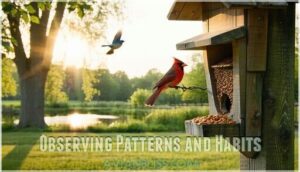
Bird Tracking starts with morning coffee in hand, watching your backyard’s rhythm unfold.
Pattern Recognition reveals Cardinals prefer sunflower seeds at dawn while Blue Jays dominate mid-morning.
Behavioral Cues like tail-flicking signal nervousness, while relaxed preening indicates comfort.
Flocking Dynamics show mixed species feeding together during migration.
Document bird feeding habits, migration patterns, and habitat preferences through consistent observation—this preparation transforms random encounters into predictable photography opportunities, utilizing Pattern Recognition and understanding of Behavioral Cues.
Using Field Guides and Apps

Modern field guides and apps transform bird identification from guesswork into precision.
Merlin Bird ID achieves 90% accuracy across 8,000+ species, while eBird provides real-time location data from 100 million annual observations.
Download offline packs for remote shoots—you’ll capture species you’d otherwise miss.
These birding tools reveal behavioral patterns and feeding schedules that elevate your photography timing and composition skills.
Learning Bird Sounds and Calls

Sound patterns reveal secrets that visual observation can’t reveal.
Bird calls tell stories about feeding, mating, and territory marking that transform your photography timing. Apps like Merlin turn your phone into a birding detective tool, helping you identify species before they appear.
Audio recording captures vocal mimicry and behavioral cues that predict perfect photo opportunities.
Bird journaling with sound notes creates a roadmap to consistent shots through pattern recognition.
Equipment Selection
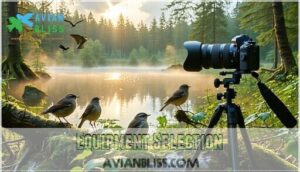
Your equipment choices directly impact your ability to capture stunning bird habitat photos without disturbing your subjects.
The right gear combination of telephoto lenses, stable support systems, and reliable power solutions will transform your photography from amateur snapshots to professional-quality images.
Telephoto Lenses for Distant Birds
Distance becomes your ally when telephoto lenses reveal bird photography’s potential without disturbing natural behaviors.
These specialized tools transform distant subjects into frame-filling portraits while maintaining ethical shooting practices.
When selecting the right equipment, understanding telephoto lens options is vital for capturing stunning shots.
Key Telephoto Lens Considerations:
- Focal Length – 400-600mm lenses provide ideal reach for distant birds, with 600mm offering 12x magnification compared to human vision
- Image Stabilization – Built-in stabilization reduces camera shake by 4-5 stops, essential for handheld telephoto shooting
- Optical Quality – Prime lenses deliver sharper images and wider apertures than zoom alternatives at comparable prices
- Camera Mount compatibility affects autofocus performance, with native mounts providing faster, more accurate tracking
- Lens Selection balance – Consider weight versus reach; modern designs reduce bulk without sacrificing telephoto performance for wildlife photography
Tripods and Remote Shutter Releases
You’ll want rock-solid tripod stability to eliminate camera shake during those long telephoto shots.
A gimbal head transforms your setup, allowing smooth tracking as birds dart between branches.
Remote triggers let you capture skittish species without movement – they’re game-changers for natural behavior shots.
Quality camera mounts guarantee your bird photography equipment stays secure when that perfect moment arrives.
For superior results, consider using proper tripod stand techniques to minimize camera movement.
Memory Cards and Batteries
Fast storage cards prevent missing shots during burst sequences.
Choose cards with write speeds of 90MB/s or higher for seamless performance.
Battery life determines your shooting duration—carry spare batteries and portable chargers.
Cold weather drains power faster, so keep backup power solutions warm.
These backup strategies guarantee your camera equipment stays operational throughout extended photography sessions.
Understanding the right bird photography equipment is vital for capturing stunning shots in various habitats and conditions.
Ethical Photography Practices

You’ll capture stunning bird photographs while protecting the wildlife that makes your shots possible. Ethical practices guarantee birds remain healthy and undisturbed, creating sustainable opportunities for both photography and conservation.
Maintaining Safe Distance From Nests
You’ll protect nesting birds by maintaining 30-100 meters from raptor nests and 10-15 meters from songbird nests.
These distance guidelines guarantee bird safety while respecting ethical boundaries.
Watch for alarm calls or agitated movements—signs you’re too close.
Use telephoto lenses for nest protection without disturbing wildlife.
Your telephoto lens becomes your best friend for bird photography distance maintenance, capturing intimate nesting photos while preserving bird wellbeing in their natural habitats.
Avoiding Baiting and Flash Photography
Although baiting might seem like a shortcut to spectacular shots, it creates dependency and disrupts natural feeding patterns.
Flash photography can damage bird vision and stress nocturnal species like owls.
- Natural behavior documentation – Capture authentic moments without artificial attractants
- Ambient light techniques – Use available light sources instead of harsh flash
- Patience over shortcuts – Wait for genuine opportunities rather than forcing encounters
- Habitat preservation – Avoid altering environments with food placement or bright lights
Ethical photography respects wildlife boundaries while still delivering stunning results. Your telephoto lens becomes your best friend for maintaining distance while achieving intimate portraits.
Remember, the most compelling images often come from observing undisturbed, natural behaviors.
Respecting Bird Wellbeing and Habitats
Your responsibility extends beyond capturing stunning images to safeguarding the environments that sustain these magnificent creatures.
Habitat preservation forms the cornerstone of ethical photography practices, ensuring future generations can witness the same natural beauty you’re documenting today.
Practice responsible feeding by avoiding artificial attractants that disrupt natural foraging patterns and create dependency.
Bird safety requires maintaining respectful distances, especially during nesting seasons when disturbance can prove fatal.
Wildlife conservation thrives when photographers become stewards, protecting bird-friendly environments through mindful documentation that celebrates rather than exploits avian subjects.
Seasonal Photography Opportunities
Understanding seasonal patterns transforms your bird photography from random encounters into strategic opportunities.
Each season brings distinct species behaviors, lighting conditions, and compositional possibilities that can elevate your shots from ordinary to extraordinary.
Spring Migration for Peak Diversity
Spring migration transforms your backyard into a wildlife highway.
Between mid-April and late May, you’ll witness peak diversity as over 300 bird species funnel through North America’s flyways.
Target early morning golden hour near water sources and native flowering trees.
Migration patterns create dense concentrations of warblers, tanagers, and orioles—perfect for capturing multiple species in single frames while supporting habitat preservation through your conservation efforts.
Fall Migration for Prolonged Opportunities
Fall migration stretches across months, giving you extended opportunities to capture diverse species and behaviors.
Unlike spring’s rushed passage, autumn brings relaxed pacing perfect for documenting Migration Patterns and Flight Behaviors in Seasonal Habitats.
Track these fall photography opportunities:
- Early fall flocks gathering in staging areas before departure
- Staggered departures allowing multiple species documentation over weeks
- Weather-triggered movements creating predictable Bird Tracking moments for wildlife habitat images
Winter Captures for Species-Specific Behaviors
Winter transforms bird photography into a treasure hunt for unique behaviors.
Cold weather drives species-specific adaptations like food caching and group roosting that create compelling shots.
Frosty mornings reveal bird flocking patterns against snowy habitats, while winter landscapes provide striking backdrops.
These cold-season bird behavior shots showcase survival strategies you’ll rarely capture during warmer months, highlighting the importance of winter landscapes.
Advanced Photography Techniques

Once you’ve mastered the basics, it’s time to push your bird photography beyond standard shots with techniques that create dramatic visual impact.
These advanced methods will help you capture the energy and movement that makes habitat photography truly compelling, using techniques that create dramatic visual impact.
Creative Blur for Dynamic Shots
Motion blur transforms static bird photography into storytelling magic.
Use slow shutter speeds between 1/30 and 1/80 seconds for panning shots that freeze your subject while blurring the background.
This bird photography technique captures dynamic focus on moving birds, creating feather details that pop against streaked surroundings.
Perfect your bird photography motion capture by following the bird’s flight path smoothly, maintaining steady pressure on the shutter throughout the pan for compelling bird photography action.
Low-Light Mastery for Challenging Conditions
When dawn breaks and dusk settles, you’ll face photography’s greatest challenge.
Master low-light photography by opening your aperture wide (f/2.8-f/4) and raising ISO settings to 800-3200.
Control shutter speed carefully—1/125s maintains sharpness while gathering light.
Use noise reduction software during post-processing.
Skip flash; instead, position yourself behind natural light sources for ideal illumination without disturbing birds.
Understanding low light techniques is vital for capturing stunning bird habitat photos in challenging conditions.
Capturing Flight and Action Shots
Freezing bird movement requires shutter speeds of 1/1000s or faster for sharp wing capture.
Burst mode maximizes your chances during unpredictable aerial displays. Track birds smoothly through your viewfinder, anticipating their flight path rather than chasing.
For dynamic action shots, try panning at 1/30-1/80s to show motion trails while keeping the subject sharp. Practice these flight techniques consistently.
Frequently Asked Questions (FAQs)
Is backyard bird photography a good idea?
Over 4 billion birds migrate through North America annually, making backyard photography incredibly rewarding.
You’ll capture diverse species without traveling far, using telephoto lenses to maintain respectful distances while documenting natural behaviors in familiar surroundings.
What is bird photography?
Bird photography captures images of birds in their natural environments, combining technical camera skills with wildlife observation.
You’ll document behaviors, showcase plumage details, and preserve fleeting moments of avian life through patient fieldwork and proper equipment, which requires patient fieldwork.
Do you know the basics of bird photography?
Over 60% of bird nesting failures stem from human interference, making respectful photography essential.
You’ll need telephoto lenses, fast shutter speeds, and patience to capture stunning shots while maintaining ethical distances from your feathered subjects.
How can I improve my backyard bird photography?
Create native plant habitats with water features,
use telephoto lenses from respectful distances.
Shoot during golden hour with fast shutter speeds,
and practice patience—your feathered friends will reward consistent, ethical observation.
What makes a good bird photo?
Like capturing lightning in a bottle, you’ll craft stunning bird photos when you master sharp focus, perfect timing, and natural behavior.
Use fast shutter speeds, proper lighting, and compose thoughtfully to freeze authentic moments that showcase each bird’s unique personality and environment, utilizing perfect timing to capture the essence of the scene.
Why is bird photography important?
Photography captures fleeting moments that reveal birds’ true personalities, documents species behaviors for conservation research, and creates emotional connections that inspire environmental protection efforts in your community.
What makes a good bird photograph?
Sharp focus captures every feather detail, perfect timing freezes natural behavior, and proper lighting reveals vibrant colors.
You’ll need patience, technical skill, and respect for your subjects to create compelling images.
What is the rule of thirds in bird photography?
You’ll place your subject off-center, using an imaginary grid that divides your frame into nine equal sections.
Position birds along these grid lines or at their intersections for naturally balanced, visually appealing compositions, which will help create a visually appealing image.
Can you make money with bird photography?
Earning income from bird photography requires dedication, but it’s possible through stock photography, print sales, and workshops.
You’ll need solid technical skills and quality gear to compete effectively in this specialized market.
What is the best format for bird photography?
When the chips are down, you’ll want RAW format for maximum flexibility.
RAW captures all sensor data, letting you recover highlights and shadows during post-processing without quality loss, unlike compressed JPEG files.
Conclusion
Mastering these bird habitat photography ideas will transform your backyard into an absolutely breathtaking wildlife studio.
You’ll create stunning images by combining thoughtful habitat design with technical photography skills. Native plants and water features attract diverse species, while proper camera settings and ethical practices guarantee quality results.
Understanding bird behavior patterns helps you anticipate perfect moments. Remember to maintain respectful distances and prioritize bird welfare over the shot.
With patience and practice, you’ll capture extraordinary photographs that showcase nature’s beauty while supporting local wildlife conservation efforts.