This site is supported by our readers. We may earn a commission, at no cost to you, if you purchase through links.
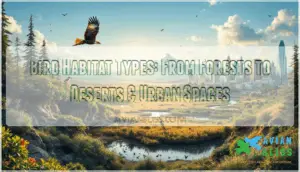 A Golden Eagle spirals above a windswept ridge at 12,000 feet while a mangrove kingfisher hunts mudskippers in a tropical estuary half a world away—and both are thriving in their wildly different corners of the planet. Birds have mastered nearly every habitat Earth offers, from sun-scorched deserts where temperatures crack 120°F to Arctic tundra locked in winter darkness for months.
Understanding bird habitat types reveals how species evolve specialized adaptations for survival: the crossbill’s twisted mandibles crack conifer cones in boreal forests, while burrowing owls nest underground in grasslands to escape prairie heat.
Whether you’re watching chickadees at your backyard feeder or tracking shorebirds across coastal wetlands, recognizing these distinct ecosystems unlocks the patterns behind where birds live and why they can’t survive anywhere else.
Table Of Contents
Key Takeaways
- Birds have colonized virtually every terrestrial habitat on Earth through specialized anatomical and behavioral adaptations—from crossbills’ twisted mandibles for cracking conifer cones to burrowing owls nesting underground to escape prairie heat—proving that survival strategies are habitat-specific rather than universal.
- Tropical rainforests support over 7,900 bird species across just 18% of Earth’s land surface, yet forest fragmentation and deforestation caused tropical bird populations to crash 25–38% between 1980 and 2020, making these ecosystems both biodiversity hotspots and conservation priorities.
- Grassland birds across North America have declined 43% due to habitat loss, with over 90% of native prairie vanished from regions like the Puget Lowlands, demonstrating that open-country species face steeper conservation challenges than forest dwellers.
- Urban and suburban landscapes function as legitimate bird habitats where species adapt to human-modified environments, though agricultural intensification leaves nearly half of bird species in heavily modified areas facing vulnerable or endangered status as generalist species thrive while specialists disappear.
Forest Habitats for Birds
Forests stand as one of the most essential sanctuaries for bird life, offering everything from towering canopies to shadowy understories where species carve out their niches. You’ll find birds adapting to remarkably different woodland conditions—whether it’s the seasonal rhythm of deciduous trees, the year-round shelter of evergreens, or the dense humidity of tropical jungles.
Let’s break down the major forest types that shape where and how birds thrive.
Temperate Deciduous Forests
When leaves flush green in spring and burn crimson by fall, you’ll find some of North America’s most adaptable bird species thriving in temperate deciduous forests. The forest canopy shelters warblers and tanagers, while the understory layer hosts thrushes foraging through leaf litter.
These deciduous ecosystems support diverse avian ecology through their structure—each tree species creates unique niches. Habitat preservation matters here because wildlife ecology depends on intact layers from ground to crown.
Coniferous and Boreal Forests
Up where evergreen needles cloak the branches year-round and winter stretches long and silent, boreal and coniferous forests host specialized species built for survival in harsher climates. You’ll spot crossbills prying seeds from spruce cones and boreal chickadees gleaming insects from bark crevices across the tree canopy.
Conservation status varies, but habitat preservation protects these coniferous trees and forest floors where boreal wildlife depends on intact forest ecology for nesting and foraging throughout unforgiving seasons.
Tropical Rainforests
Drop the evergreens behind—tropical rainforests demand a completely different game. Here, over 7,900 bird species flourish across just 18% of Earth’s land, with Colombia alone hosting 1,917. You’ll encounter endemic birds found nowhere else: toucans, cotingas, hummingbirds thriving in rainforest canopy layers.
Yet forest fragmentation threatens this wild abundance. Between 1980 and 2020, tropical bird populations crashed 25–38% from deforestation and heat extremes. Bird migration adds complexity—180 North American species winter here annually, recovering from grueling journeys.
Tropical bird populations crashed 25–38% between 1980 and 2020 as deforestation and heat extremes shattered forest ecosystems that 180 migratory species depend on for survival
Protected rainforests now stand as your frontlines for species diversity and ecological balance. Understanding the importance of tropical rainforests is vital for conservation efforts.
Swamps and Wet Woodlands
Where tropical rainforests demand canopy acrobatics, swamps and wet woodlands play by entirely different rules—waterlogged ground, standing water, and dense understory vegetation create a wholly distinct ecosystem that attracts birds you won’t find in drier forests. Cypress swamps and flooded forests harbor specialized species adapted to saturated conditions.
These wetland ecosystems—including mangrove habitats and riverine systems—anchor critical bird conservation efforts. Habitat loss threatens these waterlogged sanctuaries, making wetland ecology essential to ecological balance. Your understanding of swamp and wet woodland conservation directly aids wildlife conservation goals and habitat restoration initiatives.
Grassland and Open Country Habitats

Grasslands and open country habitats define themselves by their expansiveness—vast stretches of land where scattered trees yield to grass, shrubs, and rolling terrain.
You’ll find birds here thriving in conditions that’d seem barren to the untrained eye, each species carved by evolution to exploit these wide-open spaces.
Let’s explore the distinct grassland ecosystems that shape where your wild birds make their homes.
Prairies and Savannas
Prairies and savannas are your frontline battlegrounds for grassland bird conservation. These open expanses—where over 90% of native prairie has vanished from the Puget Lowlands—harbor specialized species demanding freedom from fragmentation.
Oak savanna restoration and prescribed burning directly benefit disturbance-dependent birds, while grassland management combats the 53% population decline threatening species like Lewis’s woodpecker.
Your habitat conservation efforts here ripple through entire migratory networks. Effective bird conservation requires addressing climate change issues to protect species.
Meadows and Pastures
Meadows and pastures might seem like nothing more than fields of grass, but they’re actually some of the most vibrant hunting grounds for ground-nesting birds and open-country hunters seeking room to roam. These semi-open habitats demand active management to preserve their ecological character and the specialized species that depend on them.
- Grassland ecology thrives when you maintain low vegetation density through rotational grazing or mowing, preventing woody encroachment that chokes out open-country species.
- Meadow management practices like late-season cutting protect nesting birds during breeding cycles while supporting insect populations these species hunt.
- Pasture conservation benefits from wildlife grazing patterns that mimic natural disturbance—creating habitat mosaics rather than uniform fields.
- Habitat conservation here directly counters the 43% grassland bird population decline across North America, particularly for species like Grasshopper Sparrows and Eastern Meadowlarks.
- Species conservation succeeds when your management integrates ecosystem services—balancing agricultural productivity with wildlife needs through evidence-based habitat restoration.
These landscapes represent your best opportunity to reclaim ground for birds demanding freedom from forest enclosure.
Steppe and Shrublands
Steppes and shrublands demand your attention because they’re where birds break free from the constraints of dense vegetation, thriving in sparse, hardy landscapes shaped by fire, drought, and wind. These semi-arid environments host specialized steppe wildlife adapted to unpredictable conditions. Your grassland management here requires understanding that shrubland ecology functions differently than meadows—fire and disturbance maintain habitat structure rather than threaten it. Conservation status depends on balancing grazing pressure with natural regeneration cycles.
| Habitat Feature | Steppe Wildlife | Conservation Priority |
|---|---|---|
| Low shrub density | Ground-nesting specialists | Prevent woody encroachment |
| Sparse herbaceous layer | Insectivores, seed-eaters | Maintain fire regimes |
| Exposed soil patches | Cryptic ground foragers | Monitor disturbance frequency |
| Wind-sculpted vegetation | Open-country hunters | Protect migration corridors |
| Drought adaptation | Heat-tolerant species | Manage grazing intensity |
Species conservation succeeds when your wildlife management recognizes that steppes aren’t degraded grasslands—they’re distinct ecosystems demanding specialized ornithology approaches.
Wetland and Aquatic Bird Habitats
Water shapes some of the richest ecosystems on the planet, and birds have evolved to thrive in these ever-changing environments. From shallow marshes teeming with cattails to fast-moving streams and open water, wetland and aquatic habitats offer food, shelter, and breeding grounds that few other landscapes can match.
Let’s explore the specific waters and wetlands where you’ll find birds truly at home.
Marshes and Bogs

Marshes and bogs are nature’s wildcard—unpredictable, vibrant, and absolutely essential for birds willing to embrace the wet. These wetland ecosystems thrive on constant moisture and specialized marsh vegetation rooted in peat formation.
Bog conservation matters because habitat loss threatens countless species dependent on aquatic plants and saturated soil. Wildlife management here focuses on preserving water levels and vegetation structure.
Your commitment to understanding these bird habitats directly bolsters their conservation status and the species that call them home.
Lakes and Ponds

When you spot a glassy lake or quiet pond, you’re looking at one of nature’s most magnetic pull for birds—places where survival hinges on open water and the abundance it brings. Water quality directly determines what freshwater birds can thrive here.
Aquatic plants anchor entire pond ecosystems, providing food and nesting sites. Lake shorelines create vital boundary zones where species forage and rest during animal migration.
Your wildlife management strategies—protecting water levels and vegetation structure—strengthen conservation status and habitat resilience for countless species dependent on these open-water systems.
Rivers and Streams

Rivers and streams carve through landscapes as active highways where water’s constant motion creates conditions unlike any still-water system—shaping entirely different ecological demands for the birds that depend on them.
Flowing water delivers fresh aquatic food and maintains riverbank vegetation that anchors nesting colonies.
Waterbirds exploit these riverine ecosystems during animal migration, where stream ecology provides critical stopover habitat.
Your conservation efforts protecting water quality and riparian zones strengthen wildlife resilience across entire watersheds.
Coastal Wetlands and Mangroves
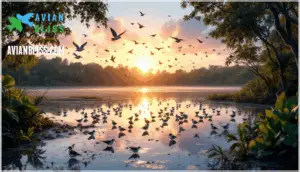
Where rivers meet the ocean, mangrove forests and coastal wetlands emerge as some of nature’s most productive bird sanctuaries. These ecosystems host 193 bird species across vast migratory networks—nearly a third of the global Western Sandpiper population relies on them during migration. Yet mangroves have declined 35% since 1980, destroying critical avian habitat.
You’re witnessing habitat destruction on a massive scale, but restoration efforts prove recovery is possible. Wetland restoration in Mexico increased bird abundance to near-natural levels, demonstrating that your conservation choices directly support biodiversity and species conservation.
These coastal zones aren’t just bird refuges; they’re ecological anchors for entire wildlife and ecosystems dependent on them.
Urban and Suburban Bird Habitats

Cities and suburbs might seem like the last place you’d find thriving bird populations, yet they’re teeming with avian life. You don’t need untouched wilderness to attract and support birds—your own backyard, the parks in your neighborhood, and even the built environment around you offer genuine habitats.
Here’s where birds are making their mark in the spaces you inhabit every day.
Residential Gardens and Parks
Your own backyard might be the most underrated frontier for bird observation—these intimate spaces blur the line between human territory and wild habitat, creating unexpected sanctuaries where you’ll encounter species that have learned to thrive alongside us.
Gardens and parks function as essential ecological oases within urban sprawl. By installing garden bird feeders and residential bird boxes, you’re actively participating in wildlife conservation while transforming your landscape into a living laboratory. Parks serve dual purposes: they offer recreation for us and refuge for birds coping with habitat destruction. Consider what you’re building:
- Native plantings attract insects, providing natural food sources beyond feeders
- Water features draw species for drinking and bathing, shaping bird conduct
- Layered vegetation mimics forest structure, offering nesting and roosting sites
- Community green spaces boost habitat connectivity across fragmented urban environments
These spaces demonstrate that bird watching isn’t confined to wilderness. Your role in park wildlife management and environmental impact extends beyond observation—you’re actively restoring the urban tree canopy and creating refuges where birds reclaim ground they’ve lost.
City Trees and Green Spaces
From your windowsill to the street corner, city trees and green spaces function as critical lifelines—they’re where birds navigate the concrete jungle and you get front-row seats to their extraordinary resilience.
Urban forestry directly shapes bird populations; mature trees provide essential canopy structure for nesting and foraging. Green roofs and city parks extend habitat connectivity across fragmented urban spaces, reducing isolation pressures on wildlife.
Tree canopy coverage drives urban wildlife diversity—species richness increases proportionally with vegetation density.
Through bird watching in these spaces, you’re documenting nature conservation in real time, contributing to wildlife education and strengthening your community’s ecological understanding.
Human-Modified Landscapes
But here’s where things get complicated: human activity doesn’t stop at park boundaries. Agricultural intensification, sprawling development, and habitat fragmentation reshape the landscape in ways that even urban green spaces can’t fully counteract.
Nearly half of bird species in heavily modified agricultural areas face vulnerable or endangered status. Generalist species thrive while specialists vanish—your neighborhood robins persist where warblers disappear.
This biodiversity loss demands smarter urban planning that connects fragmented patches, reduces pesticide use, and preserves the ecological corridors birds desperately need to survive in our transformed world.
Specialized and Extreme Bird Habitats

Birds don’t just stick to the comfortable places—some of them thrive in the harshest corners of our planet. From scorching deserts to windswept peaks and frozen tundras, these habitats push adaptation to its limits and reveal how resourceful birds really are.
Let’s explore where birds make their homes in Earth’s most demanding environments.
Desert and Arid Regions
Birds have cracked the code to thriving where most creatures can’t survive—deserts and arid regions demand masters of extreme adaptation, and these species have evolved some of nature’s most ingenious solutions. From nocturnal hunters to heat-resistant foragers, desert birds navigate extreme temperatures and scarce water through specialized physiology and conduct. Their survival hinges on oasis conservation and understanding desert ecology to maintain these critical refuge zones.
- Roadrunners and Gambel’s Quail exploit cactus habitats, extracting moisture from seeds and insects while minimizing water loss
- Sand Dune Ecosystems support specialized species like Burrowing Owls that nest underground to escape surface heat
- Nocturnal Activity Patterns allow species like Lesser Nighthawks to hunt during cooler hours, conserving energy
- Arid Landscape Migration Routes connect distant water sources, enabling seasonal movement across harsh terrain
- Wildlife Conservation of Oases protects critical refuges where desert birds congregate, sustaining ecological balance and species survival
Alpine and Mountainous Areas
Mountains and high elevations strip away the comfortable margins—here, altitude itself becomes the architect of survival, forcing birds to master thin air, brutal cold, and relentless exposure. Alpine meadows and rocky outcrops host specialized bird species adapted to extreme conditions.
High altitudes demand physiological resilience: thicker plumage, enhanced oxygen metabolism, and efficient thermoregulation. Golden Eagles and Ptarmigans exploit these snowy habitats through keen hunting prowess and camouflage.
Mountain ecosystems drive animal migration patterns as birds escape seasonal extremes. Wildlife conservation protects these fragile bird habitats from climate pressures threatening alpine bird species survival.
Polar and Tundra Environments
Tundra landscapes push survival to its limits—here, the Arctic Circle marks where resilience becomes everything. Over 200 bird species breed across these frozen expanses, with roughly 263 million birds arriving annually. You’ll find geese and shorebirds dominating this polar biodiversity, though climate-driven permafrost thaw and shrub encroachment now threaten their ecological balance. Arctic temperatures warm twice as fast globally, forcing animal migration shifts and creating phenological mismatches between chick hatching and peak insect availability. Mercury bioaccumulation through atmospheric transport compounds these challenges, demanding urgent wildlife conservation efforts.
Key pressures reshaping tundra habitats:
- Permafrost thaw mobilizes heavy metals, increasing mercury exposure in piscivorous species like Red-throated Loons
- Shrub encroachment alters arthropod communities, reducing ground-nesting habitat for sandpipers and plovers
- Phenological shifts create breeding mismatches, forcing earlier arrivals amid volatile environmental conditions
- Polar predation increases dramatically, with bears targeting bird eggs as sea ice diminishes
- Wetland drying reduces breeding sites, constraining reproductive success across water-dependent species
Islands and Cliffside Habitats
Cliffs and islands create evolutionary laboratories where isolation fosters extremes. Seabirds gather in colonies numbering millions, while endemic species thrive on rock outcrops no larger than a city block. Here, you’ll observe cliff-nesting alcids, gulls, and petrels utilizing vertical real estate beyond the reach of predators. Coastal erosion accelerates habitat loss, underscoring the critical need for marine conservation to support avian research tracking these precarious populations.
| Habitat Feature | Representative Taxa | Conservation Status |
|---|---|---|
| Vertical cliff faces | Atlantic Puffins, Razorbills | Vulnerable to disturbance |
| Isolated island peaks | Galápagos Finches, Hawaiian Honeycreepers | Critically Endangered (many island endemics) |
| Coastal seabird colonies | Northern Gannets, Common Murres | Stable but climate-threatened |
Animal migration and habitat dynamics continually reshape these ecosystems. Ornithological research now documents range contractions as storms intensify and fish stocks shift.
Frequently Asked Questions (FAQs)
How do agricultural fields affect bird populations?
Like a double-edged sword, agricultural fields cut through the landscape, fragmenting habitat while displacing grassland specialists. Intensive monoculture disrupts migration corridors and threatens conservation status.
Crop rotation and bird-friendly farm management practices can restore ecological balance.
What birds thrive in scrubland and brushy areas?
Scrubland birds like Northern Cardinal and Gray Catbird flourish in thorn forest and chaparral wildlife zones, where dense brush provides nesting cover.
Desert sparrows exploit these bird habitat niches too, though ornithology research reveals concerning conservation status trends across degraded brush habitat ecosystems.
Do birds prefer old-growth or secondary forests?
Old-growth forests support greater avian diversity than secondary forests due to structural complexity and mature tree canopy development. However, habitat fragmentation affects both types.
Ornithology research shows certain species depend on old-growth for survival, while others adapt to regenerating ecosystems.
How do seasonal changes impact habitat suitability?
Seasonal migration drives food availability and breeding patterns across hemispheres. Climate shift alters habitat fragmentation, affecting conservation status.
Bird conduct adapts through ecology-based responses, though climate change increasingly disrupts traditional migration routes and timing.
What role do hedgerows play in bird conservation?
You’ll find hedgerows act as critical wildlife corridors in farmland biodiversity, supporting bird migration and nesting.
Conservation efforts increasingly focus on habitat restoration of these linear features, boosting conservation status for declining species through strategic ecology-based environmental science and conservation biology interventions.
Conclusion
Like Darwin’s finches scattered across the Galápagos, each species locked to its ecological niche, birds reveal nature’s blueprint through their chosen terrain. You’ve traced the invisible borders that separate a puffin’s salt-lashed cliff from a roadrunner’s cactus-studded basin—boundaries drawn not by maps but by evolutionary necessity.
Understanding bird habitat types transforms random sightings into purposeful encounters, turning your binoculars into a decoder ring for survival strategies written across millennia. The next warbler you spot isn’t just visiting; it’s home.
- https://www.ducks.org/newsroom/us-bird-populations-continue-alarming-decline-new-report-finds
- https://www.allaboutbirds.org/news/incorporating-ebird-trends-into-state-of-the-birds-2025/
- https://abcbirds.org/news/2025-state-of-the-birds/
- https://journal.afonet.org/vol96/iss1/art5/
- https://www.fishwildlife.org/landing/blog/2025-state-birds-report-reveals-alarming-decline-bird-populations-almost-every-habitat