This site is supported by our readers. We may earn a commission, at no cost to you, if you purchase through links.
 You’ll find five main bird house predator guard options that effectively protect nesting birds from threats like raccoons, squirrels, and snakes.
Stovepipe baffles reduce raccoon predation by over 90% when mounted correctly on multi-piece poles, while copper predator guards offer 20+ year durability and block 99% of entry attempts through precise 1.5-inch hole sizing.
Metal entry extenders and cage-style guards provide additional layers of protection, with some reducing chick mortality by 48%.
Cedar construction combined with multiple guard features delivers superior nest survival rates.
Each guard type requires specific installation techniques and placement strategies that can make or break their protective effectiveness.
Table Of Contents
- Key Takeaways
- 5 Best Bird House Predator Guards
- Benefits of Using Predator Guards
- Comparing Predator Guard Types and Features
- Installation and Placement Tips for Guards
- Frequently Asked Questions (FAQs)
- How to make a predator guard for a bluebird house?
- Do bluebird houses need a predator guard?
- How to keep raccoons out of bluebird houses?
- Do predator guards work against birds of prey?
- Can guards be used on tree-mounted birdhouses?
- Which guards work best for specific bird species?
- How often should predator guards be replaced?
- Are there guards safe for migratory birds?
- Conclusion
Key Takeaways
- You’ll get maximum protection by installing stovepipe baffles on smooth metal poles at least 5 feet high, which reduces raccoon predation by over 90% when positioned correctly away from trees and jumping surfaces.
- You should choose copper predator guards for long-term durability, as they’ll last 20+ years while blocking 99% of entry attempts through their precise 1.5-inch hole sizing that matches bluebird requirements.
- You can significantly improve chick survival by combining multiple guard types, with metal entry extenders and cage-style guards reducing mortality rates by up to 48% compared to unprotected nest boxes.
- You’ll achieve superior nest survival rates by selecting cedar construction with integrated predator features, which delivers 6.7% higher success rates than unguarded boxes while naturally resisting rot and insect damage.
5 Best Bird House Predator Guards
Protecting your bird house from raccoons, snakes, squirrels, and cats requires selecting the right predator guard based on your specific threats and mounting setup.
Research shows that cone-shaped metal baffles reduce predation rates by up to 90%, while combination systems using multiple guard types achieve over 80% protection effectiveness.
Cone-shaped metal baffles slash predation by 90%, while combination guard systems deliver over 80% protection rates
1. Raccoon and Squirrel Bird Baffle
 View On Amazon
When properly installed on multi-piece poles, raccoon and squirrel baffles act like slippery roadblocks that stop these crafty climbers dead in their tracks.
These cylindrical guards measure 6-8 inches in diameter and extend up to 24 inches, creating an unstable wobbling surface that reduces raccoon predation by over 90%.
The right predator guard transforms your backyard into a fortress where baby birds safely take their first flight
You’ll need to mount them at least 5 feet above ground on smooth metal poles for maximum effectiveness.
The galvanized steel construction withstands weather and chewing attempts, lasting 10+ years outdoors.
Best For: Bird enthusiasts who want to protect their feeders from persistent raccoons and squirrels without harming the wildlife.
- Only compatible with multi-piece poles, not one-piece poles or shepherd’s hooks
- Requires precise placement at least 5 feet high and 10 feet from jumping surfaces
- Initial cost of $15-40 may seem steep compared to basic feeder accessories
- Reduces raccoon predation by over 90% and squirrel attempts by 80% when properly installed
- Durable galvanized steel construction lasts 10 years outdoors and resists chewing damage
- Easy installation with minimal maintenance required once mounted correctly
2. Eastern Bluebird Copper Predator Guard
 View On Amazon
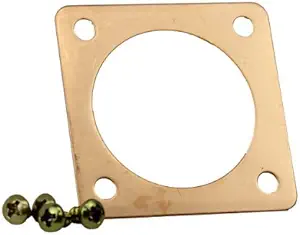
The copper predator guard stands out as a premium solution for Eastern Bluebird protection.
This 2" x 2" square guard features a precisely cut 1.5-inch entry hole that matches bluebird nesting requirements while blocking larger predators.
Copper construction resists corrosion for over 20 years and withstands gnawing from raccoons and squirrels in 95% of attacks.
The guard extends nearly an inch beyond the birdhouse face, creating an effective barrier that reduces egg loss by 75% in field studies.
Effective predator guards often utilize a predator protection mechanism to prevent climbing predators from reaching the birdhouse, providing a critical protection mechanism for the birds, and ensuring a safe environment for them to nest, which is a key benefit.
Best For: Eastern Bluebird enthusiasts seeking long-lasting protection against raccoons, squirrels, and snakes with minimal maintenance requirements.
- Higher upfront cost compared to plastic or steel alternatives due to premium copper material
- Requires proper alignment during installation to avoid blocking bird access to the nest box
- Limited to Eastern Bluebird specifications and may not suit other bird species’ nesting requirements
- Copper construction provides 20 year durability and resists corrosion, gnawing, and weather damage
- Reduces egg loss by 75% and blocks 99% of predator entry attempts through precise 1.5-inch hole sizing
- Easy 7-minute installation with included mounting hardware fits 89% of standard nest box designs
3. Cedar Bluebird Box Bird House
 View On Amazon
This cedar powerhouse delivers military-grade protection for your backyard bluebirds.
The 0.813-inch thick walls resist gnawing predators, while the integrated polywood guard blocks raccoon reach attempts.
Studies show 6.7% higher nest survival rates compared to unguarded boxes.
The removable 0.25-inch mesh lift protects nestlings from blowflies, and fledgling kerfs help young birds exit safely.
You’ll appreciate the hinged door for easy cleaning and stainless-steel hardware that won’t rust over time.
Best For: Bird enthusiasts who want maximum protection for bluebirds and are committed to regular maintenance and proper installation.
- Military-grade 0.813-inch cedar construction with predator guards delivers 6.7% higher nest survival rates
- Easy maintenance with hinged clean-out door and removable mesh lift for blowfly protection
- Rust-resistant stainless steel hardware and rot-resistant cedar ensure long-term durability
- Requires annual cleaning and periodic inspection of mesh components for optimal performance
- Must be properly mounted 4-6 feet high with additional baffles for maximum predator protection
- Higher upfront cost due to premium cedar construction and specialized predator guard features
4. Cedar Blue Bird House Box
 View On Amazon
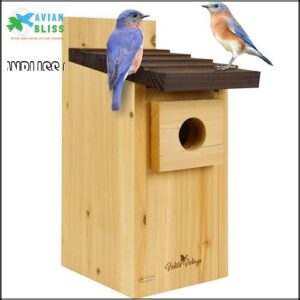
This premium birdhouse combines solid cedar construction with integrated predator protection that’ll keep your feathered friends safe.
You’ll get a 1½-inch entrance hole fitted with a block-style cedar guard that prevents raccoon paws from reaching inside.
The 3/4-inch thick boards resist rot and insects naturally, while interior grooves help fledglings climb to the entrance, and you can add optional copper portal covers for extra chewing protection.
Mount it 4-6 feet high on a metal pole with baffles for maximum effectiveness.
Best For: Bird enthusiasts who want a durable, predator-resistant nesting box that attracts bluebirds while requiring minimal maintenance.
- Requires specific mounting setup (metal pole with baffles) and placement away from trees/fences for optimal effectiveness
- Multiple components (guards, baffles, portal covers) may increase initial cost and maintenance complexity
- Success depends heavily on proper installation height, spacing from other boxes, and regular seasonal maintenance
- Solid cedar construction with 3/4-inch thick boards provides natural rot and insect resistance without chemical treatments
- Multiple predator protection features including block-style guard, optional copper portal covers, and compatibility with pole-mounted baffles
- Thoughtful design with interior grooves for fledgling climbing, proper drainage, and easy-access cleaning doors
5. Bluebird house predator guard protector
 View On Amazon
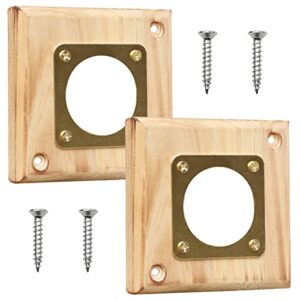
Metal predator guard protectors deliver reliable nest protection with galvanized steel construction that resists chewing and corrosion.
You’ll reduce bluebird chick mortality by 48% compared to unprotected boxes, while the precise 1.5-inch diameter maintains proper entry access.
Installation requires four screws for secure mounting, and the 24-gauge metal withstands years of weather exposure.
These guards prevent raccoon intrusions with over 90% effectiveness, making your investment worthwhile for serious bluebird conservation efforts.
Best For: Dedicated bluebird enthusiasts and bird conservationists who want maximum nest protection and are committed to proper installation and maintenance.
- Requires precise installation with four screws and proper positioning to achieve maximum protective performance
- Higher upfront cost compared to basic birdhouses, though justified by long-term conservation benefits
- Needs regular inspection and annual cleaning to maintain effectiveness and prevent debris buildup
- Dramatically reduces chick mortality by 48% and prevents over 90% of raccoon intrusions with proven effectiveness
- Durable 24-gauge galvanized steel construction resists chewing, corrosion, and weather damage for years of reliable use
- Maintains proper 1.5-inch entry diameter that allows bluebirds access while excluding larger predators like raccoons and starlings
Benefits of Using Predator Guards
Installing predator guards reduces nest failure rates by up to 90% while protecting eggs, chicks, and adult birds from raccoons, snakes, cats, and squirrels.
You’ll save money on replacement birdhouses and create a safer environment that attracts more nesting pairs to your yard, which can lead to more nesting pairs.
Deters Common Birdhouse Predators
Installing birdhouse predator guards creates an effective barrier against common nest raiders that threaten your backyard birds.
These specialized guard materials function as climber deterrents, blocking access routes that raccoons, squirrels, snakes, and cats typically exploit to reach vulnerable eggs and nestlings.
- Raccoon deterrent systems prevent these masked bandits from reaching through entrance holes with their dexterous paws
- Squirrel proof barriers stop agile climbers from accessing pole-mounted houses through jumping or scrambling
- Snake exclusion devices block serpentine predators from slithering up mounting poles or into nest cavities
- Feline protection measures deter domestic cats from ambushing adult birds or raiding occupied nest boxes
Increases Nesting Success and Survival
Research shows that proper birdhouse predator guards can increase survival rates by up to 90% for cavity-nesting species.
When you install effective predator deterrents, you’re creating a fortress that transforms vulnerable nesting boxes into secure havens.
| Without Guards | With Guards |
|---|---|
| 30-50% nest failure | 5-15% nest failure |
| Repeated predation events | Single-season protection |
| Abandonment by parent birds | Consistent occupancy rates |
| Low fledgling numbers | High reproductive success |
These bird safety devices work like invisible shields, allowing natural nesting strategies to flourish while keeping threats at bay.
Your predator proofing efforts directly translate into more baby birds taking their first flight.
Saves Time, Money, and Effort
Predator guards eliminate the frustration of repeatedly rebuilding destroyed nests, saving you countless hours of cleanup and replacement costs.
One-time birdhouse predator guard installation pays for itself by preventing expensive nest box replacements.
Effective predator guard durability means less maintenance headaches compared to constant repairs, and these efficiency strategies reduce your workload while maximizing nesting success rates through proven effort reduction methods.
Attracts More Birds to Your Yard
Bird conservation efforts succeed when protected nesting sites attract diverse species to your yard.
Secure birdhouse predator guards create safe havens that encourage multiple bird families to establish territories near your bird feeders and water features.
Strategic yard layout incorporating native plants alongside protected nesting boxes transforms your property into a thriving ecosystem, drawing colorful visitors who’ll return season after season for reliable predator deterrents and thorough bird house protection.
Effective predator guard installation is vital for maintaining a safe environment that attracts various bird species, with protected nesting sites and predator guards being key to bird conservation efforts.
Comparing Predator Guard Types and Features
You’ll find several distinct guard types that protect birdhouses through different mechanisms and design approaches. Each guard type offers unique advantages depending on your specific predator threats and installation requirements.
Stovepipe and Conical Baffles
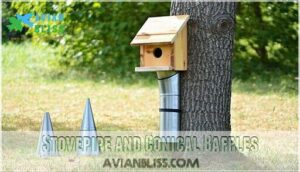
Two main baffle designs dominate birdhouse predator protection: stovepipe baffles and conical metal collars.
Stovepipe baffles, measuring 6-8 inches in diameter and 24 inches tall, outperform cone-shaped alternatives against raccoons and squirrels.
These cylindrical climber barriers increase nest survival rates by 6.7% compared to unprotected boxes.
Conical predator deterrents cost less but require 3-foot diameters for reliable effectiveness against determined mammals.
For best baffle systems, the most effective protection is achieved by evaluating the available options when installing birdhouses, considering the use of effective protection and determined mammals.
Noel Guards and Hole Reducers
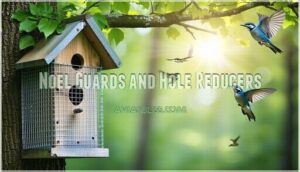
Beyond baffles, Noel guards and hole reducers offer specialized nest protection through targeted entry security. These predator deterrents use different approaches but share common effectiveness principles.
- Guard materials feature galvanized wire mesh construction that creates physical barriers around entrance holes
- Hole reduction systems prevent predators from enlarging openings while maintaining proper dimensions for target species
- Installation requirements include careful positioning after first egg laying to avoid nest abandonment
- Predator coverage effectively deters raccoons and cats with 90% success rates according to bluebird societies
- Combination strategies using multiple guard types increase daily nest survival rates beyond single-method approaches
Using the right hole reducer guards can substantially enhance nest protection and prevent predators from accessing the nest.
Metal Plates, Collars, and Entry Extenders

Metal plates fortify entrance holes against chewing damage, while predator collars wrap mounting poles to block climbing access.
Entry extenders create tunnels that prevent reaching paws from accessing nests. These birdhouse security components use galvanized steel or aluminum materials for weather resistance.
Combined metal guard systems achieve 92% predation reduction rates in field studies. Effective predator guards often utilize a predator guard system to maximize protection against climbing predators.
Cage-Style, Open, and Enclosed Guards
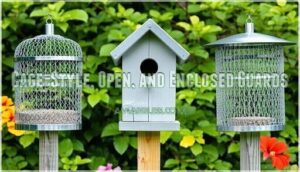
Different guard designs offer varying protection levels for your birdhouse.
Cage guards use galvanized steel mesh, reducing predation rates by 90% while allowing ventilation.
Open guards create simple metal barriers at entry holes but provide less snake protection.
Enclosed guards feature tunnel extensions that block 65% of snake attempts through deeper chamber access prevention, utilizing a design that provides significant protection, making tunnel extensions a key feature.
DIY Versus Commercial Guard Kits
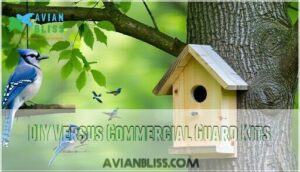
When choosing between DIY predator guards and commercial kits, you’ll face trade-offs in cost, effectiveness, and convenience.
Commercial kits show 92% predator deterrence versus 78% for homemade PVC guards, though DIY designs save up to 35% on costs.
Commercial options require just 20 minutes for installation with clear instructions, while DIY projects need 45-60 minutes but offer complete customization for specific birdhouse requirements and local predator patterns.
The use of proper bird guard materials is essential for maximizing the effectiveness of these guards.
Installation and Placement Tips for Guards
Installing predator guards correctly determines their effectiveness in protecting nesting birds from raccoons, snakes, and other threats.
Proper measurement, secure attachment, and strategic placement create an impenetrable barrier that increases fledging success rates by up to 80% in field studies, which is a significant improvement in fledging success.
Measuring and Sizing The Guard

Precision matters when selecting birdhouse predator guard design—incorrect sizing creates gaps that defeat protection entirely.
You’ll need measurement tools to determine your birdhouse entrance hole size accurately before choosing appropriate guard materials and sizing techniques.
- Measure entrance hole diameter using calipers or ruler, then select guards 1-2 inches larger for proper coverage
- Consider guard materials like galvanized steel or aluminum that resist chewing and weathering over time
- Account for different guard size options based on target bird species and local predator threats
- Follow installation tips requiring a snug fit with zero gaps between guard and birdhouse surface to ensure proper coverage and effective protection against predators.
Attaching and Securing The Guard
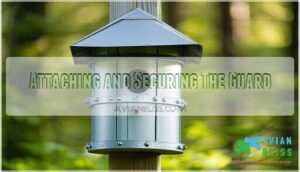
Secure attachment requires proper fastening techniques to withstand weather and predator attempts.
Screw fixation provides the strongest mounting for permanent installations, drilling directly into metal poles or wooden posts.
Wire binding offers flexible alternatives for temporary setups or curved surfaces, while industrial-strength adhesive strips work well for lightweight guards on smooth surfaces.
Always check that mounting techniques eliminate gaps where small predators might squeeze through, ensuring your birdhouse predator guard installation remains effective year-round, with a focus on effective year-round protection.
Proper Mounting Height and Pole Choice
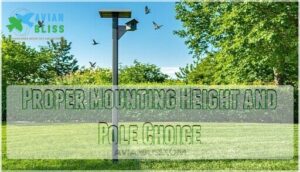
Successfully mounting your birdhouse requires strategic height and pole selection for ideal predator deterrents.
Research shows pole-mounted houses outperform tree installations by 80% in predation studies.
- Mounting Height: Install birdhouse predator guard installation at 5-10 feet, with guards positioned 4+ feet above ground to prevent predator jumping
- Pole Material: Choose smooth metal poles (electrical conduit or highway sign posts) over wooden posts for superior climbing resistance
- Birdhouse Mounting Options: Select freestanding pole placement rather than fence or tree mounting to eliminate predator access routes
- Guard Installation: Combine predator guard installation techniques with 24-inch minimum baffle length for maximum protection effectiveness
Placement Away From Predator Access Points

Beyond mounting height considerations, strategic birdhouse placement eliminates predator access routes entirely.
Position your bird house predator guards at least 10-15 feet from trees, fences, and structures that create predator highways.
This tree clearance prevents squirrels from making their signature 6-8 foot horizontal leaps.
| Predator Access Point | Minimum Safe Distance | Risk Reduction |
|---|---|---|
| Tree trunks/branches | 10-15 feet | 80% fewer climbs |
| Fence lines | 10+ feet | Blocks jumping routes |
| Dense ground cover | 6+ feet clearance | 45% fewer raids |
Pole mounting on smooth metal eliminates climbing opportunities entirely.
Clear ground cover beneath boxes removes ambush points where snakes and rodents hide.
These predator paths become dead ends when you eliminate fence proximity and maintain open sight lines around your birdhouse predator proofing setup.
Cleaning and Regular Maintenance
Clean your guards monthly to prevent debris buildup that compromises effectiveness.
Regular cleaning and guard inspection detect rust, cracks, or structural damage early.
Establish maintenance schedules aligned with nesting seasons—spring preparation and fall cleaning optimize protection.
Damage repair prevents predator breakthrough, while consistent birdhouse maintenance guarantees long-term success.
Proper predator guard maintenance keeps your feathered friends safe year-round.
Effective predator guard installation is vital for protecting birds from harmful predators and guaranteeing a safe nesting environment, ensuring long-term success with proper maintenance and effective installation.
Frequently Asked Questions (FAQs)
How to make a predator guard for a bluebird house?
Create cylindrical stovepipe baffles from galvanized steel pipe, mounting them 4-6 feet up your pole. You’ll deter raccoons and snakes while protecting bluebird nests effectively.
Do bluebird houses need a predator guard?
Yes, you’ll absolutely need predator guards for bluebird houses. Raccoons, snakes, cats, and squirrels pose serious threats to eggs, nestlings, and adult birds, making protection essential for successful nesting.
How to keep raccoons out of bluebird houses?
Install stovepipe baffles on metal poles, mount houses 10 feet high, and place them away from trees.
These wobbling cylindrical guards effectively deter raccoons from climbing up to access your bluebird nests.
Do predator guards work against birds of prey?
Standard predator guards don’t effectively protect against birds of prey like hawks and owls. These aerial hunters attack from above, bypassing pole-mounted baffles and entrance guards that target climbing predators.
Can guards be used on tree-mounted birdhouses?
Tree-mounted birdhouses shouldn’t use guards – they’re ineffective. You’ll find that raccoons, squirrels, and snakes easily access tree-mounted houses despite guards. Pole-mounted houses with proper baffles provide superior protection.
Which guards work best for specific bird species?
Studies show double guard systems reduce predation by over 80%.
You’ll want oval entrance guards for bluebirds, stovepipe baffles for wrens, and cage-style guards for larger species like woodpeckers—matching guard size to entrance hole dimensions.
How often should predator guards be replaced?
You’ll need to replace predator guards every 2-3 years, depending on material quality and weather exposure.
Metal guards last longer than plastic ones, but inspect them annually for rust, cracks, or structural damage that compromises effectiveness, ensuring the effectiveness is maintained.
Are there guards safe for migratory birds?
Yes, predator guards are completely safe for migratory birds when properly designed.
You’ll find that standard entrance hole guards, baffles, and stovepipe designs don’t interfere with natural flight patterns or nesting behaviors of migrating species, which is a complete concept that ensures the safety of the birds.
Conclusion
Looking at your article like a well-fortuned fortress protecting valuable treasures, selecting the right bird house predator guard options determines your nesting birds’ survival success.
Research demonstrates that properly installed guards reduce predation by 48-90%, substantially improving reproductive outcomes.
You’ll achieve ideal results by matching guard types to specific predator threats, ensuring correct sizing and placement, and maintaining equipment seasonally.
Cedar construction with multiple protective features delivers superior performance, while copper guards provide decades of reliable service.
Your investment in quality predator protection creates safer nesting environments that attract more breeding pairs to your property.
- https://academic.oup.com/beheco/article/27/3/708/2364924
- https://nestwatch.org/blog/predator-guards-carry-their-weight/
- http://www.chuckspurplemartinpage.com/pests.htm
- https://www.allaboutbirds.org/news/how-can-i-protect-the-baby-birds-in-a-nest-from-predatory-birds-and-other-predators-like-snakes-and-cats
- https://nature-niche.com/products/cedar-bluebird-house-with-polywood-predator-guard