This site is supported by our readers. We may earn a commission, at no cost to you, if you purchase through links.
 You’ll need proper bird house ventilation requirements to keep your feathered tenants healthy and thriving.
Install two 5/8-inch diameter holes near the top of each side wall for ideal airflow. This creates four ventilation holes total, allowing hot air to escape while preventing deadly heat buildup that can cook eggs or suffocate nestlings.
Position holes slightly below the roof line to prevent rain entry while maintaining air circulation.
Proper ventilation also reduces humidity levels, preventing mold growth and bacterial infections that threaten young birds.
Your ventilation system works like a natural air conditioning unit, maintaining comfortable temperatures during scorching summer days when birdhouses can become death traps without adequate airflow.
Table Of Contents
- Key Takeaways
- Ventilation Basics
- Designing Ventilation
- Birdhouse Ventilation Types
- Ventilation and Bird Health
- Maintaining Ventilation
- Frequently Asked Questions (FAQs)
- Do bluebird houses need ventilation?
- How to protect a birdhouse from heat?
- Do ventilation holes attract predators to birdhouses?
- Can too much ventilation harm nesting birds?
- Should ventilation differ for winter roosting boxes?
- How does climate affect ventilation hole requirements?
- Do ventilation holes need protective screening material?
- Conclusion
Key Takeaways
- You’ll need to install four 5/8-inch ventilation holes near the roof line—two on each side wall—to create proper cross-ventilation that prevents deadly heat buildup and maintains healthy air circulation.
- Position your ventilation holes just below the roof line to prevent rain entry while allowing hot air to escape, which keeps interior temperatures manageable during scorching summer days.
- Regular maintenance is essential—inspect and clean ventilation holes monthly during nesting season to remove blockages from debris, spider webs, or mud that can compromise airflow.
- Proper ventilation reduces humidity levels and prevents mold growth and bacterial infections that threaten nestling health, directly improving survival rates and breeding success.
Ventilation Basics
You’ll need proper ventilation in your birdhouse to prevent deadly heat buildup and humidity that can kill nestlings.
Without adequate airflow, your feathered tenants face respiratory problems, bacterial infections, and overheating that dramatically reduces their survival chances, including deadly heat buildup.
Poor ventilation kills nestlings through overheating and respiratory failure.
Importance of Ventilation
Proper bird house ventilation isn’t just a nice-to-have feature—it’s essential for your feathered friends’ survival.
Without adequate birdhouse air flow, you’re creating a dangerous environment where nestlings can’t thrive.
Here’s what poor nest box ventilation causes:
- Overheating Prevention fails, leading to deadly temperature spikes
- Air Quality deteriorates from ammonia and carbon dioxide buildup
- Fungal Risks multiply in humid, stagnant conditions
Effective birdhouse temperature regulation and proper ventilation directly impact nestling survival rates.
Role in Temperature Regulation
Bird house ventilation acts like your home’s air conditioning system, preventing deadly heat stress in nesting birds.
Without proper ventilation, birdhouse temperature can soar 15-20 degrees above outside air, causing nestling overheating.
Ventilation efficiency depends on strategic hole placement and material selection, which is crucial for well-designed birdhouse air flow that keeps interior temperatures manageable, protecting vulnerable chicks from climate impact during hot summer days when overheating poses the greatest threat.
Proper ventilation also aids in reducing humidity issues, which is essential for maintaining a healthy environment and preventing climate impact.
Impact on Humidity Levels
High humidity creates a breeding ground for mold prevention challenges and bacteria growth inside your birdhouse.
Poor ventilation turns your birdhouse into a dangerous humidity trap for nesting birds.
Without proper ventilation holes, moisture from droppings and nesting material becomes trapped, threatening hatchling health.
Smart airflow design prevents bird house humidity buildup that leads to respiratory problems, and your ventilation holes work like tiny windows, allowing fresh air to sweep away dangerous moisture before birdhouse overheating occurs.
Designing Ventilation
When designing ventilation for your birdhouse, you’ll need to create the right balance of airflow without compromising the nest’s security.
Strategic placement, proper sizing, and suitable materials work together to maintain healthy air circulation that protects growing birds from overheating and harmful moisture buildup, which is crucial for the nest’s security.
Placement of Ventilation Holes

Position ventilation holes near the roof for maximum effectiveness.
Place them just below the roof line on opposite sides to create cross-flow air circulation.
Keep holes 1-2 inches from the top to prevent rain entry while maintaining airflow.
This hole placement works with roof overhang to protect against weather while ensuring proper bird house ventilation and preventing birdhouse overheating.
Some designs even incorporate strategic air vents for enhanced circulation.
Size and Number of Holes
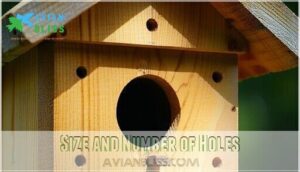
Getting ventilation right means hitting the sweet spot with hole diameter, quantity, and spacing.
You’ll want to drill holes that actually work:
- Hole Diameter: Use 1/8 to 1/4-inch holes for small birdhouses
- Hole Quantity: Create at least two ventilation holes, four for larger boxes
- Hole Placement: Position near the top sides, just below the roof
- Hole Spacing: Space evenly around the birdhouse for ideal airflow
- Hole Shape: Keep them round for consistent ventilation performance
Materials for Ventilation
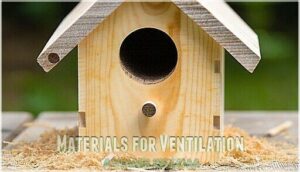
You’ll want to choose breathable materials that promote proper airflow while withstanding weather conditions.
Wood types like cedar and pine work best for birdhouse materials, naturally resisting moisture and decay. Metal mesh provides excellent ventilation but requires rust-resistant coating.
Plastic alternatives offer durability but may trap heat without adequate birdhouse ventilation holes. Cedar wood birdhouses are a popular and durable option.
Natural fibers and recycled materials can supplement traditional options while meeting birdhouse ventilation requirements effectively.
Birdhouse Ventilation Types
You’ll find three main ventilation approaches when building birdhouses, each offering different benefits for your feathered tenants.
Understanding these options helps you choose the best method to keep nestlings healthy and comfortable during the vital breeding season.
Natural Ventilation Methods

Natural airflow creates effective birdhouse ventilation through simple physics.
Convection currents develop when warm air rises through strategically placed openings, pulling fresh air into the box. Box orientation matters—face entrance holes away from prevailing winds while maintaining roof overhang protection.
Key natural ventilation methods:
- Gap ventilation – Leave ¾-inch spaces between roof and walls
- Side hole placement – Drill ¼-inch holes near the roofline
- Material breathability – Use rough-cut lumber that allows air exchange
- Cross-ventilation – Position holes on opposite sides for airflow
- Gradient design – Slope roofs to encourage natural air movement
This passive approach maintains steady birdhouse airflow without mechanical components, relying on temperature differences to drive circulation.
Proper ventilation also aids in keeping bugs out of the birdhouse.
Mechanical Ventilation Options
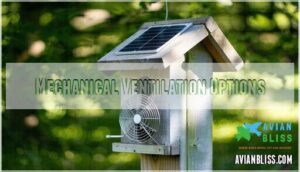
You can upgrade your birdhouse ventilation with mechanical options for better airflow control.
Solar powered fans provide continuous air circulation, reducing internal temperatures by up to 8°C during hot days.
Battery-operated air pumps offer reliable ventilation with automated control systems.
Many retailers offer a birdhouse solar fan for this purpose.
Fan integration requires waterproof installation, while active cooling systems maintain ideal birdhouse air circulation even when natural airflow fails.
Comparison of Ventilation Types
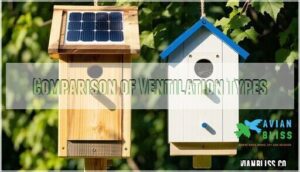
Passive bird house ventilation typically meets your basic needs, while active systems offer enhanced control but aren’t necessary for backyard setups.
You’ll find passive designs succeed in over 90% of cases with proper hole placement and size.
Active ventilation costs more, requires maintenance, and may disturb nesting birds.
Material impact matters too—wood outperforms metal by maintaining stable temperatures naturally.
Ventilation and Bird Health
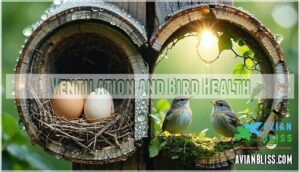
When you provide proper ventilation in your birdhouse, you’re creating a healthier environment that directly impacts your feathered guests’ survival and well-being.
Poor air circulation leads to dangerous humidity buildup, bacterial growth, and respiratory problems that can kill nestlings before they ever leave the nest.
Effects on Nestling Health
Proper bird house ventilation directly impacts your nestlings’ health and survival.
Poor airflow creates overheating risks that stress young birds and reduces hatchling survival rates.
Without adequate ventilation, respiratory issues develop from stagnant air and elevated carbon dioxide levels.
Fungal growth thrives in humid conditions, threatening nesting success.
Temperature regulation through ventilation keeps your birdhouse comfortable, supporting nestling protection and healthy development throughout the breeding season, ensuring healthy development, nestling protection, and a successful breeding season.
Reduction of Disease Risk
Ventilation keeps dangerous organisms at bay in your birdhouse.
Poor airflow creates breeding grounds for fungal growth and microbial risks that threaten nestlings.
Ammonia buildup from droppings becomes toxic without proper air exchange.
Good birdhouse ventilation paired with effective birdhouse drainage reduces parasite control issues.
Regular birdhouse cleaning and disinfection prevent avian diseases, while proper nest sanitation protects vulnerable chicks from harmful bacteria and mold.
Improvement of Survival Rates
When you install proper bird house ventilation, you’re directly boosting nesting success rates by creating safer environments.
Research shows ventilated birdhouses reduce nestling mortality through better birdhouse temperature regulation and improved hatchling health.
Your material choice and location impact survival outcomes – well-ventilated designs with predator deterrents maintain conditions that help more young birds reach maturity successfully.
Proper ventilation also guarantees removal of harmful gases, contributing to better air quality within the birdhouse, which in turn helps to create an environment that’s most favorable for the birds, promoting better air quality and safer environments with improved hatchling health and well-ventilated designs.
Maintaining Ventilation
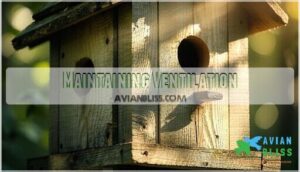
Proper ventilation maintenance guarantees your birdhouse stays healthy for its feathered residents throughout the breeding season.
You’ll need to check ventilation holes regularly and clean them to prevent blockages that can harm nesting birds.
Regular Cleaning Schedule
Clean your birdhouse annually to maintain proper ventilation and bird health.
Schedule birdhouse maintenance after nesting season ends, typically late fall or early winter.
Remove old nests completely and check for mold or pest damage.
Use proper disinfection methods to prevent disease transmission.
- Cleaning frequency: Once yearly after breeding season
- Nest removal: Clear all nesting materials and debris thoroughly
- Birdhouse disinfection: Use 10% bleach solution, rinse well, air dry
- Inspection timing: Check ventilation holes during cleaning for blockages
Inspection of Ventilation Holes
Check ventilation holes monthly during nesting season for blockages from debris, spider webs, or mud.
Look for signs of predator access or enlarged holes that compromise structural integrity. Test airflow by gently feeling for air movement near openings.
Blocked ventilation reduces oxygen flow and increases humidity, threatening bird health.
Proper drainage prevents water accumulation.
Regular birdhouse maintenance prevents insect intrusion and guarantees proper birdhouse ventilation throughout breeding cycles, ensuring proper drainage.
Repair and Replacement Options
When material degradation or structural damage threatens your bird house ventilation system, you’ll need swift action.
Silicon caulking fixes minor birdhouse crack repair issues, while wood filler handles larger holes.
For severe ventilation blockage or pest infestation, complete replacement of panels becomes necessary.
Addressing birdhouse structural integrity is key to longevity. Pre-cut plywood panels restore birdhouse ventilation efficiently, and composite materials improve long-term reliability for superior bird house ventilation performance, ensuring complete concepts are applied.
Frequently Asked Questions (FAQs)
Do bluebird houses need ventilation?
Imagine this scenario: your neighbor’s bluebird house sits empty all summer while birds nest elsewhere.
Yes, bluebird houses absolutely need ventilation to prevent overheating and maintain healthy air circulation.
You’ll want 1/8 to 1/4-inch holes near the roof on each side to ensure ventilation.
How to protect a birdhouse from heat?
Position your birdhouse in shade or use light colors to reflect heat. Add proper ventilation holes near the roof and drainage holes in the floor for airflow.
Do ventilation holes attract predators to birdhouses?
Proper ventilation holes don’t attract predators when positioned correctly near the roof.
You’ll keep birds safer by avoiding perches, which actually help predators access nests, while maintaining essential airflow for healthy nestlings, and this is crucial for their well-being, thus safer is the key to their survival.
Can too much ventilation harm nesting birds?
Yes, excessive ventilation can harm nesting birds by creating drafts that chill eggs and chicks, especially during cold weather.
You’ll want balanced airflow—enough to prevent overheating but not so much that it compromises the cozy environment birds need for successful breeding.
Should ventilation differ for winter roosting boxes?
Unlike summer’s wide-open airflow needs, you’ll want restricted ventilation for winter roosting boxes since birds huddle together for warmth and excessive drafts can be deadly during cold nights.
How does climate affect ventilation hole requirements?
Hot climates need more ventilation holes to prevent overheating, while cold regions require fewer holes to maintain warmth.
You’ll want larger gaps in humid areas to reduce moisture buildup that encourages harmful bacteria and mold growth.
Do ventilation holes need protective screening material?
While solid barriers block airflow completely, screening allows ventilation while keeping insects out.
You don’t typically need screens since the small hole size naturally prevents most pests from entering your birdhouse.
Conclusion
Like a lighthouse guiding ships through treacherous waters, proper bird house ventilation requirements serve as your feathered friends’ lifeline through scorching summer heat.
You’ve learned that strategic placement of ventilation holes prevents deadly temperature spikes while maintaining healthy humidity levels.
Remember to position four 5/8-inch holes near the roof line, creating cross-ventilation that mimics nature’s cooling system.
Regular maintenance guarantees these essential airways remain clear, protecting generations of nestlings from heat stress and disease.
Your commitment to proper ventilation transforms simple wooden boxes into safe havens where birds can thrive.
- https://www.adfg.alaska.gov/index.cfm?adfg=livingwithbirds.birdhousetips
- https://www.vencomaticgroup.com/blog/importance-good-air-quality-layers
- https://www.reddit.com/r/Ornithology/comments/1fqiq30/help_with_making_bird_house_ventilationdrainage/
- https://help.pornhub.com/hc/en-us/categories/4419836212499-Our-Commitment-to-Trust-and-Safety
- https://www.youtube.com/watch?v=8CSe-xCmWyE