This site is supported by our readers. We may earn a commission, at no cost to you, if you purchase through links.
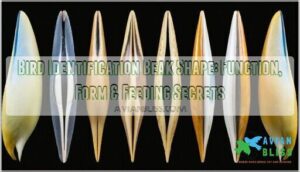 You’re cracking the code of bird identification by focusing on beak shape, a key characteristic that reveals a bird’s diet, lifestyle, and evolutionary history.
By understanding beak shapes, such as spear-shaped, chisel-shaped, or cracker-shaped, you’ll uncover the unique adaptations that enable birds to thrive in their environments.
Mastering bird identification beak shape will take your bird-watching skills to the next level, and there’s more to discover about how beak shape influences a bird’s behavior and survival strategies.
Table Of Contents
- Key Takeaways
- Bird Beak Structure
- Beak Shape Variations
- Beak Adaptations
- Beak Functions
- Identifying Birds
- Frequently Asked Questions (FAQs)
- How to identify a bird by its beak?
- What does the shape of the beak indicate?
- What are different types of bird beaks?
- How to figure out what type of bird?
- How do beaks change with age?
- Can beak shape affect bird social status?
- Do beak colors indicate bird emotions?
- How do beaks respond to environmental changes?
- Can beak shape influence bird migration patterns?
- Conclusion
Key Takeaways
- You’ll identify birds more easily by paying attention to their beak shape, which reveals their diet, lifestyle, and evolutionary history, so you can take your bird-watching skills to the next level.
- You’ll discover that different beak shapes, such as spear-shaped, tweezer-shaped, cracker-shaped, and chisel-shaped, are adapted for specific diets and environments, and that’s what makes each bird unique.
- You’ll learn that beak shape isn’t just about eating – it’s also used for obtaining food, caring for offspring, maintaining feathers, building shelters, and communicating with other birds, making it a crucial aspect of a bird’s survival.
- You’ll find that understanding beak shape and its functions will help you distinguish between specialist and generalist species, and that beak color, texture, and size can also provide valuable clues for bird identification, so you can become a better bird watcher.
Bird Beak Structure
When you look at a bird’s beak, you’re seeing a tough structure made of keratin, similar to your fingernails, with an upper and lower mandible that work together for feeding and survival.
Bird beaks are incredibly tough and made of keratin, similar to human fingernails.
Each beak varies in shape and function, revealing how birds have become experts at using this tool in their daily lives, and showcasing the unique adaptation of each beak.
Composition of Beaks
When you look at bird beak structure, you’ll notice science at work.
Here’s what shapes bird beak composition:
- Keratin hardening creates a tough outer shell.
- A bone structure forms a sturdy base.
- Mandible mobility boosts function.
- Sensory receptors detect food and touch.
- Beak regrowth guarantees lasting, adaptive bird anatomy for reliable bird beak identification.
Specialist beaks are finely tuned for specific food sources, showcasing adaptive bird anatomy and the importance of beak regrowth.
Beak Shapes and Functions
After learning what makes up a beak, you’ll notice that bird beak shapes are a clever mix of style and substance.
From slender tweezers to hooked daggers, beak morphology lets each bird stand out.
These shapes aren’t just for looks—they drive feeding strategies, fine-tune sensory perception, and even allow for tool manipulation.
Beak function and evolution reveal fascinating secrets for bird identification.
Upper and Lower Mandibles
Curious about beak morphology? Every bird beak features an upper mandible and a lower mandible, working in tandem for your favorite feathered friend’s survival.
Here’s what sets them apart:
- Upper mandible attaches to the skull
- Lower mandible uses independent hinges for jaw-like action
- Keratin growth keeps beaks sharp and durable
- Sensory receptors add impressive beak mobility and aid bird identification
The structure and function of these components are crucial for a bird’s survival, highlighting the importance of sensory receptors in their daily activities.
Beak Shape Variations
You’ll notice that bird beaks come in all shapes and sizes, each one designed for a specific task like spearing fish, cracking seeds, or catching insects.
By paying attention to these variations, you’ll uncover clues about a bird’s diet, habitat, and how it survives—no magnifying glass required, which can help understand the bird’s diet.
Spear Shaped Beaks

With spear-shaped beaks, you’ll spot true hunters. Birds like kingfishers and egrets wield these pointy “fishing spears” to nab fish with remarkable strike accuracy. Evolution gave them this advantage for targeting prey in watery habitats, making each catch a showdown of skill and instinct.
These beaks show dietary adaptations that optimize food handling.
| Beak Feature | Scientific Gain |
|---|---|
| Spear Beak | Fishing Techniques |
| Narrow, Pointed | Strike Accuracy |
| Long Length | Prey Size Adaptation |
| Streamlined | Habitat Overlap |
Tweezer Shaped Beaks
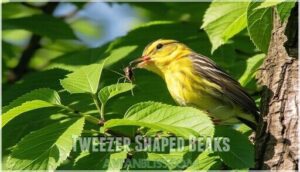
Precision is the trademark of birds with tweezer shaped beaks.
These slender, pointed tools excel at Insect Handling and Precise Foraging, often in leafy habitats.
Species like warblers and wrens use this insecteating beak to grab prey from crevices.
Recognizing this bird beak type helps with identifying bird beaks in the field, showcasing real Evolutionary Advantages.
Cracker Shaped Beaks
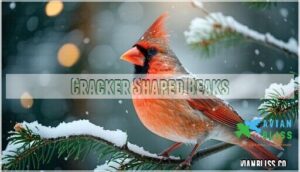
When you move from a tweezer beak to a cracker beak, you’ve entered a domain of seed specialists.
Think finches with broad, conical morphology—built for crushing strength. This type of seedeating beak is a top clue in any beak shape guide.
Look for these features:
- Seed Cracking experts
- Finch Beaks
- Sturdy Cardinal Diets
- Powerful bird beak types
- Classic identifying bird beaks
Chisel Shaped Beaks
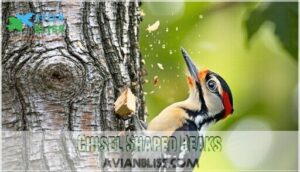
Like nature’s power drill, chisel-shaped beaks transform woodpeckers into living excavators.
These drilling chisel-tipped beaks punch through bark with surgical precision, revealing hidden bark beetle treasures beneath.
Woodpecker anatomy includes shock-absorbing skulls that protect against constant hammering.
Their specialized beak shape handles nest excavation duties while managing inevitable beak wear from endless drilling mechanics against unforgiving wood surfaces.
Beak Adaptations
You’ll notice that each bird’s beak isn’t just for show—it’s shaped by evolution to help the bird thrive in its environment, whether that means cracking seeds or snagging fish.
Bird beaks are perfectly shaped for their environment and diet
As you explore different beak adaptations, you can spot connections between beak form, feeding style, and the bird’s unique ecological niche, which is influenced by its ecological niche.
Ecological Niche Adaptations
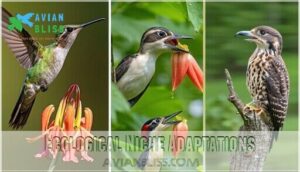
Tucked into every corner of nature, birds find their place thanks to beak adaptation.
You’ll spot specialist birds whose beak shape fits their ecological niche like a lock and key.
Think feeding behavior, habitat symbiosis, and bird specialization—all shaped by evolutionary processes.
These dietary adaptations let each bird thrive, minimizing resource competition and creating harmony within their environments.
Bird beaks are diverse, with over 18,000 species exhibiting unique beak structures.
Dietary Specializations

You’ll notice beak shape affects feeding efficiency.
Consider these diet specializations:
- Carnivorous birds
- Seed-eating birds
- Frugivorous birds
- Filter feeders, showcasing beak morphology and habitat influence on bird diet and beak adaptation.
Bird beaks are a prime example of dietary beak adaptations.
Wading Bird Beaks

Bird identification gets easier when you spot wading birds performing Mud Probing or Fish Stabbing with their unique beak shapes.
From spoonbills’ Prey Scooping to herons’ sharp bills, beak evolution shows clear ties to bird morphology and habitat symbiosis.
Each beak tells a story about survival, expertly designed for the wetland buffet on offer.
These birds depend on healthy wetlands, which support foraging needs to thrive in their wetland environment.
Piscivorous Bird Beaks

Piscivorous birds showcase remarkable beak morphology for aquatic hunting success.
Their bill adaptations reflect millions of years perfecting fish capture techniques in marine ecosystems.
You’ll spot spear-shaped beaks on herons for stabbing prey, while pelicans feature expandable pouches for bulk storage.
Kingfishers sport needle-sharp bills for precision diving, and cormorants possess hooked tips for gripping slippery fish.
These specialized bird beaks make identification straightforward once you understand their bird feeding behavior patterns.
Beak Functions

You’ll discover that bird beaks function as sophisticated multi-tools designed for far more than just eating.
These remarkable structures serve as precision instruments for obtaining food, caring for offspring, maintaining feathers, building shelters, and communicating with other birds, making them precision instruments.
Obtaining Food
When you spot a bird, its beak shape reveals foraging strategies and diet versatility.
Spear-shaped beaks pierce fish, while conical beaks crack seeds through precise beak mechanics.
Food manipulation varies dramatically—hummingbirds probe flowers, hawks tear meat, and ducks filter water.
Habitat influence drives these adaptations, making bird beak function your key to understanding bird feeding behavior and consumption patterns.
Feeding Young
Many parent birds use regurgitation methods to deliver pre-digested food directly into nestlings’ mouths.
Parental beak size determines how effectively adults can transfer nutrients, while nestling beak shape affects their ability to receive meals.
Food delivery rates increase when cooperative breeding occurs, as multiple adults share feeding duties.
Bird identification often relies on observing these feeding habits and beak adaptations during nesting seasons.
Preening and Defense
When you spot a bird working over its feathers, you’re watching preening in action—a daily ritual for feather maintenance.
Specialized beak shape boosts beak strength for untangling, cleaning, and parasite removal. In tense moments, birds use their beaks for injury defense and predator deterrence, too.
Social preening even builds flock bonds and helps sharpen your bird identification skills.
- Keeps feathers tidy
- Removes parasites
- Deters predators
- Defends against injury
- Supports social preening
Shelter Building and Communication
Ever seen a parrot use its beak like a Swiss Army knife? Beak shape plays a key role in nest construction, territory defense, and beak signals.
Different birds use vocal mimicry and clever beak adaptations in cooperative breeding and communication. Here’s a quick look:
| Beak Function | Example Species | Adaptation Type |
|---|---|---|
| Nest Construction | Woodpecker | Chisel beak |
| Beak Signals | Parrot | Hooked/beak clapping |
| Vocal Mimicry | Mockingbird | Flexible/tapered |
Identifying Birds

When you’re out spotting birds, you’ll want to pay close attention to the size, shape, and color of their beaks, since these features often reveal key details about a bird’s identity and lifestyle.
With a trained eye, you can distinguish between specialist and generalist species just by noticing how their beaks are built for cracking seeds, catching insects, or probing for food—no binoculars needed, unless you’re as nearsighted as a mole.
Beak Shape and Size
Shifting from function to form, you’ll notice beak shape and size can be a birder’s compass for bird identification.
From eagle hooks to hummingbird straws, those differences aren’t just luck—they’re the results of:
- Beak Proportions shift with shape evolution and environmental impact
- Genetic influence creates size dimorphism
- Distinct bird beak sizes fit unique feeding needs
Understanding beak adaptation products can further enhance identification skills.
Beak Color and Texture
Once you’ve sized up a beak, the next clues are color pigments and texture variations.
The shade might hint at age indicators or health status, since keratin condition causes differences in bird beak colors.
Some birds wow you with beak iridescence, while others show off subtle patterns or rough patches — all useful for bird identification beyond beak shape.
Specialist Birds and Beak Shapes
Specialist birds showcase remarkable beak adaptations that reveal their dietary preferences instantly.
These evolutionary marvels tell you exactly what each bird eats and where it hunts.
- Nectarivorous Beaks: Hummingbirds sport needle-thin bills perfect for flower probing
- Filter-Feeding Bills: Flamingos use comma-shaped beaks to strain tiny organisms from water
- Shredder Beaks: Hawks wield razor-sharp hooks for tearing prey into bite-sized pieces
- Mandible Pouches: Pelicans employ expandable throat sacs to scoop fish efficiently
Generalist Birds and Beak Shapes
You’ll recognize generalist birds by their versatile, moderately-sized beaks that function like nature’s Swiss Army knives.
Their omnivorous beaks, found on robins, crows, and blackbirds, offer adaptive advantages through flexible foraging strategies.
Their generalist beak design responds to evolutionary pressures and habitat influence, allowing these species to exploit diverse food sources and thrive across various environments.
These birds exhibit ecological beak roles, allowing them to adapt to different food sources, which is a key aspect of their versatile and adaptive nature, enabling them to play ecological roles.
Frequently Asked Questions (FAQs)
How to identify a bird by its beak?
You can identify a bird by its beak shape, considering factors like size, curvature, and specialized features that reflect its diet and habitat, making each beak unique.
What does the shape of the beak indicate?
You’ll find the beak shape indicates a bird’s diet, habitat, and feeding behavior, offering clues to its ecological niche and survival strategies.
What are different types of bird beaks?
Like a master key, different beak types access various food sources, you’ll discover spear, tweezer, cracker, and chisel beaks, each uniquely adapted for specific diets and environments, aiding survival.
How to figure out what type of bird?
You’ll figure out the bird type by observing its beak shape, size, and color, and considering its habitat, behavior, and dietary habits to narrow down possible species matches quickly.
How do beaks change with age?
As you grow, your bird’s beak changes, wearing down and regrowing keratin, adapting to its diet and environment, a constant transformation to guarantee survival and peak function.
Can beak shape affect bird social status?
You’ll discover beak shape can indeed influence bird social status, as certain shapes signify dominance or attractiveness to potential mates, affecting their standing within the flock.
Do beak colors indicate bird emotions?
You’ll find beak colors don’t directly indicate bird emotions, but rather, they can signify species, age, or health, playing a role in communication and social interactions among birds.
How do beaks respond to environmental changes?
You observe beaks adapting to environmental changes through wear, regrowth, and shape modification, enabling birds to survive and thrive in various ecosystems and conditions.
Can beak shape influence bird migration patterns?
You’ll notice beak shape subtly influences migration patterns, as certain shapes aid birds in foraging, which, in turn, affects their energy reserves and ability to migrate efficiently.
Conclusion
You’ve learned that 90% of bird species have unique beak shapes.
Now, you’ll crack the code of bird identification beak shape, understanding how it reveals diet and lifestyle, and take your bird-watching skills to the next level with bird identification beak shape expertise.