This site is supported by our readers. We may earn a commission, at no cost to you, if you purchase through links.
Your students spot a flash of yellow at the feeder outside your classroom window. “What is it?” they ask, eyes bright with curiosity. Without the right bird identification books for teachers, that moment of wonder fades into a shrugged “I don’t know.”
These books transform casual sightings into engaging science lessons. They connect children to the natural world right outside your door. The best guides balance scientific accuracy with student-friendly visuals and activities. They work equally well at desks and during outdoor observation walks.
Selecting the right resources means considering your region, grade level, and teaching goals.
Table Of Contents
- Key Takeaways
- Top 10 Bird Identification Books for Teachers
- 1. What It’s Like To Be A Bird Book
- 2. Birds Word Search Puzzle Book
- 3. State Birds And Flowers Coloring Book
- 4. Birds Photographs Book
- 5. Brave Little Camper Sound Book
- 6. Mrs Peanuckle Bird Alphabet Book
- 7. Animal Book for Kids
- 8. Random Facts Book For Curious Minds
- 9. The Best Nest Book
- 10. Cupkin Bird Sticker Book Activity
- Key Features of Effective Bird ID Books
- Choosing The Right Guide for Your Region
- Integrating Bird Books Into The Classroom
- Enhancing Student Engagement With Bird Books
- Tips for Selecting Bird Books for Teaching
- Frequently Asked Questions (FAQs)
- Conclusion
Key Takeaways
- The best bird identification books balance scientific accuracy with student-friendly visuals and work both at desks and during outdoor observation, with choices ranging from field guides like Sibley’s detailed illustrations to hands-on resources like sticker books and puzzles that build vocabulary and fine motor skills.
- Regional guides outperform national field guides in classrooms because they match local species students actually see outside, making identification faster and building genuine connections to neighborhood birds rather than overwhelming kids with hundreds of irrelevant species.
- Durable features matter more than pretty pictures—look for water-resistant pages, spiral binding that lies flat on clipboards, and reinforced covers that survive backpack transport and enthusiastic handling during multiple school years of field trips.
- Bird books become powerful teaching tools when paired with hands-on activities like bird bingo, matching games, and outdoor observation walks that align with science standards while building real identification skills students retain long after the lesson ends.
Top 10 Bird Identification Books for Teachers
You need books that work in real classrooms and survive field trips. The right guide makes bird identification simple for students while keeping lessons scientifically accurate.
Here are ten books that teachers actually use and trust.
For in-depth reviews and side-by-side comparisons, check out this comprehensive birdwatching field guide comparison to find the perfect match for your needs.
1. What It’s Like To Be A Bird Book
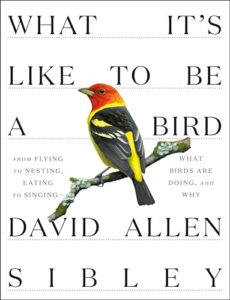
You’ll find What It’s Like to Be a Bird by David Sibley brings bird behavior and avian ecology into your classroom with striking clarity. This bird-themed book covers over 200 species through 330+ life-sized illustrations and explores sensory experiences from a bird’s perspective.
Your students gain perceptual insights into how birds navigate their world while developing bird identification skills essential for birdwatching books. The 240-page guide bolsters wildlife conservation education and works beautifully as both a reference and a read-aloud resource for all ages.
| Best For | Teachers, parents, and nature enthusiasts who want an accessible, beautifully illustrated guide to understanding bird behavior and sharing it with students or children. |
|---|---|
| Publisher | Knopf |
| Language | English |
| Page Count | 240 pages |
| Weight | 3.17 pounds |
| Target Audience | Adults and children |
| Publication Year | 2020 |
| Additional Features |
|
- Over 330 life-sized illustrations bring birds to life and make identification easier for beginners and experienced birders alike.
- Written from a bird’s perspective, helping readers develop empathy and observational skills while learning about avian senses and behavior.
- Works as both a teaching resource and coffee table book, making it versatile for classrooms, families, and casual reading.
- Focuses on familiar backyard birds rather than providing comprehensive coverage of all species.
- Some readers may find the casual, nontechnical writing style lacks the depth they’re looking for in a field guide.
- Certain statements may require fact-checking, and not all illustrations are perfectly to scale.
2. Birds Word Search Puzzle Book
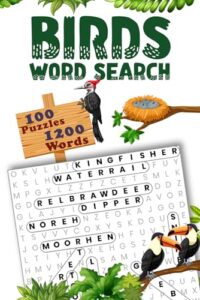
While Sibley’s guide excels at observation, you’ll strengthen avian vocabulary and cognitive development with the Birds Word Search Puzzle Book.
Pairing puzzles with a comprehensive bird identification guide for the United Kingdom ensures you’re learning accurate scientific names while building recognition skills.
This independently published resource ($9.99, 130 pages) delivers 100 puzzles in large print format—perfect for word search strategies that reinforce spelling and pattern recognition. Your students practice bird identification terms while building concentration skills essential for educational games.
The puzzle benefits extend beyond literacy: each grid exercises visual discrimination and working memory. Solutions appear at the back, and the durable 6×9 format suits both classroom centers and field trip activities for ages 8 to adult.
| Best For | Teachers and parents looking for an affordable, screen-free activity that builds vocabulary and focus while keeping kids engaged with bird-themed content. |
|---|---|
| Publisher | Independently published |
| Language | English |
| Page Count | 130 pages |
| Weight | 9 ounces |
| Target Audience | Adults, teens, and seniors |
| Publication Year | 2023 |
| Additional Features |
|
- 100 puzzles with solutions included give you plenty of material for classroom centers, early finishers, or home practice without needing prep time
- Large print format works well for younger readers and makes the puzzles accessible across different age groups from elementary through senior adults
- At $9.99 for 130 pages, it’s a budget-friendly resource that doubles as both an educational tool and a relaxing activity
- Only available as a physical book, so you can’t use it on tablets or print extra copies for your whole class
- 100 puzzles might run out quickly if you’re using them regularly with frequent puzzle solvers
- No adjustable difficulty levels, which means advanced students might find them too easy while struggling readers could get frustrated
3. State Birds And Flowers Coloring Book
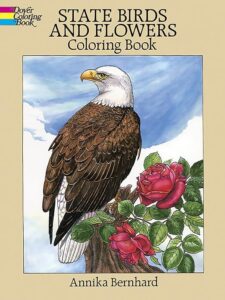
Beyond puzzles, you’ll bridge ornithology and state civics with Dover’s State Birds and Flowers Coloring Book ($5.99, 64 pages). This educational tool features 51 accurately detailed bird illustrations paired with corresponding state flowers—cardinal with goldenrod, mockingbird with apple blossom.
Full-color reference images on the covers guide your students’ coloring techniques while reinforcing geographic knowledge. The 11×8.25-inch format suits grades 1–8, and at under six dollars, you can provide individual copies for classroom activities that strengthen both bird identification skills and U.S. state symbol literacy through hands-on engagement.
Parents can complement this workbook with a simple bird identification guide for kids that breaks down key field marks and observation techniques in beginner-friendly terms.
| Best For | Teachers looking for an affordable classroom resource that combines art activities with learning state symbols, and homeschool parents wanting to reinforce U.S. geography through hands-on coloring. |
|---|---|
| Publisher | Dover Publications |
| Language | English |
| Page Count | 64 pages |
| Weight | 8.8 ounces |
| Target Audience | All ages |
| Publication Year | 1990 |
| Additional Features |
|
- Covers all 50 states plus national symbols in one compact 64-page book, making it easy to teach the entire country’s bird and flower designations
- Full-color reference images printed on the covers help students color accurately without needing separate field guides
- Priced around $6, it’s affordable enough to buy individual copies for each student rather than sharing
- Paper quality allows marker and watercolor bleed-through, limiting which art supplies you can use effectively
- Illustrations are printed on both sides of each page, so heavy coloring media will show through and affect the reverse image
- Detailed line work may frustrate younger elementary students or those still developing fine motor skills
4. Birds Photographs Book
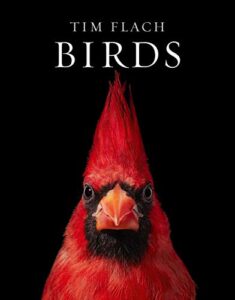
For visual learning that mirrors real field conditions, Abrams’ Birds (336 pages, $65) by photographer Tim Flach offers what field guide illustrations can’t—authentic plumage variation, lighting, and habitat context.
Pairing Flach’s images with a solid grasp of behavioral identification techniques helps you recognize species faster in the field.
Each species profile pairs stunning 10×13.75-inch photographs with ornithological notes by Richard O. Prum, turning image analysis into a conservation education tool.
Young birders can deepen their connection to species conservation by building nesting boxes that support local populations year-round.
Your students will identify subtle feather patterns and coloration that National Geographic bird watching books often simplify, building species identification skills through high-resolution bird photography that fosters inquiry-based activities aligned to science standards.
| Best For | Teachers looking to build species identification skills through authentic wildlife photographs that show real plumage variation and habitat context instead of idealized illustrations. |
|---|---|
| Publisher | Abrams Books |
| Language | English |
| Page Count | 336 pages |
| Weight | 6.7 pounds |
| Target Audience | Bird enthusiasts |
| Publication Year | 2021 |
| Additional Features |
|
- High-resolution 10×13.75-inch images capture subtle feather patterns and natural lighting conditions that mirror what students see during actual bird watching
- Ornithological notes by Richard O. Prum turn each photograph into an inquiry-based learning opportunity aligned with science standards
- Large format and detailed visuals work well for classroom sharing and help students with vision issues see diagnostic field marks clearly
- At 6.7 pounds and over 300 pages, the book is too heavy for students to carry into the field or handle comfortably during extended sessions
- Most species information appears in the back rather than alongside each photograph, requiring constant page-flipping during identification activities
- The $65 price point and single-copy format limit access compared to digital bird ID apps that let every student zoom and compare images on their own device
5. Brave Little Camper Sound Book
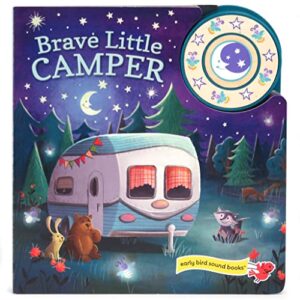
Early childhood environmental awareness begins with stories that quiet nighttime fears. Cottage Door Press’ Brave Little Camper (5 pages, $12.99) introduces forest animals through embedded sound effects, helping your youngest learners recognize nocturnal calls before field identification begins.
While not a true bird identification guide, this board book builds camper safety awareness and auditory discrimination skills essential for future bird books and educational resources.
The durable format withstands toddler handling in teaching resources collections, preparing preschoolers for more rigorous children’s literature as observation skills develop.
| Best For | Parents and teachers looking for a durable interactive book that helps toddlers and preschoolers feel comfortable with nighttime sounds and forest environments. |
|---|---|
| Publisher | Cottage Door Press |
| Language | English |
| Page Count | 5 pages |
| Weight | 10.4 ounces |
| Target Audience | Babies to kindergarteners |
| Publication Year | 2016 |
| Additional Features |
|
- Sturdy board book design holds up well to repeated use by young children, making it practical for classrooms and home libraries
- Sound buttons help kids connect animal noises to pictures, building early listening skills and reducing fear of nighttime sounds
- Simple story about a camper’s first night in the forest tackles bedtime anxiety in a gentle, age-appropriate way
- Limited number of sounds (reviewers mention only one to three different audio options) may not hold attention for long
- No off switch for the sound feature means you can’t save battery life between reading sessions
- Text might be too wordy for babies and younger toddlers—better suited for kids 18 months and up
6. Mrs Peanuckle Bird Alphabet Book
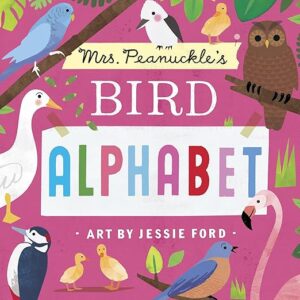
Alphabet learning meets bird diversity in Rodale Kids’ Mrs. Peanuckle’s Bird Alphabet ($7.99, 28 pages), where your preschoolers will encounter 26 species through Jessie Ford’s vibrant illustrations.
This 2018 board book links each letter to a defining characteristic, building nature literacy while reinforcing emergent reading skills. You’ll appreciate the durable format during circle time and outdoor observation preparation.
Though species selection appears random rather than taxonomic, the book acts as an entry point for educational tools that develop bird identification readiness in children’s literature collections.
| Best For | Parents and educators introducing toddlers (ages 0-3) to alphabet learning and bird diversity through durable, visually engaging board books. |
|---|---|
| Publisher | Rodale Kids |
| Language | English |
| Page Count | 28 pages |
| Weight | 9.8 ounces |
| Target Audience | Toddlers |
| Publication Year | 2018 |
| Additional Features |
|
- Combines alphabet reinforcement with nature education, teaching 26 bird species through colorful illustrations and memorable facts
- Durable board book construction withstands repeated handling by young children during solo exploration and group read-alouds
- Affordable at $7.99 for a 28-page educational resource that works both at home and in pre-k classroom settings
- Bird selection lacks clear organization or taxonomic structure, which may feel random to adults seeking systematic learning
- Content can become repetitive for parents and caregivers who read it frequently with the same child
- May not hold the attention of older children who have outgrown basic alphabet books
7. Animal Book for Kids
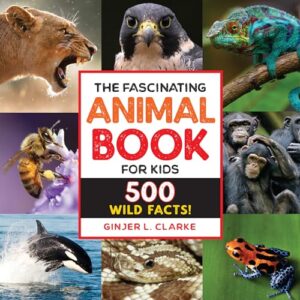
For educators seeking extensive animal facts across multiple taxa, The Animal Book: A Visual Encyclopedia of Life on Earth by DK ($12.73, 210 pages) presents bird diversity within a broader zoological framework.
This educational resource covers 1,500+ species through visual learning strategies aligned with science standards for ages 9-12. You’ll find bird identification embedded alongside mammals and reptiles, supporting comparative anatomy lessons through high-quality photographs and labeled diagrams.
The Smithsonian-reviewed content meets classroom biodiversity literacy goals while functioning as picture books that engage children’s literature expectations for kid education materials.
| Best For | Kids aged 9-12 who want to explore a wide range of animals beyond just birds, with visual learning through photos and diagrams rather than dense text. |
|---|---|
| Publisher | Callisto Kids |
| Language | English |
| Page Count | 210 pages |
| Weight | N/A |
| Target Audience | Kids aged 9-12 |
| Publication Year | 2021 |
| Additional Features |
|
- Covers over 1,500 species across all major animal groups, giving kids a complete picture of the animal kingdom instead of focusing on just one category
- Smithsonian-reviewed content with labeled diagrams and high-quality photos makes it great for school projects and independent research
- Large visual format keeps kids engaged and works well for both casual browsing and looking up specific facts
- Birds are just one section among many animal groups, so kids focused specifically on birds might want a more specialized book
- At 210 pages covering 1,500 species, individual animals get brief treatment rather than in-depth coverage
- The visual encyclopedia format may not work as well for kids who prefer story-based or narrative animal books
8. Random Facts Book For Curious Minds

When students crave bird identification paired with broader natural history curiosity, Random Facts for Curious Minds ($12.97, 279 pages) delivers 1,300+ fun facts spanning science and nature topics—including avian biology—through educational books designed for ages 8-12.
This learning resource supplements traditional field guide study with random trivia that sparks bird watching enthusiasm during classroom downtime. National Geographic–quality images support visual retention, while online chapter quizzes reinforce bird books content you’re already teaching. The engaging format reduces screen time while building foundational knowledge for future ornithological exploration.
| Best For | Kids aged 8-12 who love learning random facts about animals, space, and science, plus trivia enthusiasts of any age looking for a screen-free way to feed their curiosity. |
|---|---|
| Publisher | Independently published |
| Language | English |
| Page Count | 279 pages |
| Weight | 13.3 ounces |
| Target Audience | Kids aged 8-12 |
| Publication Year | 2025 |
| Additional Features |
|
- Over 1,300 facts across 12 chapters covering everything from nature to space, with hundreds of images to keep things visually interesting
- Online quizzes for each chapter help reinforce what you’ve learned and test your retention
- Great for road trips, reducing screen time, or just having impressive facts to share at school
- Quizzes aren’t in the book itself—you need internet access to take them
- Facts are written in paragraph form rather than with clear headers, which some readers find less engaging
- The introductions to questions can feel repetitive after a while
9. The Best Nest Book
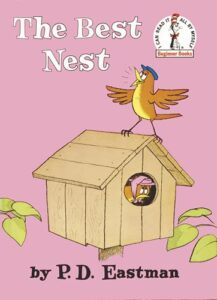
When young learners struggle to connect bird identification with real-world avian behavior, The Best Nest ($6.95, 72 pages) bridges that gap through P. D. Eastman’s charming story about nest architecture and bird habitats.
This 1968 Beginner Books classic introduces nesting materials and nesting seasons through simple vocabulary perfect for ages 3-7, making it an accessible field guide companion that complements National Geographic resources.
You’ll find it aids bird watching lessons while teaching avian behavior fundamentals—though some educators note the word “hate” may require brief discussion during read-alouds.
| Best For | Parents and teachers looking for an engaging early reader that helps kids ages 3-7 build vocabulary while learning about birds and appreciating what they have. |
|---|---|
| Publisher | Random House Books for Young Readers |
| Language | English |
| Page Count | 72 pages |
| Weight | N/A |
| Target Audience | Children aged 3-7 |
| Publication Year | 1968 |
| Additional Features |
|
- Simple words paired with colorful illustrations make it perfect for beginning readers or read-aloud sessions
- Teaches kids about bird nests and habitats in a fun, story-driven way that complements nature lessons
- Budget-friendly at $6.95 for 72 pages of content that encourages a love of reading
- Uses the word “hate” in the story, which some parents may want to discuss with their children
- May not keep very young kids (under 2) or highly active children engaged for the full read
- Written in 1968, so the style and references might feel a bit dated compared to modern picture books
10. Cupkin Bird Sticker Book Activity
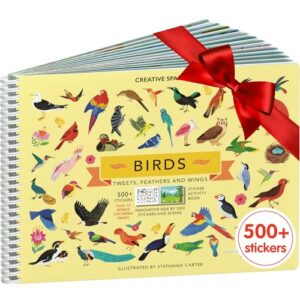
For hands-on bird identification beyond field guides, the Cupkin Bird Sticker Book Activity ($24.99) transforms passive learning into active species introduction through 500+ hand-drawn stickers across 12 global bird habitats.
You’ll find this spiral-bound resource fosters fine motor development while teaching bird lovers ages 3-10 to distinguish regional species through visual matching—a child engagement strategy that sustains 45 minutes of focused observation per scene.
The side-by-side layout and FSC-certified paper make it practical for teaching resources in classroom centers, though sticker durability varies with handling force during educational activity planning sessions.
| Best For | Parents and teachers looking for a screen-free activity that keeps kids aged 3-10 engaged while introducing them to bird species through hands-on sticker play. |
|---|---|
| Publisher | CUPKIN |
| Language | N/A |
| Page Count | 12 pages |
| Weight | 11.2 ounces |
| Target Audience | Kids aged 2-8 |
| Publication Year | N/A |
| Additional Features |
|
- Over 500 hand-drawn stickers across 12 different bird habitats keep kids busy for extended periods (around 45 minutes per scene)
- Spiral binding lays flat and side-by-side layout makes it easy for kids to use independently without constant page flipping
- Doubles as both entertainment and learning tool, helping develop fine motor skills while teaching bird identification
- Sticker quality is hit or miss—some peel off too easily while others are too hard for small hands to remove
- Thin sticker parts can tear if kids aren’t gentle, which can be frustrating during play
- Size complaints go both ways, with some finding it too large for travel and others wishing it were bigger
Key Features of Effective Bird ID Books
Not all bird books work well in a classroom setting. You need guides that hold up to daily use, provide accurate species information, and help students identify birds quickly during outdoor lessons.
Let’s look at the key features that make a bird identification book truly effective for teaching.
Scientific Accuracy and Updated Information
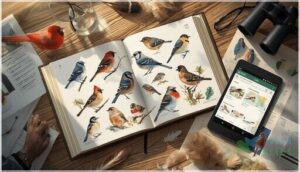
You need a bird identification guide tied to current taxonomy—names and species limits shift every year. The 2024 eBird Clements Checklist added 128 species worldwide, so older field guides can mislead students.
Choose books anchored to AOS or Cornell Lab standards for scientific validation. Updated ornithology resources integrate data from platforms like eBird, giving you accurate range maps and species verification your classroom can trust.
For the most accurate information, consider consulting the latest taxonomy update to guarantee your teaching materials are up-to-date.
Visuals: Illustrations Vs. Photographs
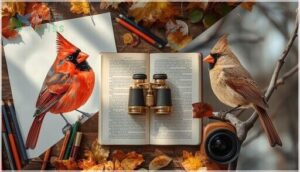
Once you’ve confirmed scientific accuracy, you face a choice between illustrations and photographs in your field guide. Illustrations simplify complex feather patterns for quick bird identification, exaggerating contrasts so your students spot key marks faster. Photographs deliver photo realism and natural color variation, showing birds exactly as they appear during bird watching.
For visual learning, younger readers respond to colorful bird portraits while older students value nature photography’s authentic bird picture books detail.
When evaluating the methodological rigor of scientific studies, researchers rely on post retrieval auditing to verify accuracy.
Durability for Classroom and Field Use

Photos and illustrations matter little if pages tear during field trips. Water resistance protects your field guide from morning dew and spills when students practice bird watching and identification outdoors. Spiral binding lets pages lie flat on clipboards, while reinforced corners prevent classroom wear. Look for these durability features in teaching resources:
- Waterproof or laminated pages resist moisture during outdoor observation
- Hardcover formats with padded edges survive drops and backpack transport
- Smear-resistant inks maintain legibility after repeated handling
- Tear-resistant paper withstands enthusiastic page-turning by young birders
Quality binding materials and cover protection transform fragile books into reliable teacher resources and support tools that last multiple school years.
User-Friendly Layout and Indexing
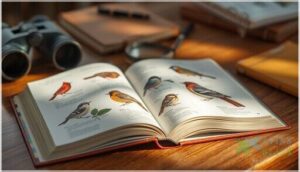
A durable guide means nothing if you can’t find the birds you need. Clear navigation with visual hierarchy lets you jump from cardinal to chickadee in seconds during lessons.
Index features like common-name sorting and field marks make quick reference seamless.
The Sibley Field Guide sets the standard with accessibility design that aids bird watching and identification in real classrooms, helping you teach birding books effectively.
Choosing The Right Guide for Your Region

Not all bird guides work equally well in every classroom. A book that covers 900 species across North America might overwhelm students when only 40 birds live in your area.
Your choice between national and regional guides shapes how quickly your students can identify the birds they actually see outside your window.
National Vs. State-Specific Bird Guides
When you’re choosing a field guide, think of national versus regional guides as zooming in or out on a map. National Geographic Field Guide and Sibley Field Guide offer broad bird distribution across North America, while state-specific regional guides zero in on birds your students will actually see.
For classroom relevance and conservation impact, regional focus often wins—you’ll match local species lists to your backyard observations perfectly.
Importance of Local Species Coverage
You’ll find local species coverage transforms your classroom from generic to genuinely connected. Regional guides improve bird identification accuracy because students recognize neighborhood species—not distant rarities.
That place-based learning strengthens local biodiversity awareness and conservation efforts. When field guide selection prioritizes species relevance, your students develop real observation skills.
Regional focus means birding books that actually match what’s outside your window, building confidence and curiosity through authentic local species coverage.
Regional Adaptations for Teaching
You’ll discover regional guides bring ecological relevance straight into your classroom adaptations. Local species coverage helps teaching elementary students connect bird identification to their cultural context.
Field guides featuring nearby habitats let you design lessons around what’s truly present. Birding books aligned to state curricula make observation meaningful.
That regional focus turns abstract science into hands-on discovery your students can touch, see, and remember.
Integrating Bird Books Into The Classroom
Bird identification books can transform your science lessons when you weave them into daily classroom activities. You’ll want to pair field guides with hands-on observation exercises that get students outside and looking closely at local species.
The right approach connects these resources to your curriculum standards while building real-world skills your students will use for years.
Lesson Planning and Activity Integration
Bird identification books become powerful teaching resources when paired with structured curriculum design. You can build engaging lesson plans around these guides with proven classroom strategies:
- Align activities to NGSS standards for early elementary science
- Introduce field guides indoors before outdoor work
- Use spotting sheets to teach bird description vocabulary
- Pair literacy education with hands-on identification practice
- Create book companions with writing prompts and activity packets
These educational resources transform passive reading into active learning experiences.
Promoting Outdoor Observation Skills
Physical field guides sharpen your students’ outdoor observation skills by teaching them to notice key characteristics—shape, size, sound, and habitat. When kids step outside with birding books in hand, they learn to slow down and observe details that digital devices often miss.
Field guides teach students to slow down and notice details that digital devices miss
These wildlife watching tools build environmental awareness through nature exploration, turning casual outdoor activities into focused wildlife conservation lessons that develop systematic bird identification skills.
Using Books to Support Science Standards
You can align birding books with future-ready Science Standards by building lessons around observation practices, data collection, and ecosystem concepts. Field guides and educational resources support science literacy while meeting standards-aligned performance expectations in life science.
Use bird identification activities to teach scientific argumentation, evidence-based reasoning, and classroom integration of real-world phenomena. These teacher support materials connect bird conservation to educational activities for kids through standards alignment.
Enhancing Student Engagement With Bird Books
You can turn any bird book into a hands-on learning tool when you know what keeps students curious. The right activities help kids remember what they see and build real observation skills.
Here are three ways to make bird identification stick in your classroom.
Interactive Activities and Puzzles
Puzzle solving transforms passive reading into active mastery. When you pair bird identification with hands-on learning exercises, students retain field marks and species names far longer than through lectures alone.
- Bird-themed word searches reinforce terminology like “eye-ring” and “wing bars” through visual scanning
- Interactive quizzes test recall of plumage details after outdoor observation walks
- Matching games pair silhouettes with names to build rapid identification skills
- Visual challenges using real photos sharpen pattern recognition across similar species
Storytelling and Narrative Elements
Beyond puzzles, narrative structure turns field guides into memorable adventures. When bird characters drive the plot in picture books, your students form emotional connections that outlast any worksheet.
Read aloud sessions using bird-themed books blend science integration with storytelling techniques that kindergarteners actually remember. Children’s literature that centers avian protagonists—not just facts—sparks curiosity and makes ornithology feel like discovery, not drill.
Visual Learning and Identification Games
Field guides paired with game-based learning boost your students’ bird recognition more effectively than text alone. Try bird bingo using local species identification or silhouette-matching challenges—both train visual cues like beak shape and wing bars.
Interactive displays and schoolyard blitz activities with laminated ID cards turn field guides into hands-on tools, sharpening species identification skills while connecting kids to birding books and bird watching communities.
Tips for Selecting Bird Books for Teaching

Choosing the right bird book for your classroom starts with knowing your students and your teaching goals. You’ll want to think about what sparks curiosity in your kids, how practical the book is for field trips, and what other teachers have learned from real classroom use.
These three considerations will help you find a guide that actually works when you need it most.
Matching Books to Student Interests
When your students choose their own birding books, reading motivation soars. Research shows that student choice paired with interest alignment drives better learning outcomes in elementary education.
Offer a range of bird-themed picture books—from field guides to children’s literature—so each reader finds a match. High achievers often prefer personal book selection, while struggling readers benefit from gentle recommendations that still honor their curiosity about bird identification.
Considering Portability and Ease of Use
Compact designs make all the difference when you’re supervising twenty students outdoors. Portable guides under three ounces fit jacket pockets, letting children carry their own birding essentials without arm fatigue. Choose field-tested laminated folding guides—roughly four by eight inches—that resist moisture and open quickly during active observation. Simple layouts with consistent bird identification techniques support ease navigation, helping your whole class spot field marks before the warbler disappears.
- Pocket-sized formats reduce carrying weight for extended outdoor lessons
- Laminated pages withstand dew, dirt, and repeated handling by young learners
- Six-panel folding detailed guides expand for quick species comparison
- Consistent layouts speed visual scanning during time-limited bird identification
Evaluating Reviews and Teacher Recommendations
How do you separate useful teacher feedback from generic marketing? Look for peer reviews that name specific grade levels and curriculum alignment—K–12 educators trust colleagues who detail standard support and reading-level fit.
Star rating systems help, but detailed elementary school curriculum comments reveal whether a book’s visuals and bird identification features truly work during outdoor lessons.
Colleagues’ recommendation strategies often spotlight engagement tools you won’t find in publisher catalogs.
Frequently Asked Questions (FAQs)
How do bird books address different learning styles?
Do you learn best by seeing, hearing, or doing? Bird books blend visual learning with auditory aids and kinesthetic activities through multimodal design, interactive elements, and classroom reading activities customized for elementary teachers.
What budget options exist for classroom bird guides?
You’ll find free resources through libraries and digital copies from publishers. Used books cut costs by half, while classroom bundles offer bulk discounts.
Laminated field guides provide durable, budget-friendly alternatives for hands-on identification.
Are digital bird identification apps better than books?
Apps excel at accessibility and engagement, but field guides often teach identification skills more effectively.
Research shows books help students recognize novel species better.
You’ll want both educational tools in your birding library for balanced learning.
How often should teachers update their bird guides?
Taxonomy changes faster than most realize—species splits occur almost annually. You should refresh field guides every 2–5 years, with interim regional updates when local species shift or new curriculum alignment standards emerge.
Can bird books support bilingual or ESL students?
Yes, bird books support bilingual and ESL students through visual aids that boost vocabulary acquisition, bilingual resources with parallel text, and cultural relevance that connects nature education to students’ heritage and language development strategies.
Conclusion
The right resources turn those “I don’t know” moments into discoveries your students will remember long after the bell rings.
Bird identification books for teachers give you the tools to nurture young naturalists with confidence. Start with one guide that fits your region and grade level.
Watch as feathered visitors outside your window become familiar friends. Your classroom will never look at birds the same way again.
- http://windows.microsoft.com/en-us/internet-explorer/download-ie/
- https://jodi-durgin.mykajabi.com/starts-with-a-story-45189951-66ec-49bb-97c1-437b4197d7c5
- https://www.superteacherworksheets.com/printable-pdf-worksheets/wordsearch/18756-Bird-Word-Search
- https://www.twinkl.com/blog/how-can-word-puzzles-help-your-child-learn
- https://www.rainbowresource.com/008719.html