This site is supported by our readers. We may earn a commission, at no cost to you, if you purchase through links.

Most birders can spot a cardinal’s bright red feathers from across a yard, but identifying that same bird by sound alone? That’s where things get tricky. Yet birds vocalize far more often than they perch in plain view, which means you’re missing most of the action if you rely only on your eyes.
Learning bird identification using song and calls opens up an entirely new dimension of birding—one where a morning walk becomes a concert, and every chip note or trill tells you exactly who’s nearby.
The good news: your ears can become just as reliable as binoculars. With some practice and the right techniques, you’ll start recognizing species before you ever see them, turning mysterious sounds into familiar friends.
Table Of Contents
- Key Takeaways
- Songs Vs. Calls: Understanding Bird Vocalizations
- Getting Started With Birding by Ear
- Essential Techniques for Recognizing Bird Songs
- Using Technology to Identify Bird Sounds
- Advanced Bird Sound Identification Strategies
- Improving Your Skills Over Time
- Frequently Asked Questions (FAQs)
- Conclusion
Key Takeaways
- Learning to identify birds by sound unlocks a hidden dimension of birding since birds vocalize far more often than they appear in plain view, meaning you’ll detect significantly more species once your ears are trained.
- Start by distinguishing songs (complex, melodic vocalizations used for mating and territory defense during breeding season) from calls (short, sharp notes for everyday communication like alarms and flock coordination used year-round).
- Focus your practice during the dawn chorus—one hour before to two hours after sunrise—when over 75% of species hit peak vocalization, and begin with common backyard birds like Northern Cardinals, American Robins, and Black-capped Chickadees that beginners identify correctly over 85% of the time.
- Use technology strategically by pairing apps like Merlin Sound ID (86% accuracy in field tests) with hands-on practice in the field, creating mnemonics for memorable songs, and recording unfamiliar calls for later analysis to build your personal sound library.
Songs Vs. Calls: Understanding Bird Vocalizations
Before you can identify birds by sound, you need to know what you’re actually hearing. Birds make two main types of vocalizations—songs and calls—and each has a different purpose.
Let’s break down what makes them unique and why recognizing the difference will sharpen your identification skills.
What Are Bird Songs?

Bird songs are complex, melodious vocalizations that differ from simpler bird calls. Songbirds produce these learned patterns primarily during the breeding season, driven by hormones like testosterone. You’ll hear males singing to attract mates and defend territories. Songs consist of notes organized into syllables, phrases, and motifs. Some species perform a single song type, while brown thrashers can deliver over 2,000 unique variations. Research indicates that the songbird auditory forebrain undergoes structural changes between seasons.
| Song Characteristic | What It Means for You |
|---|---|
| Complexity varies widely | Start with simpler songs, progress to complex repertoires |
| Seasonal timing matters | Best listening happens during the spring breeding season |
| Learned, not innate | Birds practice and hone their songs over time |
| Territory and mate attraction | Hearing a song means a male is claiming his space |
| Frequency relates to body size | Larger birds generally sing lower, smaller birds higher |
What Are Bird Calls?
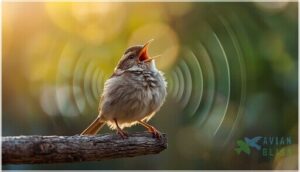
While songs showcase complex melodies, calls are short, sharp notes that handle everyday communication. You’ll hear them year-round from both males and females—alarm warnings, contact chirps to keep the flock together, begging peeps from hungry chicks. Think of calls as quick text messages versus songs’ love letters. Black-capped Chickadees add more “dee” notes when danger’s closer, creating a measurable threat scale. Understanding bird communication methods, such as bird vocalizations, is essential for effective bird identification.
| Call Type | Primary Function | When You’ll Hear It |
|---|---|---|
| Alarm calls | Alert to predators | Year-round, immediate danger |
| Contact calls | Maintain flock cohesion | During foraging and flight |
| Begging calls | Signal hunger levels | Nesting season, young birds |
| Food calls | Announce food sources | Any season, group feeding |
| Flight calls | Coordinate movement | Migration periods, travel |
Why Birds Produce Different Sounds

Every vocalization you hear has a specific survival purpose. Songs help males attract mates and defend territories—song quality literally signals health and fitness. Females often choose partners based on repertoire size and complexity. Meanwhile, calls coordinate daily life: keeping flocks together, warning of danger, and identifying family members. Habitat shapes these patterns too. Birds near rushing water vocalize at higher frequencies to cut through background noise.
| Vocalization Type | Primary Purpose |
|---|---|
| Songs | Mate selection, territorial defense |
| Alarm calls | Predator warnings, species recognition |
| Contact calls | Flock coordination, individual identification |
Territorial Songs Vs. Contact Calls

Understanding these two categories deepens your identification skills. Territorial songs are loud, melodic performances lasting several seconds—males belt them out to claim space and attract mates. During breeding season, song frequency can jump 40% in contested areas. Contact calls? They’re quick, simple chirps under one second, keeping flocks connected and coordinating movement. Both vocalizations matter, but their purposes couldn’t be more different.
| Feature | Territorial Songs | Contact Calls |
|---|---|---|
| Duration | Several seconds long | Under one second |
| Complexity | Melodic and intricate | Brief and simple |
| Volume | Much louder | Quieter, higher pitch |
| Purpose | Mate attraction, territorial defense | Flock cohesion, alarm signals |
Getting Started With Birding by Ear

Learning to identify birds by sound opens up a whole new world of birding. You’ll spot more species and enjoy your outings even when birds stay hidden in the trees.
Let’s cover the basics that will help you start recognizing those songs and calls with confidence.
Why Sound Identification Matters
You might walk past a dozen species without ever knowing they’re there. Sound identification changes everything. It aids biodiversity monitoring in citizen science projects, detects cryptic and nocturnal birds that visual scans miss, and delivers ecological insights for conservation impact.
Sound identification unlocks hidden birds and reveals ecological insights that visual observation alone will never capture
Acoustic recorders even outperformed human observers in meadow habitats. Learning avian vocalization unlocks research applications you can’t access through sight alone.
Best Species for Beginners
You’ll want to start with species you’re likely to hear every day. Northern Cardinals, American Robins, and Black-capped Chickadees are your best bets—beginners correctly identify their vocalizations over 85% of the time.
Song Sparrows and Eastern Phoebes round out the starter list. These five species dominate backyard soundscapes across North America, making them perfect for learning bird songs and calls through repeated exposure.
When and Where to Listen
During the dawn chorus—within one hour before and two hours after sunrise—over 75% of species hit peak vocalization. This acoustic environment outperforms dusk every time.
Seasonal changes shift patterns dramatically: regular singing starts late February through March, while habitat influence matters too. Wetland-rich woodlands host the most diversity.
Noise impact from urban areas can delay or mask songs, and regional patterns vary by migration timing and local ecosystems.
Building Your First Sound Library
Your acoustic library starts with a smartphone or dedicated recorder that samples at 44.1 kHz and records in WAV format. Start cataloging species systematically—even simple audio clips build pattern recognition over time.
- Target common backyard birds first: robins, cardinals, and chickadees provide clear sound recordings for practice
- Record peak morning hours: capture the strongest vocalizations when signal quality matters most
- Label each audio clip immediately: note species, date, location, and behavior to maintain useful data management
- Store uncompressed files: WAV format preserves sound patterns better than MP3 for later analysis
Xeno-canto’s 575,000+ recordings offer validation when you’re unsure about your field captures.
Essential Techniques for Recognizing Bird Songs
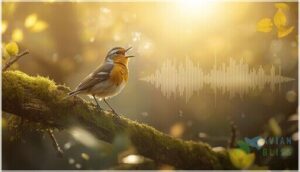
Learning to recognize bird songs takes more than just good ears—it requires the right approach. Once you understand how to break down what you’re hearing, identification becomes much easier.
Here are five essential techniques that will sharpen your birding-by-ear skills and help you confidently name the birds around you.
Active Listening and Attention to Detail
Active listening is the cornerstone of successful birding by ear. You can’t just hear birds—you need to truly listen. Focus on sound details like subtle variations and background distractions.
Research shows that cognitive load and false alarms dramatically affect your accuracy, especially in noisy environments. Think of auditory streaming as your brain’s way of filtering important signals.
Deep learning models prove that paying attention to detail improves birding skills considerably.
Identifying Rhythm and Pitch Patterns
Birdsong is like a fingerprint—each species has distinct rhythm, pitch, and repetition patterns. You’ll notice speed, pauses, and pitch variation create species-specific signatures.
Spectrogram analysis helps you visualize these patterns, showing how notes rise, fall, or repeat.
Learning rhythm and pitch takes practice, but once you recognize a Northern Cardinal’s upslurred notes or a Golden-crowned Sparrow’s descending melody, you’ll identify them instantly.
Creating Effective Mnemonics
Once you’ve spotted the rhythm and pitch, lock it in with a mnemonic phrase. The American Goldfinch sings “potato chip, potato chip,” while the Barred Owl asks, “Who cooks for you?”
These memory tricks boost recall speed by 30-50% in beginners. Your mnemonic phrase choice matters—pick what you’ll remember.
Just don’t lean so hard on mnemonics that you miss the song’s actual rhythm and pitch nuances.
Recording Unfamiliar Songs for Analysis
When mnemonics fall short with an unfamiliar bird, pull out your smartphone and hit record. Point it directly at the sound source—steady hands make all the difference. Choose quiet morning hours to minimize environmental noise.
Later, audio analysis applications like Merlin or BirdNET will help identify your mystery singer. Recording quality improves with practice, and you’ll build a personal audio library that sharpens your ear faster than field guides alone.
Comparing Similar-Sounding Species
Once you’ve recorded several birds, comparing similar-sounding species becomes your next challenge. Mimicry challenges arise with mockingbirds, while regional dialects mean the same species sounds different across areas.
Acoustic overlap increases when identifying birds by sound in shared habitats. Focus on contextual clues—listen for rhythm differences and pitch direction.
Female vocalizations often prove trickier than males, so patience pays off when dealing with similar-sounding species.
Using Technology to Identify Bird Sounds

Technology has changed the game for identifying bird sounds in the field. You don’t need years of experience anymore—apps and digital tools can help you match what you’re hearing to the right species in seconds.
Let’s look at the key technologies that’ll turn your smartphone into a powerful birding companion.
Merlin Sound ID and Photo ID Features
You’ve probably heard that the Merlin Bird ID app can help you identify birds through both sound and photos—and it’s true. Here’s what makes it special:
- Sound ID accuracy reaches 86% precision in real-world field tests, identifying 458 species in the U.S. and Canada by their calls
- Photo ID limitations include potential AI misidentification in crowded or poorly-lit images, though accuracy hits 90% with quality shots
- Offline capabilities let you use both features without internet, perfect for remote birding spots
- Model improvements happen twice yearly, expanding species coverage and fixing bugs
The app analyzes your recordings in 3-second intervals for live predictions, drawing from over 10,000 global species.
How Spectrograms Visualize Bird Vocalizations
Think of spectrograms as sheet music for bird sounds—they turn calls into visual patterns you can actually see. These sound visualization tools map frequency patterns along the vertical axis and rhythm visualization along the horizontal, with amplitude intensity shown through color brightness.
Each species creates distinct signatures, making spectrogram analysis incredibly useful when you’re learning to identify subtle pitch representation differences between similar-sounding birds.
Top Bird Identification Apps Compared
Bird identification apps have transformed how we identify bird songs and calls in the field. Merlin Bird ID leads the pack with over 10 million users and solid accuracy rates around 81%, all at no cost. When you’re comparing birding app options, consider these key factors:
- Species coverage: Merlin covers 10,000+ species globally, while Picture Bird supports 1,000+ and iBird Pro offers detailed attributes for narrowing results
- User interface: Merlin wins for beginners with its straightforward design, while iBird Pro suits experienced birders seeking comprehensive tools
- Cost comparison: Merlin provides completely free AI-powered bird identification, whereas iBird Pro requires purchase for premium features
Smart Bird ID and Chirpomatic add unique touches—interactive platforms and bird-safe modes respectively. Most apps now combine photo and sound recognition, making identification faster whether you’re hearing a mystery song or spotting movement in the trees.
Offline Identification Tools for Field Use
Out in the field, offline bird identification tools shine with impressive Offline Accuracy and Field Reliability. Device Portability means you can slip Merlin or BirdWeather PUC into your pack, storing data locally for later review.
These birding apps and devices keep power consumption low, letting you track Offline Birds all day—even in remote spots—without worrying about signal or battery life.
Understanding AI Accuracy and Limitations
Ever wonder why your identification apps nail a robin but stumble with a distant heron? AI precision rates reach up to 95% in quiet settings, yet environmental noise impact drops accuracy by 15–20%. Here’s what challenges AI and machine learning in bird identification:
- Geographic data bias
- Algorithmic challenges
- Human vs AI sensitivity
Advanced Bird Sound Identification Strategies
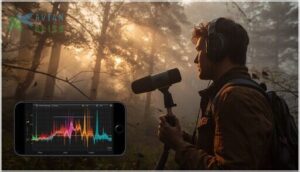
Once you’ve mastered the basics, it’s time to level up your bird sound skills. There are a few smart strategies that can make tricky identifications much easier. Here’s what you’ll want to try next.
Connecting Visual and Auditory Cues
Spotting a flash of red while hearing a clear whistle? That’s sensory fusion in action—your brain weaving visual cues with auditory patterns for sharper species recognition.
Multisensory integration helps you remember birds, reduce false positives, and even decode tricky songs using spectrograms. Sound visualization and acoustic analysis let you “see” bird songs, turning each encounter into a vivid, memorable experience.
Identifying Birds in Noisy Environments
Think city parks are a challenge for identifying birds by song? You’re right—urban adaptation means birds sing higher to cut through the racket. That’s where Noise Reduction and denoising techniques shine, but AI limitations remain.
Human advantage is clear: your ears catch subtleties missed by apps. Birding by ear techniques thrive in tough acoustic environments—trust your senses and keep listening.
Using Field Guides and Online Sound Libraries
If city noise tests your ears, you’ll love how Digital Field Guides and online sound libraries step in. The Audubon Bird Guide App and Macaulay Library offer offline sound access, vast archives, and first-rate AI model accuracy. Citizen Science Engagement keeps these resources growing—and you get:
- Thousands of bird sounds at your fingertips
- Reliable identification, anywhere
- Easy offline listening
- Community-powered discoveries
Analyzing Spectrograms for Complex Songs
With spectrograms, you’re not just listening—you’re seeing bird calls unfold. Spectrogram Complexity Indices and Feature Extraction let you spot subtle differences in pitch, rhythm, and frequency resolution.
Machine Learning now facilitates Noise Handling, making bird song analysis more reliable.
Innovation Trends in bird sound visualization help you compare intricate patterns, revealing what your ears alone might miss.
Regional Variation in Bird Vocalizations
Once you’ve mastered spectrograms, you’ll notice that the same species doesn’t always sound identical everywhere. Geographic dialects emerge because birds learn songs locally—white-crowned sparrows in California sound different from their cousins in Washington.
Habitat influence and environmental noise shape these vocal signatures too. Cities push frequencies higher, while forests allow lower pitches. Even micro-variation within populations reflects how acoustic environment and migratory patterns sculpt regional song variation.
Improving Your Skills Over Time

Learning bird songs isn’t something that happens overnight—it’s a skill you build gradually through consistent effort and real-world experience. The good news is that plenty of strategies and resources can help you sharpen your ear and become more confident in the field.
Let’s look at five practical ways to keep improving your identification skills over time.
Establishing a Regular Listening Practice
Like building any skill, birding by ear requires commitment to a routine practice schedule. Try dedicating 30–60 minutes during morning listening times when birds are most vocal—studies show dawn hours capture the greatest species diversity.
Daily listening benefits your recognition abilities greatly; regular sessions improve auditory attention and memory retention. Use app feature usage for recording analysis skills, replaying unfamiliar songs while paying attention to sound details through active listening.
Joining Birding Communities and Guided Walks
Connecting with local birding groups reveals opportunities you didn’t know existed. Free weekly walks—like those every Saturday at 8:30 AM—pair you with seasoned birders who’ll point out sounds you’d otherwise miss.
These community benefits include deeper connection through contextual birding, skill development that accelerates your learning, and access to birding app features with community-contributed content.
Plus, you’re supporting conservation efforts and diversity initiatives that strengthen birding accessibility for everyone.
Learning From Experienced Birders
Expert feedback transforms your bird identification skills faster than solo practice ever could. Mentorship benefits include guided field trips where experienced birders highlight avian vocalization patterns you’d miss alone—learners often improve song recognition accuracy by nearly 50% after instruction.
Peer learning accelerates this process through real-time corrections. Community engagement strengthens your birding by ear abilities while deepening your connection to local species and their unique calls.
Contributing to Citizen Science Projects
Recording your bird observations through citizen science platforms like eBird or BirdNET directly strengthens conservation efforts worldwide. Your data quality improves research impact—volunteers contribute four times more species identifications than non-participants.
Project participation offers educational benefits while documenting population shifts and habitat changes. You’ll help detect early conservation outcomes, from migration pattern changes to breeding cycle shifts, making real differences for birds.
Tracking Your Progress and Bird Sightings
Your birding journey deserves a record that grows with you. Digital birding logs like eBird transform scattered observations into powerful data visualization tools, tracking everything from your Life List to regional migration patterns—features paper logs simply can’t match.
Modern apps make saving bird sightings simple:
- Automatic statistics calculate your year totals and species counts instantly
- Geolocation integration maps where you’ve heard each song
- Cloud backup protects your bird observation data from loss
- Community engagement connects you with birders who share your interests
- Progress tracking reveals gaps in your local species knowledge
These platforms turn casual listening into meaningful contributions.
Frequently Asked Questions (FAQs)
Can weather conditions affect bird vocalizations?
Birds sing louder in quiet conditions, yet temperature effects, precipitation impacts, and wind influence actually drive major changes in avian vocalizations.
These factors alter pitch, tempo, and timing, while humidity changes and vegetation modulation reshape sound details.
Do birds sing differently during migration periods?
Yes, many species reduce their song output during migration but increase vocalization patterns as flight calls. Migrants generally match resident song output rates only after arrival, driven by photoperiod changes and testosterone levels affecting their avian vocalizations.
How do juvenile birds learn their songs?
Like tiny musicians honing their craft, young birds undergo vocal learning through intense practice—up to 10,000 renditions daily.
This process is guided by tutor song influence from fathers, genetic predispositions, and neural song pathways that shape vocalization patterns into crystallized adult bird songs.
What equipment is best for recording bird sounds?
Choose a shotgun microphone like the Sennheiser ME66 for directional recording, or use affordable recorders like the Sony PCM A
Battery life, audio quality, and portability matter for capturing detailed bird sounds.
Can individual birds be identified by their calls?
Each bird carries vocal fingerprints as unique as snowflakes, shaped by genetic influence. Experts can identify individuals through distinct call patterns and vocalization patterns, though mimicry challenges identification. Deep-learning accuracy helps distinguish these subtle avian sounds.
Conclusion
Like learning a new language, bird identification using song and calls takes patience—but once it clicks, you’ll never walk through nature the same way again. Your ears will catch what your eyes miss, turning every outing into a richer experience.
Start with one or two species, practice regularly, and don’t rush the process. Before long, that mysterious trill overhead won’t be a puzzle anymore—it’ll be an old friend saying hello.